
What have we done to our planet? Open Your Eyes: An Anthology on Climate Change by Vinita Agrawal (ed)

The green recedes like a hairline,
blue, blue is our future. And the rains
come like an ominous doorbell. And the fire
comes like a lion devouring, and the earth’s despaired-rumble
in her belly. Under muted breath, Hindus mutter pralaya,
a continent slips through an orifice,
glaciers slide innocently into the sea like a friendly
handshake, and we leave the seventh cause of
climate change nameless.

– Usha Akella, “Adam Walking Backward”

It is either coincidental or inevitable that I started reading Open Your Eyes: An Anthology on Climate Change on the same day the collapse of a Himalayan glacier and subsequent deadly flooding in Uttarakhand, India, made international news. I finished it to reports of the exceptional winter weather and power outages that left many Texans dead. Accounts of disappearing sea ice, habitat loss, raging fires, too much or too little moisture, extended tropical storm seasons and more have become a constant soundtrack, humming along beneath the chorus of a global pandemic, too insistent to ignore. Of course, countless industries and governments are doing their best to do just that, thus the importance of responses from a multitude of disciplines, including art and literature.
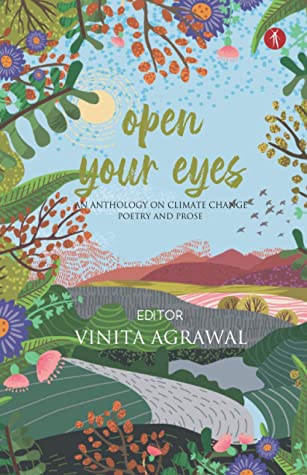
Open Your Eyes is one such effort. Edited by poet Vinita Agrawal and published in India, this attractive volume gathers poetic and prose reflections from a wide range of writers, from India and from around the world including Ranjit Hoskote, Ruth Padel, Abhay K, Anjali Purohit, Arundhathi Subramaniam, Ayaz Rasool Nazki, Barnali Ray Shukla, Esther Vincent Xueming, Indira Chandrasekhar, Kiriti Sengupta, Longbir Terang, Nabina Das, Priya Sarukkai Chabria, Sophia Naz and many, many more. For a concern so commonly associated with young western activists, this anthology offers a broader, more diverse response to the threats facing our planet, something that is by no means the province of the young. The oldest contributor here is ninety-two year-old Jayanta Mahapatra who offers a new poem, the mournful “I Am Today,” to the project. He joins sixty-two others raising their voices to call attention to the reality and risks of climate change.

It is November.
You know it from the susurration of light –
unclotted light, its guest-like tone
On my nephew’s face
the light is like a muscle,
quickening as he pedals.
The sweat still a secret –
armpits fold of private skin.

He’s seven,
as old as the ancient duration of exile.
The world’s grown warmer since his birth.
That is all I’m able to say
when he points to graffiti on the way –
‘What is Global Warming?’

– Sumana Roy, “’Global Warming’”

Concern about the health of our planet and its inhabitants is hardly new. When I was growing up in Canada, during the 1960s and 70s and on into my university years, we fretted about overpopulation and starvation, pollution, acid rain and holes in the ozone. Today, as manmade threats to the earth are increasingly urgent, governments such as the provincial one I live under are almost hostile to the notion of “Global Warming” as if it is a notion dreamed up yesterday by nefarious enemies of Capitalism and the Economy. It’s not that simple.

Given the theme of this anthology, it is hardly surprising that natural imagery runs a strong course through many of the poems and stories that comprise this book—birds and insects, rivers and forests, floods and drought, violent storms and heavy silence. The gathered offerings are strong; these themes are explored with fresh energy, rarely slipping toward the cliched or the overly sentimental. Sorrow crossed with anger tends to be the driving force; an inclination to preach gives way to the power of the image. In Rohan Chhetri’s “Fish Cross the River in the Rain” for instance, the speaker and his father go down to a river where electrofishing is being practiced:

To stand on the wave-nipped bank as shoal
after stunned shoal heave their nets. The fish
wake older, dreaming brief new lives huddled
in a foreign prison gasping at each other’s
gills blinded like a sack of mirrors.

The poets and writers contributing their work to Open Your Eyes bring, along with love of language, a lived wisdom that informs their varied approaches to the theme. Theirs is a passionate and often surprising engagement with the crisis at hand—a willingness to engage with the past, speak to the present and envision the all-too-likely future, as Sudeep Sen illustrates in his striking “Disembodied” which opens:

My body carved from abandoned bricks of a ruined temple
.                                      from minaret shards of an old mosque
.           from slate-remnants of a medieval church apse,
                          from soil tilled by my ancestors.

My bones don’t fit together correctly       as they should—
the searing ultra-violet light from Aurora Borealis
.                            patches and etch-corrects my orientation—
magnetic pulses prove potent.


My flesh sculpted from fruits of the tropics,
.                                                        blood from coconut water,
skin coloured by the brown bark of Indian teak.

My lungs fuelled by Delhi’s insidious toxic air
.                         echo asthmatic, a new vinyl dub-remix.

His poem ends with a portrait of an ominous near future, or nearly present. The prose pieces which close out the book take, for the most part, a more explicit glance into a possible world to come, employing elements magic and speculative fiction to imagine more anxious allegories of what could lie ahead. Open Your Eyes is an important contribution to the growing literature addressing the reality of climate change, yet one has to ask, is a project like this a call to arms, or evidence that, in the wilderness, a chorus of voices were shouting even if we refused to listen? I know what it should be.

Walking along the beach in Kochi with a friend we watched dogs searching among the refuse, trash and plastic washed upon the shore.

*

Open Your Eyes: An Anthology on Climate Change is edited by Vinita Agrawal and published by Hawakal Publishers. I will confess that I ordered this book (which appears to be readily available outside India) because a number of my friends have work included within its pages, but that, in the end, turned out to be a welcome door to discovering many writers I might not have encountered otherwise.

An island to hold in the palm of your hand: Purple Perilla by Can Xue

Imagine. Islands of words, small self-contained worlds of ideas, stories, exploration. Points of reference in a sea that is increasingly uneasy, uncertain to navigate. This is the vision of isolarii, a project designed to revive the notion of “island books”—collections of literature and art united on a singular idea and bound into a single volume—that first appeared during the Renaissance, but was lost as other literary forms began to take precedence. Now, under a bimonthly subscription model, the tradition has been reborn in miniature.

Purple Perilla by Chinese experimental writer Can Xue is the third offering in this series. Beautifully presented, complete with a translucent dust jacket, this tiny book is about the size of a deck of cards and contains, in just under 150 pages, three delightful short stories: “An Affair,” “Mountain Ants,” and “Purple Perilla.” Xue offers these tales, which move from an urban to a wild setting, as a lyrical reaction to our contemporary condition. Her trademark measure of unreality permeates each piece.

For those unfamiliar with her work, Can Xue is a very idiosyncratic writer. She allows her fiction to spill forth in what will be its finished state—she writes, one hour a day, without rereading or edits. As a result, her stories and novels have a wandering quality, with a real, yet unreal atmosphere. Much like a dream. The best way to approach such work is to read as Xue writes, one word at a time. This is against an attentive reader’s natural instincts, but looking for patterns and clues will not help. However, this is not to say there is no form, no direction, no meaning—only that one is forced to be patient, to listen and see where the story takes you, not worrying if it seems to tumble along freely at times. Reader and author are essentially on a journey together. As Can Xue says:

Reading my fiction requires a certain creativity. This particular way of reading has to be more than just gazing at the accepted meanings of the text on a literal level, because you are reading messages sent out by the soul, and your reading is awakening your soul into communication with the author’s.

“An Affair” tells the story of Fay, a thirty-six year old teacher, living in a city, who receives a most unusual love letter from a man who claims he has seen her on the bus. He neither reveals his name nor provides a return address, admitting he does not expect she would want to write back. This odd, enigmatic correspondence haunts Fay, leading her to wonder what kind of hold this mysterious man has on her imagination. Eventually she sets out to find him, or find out more about him, by travelling to the far end of the city where he told her he works at a cigarette factory. What she discovers on her strange, convoluted mission seems to tell her more about herself than any mysterious suitor.

The second tale, “Mountain Ants,” is set in a small city surrounded by mountains. Lin Mai lives with his parents in a mansion which is oddly isolated despite being surrounded by buildings. Visitors are rare. The boy spends much of his free time interacting with a large nest of ants in his yard. One day an old man appears at his gate. He tells Lin Mai that he lives in the mountains and has followed the ants to his home. This man, who is called Grandpa Wu, shares some knowledge about the ants and promises that one day he will take Lin Mai up a mountain. As this magical story unfolds, Lin Mai learns some curious information about his parents, the beggar known as Grandpa Wu, and the importance of tending to his own and several other mountain ant colonies in the city.

The final story “Purple Perilla,” the most dreamlike and magical of the three, ultimately carries the narrator into the wilderness, where a friend and his grandma have gone to live among the wolves. To young Chickadee this friend, a boy he has long admired, has uncanny qualities:

Unwittingly, I followed Nigu. He was so profound that he wasn’t like a child, but like … what was he like?

“I’m my grandfather’s grandfather.” Nigu turned around and spoke to me. I was stunned—he actually knew what I was thinking!

“I’m really like my grandfather’s grandfather. I think I am. Chickadee, don’t be afraid of me; I won’t hurt anyone…”

Read as a cycle, these short stories walk headfirst into the unknown. Here, questions are transformative in themselves—it’s less a matter of securing answers than of finding comfort in mystery. Bound together in this portable format, they offer a direct engagement with the magic and vision of one of China’s most inventive writers.

Each volume in the isolarii series is accompanied by several forewords. Presently, Scholastique Mukasonga’s prose riffing in response to a sentence or two from each of Can Xue’s stories is available online. It can be found here. Reading this small volume is a uniquely pleasurable experience. And, it’s worth noting that although the book is small in size, the font is not nor do the stories feel compressed or compromised in any way. It has been a while since I last wandered in Can Xue’s world and my first encounter with her short fiction, but I am now keen to return, before long, to her dreamscapes in a longer work or collection.

Purple Perilla by Can Xue is translated by Karen Gernant and Chen Zeping. It is the third volume in the isolarii series published by Common Era Inc.

Trauma: Essays on Art and Mental Health—a few words about a new anthology and my own contribution

One of my most precious possessions is a still from the
classic 1919 film The Cabinet of Dr. Caligari, created for me
four decades ago by a besotted admirer, the oddly effete son
of a burly local sportscaster. It is a close up from the final
scene at the asylum, of Cesare, the mad doctor’s imagined
murderous somnambulist, peacefully examining a flower. It
is my favourite moment in the film, a counterpoint to my
own greatest childhood nightmare. Here, the monster is, in
reality, a gentle soul. I had always feared the opposite, that
someone would one day see the monster lurking inside me.
But what I couldn’t possibly know at the time I fell in love
with that image was that, like Cesare, I too would one day
be committed to a psychiatric unit.

This is the opening paragraph of my essay, “Unravelling the Self”, which is included in the newly released volume from Dodo Ink, Trauma: Essays on Art and Mental Health. Contributors include Neil Griffiths, Kirsty Logan, Sophie Mackintosh, Monique Roffey, Alex Pheby, Marina Benjamin, Juliet Jacques, Susanna Crossman, Tomoé Hill, Emma Jane Unsworth, Yvonne Conza, Rachel Genn, the film-maker David Lynch and many more. Mental health is a topic that is drawing a growing audience, but with this anthology editors Thom Cuell and Sam Mills, hope to reach a more literary readership who wish to reflect on the issue at a greater depth.

Trauma approaches its title subject from a wide range of perspectives: psychological or  physical, intimate or public, buried in childhood or immediate—triggered by the pandemic or politics or the messy business of living. There are deeply personal accounts of childbirth, relationships with fathers, with lovers, with sexual violence. Some essays engage with history, others with literature or current affairs or potential means of healing the pain. Moving through a PDF of the collection I am struck by the extraordinary variety of essays. I have only read a few, but I hardly know where to turn next. There is so much to chose from and until I have a hard copy in my hands I will wander the detached landscape of the typeset file and read at will.

In her thoughtful introduction, Jenn Ashworth places the collection in a timely context—after all, many of the essays, including my own, were written long before the arrival of 2020 and Covid-19. She brings my essay into the discussion as follows:

In ‘Unravelling the Self’ Joseph Schreiber provocatively returns
to previous diagnoses and the gender assigned to him at
birth in an attempt to construct a present free from the
constructions of others. ‘Do we ever know who we really
are? What does a diagnosis truly hold? How much does it
form your identity, become something to cling to define and
explain the strange and uneven way your life has unfolded?’

I have resisted writing about my experiences with mental illness at any length. There is, to this day, much unresolved trauma. My essay here traces the intersection between bipolar disorder and gender dysphoria. Both are an essential part of who I am, but I no more identify as “trans” than I identify as “bipolar.” To say identify implies choice. And choice triggers guilt. Guilt longs for absolution, absolution that may be beyond reach—as it proved to be for me. In this piece I write about madness, gender, grief and the trauma I am still trying to articulate.

If asked I would say that I have never regretted my decision
to transition; it was, for me, after decades of unnamed
gender insecurity, the only thing I could do. Once I realized
testosterone would allow me shed my skin, metaphorically
speaking, I could see no other path.

I had never thought about grief, or rather that grieving was
something I would be allowed to do. To assert a transgender
identity, to transition and leave one’s birth gender behind
is supposed to be an act of affirmation. It’s something for
others to grieve. But, if I am completely honest, there are
moments when I do wish I had never had to transition at all.

If you are interested in this multifaceted anthology, it should fairly easy to obtain in the UK, beyond that Book Depository might be a good option or Kindle if you prefer an ebook.

Love is at the heart of everything. Everything except for love itself: The Fig Tree by Goran Vojnović

“We only know their story as they told it. Like in books. The only way their story can be told is the way they want to tell it. Isn’t that beautiful? Like a fairy tale. The only pictures we’re left with are the ones our minds created, as we listened to their storytelling.”

The back cover of Slovenian writer Goran Vojnović’s award winning novel, The Fig Tree, promises a “multigenerational family saga…spanning three generations”—exactly the type of description that typically has me thinking twice if not turning away altogether. However, trusting on the strength of Vojnović’s Yugoslavia, My Fatherland—a tightly woven tale of a young man who discovers that his father, long thought dead in the bloody conflicts of the 1990s, is not only alive, but a fugitive war criminal—I had no hesitation to take on this newer (2016) work, recently released from Istros Books in a translation by Olivia Hellewell.

The Fig Tree is an ambitious undertaking. It is multigenerational in the sense that we all exist within the framework of those who came before us and those who will follow. Here the central concern is that of the narrator, Jadran Dizdar, a man in his 30s who is, it seems, adrift within his own life. His grandfather has just died, perhaps under curious circumstances, his father has been gone for many years, his mother is bitter and resentful, and his wife has just walked out on him and their young son. He is trying to make sense of himself by coming to understand the decisions and actions of those around him. But is he avoiding asking the questions only he can answer?

The story begins in 1955, in Buje, Croatia, close to the Slovenian border where a young Aleksandar Đorđević is due to take up a post as forest warden. Arriving from Ljubljana in Slovenia, the newcomer bears a Serbian name and birthplace, but his heritage is complicated and uncertain. He soon takes a fancy to the nearby village of Momjan where, against the concerns of his pregnant wife, Jana, he decides to build a home—the house where they will raise their two daughters, and where one day the garden will be graced by a huge fig tree. It is also where the very next chapter opens. Moving ahead to the present time, Jana is gone, having faded away in a steady loss of memory, and now Aleksandar, Jadran’s Grandad, has also died. That event and its consequences—his daughters’ differing reactions, his grandson’s suspicion that he may have taken his own life, and his cremation and burial—form the backbone upon which will Jadran flesh out the story of his family’s near and distant history.

As a novel focused on family dynamics, it is natural that relationships—especially those between husbands and wives, parents and children—should be the primary focus of The Fig Tree. And so it is. This is a novel about all the complicated facets of love. Jadran is intent on retracing his parents’ early romance, his own love affair with Anya, and the factors that shaped his grandparents’ final years. But his connection to his father, Safet, who has made himself so strangely absent, is possibly the most nebulous element of all, one that haunts both him and his mother. When Safet disappears to Bosnia in 1992, my immediate thought was that he would get caught up in the war. However, his existence in Otoka where he assumes residence in his grandmother’s empty house, is at once mundane and mildly eccentric. He is perhaps trying to connect with his own family’s past, while escaping the family and life of his present. Five years after his departure, his son comes to visit. In his father’s absence, Jadran had created a Bosnian dad fantasy that Safet could not even begin to live up to. He has to come to terms with the truth of the man who is not an idealized hero but:

just like the person who was waiting for me at the bus station in Bihać: scrawny and greying, oddly dressed, the sort of person who offered his hand and asked how my journey was, and whether I was hungry, the sort who, after I replied that I was, glanced around confusedly, not knowing where to take me to get something to eat; unprepared, lost.

Their brief reunion is awkward and strained, both parties are uncomfortable, but the reader may well wonder if there is discomfort in the son finding an unwelcome reflection of himself in the father.

Some of the most powerful passages of The Fig Tree trace the gradual decline of Jadran’s grandmother Jana following a likely stroke. Aleksandar’s complicated reactions as his wife gradually slips away from him—loss, guilt, frustration, redefined love—is wonderfully imagined. It is also one of the spaces in which the wars which tore apart the Balkans enter the narrative:

I know who that is, she said to him, turning away. It was of no interest to her that the country was collapsing, because that was beyond her comprehension. And what she didn’t understand didn’t interest her. The present became increasingly demanding, and one evening she got up, said that she couldn’t watch any more of it, and left the present behind.

Her world no longer extended beyond the walls of their house, and Aleksandar was left alone with the impending times, with a sense of dread, alone with everything that was happening on the outside.

The conflict and its implications are echoed in personal concerns about ethnic identity and nationality. Jadran’s family is rooted in Slovenia, but he and some of the characters have a complicated heritage—something which always matters on some level but holds greater relevance as the former Yugoslavia comes apart and borders take on new importance. The arc of this story may extend beyond the war, before and after, but underlying tensions and repercussions cross into the everyday throughout.

The Fig Tree is a deeply immersive, highly rewarding novel. However, I would suggest that it might take a little time to find one’s footing within the narrative flow. This is, perhaps, because Jadran can be a somewhat difficult narrator to warm to. At times he seems colourless, willing to slip into the background or even slip offstage altogether, allowing accounts drawn from his parents’ and grandparents’ lives to be told from afar. At other times, when he is front and centre, he can get bogged down in his own mix of blame, bitterness, and limited self-awareness, on occasion even falling into unbroken passages of running thoughts, a near stream of consciousness. Early on, shifts in the storyline seem a little odd, characters and situations are often introduced in a sideways fashion, with explanations and clarifications arriving only in time. Yet, once one gets accustomed to the manner of telling, the characters and their stories become increasingly compelling. And if there is a strong current of uncertainty running through Jadran’s account, it is not surprising, there is so much he is trying to resolve, so much that may never be known:

The coffin is no longer visible. The cranking of the mechanism that lowered it down has stopped. The sound of the furnace, however, grows louder. I hear the last of Grandad’s secrets burning, I hear it all disappear. All that remains is doubt, for doubt is the only thing that’s eternal.

Then, as the novel nears a close, Jadran makes a confession that I did not see coming, but one that reveals what I had already sensed. It’s a twist that brilliantly reframes everything—not only the text that has just been read, but the notion of writing a family history at all.

The Fig Tree by Goran Vojnović is translated from the Slovene by Olivia Hellewell and published by Istros Books.