
There is something very precious about the chapbook format. The presentation of a single short prose piece or sequence of poems in a single bound volume, often printed as a defined, numbered run, is a way of isolating and calling special attention to a writer and their work. Since 2009, UK based Nightjar Press has published limited edition single short-story chapbooks. Editor Nicholas Royle and designer John Oakley have a fondness for stories that lean toward the uncanny, darker, and stranger side, as the press’s namesake might imply:
The nightjar – corpse fowl, goatsucker – is a nocturnal bird with an uncanny, supernatural reputation that flies at dusk or dawn as it hunts. It is more often heard than seen, its song a series of ghostly clicks known as a churring. Sylvia Plath, in ‘Goatsucker’, wrote that the ‘Devil-bird’ flies ‘on wings of witch cloth’; David Morley, in ‘Beethoven’s Yellowhammer’, calls it simply ‘Satanic’.
Two releases from this past October offer two different examples of the kind of oddly unsettling offerings they specialize in.
 Imogen Reid’s Fabrication is a piece of experimental fiction that draws on the author’s interest in the way techniques employed in film can transform narrative form and readability. This story builds on an observed/experienced scene—a room, a desk, a man, a faded “missing” notice—that echoes and repeats elements as it circles back on itself, creating and reinforcing the ambient quality of a dream or remembered moment within which the subject, addressed in the second person, is both protagonist and object, perhaps in more than one sense.
you can’t recall being there, but you can feel the frayed edges of an unwritten narrative slowly crystallise around the grainy image tacked to the wall, barely held in place by a steel pin, its fragile edges fluttering in the breeze like shackled butterfly wings. Beneath it, in front of the desk, partially illuminated by the eerie glow emanating from the computer screen, the chair turns and re-turns silently swivelling on its well-oiled axis, the monotonous rhythm neither surging nor subsiding.
Disorienting and intriguing, this very short story invites repeated rereading becoming in the process a longer, circular piece without beginning or end.
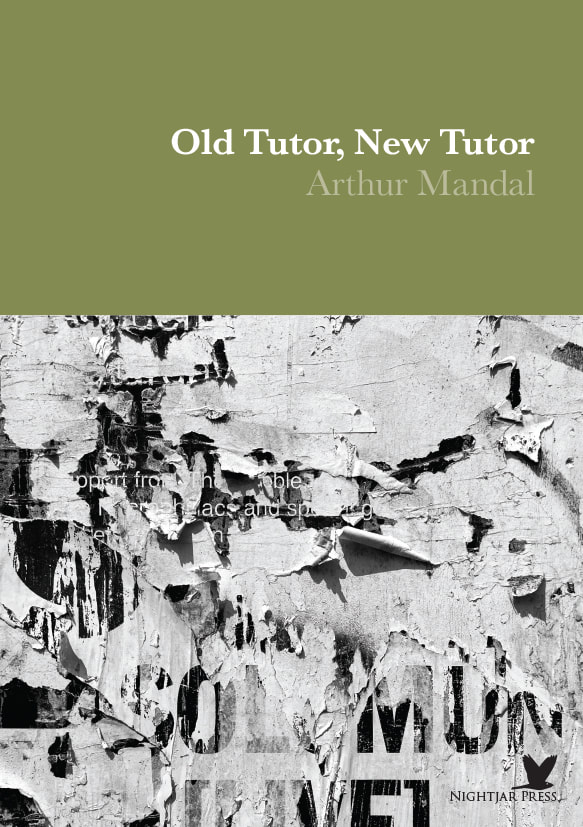 More conventional in form, but equally unnerving and ambiguously unresolved, is Arthur Mandal’s Old Tutor, New Tutor. As this story opens, the tutor Mrs Craig hired to help her daughters prepare for their A-levels is late. The girls took immediately to Mark (“he just wants to be called MO”) and now, suddenly, after six weeks, he has failed to arrive at the usual time. When she is finally convinced to call the number he had provided, she reaches what sounds like a distant, distorted connection. The tutor apologizes and promises to be back the following week. But a few days later when Mrs Craig is in town with her daughters she spots the tutor—pictured on a leaflet attached to a lamppost. Wanted for assault. The girls are in denial (“It’s nothing like him”), but their mother is convinced it’s the same man. Calls to Mark’s number go unanswered.
Then, the following week, a new tutor arrives at the usual date and time. The family is surprised, no one had called to arrange a replacement, but here he is. He introduces himself as Alan.
The new tutor stood before them, unperturbed. He wore a long, grey overcoat which dropped vertically from his shoulders to his knees. His face was young, freckled, cheeky but handsome. Although in his late twenties, he had the demeanor of a small child. In one hand he carried a briefcase; in the other an old-fashioned umbrella with a crocodile-skin handle.
The girls quickly take to the new tutor, even their previously resistant father warms to Alan’s charms. But Mrs Craig is uneasy. The source of her discomfort is uncertain; even she is at a loss to explain it. As the tale unfolds, we only have her perspective, and it becomes increasingly unclear whether her paranoia has any basis or whether she is losing her grasp on reality.
My first purchase from Nightjar Press was a signed M. John Harrison story in 2013. With a print run of only 200 copies per title, their chapbooks tend to sell out quickly, so one cannot wait too long if an offering sounds intriguing. As with these two recent purchases—one an author familiar to me, the other new—something weird and wonderful is almost certainly guaranteed.
Fabrication by Imogen Reid and Old Tutor, New Tutor by Arthur Mandal are published by Nightjar Press (October 2024).
 roughghosts