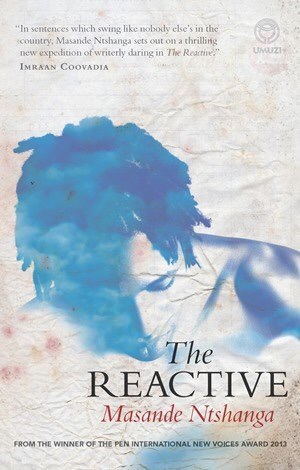
The opening lines of The Reactive, the debut novel by the young South African writer Masande Ntshanga, are startling:
“Ten years ago, I helped a handful of men take my little brother’s life. I wasn’t there when it happened, but I told Luthando where to find them.”
This fresh, matter of fact confessional tone marks the story that follows. Nathi (short for Lindanathi) was supposed to follow his half-brother to the Eastern Cape where they would both partake in rites of initiation, but he decides to stay behind. When Luthando dies due to complications, Nathi feels responsible. The memory of his brother, guilt and family obligation are themes that weigh heavily on the young protagonist as his tale unfolds.
 After his brother’s death, Nathi decides that he had best make something of himself. He enrols in university to study journalism but drops out and goes to technical college instead. He tells us that it “didn’t take much to go to school for free, in those days, or rather to trade on the pigment we were given to carry.” His tech degree lands him a job in a lab testing blood samples for HIV. In the process of testing for samples that are positive – reactive – he himself contracts the disease. He envisions himself as half-dead already. Set in 2003, with South Africa on the cusp of making anti-retroviral drugs freely available to all HIV+ individuals, Nathi sells his ARVs to others. Otherwise he drifts from job to job while spending much of his time sniffing industrial glue with Ruan and Cecilia, friends he meets at a counseling group.
In the background to all of this is a promise he made to his brother’s stepfather, his uncle Bhut’ Vuyo, a former mechanic fallen victim to alcohol and now living in Du Noon, a bleak settlement on the edge of Cape Town. Nathi had received refuge in Du Noon after disgracing his mother by dropping out of university. A text message reminding him of his commitment to his brother’s family some eight years after the fact, sets the story in motion. Nathi is drifting, he is taking risks. An encounter a with a curious masked stranger who engages the three young drug dealers in an illicit business deal may just be the motivation he needs.
In The Reactive Ntshanga paints an image of the new South Africa that is fresh and alarming. Nathi and his friends are all educated. They have or have had good jobs, apartments in Sea Point, but they are slowly losing motivation, sliding from one day to the next, grabbing taxis to parties with eccentric artists, going nowhere fast. In the end Nathi will have to decide for himself where his own loyalties lie.
This is a disturbing story, but one that is told with language that shimmers and an intensity that simmers just below the surface. Nathi’s voice is captivating, he and his world come alive. Cape Town provides an essential backdrop, as does the settlement where Bhut’ Vuyo lives in a shipping container. There are also important references to the Eastern Cape and King William’s Town, which it turns out, is the author’s home town.
Now none of this would be critical for the enjoyment of this book but, as a Canadian on his first visit to South Africa it is oddly serendipitous that I read this book on the bus, the same line that features briefly in the text in fact, on my way back to Cape Town from East London. I would likely have passed through King William’s Town with little notice in fact had I not traveled out to the Eastern Cape with a retired Xhosa man returning home to the town for a family funeral. We talked a lot through that 16 hour journey, about our countries, about life, about politics. For me, my experience of reading The Reactive will be bound to my trip and I look forward to watching Ntshanga’s career develop. He is already receiving a lot of well-deserved attention at home and abroad.
The Reactive is published by Umuzi and is available as an e-book, at least in Canada, likely elsewhere. A paper edition will be published in the US by Two Dollar Radio in 2016.
 roughghosts