
Abruptly, I was lonely. A slight ache opening into a grand, raw wound, very cutting. Bother it. I was, I am, lonely.
Lavinia, the narrator of Rosalind Belben’s fourth novel, Dreaming of Dead People, is thirty-six years old and, in terms of marriage and child-bearing potential, past her prime. At least in the context of the mid-seventies English society within which she defines herself. Standing on the cusp of spinsterhood, she wonders how she got to be where she is, longing to make sense of the tangle of emotions that beset her as she readies herself to leave the fancies and expectations of her past behind and move on with the rest of her life. Through an extended monologue that shifts between measured reflection, unguarded self-exposition, and fanciful and poetic imaginings, a portrait emerges of an intelligent and introspective woman trying to find her place in the world.
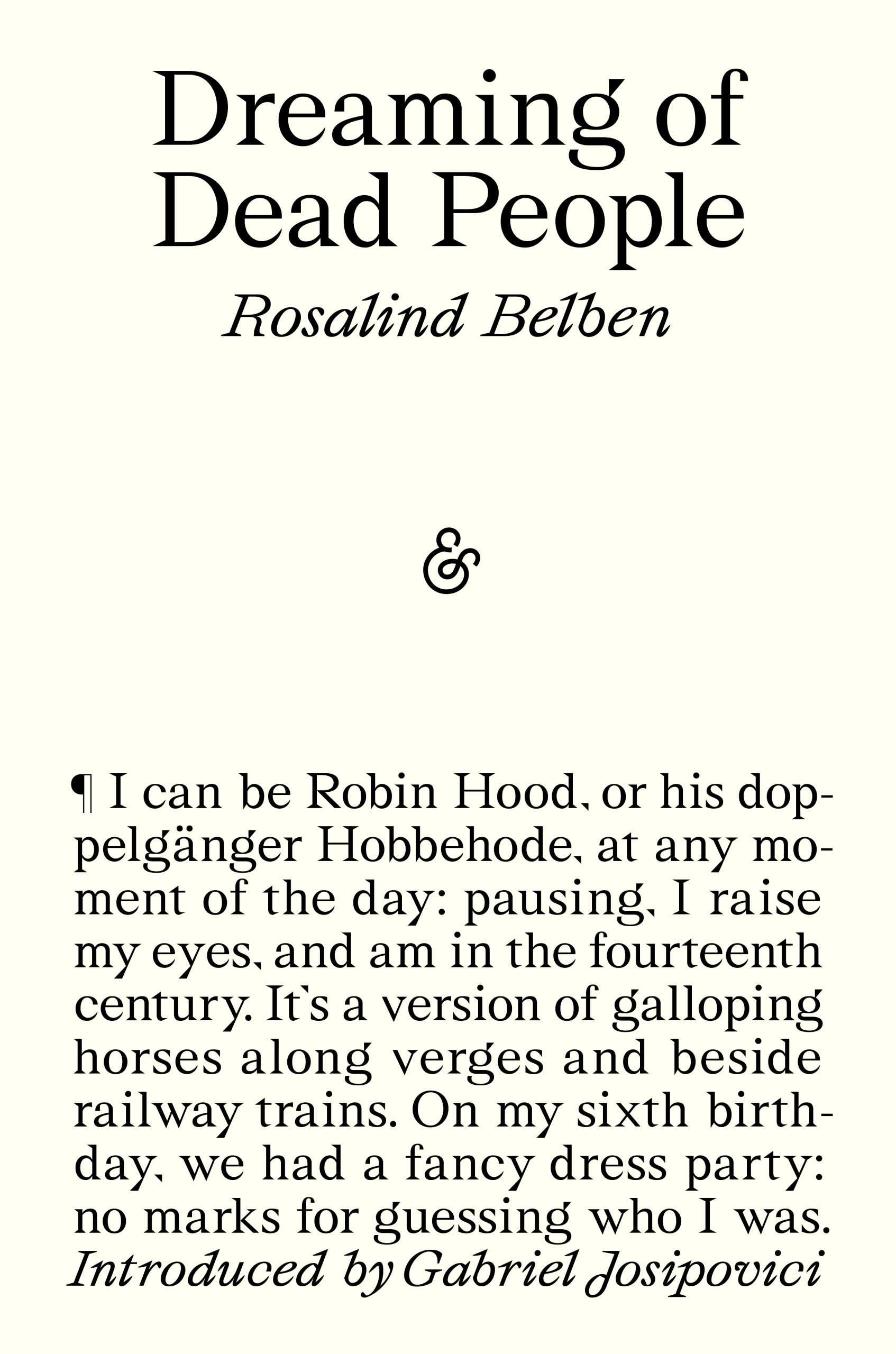 In his introduction to And Other Stories’ re-release of this 1979 novel, writer and critic Gabriel Josipovici describes it as, in his mind, Belben’s finest book. Anyone who has read The Limit (1974, re-issued in 2023) will know that she often writes about the physical needs, desires and sufferings of people and animals with a blunt frankness that can be difficult to read simply because she tends to approach such subjects with a naked honesty that can be alarming. There is some of that here—most notably when her protagonist launches into a an account of her exploration of masturbation that is as graphic as it is wryly funny—but there is so much more. This is a complex, emotionally intense narrative with experimental shifts in style and tone, and vivid lyrical passages. Lavinia is a strong personality that some may find hard to connect with (that was not my experience), but she will likely linger in the reader’s imagination long after the last page is turned.
Truth be told, Lavinia’s tale is a maze of contradictions. Though she speaks of loneliness and a longing for children, she has a defiant and independent spirit that runs counter to what she claims to have wanted. The spectre of the spinster that haunts her, is one very much rooted in her rural upbringing and on characters from books of her childhood like Mary Swainson from Arthur Ransome’s Swallows and Amazons series. However, Lavinia had never waited at home for a suitor to arrive; her early twenties were filled with travel, adventure, and lovers—even an unwanted pregnancy terminated without regret—but this free-spirited life comes to an abrupt end when her mother is diagnosed with a serious illness and she returns home to be with her, thinking the end is near. When her mother defies expectations, living for five years beyond the predicted two, she stays on in a state of conflicted hope and dismay. Yet, once her freedom is returned to her in full, she finds herself unable to pick up where she left off:
I thought I could resume. It was stupid. A lot of water had gone churning through the mill. I was older. I hadn’t the slightest inclination to sally forth metaphorically and look for a fuck as if I’d been twenty-one again. I didn’t fancy anyone I met, well, hardly anyone. Something had happened to me. I was changed, reclusive, and I daresay unlucky.
Measuring herself against other women, Lavinia admits ato n anxiety about her future self—be that the self “in five years, one year, ten minutes”—and wonders if, one day, she will feel fear or regret, or not much either way. She wonders what she should feel. At thirty-six and untouched sexually for ten years now, she worries that she will one day find herself endlessly feeding on memories of a past when she loved and was loved, watching them recede into the distance as her body wrinkles and ages. Her destiny seems fixed, she acknowledges as much, but she looks for release elsewhere:
I turned to nature. To tracks in the snow. To things that lead somewhere. I love rivers, canals, streams, water which holds the mirror up. I love lakes. I imagine swimming very much. The clasp of water, of glittering liquid. I will squat in my imagination by a loch in the Highlands dabbling my toes and watching my own body as it breaks the ripples, stroking the glass face, into the sun or away from it, toward the motionless invisible heron, stubbing my feet on a submerged tree trunk. I am anxious about drowning; I am not out of reach of help, out of my depth; and the long-tailed tits twitter in the pine tree tops. I wait for the osprey which could change one’s life but which never appears, forever a possible, and its absence.
Belben writes about nature with a poetic intensity that is quite wonderful, revealing a deep connection to the natural world, that her protagonist clearly shares—among a number of biographical details—and, at least for Lavinia, the roots lie not only in her rural childhood, but in an early and passionate identification with Robin Hood.
In the chapter “Cuckoo,” with its integration of ballads from the medieval legends, she depicts her hero without some of the more fanciful inventions which she tends to reject, focusing instead on the degree to which he was an outcast, living outside the law without rights, as a non-person. “Therein a metaphor of myself,” she insists. But then she goes on to invent an erotic encounter between Robin Hood and Hilda, the wife of Sir Richard at Lee, allowing the hero to flee before daybreak, frightened by his conflicting emotions, but ever feeling he’d left something unfinished. A metaphor indeed.
Lavinia’s own emotional world is complicated, though she tries to maintain a hardened, matter-of-fact attitude even when chronicling painful circumstances like the need to let go of a beloved dog, or the tensions of her relationship with her family. After her mother’s death, she moves to the city, in part to avoid the suspicion and pity with which spinsterhood is viewed in the country. London offers her an anonymity she treasures, but it comes with costs. Here she imagines in detail how it would be to raise a daughter she would name Jessie, fretting over the understanding of animals and nature the child would miss out on, and worrying that Jessie would not inherit her mother’s love of language and literature. She is working her way through a parenthood that will never materialize, this vicarious motherhood that stands, perhaps, as a parallel process to grieving her own complicated relationship with her mother. She is also attempting to resolve her state of placelessness, her sense of belonging to neither the city nor the country.
In London no life; no ditches; no hedgerows; no death. No worms, no bugs; no thorns, no wire. No cattle, no stock of any sort. No thrills and no excitement. It is undramatic.
Venturing back into rural solitude she feels invigorated, at least for a few hours:
But the country is a great deceiver. Because it is, of course, no longer there: the land of my imagination. I have been sniffing and sniffing; and the rose is blown. A lot of the country has become ghastly. Bungaloid, obliterated, crowded, and spoiled. It is . . . progress.
She has to venture further to regain the natural connection she craves, returning in memory to a trip to the Highlands as, for a stretch, the narrative becomes a rich and vivid piece of nature writing. And then, following this Scottish reverie, we reach the final, ecstatic, dream-filled title chapter. Herein the reckoning. In her own way, Lavinia comes to make sense of her life.
With an inventive narrative that is ever shifting gears, moving from language that can be blunt and coarse, to the rich and poetic, to the deeply introspective, even obsessive, Lavinia’s monologue can be a little disorienting at times. Form and style are mutable, and it is not always apparent whether she is remembering a real event, re-imagining a memory, or reasoning her way through her own uncertainties. But ultimately this is a novel of grief and loss, of mourning loved ones who have passed and a future that will never exist, thus learning to open oneself up to the freedom that lies beyond defined expectations and roles.
Dreaming of Dead People by Rosalind Belben, with an introduction by Gabriel Josipovici, is published by And Other Stories.
You can listen to Rosalind Belben read from the chapter about Jessie here:

 roughghosts