In Berlin, a sound artist—or, rather, as she would have it, a silence artist—sits in an Ikea-furnished rental apartment in Berlin. She is waiting to interview for a residency she has never heard of and didn’t apply for, but when an invitation, an advance and address arrived, she decided to follow up on their offer. But what are they really offering? And who are “they”? There are more questions than answers, but even more curious to Rachel, there was something missing in this space in which she has found herself. An echo.
The sound of her greetings had no echo, as though it had been sucked up into the airlessness of this place, into the rug and the curtains. It should have been bouncing off this floor, these bare walls and the plate glass windows. This place should be all echo but there was none, none at all.
Elsewhere, the MV Atlantic Echo is making its way from the UK to Sri Lanka bearing twelve thousand containers, existing at the intersection of eight different companies and carrying, for the first time since the pandemic, a paying passenger who generally sticks to themself. One night, as the ship is crossing the Mediterranean, the Deputy Positioning Officer, the second in command, experiences an unexplained event during his watch—strange clouds gather, his equipment briefly goes dead, and momentarily the constant grinding, throbbing, humming and droning of the massive ship falls silent. It marks the beginning of a series of strange phenomena that will strike the ship and its crew members.
Meanwhile, an artist is commissioned to paint a portrait of an industry leader—though the exact nature of the industry his family has made their name in is shrouded in a complex maze of techno-gibberish—but he is having trouble capturing the essence, in fact any essence of the man. In China, another man sits in a “mid-range hotel of a Tier 3 city” trying to work on his master project, well aware that his identity and his ideas have been stolen and have been replicated into multiple versions of himself, but he is pretty sure he is the original. And, endlessly riding trains on a vast, interconnected web of mostly subterranean rails, a dishevelled man sleeps, dreams, and watches passengers come and go, wondering if he himself actually exists at all.
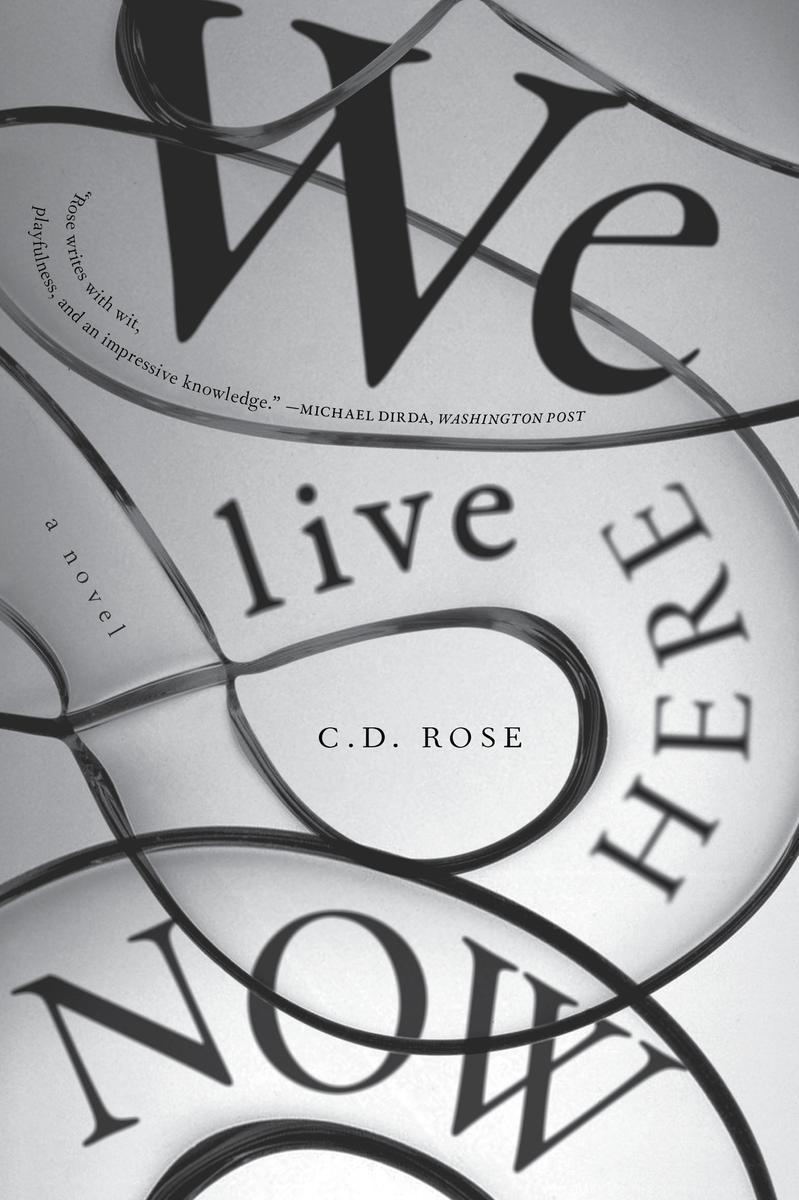 These are just some of the characters and strange circumstances that you will encounter in C. D. Rose’s surreal take on twenty-first century reality (such as it is), We Live Here Now. This inventive novel opens with an article by a fictional art critic looking back on the work of an elusive conceptual artist named Sigismunda (or Sigi) Conrad, with particular focus on her 2015 installation, We Live Here Now, a radical exploration of space and temporality that sparked controversy when people, a cleaner and several visitors, begin to vanish. The chapters that follow are set post-pandemic, and feature characters somehow connected with her or what is known of her whereabouts since 2015, either directly or indirectly. They read like a series of loosely linked short stories, sometimes intersecting directly, or bouncing off similar themes and motifs. One can find oneself listening for echoes, and tracing the flow, so to speak.
Each chapter adapts its tone, language, and energy to its protagonist(s) and subject matter. Rose’s milieu is the art world, with forays into experimental music and film. He is not only interested in the artist and the precarious nature of their work, but in the network of shippers, dealers, fixers, and those who inhabit the broader realm of intellectual manipulators, systems thinkers, and the beautiful people who want to be wherever something is happening. There is a sense that, at least until we near the end, each story (again, that is the best way to describe the chapters) is playing out more or less simultaneously, even if a character is recalling events from an indeterminate past. The pandemic is, at least officially, in the rearview mirror and many artists, or those in adjacent businesses, are finding their footing again following a period of disruption that has been productive for some, less so for others. The settings are at once immediate and futuristic. It’s a world, or worlds, of WhatsApp, chat bots, iPads, and AI. It’s also a world where words, especially within certain commercial and intellectual enterprises, say a lot but mean little. When Ryan, the artist commissioned to portray the wealthy business man asks him to explain what it is that he does, the response has a familiar unintelligibility:
‘I direct strategic development and practice management. I work towards high-quality design which brings added value,’ he said. ‘We harness passion, knowledge and expertise to evolve powerful and pragmatic solutions and I inform and direct the ambition and quality of our work.’ He went on, scarcely pausing. ‘I develop strategy, over-seeing legacy, ensuring quality and continuation, while always searching for new possibilities. We are building, developing and ensuring sustainable resilience.’
And yet again it’s a world where objects and recordings go missing, sounds are suddenly either completely absent, or constant and unidentifiable, where light takes on strange distorting qualities, and space defies expectations. Some chapters/stories are more firmly grounded in what we might agree is the “actual” world, while others expand into other dimensions, but most navigate the shifting liminal space between illusion and reality. In other words, they take place where we live now, or will soon.
As a collection of loosely linked short stories that sometimes directly reference one another in unexpected and delightful ways, this book is brilliant fun. Rose is playing with all kinds of ideas about art, commerce, reality, and the banality of modern society. But whether it works as a whole is less certain. The framing of the project, beginning and ending with articles about two major exhibits by the elusive artist who connects all of the intervening stories, though necessary to a point, risks undermining the overall impact which may sound strange to say. What sets itself up as a mystery, offering clues, coincidences, and unlikely connections, is at its best, more a novel ideas, a dynamic map to the myriad interrelationships that connect us in a multi-dimensional universe that exists in theory but eludes us in practice. Or is it? Rose invites us and his extensive cast of characters to traverse a Klein bottle or enter an Escher artwork, but he’s leaving us to find our own way out.
We Live Here Now by C. D. Rose is published by Melville House.

 roughghosts