Drink them up, swallow those clouds, gulp them down with all your might, because all you’ve got to look forward to now are ceilings.
As Ema, the fifty year-old protagonist of Zuzana Brabcová’s Ceilings, takes in her last view of the overcast skies over Prague before the ambulance attendant leads her into the Addiction Treatment Centre of the hospital, she knows that it will be months before she sees them again—except, of course, in the strange, troubled, and fantastic dreams and psychotic episodes that will accompany her through the trials of detox. She’s been here before and is well aware of what lies ahead.
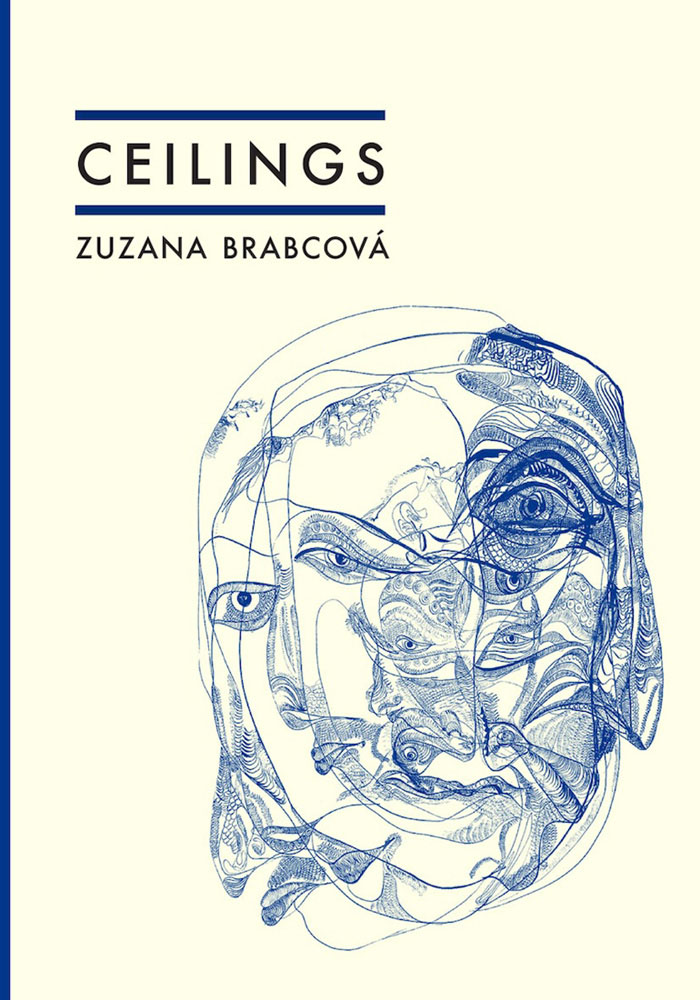
The daughter of two literary historians, Brabcová (1959–2015) was born in Prague. Under the Communist regime, she was denied the right to attend university so she worked as a librarian, a hospital attendant and a cleaner. Following the Velvet Revolution, she worked as an editor. Her first novel Far from the Tree, initially published abroad in 1987, won the inaugural Jiří Orten Prize. Ceilings (2012), recently released in Tereza Veverka Novická’s powerful English translation, was her fourth novel, a vivid, hypnotic account of one woman’s transit through drug rehab that clearly illustrates why she has been rightfully compared to Leonora Carrington and Unica Zurn (whose artwork graces the cover).
 As soon as Ema enters the hospital, The Garden as it is known, she finds herself in a world that operates on its own set of rules and regulations. The clock is now set to institutional time, where order attempts to define but can never fully contain either the camaraderie or conflicts between an eccentric collection of women—druggie or alkie?—caught in an ever-swirling cascade of medications and madness. For Ema, navigating the neuroses and idiosyncrasies of her fellow inmates is as challenging as navigating her own, as delusions, paranoias, and troubled memories blur the fragile boundaries between reality and dream, external and internal existence.
This fluidity is reflected in a polyphonic narrative which moves smoothly between third and first person, often pulling in and out of Ema’s head in a single paragraph. Add to this, asides in second person, where Ema either addresses herself or directs her thoughts to her daughter Rybka, her lesbian partner Dita, or other family members. Finally, there is a second first person narrator, Ema’s brother—a “twin” although they were born one year apart—not an alter ego, but a distinct male gendered self. Ash. He emerges at an early age, perhaps to serve as a shield against the uncertain and frightening world both inside and outside the home, and inside and outside Ema’s own unstable emotional space. Ash comes into his own when they are very young, realizing he is different:
I said to myself this secret of mine must be something like chickenpox; okay, in that case an autovaccine was needed to reduce the most visible traces to a minimum. So I decided to become a normal little boy, if that’s what they wanted: I’d fight over toys in the sandbox and might even pee my pants in a temper tantrum, and I’d clap and giggle over my birthday cake; all this could be learned by observing other children. I methodically began to appropriate the behaviour of others, their expressions, emotions, and gestures, and chose from this panoply the ones I considered useful, purposefully aping them. It was glorious: one by one, every sensation sunk into the hollowed-out nutshell of nothingness.
My rebirth every morning soon became routine, and I put on my face like a prothesis.
Ema and Ash are not exactly like two manifestations of a dissociative condition, nor do they represent a typical binary gender identity. Ema takes comfort in Ash’s existence, while he is both protective of and frustrated with his “sister,” yet cognizant of his own unreality, of the fact that he was not born and cannot die.
Confined to the hospital, Ema is forced to contend with various difficult personalities, while finding her place and forging alliances among the other patients and the nursing staff. Reality can be an anxious state. Meanwhile, dreams and episodes of delirium carry her back into her (or Ash’s) past, but the scenes are strange, distorted, and disturbing. And she is haunted not only in her restless sleep; the ceilings that hang that above her are a constant reminder that she is trapped:
It’s come back after my body expelled, at least to some extent, the poisons that were competing with it. I’m in a room, I need to get out, I rise to the ceiling. I tear though it, really easily, because the walls and ceiling are made of cardboard, and I find myself in another room. I escape through a chink into another room and so on and so forth, again and again, one room replaces another, always the ceiling, never the sky. But what if it’s not the dream that’s come back to me, but it’s me who’s come back to it? Maybe the waking life of Ema Černá is merely a sequence of pauses, brief interruptions of flight with no beginning and no end.
Ema’s dilemma, her inability to successfully integrate her internal and external reality, reflecting a lifetime of emotional and mental health challenges mediated by substance abuse, is the driving force of this intense, vulnerable, and moving novel, one that draws on Brabacová’s own experiences, including time in psychiatric rehab (and, one might imagine, the perspective afforded through her work as a hospital orderly). Its raw, unapologetic narrative slips seamlessly between voice and perspective, continually cross-referencing itself, to create a world—one woman’s world, past and present—that for all its surreal elements is cohesive, sympathetic and real.
Ceilings by Zuzana Brabcová is translated from the Czech by Tereza Veverka Novická and published by Twisted Spoon Press.
 roughghosts