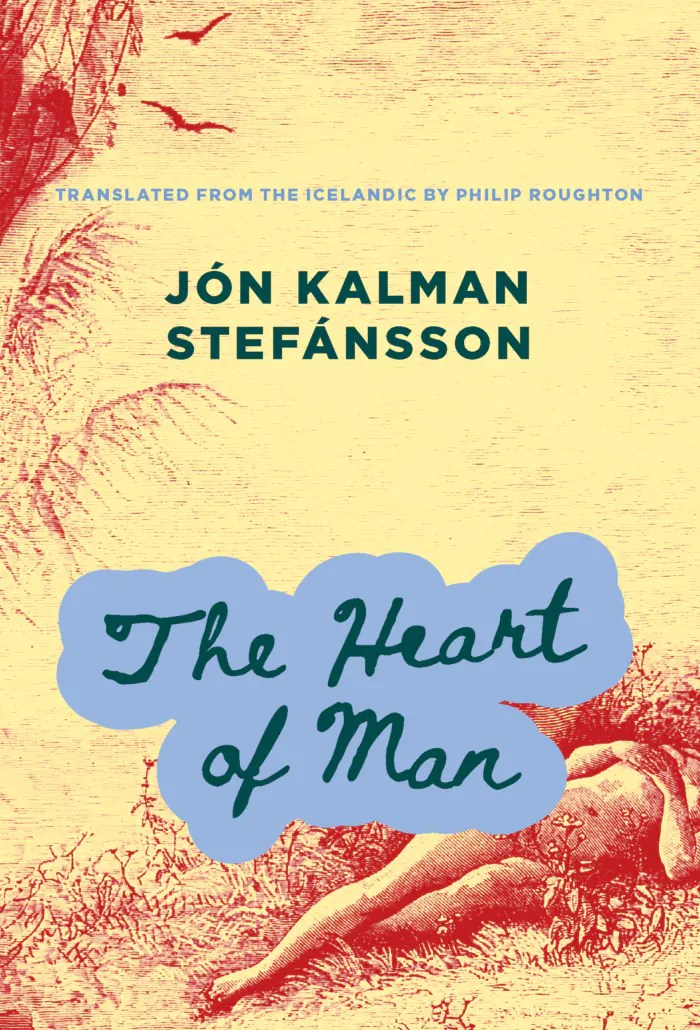
“Is your heart still beating? If so, how?” – The Heart of Man by Jón Kalman Stefánsson

There are very few things that man needs: to love, to be happy, to eat; and then he dies. Yet there are over six thousand languages spoken in the world — why do there need to be so many in order to make such simple desires understood? And why do we manage it so rarely, why does the light in words fade as soon as we write them down? One touch can say more than all the world’s words, that’s true, but the touch fades with the years and then we need words again, they’re our weapons against time, death, forgetfulness, unhappiness.

It has been a long, cold winter marked by hardship and loss, and now that the snow has finally melted and a reluctant spring settles in, it is the season when, as they say, a young man’s fancy turns to love. But in The Heart of Man, the third and final installment of Jón Kalman Stefánsson’s Trilogy About the Boy, his unnamed protagonist is not alone in his longings and desires. Romance, be it passionate or practical, is in the air, infecting more than a few lonesome souls and leading to some unlikely couplings amid tragedy, conflict, and confusion.

In each of the first two volumes, Heaven and Hell and The Sorrow of Angels, the most intense drama lies in the battle against the unforgiving elements of ice and snow during a winter that has held fast to a corner of Iceland well in to May. In the first novel, after witnessing the death of his only friend aboard a fishing boat, the sensitive nineteen year-old referred to simply as “the boy” makes his way to the Village to return a borrowed copy of Paradise Lost and finds himself taken into the home of Geirþrúður, a scandalously independent woman, and her companions Helga and the old, blind sea captain, Kolbeinn. Here he becomes part of a makeshift family, one where books and literature are appreciated. The second part follows the boy and the postman Jens as they cross a sparsely populated stretch of land to deliver mail to a community on the north shore. As storms rage, their struggle with the forces of nature hits a fever pitch, concluding with a terrifying accident.

When The Heart of Man opens, the boy is slowly regaining conscious awareness in a strange room. Jens is sleeping in the next bed. It seems that they had the good fortune to crash into the side of the doctor’s house when they lost control on their icy descent to the village of Sléttueyri, the intended destination of their trek across the frozen Icelandic landscape with a heavy mail bag and a most unusual parcel they picked up along the way. If he is surprised to have survived, the boy is even more surprised by Álfheiður who appears at his bedside with her short red hair and deep green eyes. He is smitten. But also confused, because back home he believed he had already lost his heart to Ragnheiður, the privileged daughter of an important local merchant and broker, even if she may never see him as a serious prospect. When he returns to the Village, she continues to tease and seduce him against her father’s explicit warnings, but the red-haired young woman on the northern shore still haunts the boy’s dreams. And then he receives a letter that asks: “Is your heart still beating? If so how?”

It’s beating like that of a drowning man, a wingless bird, how the hell should he answer this? Of course it’s important to receive a letter, to have a person consider it worthwhile to sit down and assemble words and have you in mind the entire time it takes to write the letter, to receive a letter indicates that you exist, that you’re closer to being light than darkness. Admittedly, not all letters are good, and some should perhaps never have been sent, never have been opened, read, some are full of hatred, accusations, they’re poison that will deprive you of your strength, they bring darkness and disappointment.

In this third volume of the trilogy, the terrain to be navigated is that of the human heart, and the boy is not the only one on such a journey. As a result the world of the Village expands and deepens as we come to know the townsfolk better. We witness the troubled power dynamics that exist between social classes, and between the sexes. One might also suggest that divisions between misfits and the accepted members of society are exposed, but to be fair, the environment and challenging living conditions of this part of the world attract and reward those who have their own distinct idiosyncrasies. There are many such characters here, each one with his or her dreams and disappointments, joys and despair. Yet, even with its multiple crisscrossing storylines, the tale never drags over its 400 pages thanks to the rhythmic force of the chorus of drowned ghosts at the helm. These timeless storytellers, fueled by longing, tend toward the melodramatic, lending an operatic quality to the narrative, but in turn allow the characters’ thoughts and actions to unfold with a degree of distance. They are relaying an account from the past, but action unfolds in the present. Dialogue is relatively succinct, woven into longer paragraphs or set aside in a scripted format, while repeated refrains reinforce the flow.

Stefánsson writes with the soul of an Icelandic epic poet, his grand romantic spirit and poetic prose is rooted in the sagas of the past but directed at a contemporary audience. His ghostly narrators, in telling the boy’s story, are reaching through a wound in existence to grasp at what they miss the most:

Yet no story can ever be told completely, or, how shall we say it; we inhale in the nineteenth century and exhale in the twenty-first. Time is an illusion; the only useable unit of measurement is life. People never change, regardless of the passage of time, what we call the years; fashions change, not mankind. But what pains us most is that we no longer exist, except in these words; they’re as close to life as we can come.

To read this tale, then, is to surrender to the music of the language, because the real question at its heart is: what is the worth of poetry and knowledge? The boy, orphaned after the death of his parents, has known years of hard labour on farms and fishing boats, but it did not come naturally. He was clumsy and prone to daydreaming. So, although his strength and endurance have been recently tested in his journey overland with the postman, it is the fact that he has been welcomed into a home filled with books and given a chance to learn, that truly gives him a sense of value. But will that be sufficient to resolve his internal conflicts and secure his future happiness? Is that even possible for anyone?

The Trilogy About the Boy does come to a dramatic conclusion at the end of The Heart of Man, but it is one that is not without ambiguity. Of all of the volumes in this trilogy, this is perhaps the one that reads best as a standalone work, but again, the pieces that fall together will have a stronger impact if the earlier books are read first. And, on what is turning out to be a very hot summer across the Northern Hemisphere, it might be just the right time to escape to a colder climate for a while.

The Heart of Man by Jón Kalman Stefánsson is translated from the Icelandic by Philip Roughton and published by Biblioasis.

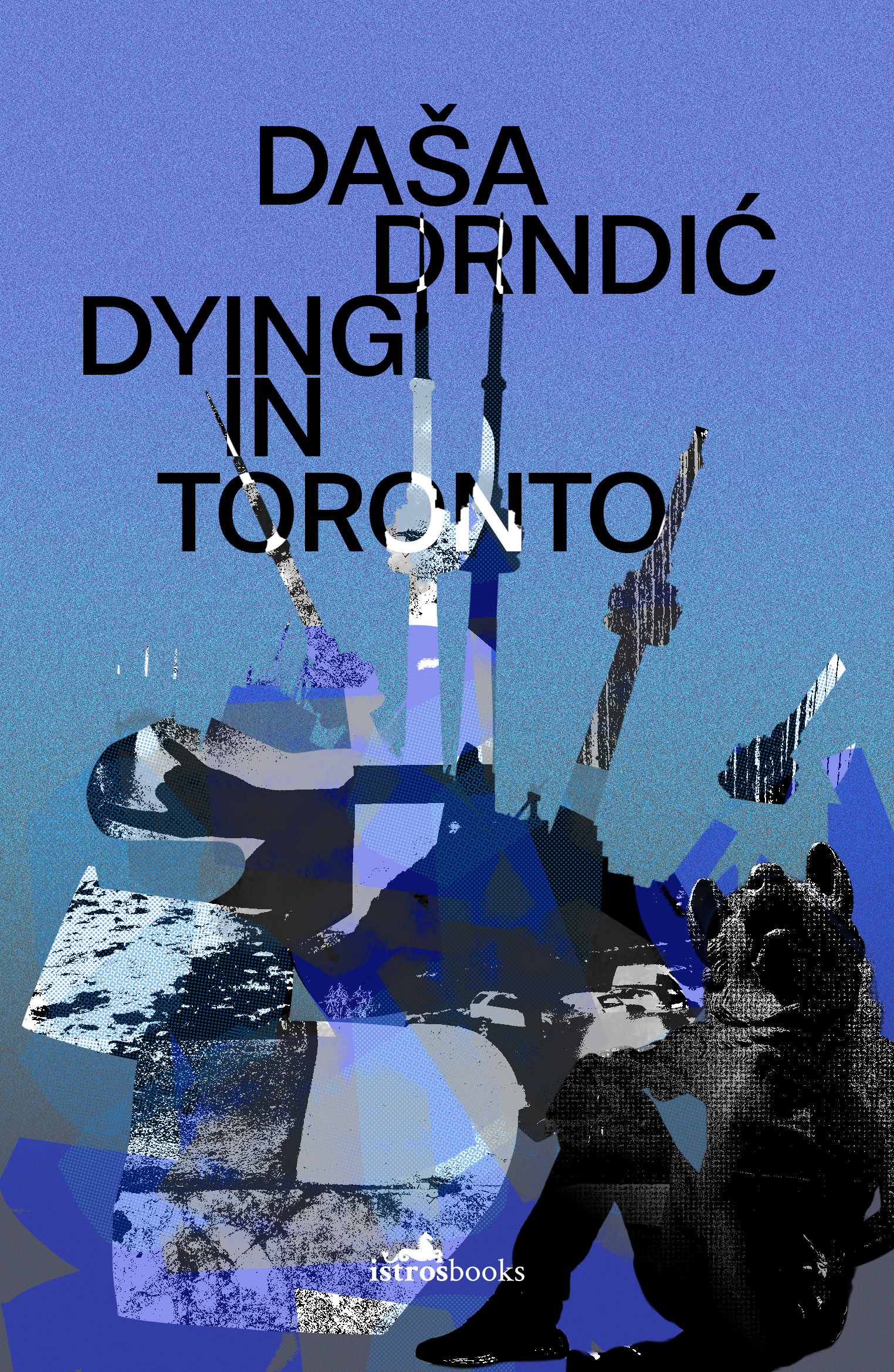
Living in exile: Dying in Toronto by Daša Drndić

Toronto consists of enclaves. All right, and parks. Enclaves are areas inhabited by minorities. There are a hundred and five minorities in Toronto, and new ones are being created all the time. Surrounded by invisible lines, walls and wires of separation and by a very visible medley of customs and languages, these minorities are becoming the majority. The little territory left over, in the centre, belongs to the majority that is slowly being transformed into a minority. And in similar circumstances, historically known to us, such a reduced majority may come to regret it.

Daša Drndić’s observations of Toronto in the mid-1990s, informed by history, much of it painfully recent for the new immigrant, is characteristically measured and insightful. And today, thirty years later, the tensions she predicts have found full expression in the anti-immigrant sentiments that have laid bare the multinational myth that we, as Canadians, have long held to. Fresh from the Croatian War of Independence, she had crossed an ocean as a refugee, only to find herself left to fashion some kind of home in a Greek-Chinese-Indian enclave in a sprawling metropolis in the so-called “New World.”

Dying in Toronto, subtitled Or Our Lady of Czestochowa is still shedding tears, originally published in Croatian in 1997, is an extended essay (or series of essays, if you prefer) chronicling her experiences as an immigrant living in Toronto from the summer of 1995 and into 1996. It may be considered as the non-fiction counterpart to 1998’s Canzone di Guerra which was released in English by Istros Books in 2022 (and as Battle Songs by New Directions in 2023). Both books are translated by Celia Hawkesworth, and feature narratives woven with factual commentaries and detailed footnotes, but Canzone has a fictionalized storyline, and a somewhat more experimental feel, especially with the regular asides about pigs. With Dying in Toronto, Drndić does not take on an alter ego for herself and her thirteen year-old daughter. Her focus is more directly on the machinery and indignity of the government system newcomers must navigate, and the adaptations (and sacrifices) they are forced to make. It is a sobering, yet often wry, account.

For her first months in Toronto, Drndić is keen to maintain, in this foreign urban landscape, a current and updated link with life back home. She discovers that an Istrian Croatian newspaper, Glas Istre  (The Voice of Istria) can be obtained if she is patient enough to make a long trek across town to buy it. She maps a route, but then thinks better of it. She decides to stop nostalgizing, and try to integrate amid the visible minorities and the white majority. She visits the library and goes to the cinema, for although her finances are limited, she requires creative stimulation (a luxury to be hidden from her case worker). Likewise, social and cultural contacts are important, so she reaches out to other Croatian and Slavic immigrants most of whom are also living diminished lives, at least relative to their pasts and professional  credentials. As for her daughter Maša, she indulges her with a string of small, short-lived, mostly rodent-related pets. As a single mother, Drndić and her daughter are naturally very close; together they struggle to adapt to the realities of their new existence:

The dichotomy of our life here is interesting. On the one hand a pathetic attempt at getting close to intellectual circles, on the other – identification with socially marginalised groups, partly out of curiosity and the masochistic satisfaction of reducing everyday life to the elementary and partly because of objective material poverty.

Yet, for Maša there is also a distinct kind of adolescent loneliness. She is at a sensitive age to be uprooted, though, with the war, she really has not known any kind of normal settled life since she was a young child. Her mother hopes to make up for this while still ensuring she has a connection to her homeland. It’s a difficult balance.

The portrait Drndić paints of Toronto, and more broadly of Canadians, is sharp, even cutting, but not without a dry sense of humour. To anyone familiar with the city, the history she describes will be familiar, as will its more garish landmarks—the legendary, now closed, Honest Ed’s discount department store and the oddly eccentric Casa Loma. But her diversions extend beyond Toronto, north to the Inuit in the Arctic, and back in time to trace the surprisingly long record of Croatian migration to Canada. As a Canadian reading this book, it is easy to nod with a smile as she points out our idiosyncrasies, because her tone is light. However, when it comes to the immigration and refugee “system” itself, and the perils of those who get caught trying to make their way through it, one can hear a bitter sarcasm come through. And even more unsettling is her response to the 1995 Quebec separation referendum—although it fails by the slimmest of margins, she is certain the province will ultimately secede one day. She also sees clearly the racist forces at play and the disregard of First Nations and Inuit rights. Little has changed. Today we are looking at separatist movements and talk of referenda again, but now it is not only in Quebec. In the west, in Alberta, the province where I live, we will soon go to the polls to decide whether we want to stay in Canada or make plans to vote to leave.

Clear-eyed and ever wise, Dying in Toronto is a work of astute social criticism with a deeply personal element, that not only speaks to a certain era in time, but provides undeniable evidence that the forces that divide us today are not new, nor are they unique to those long standing trouble spots like the Balkans or the Middle East; they were already taking root  decades ago, even in a place that still imagines itself peaceful, welcoming. Like Canada. It is good to have this valuable work finally available in English.

Dying in Toronto by Daša Drndić is translated from the Croatian by Celia Hawkesworth and published by Istros Books.

To live is to love life: Aside from My Heart, All is Well by Héctor Abad

Father Luis Cordoba was a large man, and his heart even larger—too large, in fact. When, after attempts to treat his condition with a pacemaker, diet, and exercise proved insufficient to ease his poor organ’s further decline, it became apparent that he would require a transplant. But while waiting for a suitable donor to die, he would have to rest quietly and refrain from strenuous activity, like climbing stairs. So, at the beginning of Colombian writer Héctor Abad’s Aside From My Heart, All is Well, he moves from the home he has shared for twenty years with fellow priest and longtime friend, Aurelio Sánchez, also known as Lelo, into a house occupied by two women and three children. This book is, on one level, an account of his final months of life, as recorded by Aurelio, looking back from a vantage point another two decades on. However, once our narrator began to gather his memories of his friend, it became a much broader exercise, evolving into a tribute, a personal memoir, and a meditation on the costs a commitment to the priesthood exacts.

Neither Luis, who was known to most of his friends as el Gordo, nor Aurelio have what might be considered a traditional approach to their vocations. They both might have intended to follow the norm more closely when they met in seminary and embarked on their earliest placements, in Europe and then back home in Colombia, but when Luis was given the opportunity to take up residence in his family home in Medelin, the two proposed that they might live together, take in other priests, seminarians, or missionaries as need be, and pursue their own ministries, in their own ways. Their order was skeptical at first, as the two had already demonstrated their eccentricities, but permission was granted—as long as they promised to be “prudent, modest, and restrained.” So the two men became roommates. Aurelio said Mass every morning for a nearby congregation followed by bible classes at the university, but an attraction to men tested—and often defeated—his commitment to celibacy. El Gordo had other temptations which he would ultimately adapt into his own form of ministry:

Like all of us, Luis had taken vows of obedience to his superiors when he was ordained; also vows of chastity, renouncing the possibility of having a wife and children, and – as far as possible – the libido and carnal relations, as if he were a eunuch. Under those conditions he had been a priest in a rural parish near Munich and in an urban parish in Manizales. The same vows committed him to devote himself to the service of others and his objectives in life must not aspire to lucre or any personal benefits. But after these sacrifices and abdications, and after thinking it through carefully, Córdoba had resolved not to deprive himself of his other three remaining passions, two of them almost spiritual and the third – the one he had the most trouble confessing – carnal: classical music (especially opera), cinema, and fine dining. Had not Jesus multiplied loaves and fishes? Had he not turned water into wine? Had he not bid farewell with a last supper? Well, exactly.

Over time, Luis became a respected film critic and students flocked to his lectures on classical music and cinema. His typical priestly duties were limited, many had no idea about his official profession, but, unlike his best friend he held fast to his vows. That is, until his fragile heart forces him to move in with Theresa, whose husband had left her and their two young children, and her Black maid Darlis and her daughter. Being in the presence of two beautiful women and a house filled with the laughter of three children begins to lead the priest to question what he has given up. He begins to imagine how, at the age of fifty, a new heart could potentially mean a new life.

Aside From My Heart, All is Well is a gently meandering novel guided by warmth and subtle humour. Aurelio balances his account of Luis’ life before and after he had to leave their shared home, with the story of his own upbringing and experiences in Catholic boys schools, and the challenges he and his fellow clergymen had within a Church hierarchy that could be less than forgiving, in a country that could be violent and lawless. Given Luis’ great fondness for opera, favoured arias are referred to throughout the narrative, when relevant, linked with QR codes so one can listen while reading—nice touch that is handled well. But the subtle thread that holds it all together is that of the heart itself, that essential yet fickle organ, in both its physical and emotional connotations. It seems that Aurelio originally launched his mission to honour his friend at the behest of Joaquín who, it turns out, is Theresa’s former husband:

Sometimes I wonder why and for whom I am writing these notes, if they are for Joaquín or for me. If I’m writing this for myself or just for the pleasure of pleasing him. The more I write, the more I grow fond of the exercise of remembering or reconstructing everything I know about my friend Córdoba, all that he told me. I’m supposed to be doing it so Joaquín can discover details about Córdoba’s life. But he’s not very clear, and his idea has changed over time. At first, he was talking about a novel, and then he began to say it would be better to write a well-documented biography of Luis Córdoba, an intellectual biography. I don’t know what to believe anymore. The last thing he told me was that his only real interest was to establish a contrast that would serve as a parable of Colombian life.

Joaquín had long been a friend of both priests, so he is able to provide important insight into Luis’ final months in his ex-wife’s house and offer relevant research to further the project he instigated taking it even farther afield. But when he finds himself facing the same heart condition that Luis had, he also becomes obsessed with understanding his own possible fate from a medical perspective.

As for Luis, he is portrayed as a humble and optimistic man, well loved by so many for his dedication to music and cinema, but whereas Aurelio long struggled with his carnal urges, the recognition of his own unfulfilled desires comes too late. This is, then, a story about mid-life longing and regret. Of the three men at its heart, Luis, Aurelio, and Joaquín, one realizes too late that he wishes he had married and had a family, one is denied that possibility by his sexuality (not to mention his vows), and one walked away from a marriage and family for a much younger woman and the illusion of glamour. But, as we do, each man finds his own way to make things work, Luis perhaps most successfully by having a heart large enough to accommodate his first passions—opera, film, and fine dining—and still find room to welcome the possibility of even more love right to the very end.

In his closing comments, Abad notes that his novel is “based freely on the life of Luis Alberto Álvarez, an extraordinary priest who was a friend of mine” and an important figure in Colombian cultural circles. He draws on many sources, including his own heart condition, to create a vibrant fictional Luis in a rich environment that is beautifully reflected in Anne McLean’s warm English translation.

Aside from My Heart, All is Well by Héctor Abad is translated from the Spanish by Anne McLean and published by Archipelago Books.

In it for the money : My Prizes—An Accounting by Thomas Bernhard

In recent weeks, talk, at least in the literary circles I circle, has turned to literary prizes and prize winners, more explicitly to the question of the use of AI to at worst generate complete stories or at best, toss ideas around in the creation of said stories. So, wanting a fresh, pre-artificial intelligence take on the matter of awards honouring writers and artists, I naturally thought of Thomas Bernhard and his short volume My Prizes: An Accounting. An acerbic take on the whole enterprise of prize giving seemed in order. And Bernhard delivers in spades.

With the characteristic venom of any one of his characters, less the intensity of his typical rant-filled nested narratives, Bernhard makes it clear what he thinks of literary prizes in general and more specifically a number that he has been awarded over the years. In each instance, were not for the cash that accompanies the honours, its likely he would decline the prizes. But like most writers, debts pile up and there is always a need for money!

In each chapter, Berhard recalls the circumstances surrounding one of the many prizes he received during the 1960s and 70s. In the first, on the occasion of the awarding of the Grillparzer Prize of the Academy of Sciences in Vienna, he is faced with the need to acquire something more formal to wear to the ceremony than the grey wool trousers and bright red pullover combination he was inclined to wear absolutely everywhere and, naturally, he leaves the task of purchasing a suit to 9:45am, a mere one hour and fifteen minutes before the event is due to start. In his haste he chooses an outfit that, following lunch with friends and family following the ceremony, he realizes is uncomfortably tight. So he exchanges it for a larger size, a circumstance he can’t help but recognize as absurd.

Winning the Austrian State Prize for Literature in 1967 affords him plenty of opportunity to rail against Austria, an obsessive pastime of many of his fictional protagonists, when it turns out that he is to be awarded the so-called Small State Prize, typically given to young writers in their twenties, rather than the so-called Large State Prize acknowledging a so-called life’s work. (That classic Bernhard qualifier “so-called” is applied generously through this short collection.) Already in his late thirties, the fact that he is merely getting the award normally reserved for youth embarrasses and annoys him and he takes great pains to correct his impressed friends who think “Austrian State Prize” sounds very impressive indeed.

And so what is the Small State Prize? they asked and I replied that the Small State Prize is a so-called Nurturing of Talent and so many people have already won it you can no longer count them, and now I’m one of them, I said, for I’ve been given the Small State Prize as a punishment. Punishment for what? they asked and I couldn’t give them an answer. The Small State Prize, I said is a dirty trick if you’re over thirty and as I’m almost forty it’s a huge dirty trick. But I said I’d sworn to come to terms with this huge dirty trick and I had no thought of declining this huge dirty trick. I’m not willing to give up twenty-five thousand schillings, I said, I’m greedy for money, I have no character, I’m a bastard too. People didn’t give up, they drilled down. They knew exactly where to drill to drive me crazy.

He spends much time defending his feeling of dishonour with the award and his country, and then goes on to channel it all into what turns out to be a rather disastrous acceptance speech. Great fun.

We are also treated to Bernhard’s hilarious accounts of a few of the impulsive purchases he makes with his prize money over the years. He buys a red Triumph Herald in one case, failing to even consider whether the vehicle is a sound investment. In another instance he describes his hasty commitment to a decrepit house—the walls of his own he has longed for. His poor aunt who accompanies him on the viewing tries to talk him out of a rash decision. He signs the paperwork anyhow but then has to wonder whether he has the fortitude to see the house transformed into a liveable domicile.

The perfect antidote to the seemingly endless arts and entertainment award season, this  little volume offers a personal reflection that is at once cynical, funny, and when you least expect it, sentimental. Sometimes Bernhard is almost pleased, even honoured with the acknowledgements he receives. But he rarely lets that colour the speeches he is forced to give in response, many of which are gathered at the end of the book. He tends to the short, if not so sweet, when he gets on stage—after all, a brisk award ceremony is always a welcome one.

My Prizes: An Accounting by Thomas Bernhard is translated from the German by Carol Brown Janeway and published by Knopf, as a stand-alone text and together with his memoirs Gathering Evidence.

“I don’t know, Heinz, are you the one or aren’t you?” My Mother’s Silver Fox by Alois Hotschnig

The past is so long ago. A lot is certain and clear—there are documents. But I was only a few years old at the time, so it’s difficult: I only know what I experienced physically. That I do know. But the paths, the detours we followed, even the ones I was there for, those I have to imagine.

Heinz Fritz grows up haunted by a past filled with mystery, secrets, ghosts. He is the son of a Norwegian woman who fell in love with a wounded Austrian soldier she was caring for during the Nazi occupation of Norway. When she discovered she was pregnant, she was forced to leave. As the daughter of the mayor of the northern town of Kirkenes, her circumstances made it impossible for her to stay. It seems that her soldier accompanied her to Oslo, and from there she travelled alone to his hometown of Hohenems, where she was to live with his family. But somehow the plan goes awry. Something happened in Berlin, something which remains unexplained, and although she reaches her destination, soon after Heinz is born in late 1942, she falls ill and he is taken away from her. He ends up fostered out to a farmer and his wife near Lustenau until his mother suddenly arrives to claim him four years later. Mother and son then live together, happily if precariously, for several years until she meets and marries a man named Fritz with whom she will have two more children. But Heinz’s stepfather is cruel and his mother emotionally fragile,  prone to frequent epileptic fits, leaving him uncertain where he belongs, if anywhere. It doesn’t help that his mother regularly questions whether he really is her Heinz, or whether he’d somehow been mixed up with another as an infant.

An unsettling and inspiring meditation on memory, identity, and the power of love and resilience, My Mother’s Silver Fox, by Austrian writer Alois Hotschnig, is the story of one man’s attempt to untangle the truth of his own history as he looks back over almost eighty years of life. Heinz  longs to understand his origins, but he has surprisingly little to go on at first. Whenever he asks his mother about her past or his real father, she inevitably falls into a seizure, so he stops asking. The bits and pieces of information he manages to gather over time, whether close to home or when he finally visits Norway with his mother, contradict one another. The only seemingly solid documentation he possesses is an itinerary charting his mother’s journey from Oslo to Hohenems, apparently under the auspices of the Lebensborn, the secret SS initiative designed to promote racial purity and build an Aryan race.

If marrying Fritz is his mother’s attempt to find stability, eight year-old Heinz finds that settling down offers him no sense of security. His stepfather seems most intent on teaching him to slaughter animals, so he copes by what he describes as relocating internally. He discovers that it is possible to hide inside his own imagination. His earliest realization that such a possibility exists comes when his mother reads to him from her cherished copy of Peer Gynt. Although the text is in Norwegian, he understands it because each time she reads it she becomes Peer Gynt’s mother, dramatically performing her death for him. It is a performance she repeats as his mother too, so often in fact that he finds it hard to tell when she is acting and when she is actually having a seizure. Each time she is there, but not there:

No one knew where her journey took her. But I wanted to get away from there too, ideally with her, and so I tried to go on the journey the same way she did and practiced falling down and falling over. I portrayed what went on before my eyes, I re-enacted it, actually, as I re-enacted everything that scared me in order to get hold of it. No matter how often I witnessed them, her episodes shocked me every time. And they attracted me. Everything that frightened me also attracted me and in the way that my mother enacted Åse’s ascension to heaven, I tried to accompany her on her journeys. I wanted to understand and I wanted to feel the strength she had in those moments when she was unconscious.

So, Heinz learns from his mother that he can find refuge in acting; by performing he can be protected from that which threatens and frightens him, through private fantasies and later on a makeshift stage in his backyard. But, soon he becomes hungry for more inspiration than the tattered magazines his family subscribes to and when a friend lends him a copy of his first proper book—Bram Stoker’s Dracula—he is completely consumed by the main character, terrified and obsessed. “I almost didn’t survive my first book,” he tells us, “but I let it happen because without this book I certainly would not have survived, I sensed that, too.” From that point on, he cannot help but surrender to the heroes of books he reads or films he sees, and eventually, every role he takes on in the theatre as a professional actor.

But the road to the theatre is a long one. Heinz’s childhood and adolescent years are difficult. By the age of fifteen, after only seven years of schooling, he is working full-time in an embroidery factory to help support his family. His stepfather is dying, his mother is often hospitalized, and he has two younger siblings. As close as he is to his mother, she remains a mystery, one that deepens as her illness progresses. When he does find out who his real father is and where to find him, he is not welcomed, or even acknowledged. In his absence, he longs for a true father figure of some kind, someone lasting, but instead he finds a series of men who pass through his life, each making some important contribution. They can’t, however, fill in the missing past. When, at the age of sixty, Heinz finally does meet his real father, there are some answers, but are they even true?

There is a haunting, almost diaphanous quality to this circuitous first person narrative, so thoughtfully translated by Tess Lewis who has also translated two of Hotschnig’s earlier works. The tone is cautious, the style halting, with italics used generously for emphasis and to indicate uncertainty. It is as if Heinz is sorting his story out as he tries to tell it. He is an actor, after all, so he is inclined to perform his life, as he once staged recitals in his childhood backyard, relying as much on his imagination as on the scattered facts he knows, or thinks he knows, for sure. Ultimately, the unfilled and conflicting elements of his account reflect so many of the secrets that persisted in the wake of WWII, and even more powerfully so because Heinz Fritz’s life echoes (with permission, Hotschnig notes) the real life story of Austrian actor Heinz Fitz. The final result is mesmerizing.

My Mother’s Silver Fox by Alois Hotschnig is translated from the German by Tess Lewis and published by Seagull Books.

A jay in the grass is a turning point in history: In a Cabin, in the Woods by Michael Krüger

There must be a crack in the fabric of the house,
the candle flickers as if it can’t decide,
and the piece of paper on which I’d been
scribbling all day long, trying to find a beginning,
lies on the floor, butter-side down.
But the doors and windows are all tightly closed.
A beginning of what?

—from poem #13

When we look back now at those eerie early months of the pandemic, when we all retreated, each to his own quarters, surfacing only with masks and the niceties of prescribed social distancing, it all seems so far behind us. Afterall, even if the virus is still circulating, any hope that humanity would emerge from isolation united has been proven to be extremely naive. But for many creative professionals—artists, musicians, writers—that period offered an unexpected opportunity to turn inward and focus on their art in a newfound, if temporary, silence.

For German writer and poet Michael Krüger, quarantine was especially critical. He had just begun treatment for leukaemia when Covid-19 hit, and was also suffering from shingles, so his immune system was very fragile. He and his wife took refuge in their house in a rural area near the Starnberger See southwest of Munich where he was under strict orders not to leave the garden (advice he tried to abide by). Inspired by the scene unfolding outside his window as spring fitfully made its way towards summer, and by brief excursions out into the immediate surroundings, he crafted a cycle of fifty poetic meditations on nature, existence, aging, and writing. He sent twenty of these poems to the Süddeutsche Zeitung where they were published weekly in 2020, before the complete sequence was released in a single volume, Im Wald, im Holzhaus, in 2021, at a time when the pandemic was still an ever present concern. Now this sequence is available in Karen Leeder’s generous English translation as In a Cabin, in the Woods.

As Krüger closely watches and records the seasonal transformations around him, the activities of birds and other small creatures, he cannot ignore the news that filters in from the outside world, nor can he express his reaction to it all without reference to the writers and composers whose words and music have long been his companions. The tone is contemplative, but not without humour:

The cuckoo is back, the long-haul flier, still a little tired
from its nighttime journey over Spain, France, the Alps,
but I heard it this morning, after the news, as I stood
before the mirror asking myself whether it was still
.       worth shaving;
as I greeted Cioran, Canetti and Blumenberg, all of whom
have asked this same question after the news, and the world
has nevertheless squeezed out another spring each year,
even if there’s always something missing that cannot
     be replaced,
maybugs, for instance, that were only put in the world
to serve as supper for the cuckoo.

—from poem #10

The poems that comprise this sequence, with their detailed observations of the natural world, tend, in a sense, towards the Romantic. Among the many poets who are summoned along the way, it is Hölderlin who appears most frequently. Krüger even notes with regret that “Corona” has foiled plans for celebrations of the great poet’s anniversary. But then illness, his own and the virus sweeping the globe, has altered so much, suspending so many assumed certainties. The familiar rhythm of the seasons is a comfort, an assurance of continuity, but one that can only go so far. Krüger, tugging at the edges of his enforced confinement and weighed down by all the books of human history he’s consumed, ventures out beyond the garden to connect with life again, only to find himself wanting to retreat once more:

Two dogs approach me, then they stop and growl.
Dogs smell fear, my grandfather had drummed into me,
so I drive them away, shouting loudly, and return proudly
to the community of the fearful, loners and eccentrics,
who are loathe to negotiate with the strong. When the great crisis
becomes a permanent state, the third world war will have
broken out, without us noticing. The pigeons stagger about
like orthodox snobs in grey tailcoats, and two woodpeckers
cross the meadow like men of the world, as if tall grass were
a ludicrous whim of nature. I want to go back to my story
about a man who, with a melancholy gesture, gives up everything
he is and has, in order to be the most confident among all
the disappointed prophets. The sparrows seem like a barrel
     of laughs.

—from poem #33 (62)

Yet, even though his specific medical circumstances arise on occasion, as do broader concerns about philosophical and political disruptions, past and present, the overall mood of this sequence is idyllic. The timeless beauty of the natural world is measured against the very real, if only half understood, reality upending the other commercial and political world that suddenly seems so present in the news, but still so far away. As he tells us, “I am one of those who came into the world old. / For me, nature should always be beautiful and terrible, / and a jay in the grass is a turning point in history” (#24). Reading these poems now, only half a dozen years after they were written, makes one almost nostalgic for the thoughtful melancholy of those early months when the everything seemed to grow quieter and the sound of airplanes passing overhead was replaced by birdsong. It is disheartening to see the way our societies and nations have become, in the intervening years, not more united and compassionate, but more divided and, in many places, hostile.

In a Cabin, in the Woods by Michael Krüger is translated from the German by Karen Leeder and published by Seagull Books.

Of beggars and kings: The Abyss by Jeyamohan

This is not a novel that eases you in slowly, gradually revealing its excesses. Rather, the truth of the situation at hand is immediately on display. Grotesque and disturbing, the first few chapters can make for uncomfortable reading. It is not simply the event taking place, but the attitudes that surround it, the relationships and circumstances that are swiftly and bluntly made clear. In a hut above an expanse of rice paddies in Tamil Nadu, a woman is giving birth. She looks like a “strange life form,” a large misshapen creature with one good strong arm and leg on one side, shrivelled limbs on the other. Only one eye, holes for a nose, and a large mouth grace her bald, flattened head. This is Muthammai and the child, equally disfigured, will be her eighteenth, yet to Pothivelu Pandaram, her owner, she is nothing but an “item”—albeit an especially valuable one, a cash cow bred to produce offspring to add to the pool of beggars that are the staple of his trade. However, no matter how grim it may seem at the outset (and at some level always is), The Abyss by Tamil writer Jeyamohan is a profoundly human story filled with selfish motives , moral ambiguity,  and affectionate, if dark, humour.

Pandaram, the central protagonist projects the image of the successful middle class man. He has a devoted wife, three beautiful daughters, and is a faithful devotee of Murugan, the handsome Hindu God of war, patron of Tamil culture. But the unseemly source of his  income is an open secret—it rests in his stock of disfigured and disabled men, women, and children. It’s a business that places him in the company of some pretty disreputable characters, but his family, in so far as they are exposed to it, seem to be surprisingly at ease with it all. And when two of his friends joke with him at the local bathing pond he is quick to defend his trade on spiritual terms:

“Stop it, Kochu Pillai. It is no laughing matter. There are all kinds of souls, great and little. Now, we say Mahatma Gandhi, yes? What’s that? Maha-atma. A great soul. That’s because his atma was great. Ours, on the other hand, is a smaller soul, a smaller atma. We must respect other souls like ours. Love them. But there are souls even smaller than ours. Those we must protect. Look after. Now, take these crea­tures. These items. But for us, who do they have? The whole lot would be out on the streets, hungry and begging. They’d starve to death. But now they are under us, so they don’t need to worry about a thing. They get enough to eat, a roof over their heads, medicines if they are sick.” Pandaram took a dip in the pond and rose.

It sounds like a reasonable, if twisted, compassion at play, but it’s not. It’s a form of slavery. As he is shuffling his beggars off to a temple or festival, or deciding which one to sell or trade, Pandaram will remind himself—and others—that he is dealing with beings who have “no souls, no brains.” The question then becomes: Who are the “freaks” in this system? Whose humanity is deserving of consideration and value? As we witness the corruption, hypocrisy, and social demands of the world Pandaram frequents, while at the same time getting to know the beggars and the reality they create for themselves, it’s is not such a difficult matter to answer.

Although they vary in the extent of their infirmities and the degree to which they can engage and communicate, the beggars are no fools. And they are under no illusion about the precariousness of their existences, but they know how to “perform,” how to squirrel away coins to purchase snacks and beedis (thin, hand-rolled cigarettes), and even how to manipulate their minders when needed. Along with Muthammai and her infant son, there’s Mangandi Samy with his legless, one-armed body and small head who doesn’t speak but sings his own made-up songs of love and loss.  And there’s Ramappan, a Kannadiga leper, and Ahmedkutty, a literate Muslim with testicles grossly enlarged by elephantiasis, and an assorted cast of other fantastically distorted and disadvantaged folk. They spar with one another, joke, fret, and when one of them longs for a fancy feast, they conspire to arrange it for him. More than simply marginalized, the lives they live may be limited but their dreams are not, and they make the best of what they do have, commenting on their state—not to mention that of greater society—with wit and biting, black humour.

Away from the temple steps, cops seek bribes, priests and pilgrims play lip service to faith, and other dealers in the beggar breeding and bartering trade engage in unspeakable cruelty that far exceeds anything our protagonist will entertain. Yet, Pandaram is the complicated knot in this story. He is self-centred, caste conscious, proud, and dishonest, but there are anxieties that keep him on edge. His eldest daughter is overdue to be married, and the expenses and negotiations required to assure a suitable match (regardless of what the prospective bride and groom might want) are excessive. Meanwhile, his middle daughter is seeing a rebel on the sly. And his youngest, his favourite, demands favours he cannot refuse. His mood swings wildly from cocky confidence to tears of despair as he regularly runs to the temple to thank Murugan for his graces or beseech Him for relief. And as things start to really unravel, one can almost feel sorry for him. But not too much.

Translator Sucharita Ramachandran’s Note which closes out the novel—but probably would be best read first—sheds light on aspects of Jeymohan’s storytelling in this rich, multi-faceted tale that do not easily make the transition into English. The original, she tells us:

is a novel with a remarkable degree of polyphony. While the novel itself was written in a register that straddled Tamil and Malayalam, it uses other languages, registers and dialects to differentiate between various char­acters. For example, Ahmedkutty speaks a Tamil–Malayalam peculiar to Muslims. A minor character speaks only Kannada. Many of the characters lapse into English when they become class conscious. The characters liberally use puns, proverbs and film songs to communicate their thoughts and feelings, and sometimes switch between languages to make a point.

She tries to preserve as much of the linguistic nuances as possible through a variety of means that read unobtrusively in translation and I was pleased to note that, apart from some very specific terms included in a brief glossary, South Indian place names, food items, and other customary features were not unnecessarily explained. This enhances the very distinctive atmosphere of this exceptional novel (and, of course, there’s always Google if you’re curious).

The Abyss by Jeyamohan is translated from the Tamil by Sucharita Ramachandran and published by Transit Books.


The earth was a rose fully opened: Eternidades / Eternities (1916–1917) by Juan Ramón Jiménez

My feeling and the star
were ecstatic in their idyll.

You passed through the garden
and your hand, playing,
paying no attention,
tore off my feeling.

(poem 107, “Flower”)

Winner of the 1956 Nobel Prize for Literature, Juan Ramón Jimenez (1881–1958) is widely regarded as one of the most important Spanish language writers of the twentieth century. But, as is often the case, the popularity of his poetry experienced its ebbs and flows over the course of his lifetime, only to be received with renewed enthusiasm in the decades since his death. Born in Moguer, in southwest Spain, he was drawn to poetry at an early age. Before he turned twenty, he was invited to Madrid by leading writers of the Modernismo style and with their support he published his first two books of poetry in 1900 and 1901. But he soon broke away from this group to develop his own distinct aesthetic, one focused on the ideal of beauty. This new approach would ultimately bring him attention and international fame, with his book of prose poetry Platero and I (1914) being translated into at least thirty languages. However, yet another important stylistic shift still lay ahead.

By the time Jiménez made his first trip to the United States in 1916 to marry his American-Spanish fiancée Zenobia Camprubí Aymar, he was already aware of English-language poets and of a new bluntness and astringency in the more recent works by Yeats, but it was the reading of Emily Dickinson that made the strongest impression on him. He would bring this inspiration, and her capacity to convey the experience of an invisible reality in a concise form, home to Spain. Her inspiration is reflected clearly in the work he composed immediately following his journey and in the years that followed. In Diary of a Newlywed Poet—a poetic memoir chronicling his trip to America composed in 1916—Jiménez introduced a new direction and style and the present volume, Eternities, written in 1916 and 1917, and published in 1918, turned on and refined this stylistic shift to focus on the dynamic relationship between the poem and the self, and between the poetic word and the re-creation of the world.

In his thorough introduction to Bitter Oleander Press’ handsome dual language edition of this milestone in Jiménez’s creative evolution, translator and poet A. F. Moritz describes Eternities as “a book that joins—or rather, sees the identity-with-difference of—poetry and Poetry: the making of poetry by the poet, and the presence of Poetry as the inner and greatest reality that is available to everyone and experienced by most.” Notably, in a move from what was known as “pure poetry” to what he would term “naked poetry,” he established a streamlined, yet potentially rich form that would in turn influence the further development of Spanish poetry of the time. In poem 5, “Poetry,” he famously imagines poetry as a woman who comes to him when he is young, but then begins “putting on fashions” to an extent that his initial boyish enthusiasm turns toward hatred and resentment:

. . . But she started to undress.
And I smiled at her.

She stood there in just the shift
of her ancient innocence.
I believed in her again.

And she dropped the shift
and showed herself naked, all . . .
O passion of my life, naked
poetry, mine forever!

This renewed connection to poetry allows the poet to reveal his unveiled self, to speak of the ideas and feelings that are true for himself, knowing that essentially he is speaking to a universal experience of the nature of existence.

Eternidades / Eternities is a sequence of 137 numbered poems, titled or untitled, some several stanzas in length, but many no more than four lines. However, the arrangement of poems appears, at first glance, to be loose, unorganized. But it has its own form. As Moritz puts it:

By the time the first ten poems, say, have been absorbed, a clear if unusual unity emerges that continuously fills itself in. The poems have a radial interconnection rather than a linear, narrative, or logical one. Better said, perhaps, they are constellated. They unite as dispersed points within an area (an orbit or ambit, to use words that Jiménez loved) and with a gradually locatable center of gravity—points that make up a picture and a story.

It is, in the reading, that a natural flow opens, circles, and changes direction as poems complement or contradict one another, even split into two parts separated at some distance across the sequence. Images drawn from nature—dawn, light, trees, flowers, the sky, stars—appear throughout, as do the perennial themes of life, love, death, and the question of time. Moods shift, moving from despair to elation to meditative reflection. A poem that reads:

How I hate the me of yesterday!
How I’m sick and tired of tomorrow
in which I have to hate the me of today!

Oh what a heap of dried up flowers,
this whole life!

(poem 69)

can be followed by one that opens:

I’ll kiss you in the darkness,
without my body touching
your body.

(I’ll run through the shadows,
so that not even the oblivion
of the sky can enter.)

(from poem 70, “World Kiss”)

There is the sense, throughout Eternities, of the poet in conversation with his own insecurities on one level, and with the mysteries of life on another, an echo of existential reality we all can recognize. His curiosity, restlessness, and joy is infectious, and his commitment to the notion of a universality of experience affords the poems in this sequence a startling connection not unlike that which readers often feel with Dickinson.

With meticulous attention to detail, Moritz translated, for this volume, the Nueva y original edición de Eternidades (1916–1917) edited by Professor Emilio Ríos, published in 2007,  including an Appendix consisting of eleven “perfected” versions of poems from the sequence that Professor Ríos appended to his text. He also preserves Jiménez’s distinctive punctuation—exclamation marks, parentheses, and ellipses—features that contribute the intrinsic energy of the poems. The result is an invaluable dual language edition of an important work of Spanish poetry that should readily appeal to a wide audience.

Eternidades / Eternities (1916–1917) by Juan Ramón Jiménez is translated from the Spanish by A. F. Moritz and published by Bitter Oleander Press.

Patience is life: Gold Dust by Ibrahim al-Koni

“We always say that the Mahri is the mirror of his rider. If you want to stare into the rider and see what lies hidden within, look to his mount, his thoroughbred. Now that I look at you more closely, I can see that you’re a young man who’s got everything. Whoever owns a Mahri like this piebald will never complain for want of noble values. You’ve honored our homes, O noble youth descended from noble men!”

Indeed, Ukhayyad, the unfortunate hero at the heart of Libyan writer Ibrahim al-Koni’s 1990 novel Gold Dust, is the son of the chief of a Tuareg tribe, and the proud owner of a Mahri, a thoroughbred camel, with striking  patterned colouring. He is perhaps a little too proud, and a little naïve too, as he finds himself facing a series of challenges, of both mystical and human design, that ultimately spiral out of control.

But this is more than the story of a man and his camel; it is a tale deeply rooted in a traditional culture long adapted to life in a harsh and unforgiving terrain. The Tuareg, a semi-nomadic Berber people of the Sahara Desert, inhabit a wide region that stretches across a number of African nations, primarily Algeria, Libya, Niger, Mali, and Burkina Faso. A highly stratified society, the men of the noble classes can be recognized by their distinctive indigo turban and veil known as  the tagolmost. Al-Koni was born into the Tuareg community and grew up in the desert, not learning to read or write until he was twelve. He would go on to study literature at the Maxim Gorky Institute in Moscow and work as a journalist in Moscow and Warsaw. He is recognized today as one of the most prolific contemporary Arabic writers. His work draws on the mythological and spiritual traditions of his people set against the spectacular, but often oppressive environment of the desert.

Gold Dust is not a work of historical fiction though the growing threat of the Italian invaders likely places it in the interwar years; but a tale of traditional myth and wisdom, and the many ways man can be led astray. With a folkloric quality, the narrative moves in a circular fashion or, as translator Elliott Colla puts it:

in cycles rather than lines. Indeed, the desert is not timeless but seasonal—with wet seasons of abundance and flourish, followed by years of drought and hardship. Human time, too, moves in this way in the novel: characters grow and wither, win and lose; caravans come and go, bringing with them holy men and refugees, riches and misery.

Ukhayyad is aware of forces that are threatening his people, but he exists within Tuareg community without any lasting connection to his home tribe (which is dispersed by the colonists after he has already left). His fortunes rise and fall, he makes choices that put his beloved Mahri at grave risk, but in a sense he is unable to find his place in domestic and social settings, especially in the relative comfort of an oasis where demons haunt the dreams of man. He seeks release in the desert:

Here, on the other hand, demons die of thirst, leaving two expanses to reveal themselves—that of the open desert and that of the heart. Here, there was a stillness of the ears, and a stillness of the heart. There was God’s presence in the desert, and His presence inside a man’s chest. And while the waters of the vineyard spring may wash clean the body, only the desert can cleanse the soul. In the desert, the soul empties and clears and becomes free and brave in the process.

Out in the desert Ukhayyad finds a spiritual freedom that evades him elsewhere. He and his Mahri are free—that is, until he learns a terrible truth that sends him back to the oasis to avenge his honour.

This slender book has been described by some as a slow moving tale, however if read in one or two sittings (which is ideal) one might well find it anything but. It is rather like a condensed epic adventure relayed in intense and spare poetic prose, haunted by the curses of witch doctors, warnings of soothsayers, the songs of jinn, and persistent, disturbing prophetic dreams. There is a death defying race across brutal desert, brittle scrub brush, and forested ravines, with young Ukhayyad barely clinging to the tail of his crazed camel, ending with man and Mahri both bloodied and battered, but alive, if barely. Then there is the love that causes our protagonist to be banished from his tribe and driven into exile where he falls victim to the deceitful machinations of a mysterious gold trader intent on stealing his wife and child. The novel ends with a desperate effort to escape murderous men intent on revenge. And throughout it all, Ukhayyad and the Mahri are continually separated and reunited, bound by a connection stronger than life.

Gold Dust by Ibrahim al-Koni is translated by Elliott Colla and published by Arabia Books by arrangement with The American University in Cairo Press.

In praise of ordinary people: Maybe Even Happiness by Ludovic Bruckstein

Imagine a travelling fair in a small provincial town, complete with all of the expected food stalls and amusements. And there, amid the festivities, stands a small unassuming structure with a sign advertising it as a panoptikum—a wax museum. But when our narrator steps inside, there are no heroes or historical figures waiting for him. ‘What is this?’ he wonders:

But because I have handed over my copper coin at the entrance, I go to take a closer look at the wax figures lined up along the walls, and gradually I begin to recognise familiar faces . . . Yes, it’s as if I’ve seen them somewhere before . . .

But when? And where?

I linger in front of one or another of the wax figures and scour my memory. And this small fairground wax museum no longer seems quite so meaningless . . .

This museum of ordinary people is the perfect entry to the fictional world of Jewish Romanian writer Ludovic Bruckstein (1920–1988). The heroes and heroines of his short stories are the everyday folk who encounter life’s joys and sorrows in their own, often unexpected, ways. Strange, sad, or funny, the tales collected in Maybe Even Happiness—drawn from the last two decades or so of his life—owe their charm to the magic of a gifted storyteller.

Born in Munkacs, Ukraine (then Czechoslovakia), Bruckstein grew up in Sighet, a town in the district of Maramures in Northern Transylvania, where his father owned a small factory. In 1944, the family was deported to Auschwitz, where Bruckstein was transferred on to Bergen-Belzen, followed by a series of forced labour camps. At the end of the war, he returned to Sighet to find that one brother was the only other member of his family to survive. Unable to leave Romania once the Iron Curtain fell, he began writing plays and then short stories. After he was finally able to emigrate to Israel in 1972, he continued to write fiction, publishing a number of novels, novellas and short story collections. The thirty-four stories in this volume are selected from several of these collections. Divided into three parts, 1967-1969, 1970-1979, and 1980-1987, each section of the book opens with a return to the small fair with its ramshackle panoptikum, and features quirky abstracted illustrations by the author’s son, Alfred M. Bruckstein.

With the odd angel, jester, or acrobat tossed in for good measure, these are the stories of tailors, office workers, engineers, and others often caught in dead-end jobs, loveless relationships, or solitary existences, who respond to the challenges life throws at them in their own, often hapless ways. Some fall into despondency, others are led astray by unrealistic ambition, while yet others find stubborn contentment within the confines of everyday reality. Some aren’t even really sure what they want. Bruckstein’s narrative style is straightforward and conversational, often playing on repetition, and his characters—all assigned distinctive features or tendencies— are treated with candid warmth and humour. Many of the stories are short, no more than a few pages, and very often the endings are tinged with a little irony, or even left unresolved. Like life itself.

There is a story, for example, about a man with a fondness for hats, as mark of honour and social standing, who purchases a new hat—“A soft, dark brown, very sober hat.” But as he makes his way home wearing it, he encounters several of his acquaintances who fail to acknowledge him, or even turn agitated expressions in his direction. Each time he wracks his brain to try to determine what he could have possibly done to deserve such treatment. And each time, an incident comes to mind. A mix of horror and anger begins to build in him until he reaches his house where, to his surprise, his wife does not even register that he is home. . . until he takes off his new hat.

One of the more whimsical tales, “The King’s Fool”, carries a deeper political commentary. Here a jester who has been floating, a disembodied soul, in Heaven for an unknown length of time (for what is time in Heaven?), becomes nostalgic for Earth and wishes to return to see how those who have followed in his profession are making out. With a gentle push he begins to float downwards (or is it upward, who can tell?) towards the earthly globe acquiring a skeleton, flesh, and skin, not to mention his jester’s regalia, along the way. He walks until he finds an inn where he orders himself a roast chicken and a glass of wine. Nothing seems changed, until he strikes up a conversation with a nondescript man eating soup. He wants to know what’s new and how His Majesty the King comports himself. The man laughs and tells him they haven’t had a king for a long time; they now have a president:

‘Then how is His Majesty your President? Good? Bad?’

‘Good or bad? He’s the same as every other president. . .’ Then, after casting a suspicious glance all around and assuring himself that nobody could overhear, he added, ‘And his lordship thinks that if he eats his fill, then the whole nation is full. . .’

‘But what does his fool tell him?’ asked the fool, intrigued.

‘His fool? What are you talking about?’ asked the citizen, in astonishment at the question.

‘What do you mean? The president’s fool, his jester. . .’

The citizen laughed in great amusement:

‘Our president doesn’t have a fool!’

The king’s fool stared at him, wide eyed with fright’

Through this, and a second encounter with a citizen who places all his faith an opposition which would, once it came into power, likely offer more of the same, the jester comes to realize that there is no one in this new system without questionable motivations who can give a president an honest read on a situation and be listened to (even if initially earning an angry kick to the backside for his trouble). His entire value as a trusted, if unlikely advisor would be null and void in this new world. Or worse, he would be locked up as a madman.

Elsewhere we meet a mild, unassuming middle-aged man who decides after failing to succeed in much, or satisfy anyone—his boss, his wife, his son—that he will commit suicide. Suddenly, the knowledge that he could be gone, maybe the next day or the day after, lifts the weight that he has carried for so many years and alters the way he sees the world. And, in spite of himself, his life starts to change. A personal no-deadline suicide pledge has made all the difference.

Then there’s the tailor who slaves away in his small shop eleven months of the year, living as frugally as he can, so that for one month he can return to his home town, spend generously, hobnob with all the “Important” people, and truly be “somebody.” Once a year. Or the young couple who have, through her job at the Anonymous Shareholding Company, been given the opportunity to stay at a five star hotel—”at a reduced rate, with payment in installments”—and they are so enamoured with their room, and the peace and quiet it offers, that they have no desire to venture outside it. Or, the middle-aged divorced, widowed, or otherwise single men and women, lonely and looking for love (or at least a little sex), who are not really sure what they want or are willing to give up to get it. Whatever it is.

Bruckstein’s stories have a definite fable-like quality to them, but his narrators and protagonists are recognizable, contemporary figures, navigating office jobs and relationships, with dreams and disappointments. And even though it would be misleading to imply that all of these tales have a positive undertone or happy ending, there is something very enjoyable about spending a little time in the company of a master storyteller when there is so much negative news in the world.

Maybe Even Happiness by Ludovic Bruckstein is translated from the Romanian by Alistair Ian Blyth and published by Istros Books.