One miserably roughed up ghost, rising from the ashes once more

Sometimes you fool yourself. You believe that you are invincible. You know that bad things happen to good people. You know that they have even happened to you. But time and time again we are caught off guard reminded of the wisdom of Monty Python’s idiom: Nobody expects the Spanish Inquisition.
14701351714_280be514fc_z
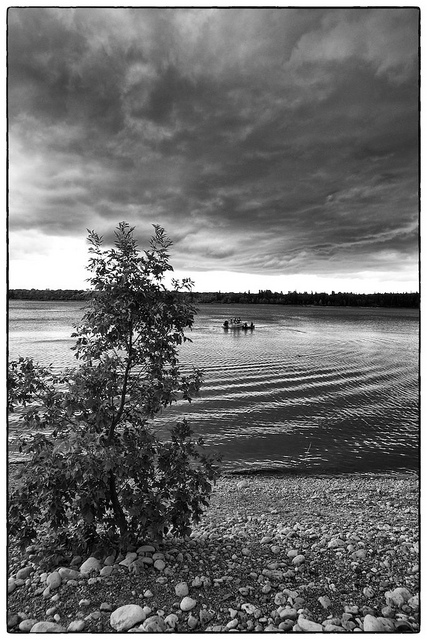
Copyright JM Schreiber Storm clouds over the Reservoir, Calgary, AB

If I had had more experience traveling I might not have made the mistakes that may very nearly have cost me my life this past week. I thought that by focusing my first visit to South Africa to longer stays in two areas, I would limit my travel time. But instead I ended up with long plane flights and interminable bus trips. Next time, and I definitely hope there is a next time  – *the hematologist looks at me askance* – I hope to take longer and fly between major centres once I get to South Africa. The buses have a certain charm and I definitely got to meet and talk to people in a way I might not have otherwise, but to top off my three week excursion with a three leg flight home with very short turnarounds was a major miscalculation  on my part. It sounded great. But I had no idea exactly how tight a three hour stop over is, especially if you have to clear customs. Longer stop overs would have helped. Baby asprins, compression stockings. Everyone has recommendations now.

Yet although I was tired and swollen upon my return, it would take a few weeks before my journey caught up with me. Last Sunday night, or rather, early Monday morning, two and half weeks after I returned home, all swelling and fatigue seemingly gone, I suffered a pulmonary embolism. Well actually, it was not clear what had happened at first. I have very little memory of that day or an evening event I had been to with friends. My 25 year-old son, a creative, troubled but wonderful soul, heard me moaning. Thomas came upstairs to find me disoriented. He called Emergency and started chest compressions.

The kid saved my life. In one of those odd ironies, or twists of fate, toward the end of my time away, Thomas had suffered a couple of acute panic attacks so severe that he twice was taken to the hospital. In the second situation he was referred on to a psychiatric nurse he liked and she suggested a 4 week outpatient program he had just started. Mind you my little detour has interrupted  his plans but they will contact him as soon as there is a good point for him to join back in. Me, I will be in the hospital for at least another week, but the more “functional” I am, the more I can spend time reading.

So good with the bad. Who knows? Maybe the two truly are bound more tightly than we realize.

1914 – Goodbye to All That: Writers on the Conflict Between Life and Art, Lavinia Greenlaw, ed.

War and conflict are among the most fundamentally human motivations behind our desire to tell and share stories. Religions, mythologies and histories draw on these timeless themes. And, as human history continues to prove that we have not yet managed to learn from the past; conflicts, ongoing or marked with progressive anniversaries, will continue to to inspire artists and storytellers alike.

greenlaw_2985334aThe centenary of the advent of the “War to End All Wars” in 2014 saw a renewed focus on the contemporary writers and poets of WWI as well as a broader assessment from today’s artists of the lasting influence of that critical event on the conflicts that have followed. An interesting contribution to the discussion arrived in the form of 1914 – Goodbye to all That: Writers on the Conflict Between Life and Art, a selection of essays edited by Lavinia Greenlaw which was published in the UK last year by Pushkin Press. This collection will see its release in North America on September 1, 2015.

For Greenlaw, the First World War has a resonance that is not tied to a particular time and place but rather stands as touchstone to “reinvigorate questions we should never stop exploring.” With that in mind a variety of writers were invited to offer reflections broadly inspired by the question: “What does it mean to have your life and your identity as an artist shaped by conflict?” To that end, writers from a number of different countries were recruited.

The final compilation is, perhaps inevitably, uneven. However, the strongest entries are startling and have stayed with me long after the reading. The first essay to catch my imagination was, much to my surprise, Daniel Kehlmann’s “A Visit to the Magician”. Having read his F: A Novel with a measure of disappointment, I was drawn into his account of his own attempt to pursue the experience of being hypnotized after this same novel was released. Because a visit to the performance of a hypnotist sets the stage for the events that unfold in F he decided that he ought to have a go at the real thing himself. The exploration of hypnotism leads to an interesting reflection on the mechanisms that may help motivate individuals to rise, against their better angels, to support dictatorships and even march to war.

“(I)t’s nothing more than the most normal effort to be like everyone else, to experience what everyone else experiences, to behave the way authorities want you to behave. And then of course there’s the desire not to do anything wrong in full sight of so many other people.”

For Belgian author Ewrin Mortier and Slovanian poet and writer Aleš Šteger connections are drawn between the First World War and subsequent conflicts, WWII in the first case, the Balkan War in the latter. In “The Community of Sealed Lips: Silence and Writing”, Mortier concerns himself with the silences that remain unspoken, and the way language and lies are employed to negotiate the complicated way that both World Wars divided Belgian communities and families. His essay encompasses the story of his own grandmother and her beloved younger brother containing the painful truth that he would weave into the fabric to his debut novel Marcel. By contrast, Šteger’s tale, “Tea at the Museum” is unsettling and unusual. When Z, a woman he has not seen or heard from in years, calls and suggests that they meet to for tea he cannot imagine why she wants to see him. She is, it seems, keen to apologize for a wrong she swears she has done to him – in a previous life lived during the First World War. The encounter leads him to confront the memories of individuals and of countries, and reflect upon the way poetic imagination is employed to talk about horrors to painful to face directly:

“Only through literature can we realize how impossible it is to have any true insight into the past, any true experience of it, and what’s more we will become part of some equally incomprehensible past.”

Elsewhere, novelist NoViolet Bulawayo writes about the work of writers from her native Zimbabwe who, through their voices raised in protest in the threat of censorship and imprisonment, served to reconnect her to her community from afar, ultimately leading to a focus and theme in her own writing. Her exploration of her own identity in this context serves as a direct and deeply personal tribute to her fellow Zimbabwean artists. Another striking and powerful contribution comes from UK based Chinese writer Xiaolu Guo. Her account of the experiences and often unfortunate end of thousands of Chinese coolies imported like cargo to dig trenches and lay railway tracks along the front toward the end of WWI is at once astonishing and disturbing.

The collection is rounded out by contributions from Ali Smith, Kamila Shamsie, Elif Shafak, Colm Toibin and Jeanette Winterson. What is most interesting is the varied and diverse ways that all of these accomplished writers respond to the theme presented for their consideration. There is plenty of food for thought here.

* Review copy provided by Steerforth Press through NetGalley.