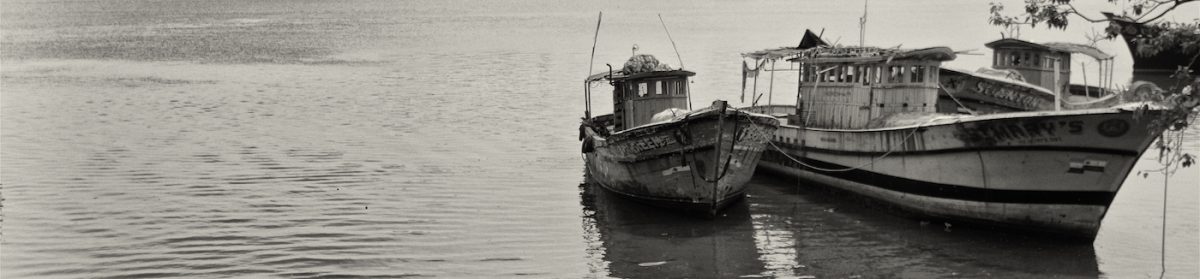
The sun setting. Quiet sea. The rig looked like a chandelier made of wire. The cranes slanted like seabirds waiting for prey.
This is not a book that eases you in gently, slowly constructing a framework and political context for the events to follow. We are offered no false assurance of safety and normal, only glances into the narrator’s past that indicate that at one time he might have harboured hope for the future, no matter how illusory. When we meet B in the opening passages, he is already off the map, so to speak, and heading for something much larger and darker than he can possibly imagine. But, as he makes his way to the South through a bleak, drought-ravaged landscape inhabited by a sparse impoverished, superstitious population with strange beliefs, he already has serious doubts about the wisdom of his mission:
As a journalist, I tried not to go after topics that the state was sensitive to. My father’s history and my mother’s continuous discouragement had made me conservative. I was diverging from that path now by taking this assignment.
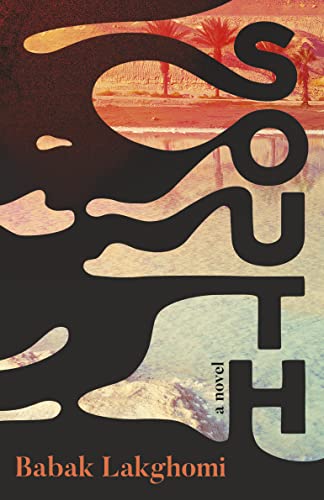
South by Babak Lakghomi, a writer born in Tehran, currently living in Canada, is a desolate, dystopic fable unfolding in an undefined time and place where environmental devastation, political unrest and totalitarian control have distorted the rules that once governed human engagement. That is, a future that seems less distant, less improbable by the day. In Lakghomi’s vision, the increasingly dire economic and ecological circumstances that have plagued an unnamed country have forced men south to work in oil refineries and on off-shore oil rigs, but as the profitability of this industry also starts to decline, labour unrest has started to spread. This is the phenomenon his protagonist B has been sent to report on.
 Having just secured a contract to publish a book about his father, a former union leader who mysteriously disappeared when he was a boy, B feels a certain obligation to take the assignment when it is offered to him by his editor. Perhaps it’s for the best. Back home his marriage is faltering and his recent sobriety is shaky. However, when he finally reaches his destination, it soon becomes clear that his presence on the rig will be tolerated, but not welcomed. Finding people willing to talk to him is difficult and, before long, dangerous. His past experiences researching and writing articles, such as an investigation into the extinction of the painted stork, have taught him that much of what is uncovered about the deep layers of corruption running through so much of what is happening in his country cannot be included in a final draft. This time he is even more restricted. He had been required to leave his cellphone and laptop before flying out to the rig. All communications with his editor and publisher, and even his wife, have to pass through administrative staff who can read every word, blocking, altering and fabricating his messages at will.
With a narrative style that is tight, almost skeletal in nature, South moves at a steady pace, growing increasingly distorted and claustrophobic. We gradually learn more about the protagonist, haunted as he is by the unexplained absence of his father, the crumbling state of his marriage, and a recent encounter with a strange woman back in the city, but much of what he is enduring as his circumstances and condition deteriorate, first on the rig and, later, captive on a cargo ship, remain shrouded by mystery. What is clear is that B has found himself caught in a net that reaches into his immediate past and perhaps further, back to whatever took his father away. The helplessness of being in a situation where you don’t even know what kind of a game you’re playing is chilling, a sensation that is heightened by the exceptionally spare prose. Every word counts.
Dystopic fiction can sometimes get bogged down in explanatory detail. In that regard South is stripped to its essentials. Acute attention is given to settings and sensations, but the only named characters are B and his wife Tara. Everyone else is referenced in simple terms—the Editor, the Assistant Cook, the girl with the lighter and so on—preserving an anonymity that reflects how precarious and unreliable every relationship is. And yet against this uncertainty, we have in B a compelling and empathetic narrative voice, continually questioning, struggling as his ordeal weighs on him physically and mentally. The horrific scenario he encounters in the South, one that is closely tied to the all-too-recognizable reality he observes back in the city, make this a novel that sits uncomfortably with a reader—as it should.
South by Babak Lakghomi is published by Rare Machines, an imprint of Dundurn Press.

 roughghosts
“That is, a future that seems less distant, less improbable by the day. ”
This is so true.
The Offspring and I were talking about it just yesterday, how best to live a life when it seems that now nothing we can do as individuals will make much difference. We came to the conclusion that all we can do is just the best that we can, leaving as a legacy only that we tried.
LikeLiked by 1 person
Yes. I’ll admit that it is disheartening to look at where we are heading.
LikeLike