When I take stock of my life, I see no reason to launch into some big family history. I haven’t got what it takes, nor do I have the means. I can’t very well ask Mother and I can’t ask Father, and as for my grandparents, I never knew them. Besides, the story of my family is nothing out of the ordinary. One might even say that along with all its uniqueness, it could just as easily serve as the prototype of the history of the Hungarian family. Or even the history of a Middle-European, middle-class, non-Jewish family. Though, come to think of it, they are pretty similar to Jewish histories. Discounting, of course, what cannot be discounted.
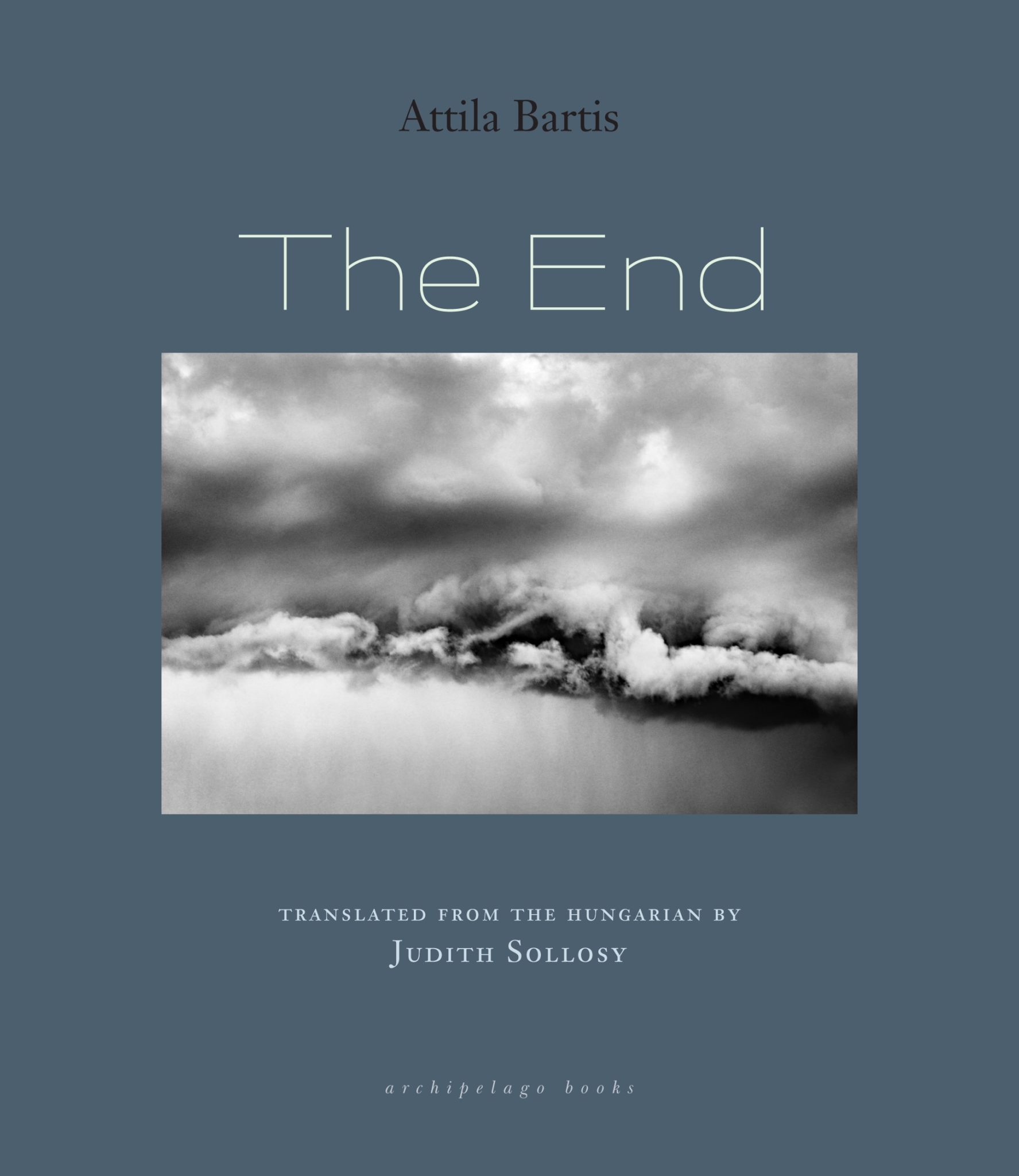
The End, the latest novel by Hungarian writer Attila Bartis to be released in English translation, begins, as its title implies, at the end. We meet András Szabad, aged fifty-two, enroute to the airport to catch a flight to Stockholm for a medical examination. He tells us he is a photographer, very well-known in fact, but admits he has not touched his camera in two years, ever since a woman named Éva died. And, for some reason, he feels it is important to let us know, off the top, that he does not believe in God. He lacks faith. But his feelings about God or not-God seem less than certain. Questions remain. To that end, a friend has suggested that he get his life down on paper as a means of resolving this unfinished business, whatever it might be.
 As a photographer, someone who frames the world as he sees it through pictures, moments preserved and observed with a certain distance—a practice he first engaged in as a child, observing a woman through a window from a gap in a fence, long before he ever held a camera—András approaches this project as one might lay out a series snapshots, each catching an image or memory from his past. He begins in the fall of 1960 when he and his father arrive in Budapest, following his mother’s sudden death and his father’s release from prison after serving three years for alleged anti-government activities. They take up residence in a small apartment, awkwardly sharing the space, continuing the same pattern of father-son avoidance passed down through four generations, each man sharing exactly the same name: András Szabad. The youngest András is seventeen when he moves to the city, a transition that marks an abrupt end to his childhood. But it is on his first Christmas there that he receives his first camera, his father’s Zorki, and that changes everything.
András chronicles his experiences finding his way around Pest, his father’s trouble finding work and meeting the young man, Kornél, who will become his life-long friend, sounding board and often frustrated better angel. He describes growing up in the rural town of Mélyvár, his beloved mother, and the difficult, lonely years of his father’s imprisonment when even a friendly neighbour could secretly be an informer. Now settled in Budapest, he drops out of school after an affair with his Hungarian teacher, listens in as his father is visited by his former collaborators, and befriends the eccentric countess, now reduced to a simpler life, who lives in apartment under the back stairs of his building with her elderly lady-in-waiting. There is no shortage of interesting characters peopling András’ otherwise ordinary world. On a larger stage, he is rather obsessed with Yuri Gagarin, the first human in space who reported that he saw no God up there, and feels defined by the seemingly endless reign of Communist leader, János Kádár. And then, there are the women.
His affairs with women are typically sexually intense and strange. He seems attracted to hopelessly inappropriate women—his high school teacher, an older woman he meets at the pool, and, of course, Éva, the concert pianist who András first sees, in the park, making out with her ex-husband, but looking directly at him over the man’s shoulder. Their torrid, yet dysfunctional, relationship lasts seven years, but she always holds him at arm’s length, across a space he can never breach. Most of his lovers end up before the lens of his camera, Éva included, as do many of the female customers he encounters once he begins taking photo ID pictures for a living. The camera—the Zorki now replaced with a Leica—becomes, for András, both an invitation to women and a shield to protect himself against them.
The strength of this nearly 600-page novel rests on the sometimes uncertain, often funny, well-paced narrative. The short, focused chapters titled in parentheses by a single feature—the punctum in Barthes’ terms—gradually unveil a portrait of a vulnerable, often stubborn, flawed man who is not sure where he stands in the world, even after achieving enviable fame. What he wants the most, Éva’s love, is the one thing that eludes his grasp, even if it is she who, after she has left him and Hungary altogether, mounts his first exhibition using “stolen” negatives. He professes an unwavering allegiance to the truth, at least as he sees it, with the wisdom, on occasion, to refrain from saying what he is thinking. And the smooth integration of dialogue—much of András’ account could be described as “verbal snapshots”—advances the flow of memories and reveals more about his nature, and that of those around him, than a more ego-driven fifty-two year-old would ever dare disclose in a formal written exercise.
For instance, when his father dies and he needs more than the part-time overnight job he has had at a print shop, András presents himself to József Reisz, the ID photographer who will teach him more about taking pictures than anyone else, and explains that he needs a job. Even though Reisz is not looking for an assistant, he is hired. The older man is a crusty, no-nonsense character with an uncanny attention to detail when it comes to people and to photography. When András serves his first client, he is fumbling with the unfamiliar folding bellows camera and, as he pushes the shutter release cable, Reisz calls out from the lab. Plate!
I pulled out the plate, I took the two required pictures, and wrote out the receipt. I was drenched in sweat. Soon as the man left, Reisz came out.
Thank you, I said.
You’ll get the hang of it, he said.
I’d have never thought that taking an ID photo was hell.
You’ll get the hang of it no time.
How did you know in there that I forgot to pull out the plate?
From the sound. There was no twang, and the shutter clicked.
You hear that from in there?
Yes. And at such times, don’t advance the film. Or if you’ve advanced it, take another picture of the client, so you’ll end up with a pair. As it is, you’ve got an empty frame now.
Fine. In the future, I’ll do that I said.
And don’t ask what the picture is for. It’s none of our business. If the client wants to tell us, he’ll tell us. If not, not.
Fine. But he looked like a lizard. He didn’t blink. Not once. He’s some sort of hunter.
He’s not a hunter.
He said he needed it for a license to carry arms.
He’s not a hunter. He’s a member of the Worker’s Militia. Hunters never stop talking.
The restrictions and ever-present threats and uncertainties of life in Communist Hungary, especially in the light of his father’s entanglements, shadow András from his early years, right through to middle age. Yet, many pieces of his life fit together seemingly by chance rather than by desire or design. He is strangely lacking in direction, even after he begins to have gallery showings. Left to his own devices, he might have been content taking ID photos or photographing the women who happened to cross his path indefinitely, enlarging some images leaving others untouched. But, flawed and frustrating as he may be, he is wonderful at isolating and narrating distinct moments of his life, slowly making his way to the memories and fears that he is continually trying to avoid. And what is life anyhow, but a series of negatives, some developed and returned to endlessly, others lying dormant until retrieved from the mists of time by accident or circumstance?
The End by Attila Bartis is translated from the Hungarian by Judith Sollosy and published by Archipelago Books.
 roughghosts