Days and hours, light and darkness: South by Babak Lakghomi

The sun setting. Quiet sea. The rig looked like a chandelier made of wire. The cranes slanted like seabirds waiting for prey.

This is not a book that eases you in gently, slowly constructing a framework and political context for the events to follow. We are offered no false assurance of safety and normal, only glances into the narrator’s past that indicate that at one time he might have harboured hope for the future, no matter how illusory. When we meet B in the opening passages, he is already off the map, so to speak, and heading for something much larger and darker than he can possibly imagine. But, as he makes his way to the South through a bleak, drought-ravaged landscape inhabited by a sparse impoverished, superstitious population with strange beliefs, he already has serious doubts about the wisdom of his mission:

As a journalist, I tried not to go after topics that the state was sensitive to. My father’s history and my mother’s continuous discouragement had made me conservative. I was diverging from that path now by taking this assignment.

South by Babak Lakghomi, a writer born in Tehran, currently living in Canada, is a desolate, dystopic fable unfolding in an undefined time and place where environmental devastation, political unrest and totalitarian control have distorted the rules that once governed human engagement. That is, a future that seems less distant, less improbable by the day. In Lakghomi’s vision, the increasingly dire economic and ecological circumstances that have plagued an unnamed country have forced men south to work in oil refineries and on off-shore oil rigs, but as the profitability of this industry also starts to decline, labour unrest has started to spread. This is the phenomenon his protagonist B has been sent to report on.
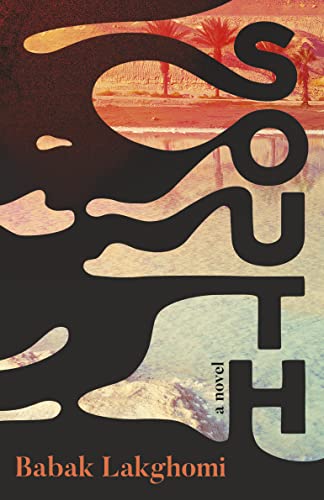
Having just secured a contract to publish a book about his father, a former union leader who mysteriously disappeared when he was a boy, B feels a certain obligation to take the assignment when it is offered to him by his editor. Perhaps it’s for the best. Back home his marriage is faltering and his recent sobriety is shaky. However, when he finally reaches his destination, it soon becomes clear that his presence on the rig will be tolerated, but not welcomed. Finding people willing to talk to him is difficult and, before long, dangerous. His past experiences researching and writing articles, such as an investigation into the extinction of the painted stork, have taught him that much of what is uncovered about the deep layers of corruption running through so much of what is happening in his country cannot be included in a final draft. This time he is even more restricted. He had been required to leave his cellphone and laptop before flying out to the rig. All communications with his editor and publisher, and even his wife, have to pass through administrative staff who can read every word, blocking, altering and fabricating his messages at will.

With a narrative style that is tight, almost skeletal in nature, South moves at a steady pace, growing increasingly distorted and claustrophobic. We gradually learn more about the protagonist, haunted as he is by the unexplained absence of his father, the crumbling state of his marriage, and a recent encounter with a strange woman back in the city, but much of what he is enduring as his circumstances and condition deteriorate, first on the rig and, later, captive on a cargo ship, remain shrouded by mystery. What is clear is that B has found himself caught in a net that reaches into his immediate past and perhaps further, back to whatever took his father away. The helplessness of being in a situation where you don’t even know what kind of a game you’re playing is chilling, a sensation that is heightened by the exceptionally spare prose. Every word counts.

Dystopic fiction can sometimes get bogged down in explanatory detail. In that regard South is stripped to its essentials. Acute attention is given to settings and sensations, but the only named characters are B and his wife Tara. Everyone else is referenced in simple terms—the Editor, the Assistant Cook, the girl with the lighter and so on—preserving an anonymity that reflects how precarious and unreliable every relationship is. And yet against this uncertainty, we have in B a compelling and empathetic narrative voice, continually questioning, struggling as his ordeal weighs on him physically and mentally. The horrific scenario he encounters in the South, one that is closely tied to the all-too-recognizable reality he observes back in the city, make this a novel that sits uncomfortably with a reader—as it should.

South by Babak Lakghomi is published by Rare Machines, an imprint of Dundurn Press.

A Pastoral Dystopia: Trencherman by Eben Venter

“Tears, nearly; heartache that I’m almost able to touch in my chest. Bossieveld stretches around this dorp, as wide as the vulture flies. In rain years the red grass pushes up. The veld surges and flows, with koppies of ironstone and mountains with cliffs where animals find shelter during the cold winters, where ewes search out the warmth of besembos during the lambing season. Elsewhere it breaks open into rivers and streams and vleis full of platannas and bullfrogs and wild geese. But only when the water runs, when the eyes of the springs open. I want to remember it like that one last time.”

I am not typically a fan of post-apocalyptic or dystopian fiction. No matter how intriguing the scenario, I find myself too frequently disappointed with the writing or the realization of the plot, or both. However, when a trusted friend enthusiastically recommended  Trencherman, a harrowing vision of a devastated South Africa by Eben Venter, my interest was piqued in spite of any reservations I might have otherwise held and, quite frankly, I would never have stumbled across this book without her guidance. Even then I was unable to source a copy outside of South Africa so it was high on my wish list for my recent visit to the country. Little could I have appreciated how my experience of this novel would be heightened by the fact that I would read it while my time in the rolling landscape of the Eastern Cape province was still very fresh in my imagination. That is, it happens, where this story is set and, for all the horror it envisions, Trencherman is also very much an evocation to the beauty of the land.

VenterTaking his lead from Joseph Conrad’s The Heart of Darkness, Venter imagines his native country at an undefined point in the near future. Years of civil unrest and socio-political upheaval have rocked the nation which never really found its footing. Now a massive explosion in the southern part of the country has destroyed the infrastructure, left a lawless void in which bribes and syndicates are the order (or lack of order) of the day. Drought has wasted the land, AIDS has has devastated the population. Our protagonist, Marlouw (a contraction of his first and last names Martin and Louw) is bachelor living in Melbourne, Australia. Both he and his sister Heleen had rejected the family farm and homeland two decades earlier. Yet for all the financial success afforded by an uninspiring career selling high end cookware, Marlouw is a rather bitter, self-centred man, crippled with a clubfoot. He has never forgiven his parents for failing to secure the surgery that would have corrected the deformity and, despite his denial, the pain and embarrassment of his disability weigh heavily on him. When his sister calls him one night desperately entreating him to return to South Africa in search of her only son, his nephew Koert, who seems to have gone missing in that dark land, Marlouw feels no immediate obligation to assist. When he does finally agree, he tells himself that he is doing so for his own personal reasons. Without fully understanding his motivations he senses that something unfinished lies in the deep recesses of his memory. His journey to unravel his own baggage will nearly cost his sanity.

As soon as he sets foot on South African soil, Marlouw realizes that he has arrived in a country that operates on cryptic and shifting terms. He adopts a heightened almost mystical approach to the task ahead, attempting to open himself to the “guides” that cross his path, but he rocks between selfish irritation and a deepening alienation as his quest proceeds. As a hero he is deeply flawed and deeply human. When he reaches the family farm, the place where he knows that his nephew has taken refuge and built up some manner of hideous power base, he is routinely thwarted in any attempts to make direct contact. The degree to which drought, disease and apparent apathy have wasted the land and the people he once knew is a shock but he is soon swept into their confined and miserable world. Upon his father’s death, he and his sister had passed the once proud farm on to the black families who had worked it for so many years. After twelve generations of Afrikaner ownership, the thirteenth generation had set their sights on foreign shores. But, as Marlouw will soon realize, he still carries a deep ancestral horror in his bones. He will not only have to confront whatever it is that his nephew Koert has come to represent, he will also have to come to terms with his own ghosts.

This is not the first time an author has turned to the Heart of Darkness to explore the dark corners of humanity. The late Canadian author Timothy Findley placed his own Marlow and Kurtz in the halls of a modern psychiatric institution in the startling and disturbing Headhunters. Trencherman skillfully evokes the darkness of the journey Conrad imagined in the depth of another part of Africa and updates it, raising important issues along the way. Venter takes the opportunity to offer harsh indictments on the divisions within his native country, envisioning an outcome that has its roots in a recklessness and disregard for ultimate risks among the privileged classes. This is, of course, a common context of the dystopian novel, but one which is, for me, often too carefully removed or generalized in some abstract future. South Africa offers a more immediate tableau that Venter does not shirk from, perhaps afforded by the fact that he, like his hero, has been living in Australia for several decades. He aims his sights close to home, directly at his own heritage and at the decision he and many other South Africans have made to leave.

Originally published in Afrikaans, the translation by Luke Stubbs is seamless. IsiXhosa passages are incorporated, and unlike some translations specifically aimed at a broader (i.e. US) English speaking market, common South African and Afrikaans expressions and terms are left in tact. A detailed glossary is included. There is a point where the dialogue degenerates into a bastardized English mixed with German that had me curious as to how these passages exist in the original, but that is only because the translation process itself, especially when it is striking and effective, is of particular interest to me. This topic is, I discovered, covered in an interview with the author here.

The memory of a land once rich, the protagonist’s struggle to balance compassion with self preservation, and the truly horrific, yet oddly contemporary spectacle that awaits Marlouw when he finally confronts his nephew combine to create an engrossing read. The closer a reader’s connection to South Africa, the more intensely this book will resonate or push buttons, but even with distance it paints an unsettling portrait.

And so it should.

Note:                                                                                                                                                                         It is my understanding that Trencherman is scheduled to be released in the UK and Australia in 2016. However, my attempts to obtain Venter’s more recent novel Wolf, Wolf which was similarly released earlier this year leads me to believe that rights do not extend to North America. Even so, once there is wider for release for Trencherman outside of South Africa, it will be easier to obtain through UK distributors.