Some ghosts have rougher journeys than others

- Copyright JM Schreiber 2012
– Copyright JM Schreiber 2012

O! WHY was I born with a different face?
Why was I not born like the rest of my race?
When I look, each one starts; when I speak, I offend;
Then I’m silent and passive, and lose every friend.

Then my verse I dishonour, my pictures despised,
My person degrade, and my temper chastise;
And the pen is my terror, the pencil my shame;
All my talents I bury, and dead is my fame.

I am either too low, or too highly priz’d;
When elate I’m envied; when meek I’m despis’d.
-William Blake, from a letter to his patron Thomas Butts, 1803

I first encountered these words in the months following my first manic breakdown in the late 1990s. With a diagnosis at hand I needed to understand its meaning so I read  the standard popular memoirs of the time. But I found myself drawn into the work of William Blake. Although many readers reject the notion that madness may have fueled his tireless creative energies, his hours conversing with angels and his periods of darkness – I found comfort in his artistic conviction even if he was destined to die without ever receiving the recognition of understanding he deserved.

For every person who successfully rises above the challenges of mental illness and negotiates the pitfalls of drugs and alcohol, there are those who spend their lives living rough. And others who lose the battle altogether. But Blake drew inspiration from his angels and demons with his loving wife by his side until the end.

Today is my birthday, and having found myself back trying to figure out what I am supposed to learn from this second mania and unexpected fall from grace, Blake’s lament has a special resonance once again.

But this time I am reflecting on a very different face than that which I confronted 17 years ago. From the time I was very young I could not make sense of the face with which I was born. The eyes that looked out from within that visage threatened to give me away. The body I struggled to feel at home in never felt like mine. The girls I befriended seemed like aliens and, with no other explanation for my discomfort I assumed that I had never learned the tricks, never tried hard enough.

The idea that gender or identity could be misaligned never occurred to me when I was growing up. At least not in the context I needed to hear. And when It did start to seep into my awareness I was already well into marriage and motherhood. It was a complicated comfort to realize that there was an explanation for my feelings. It was even more terrifying to know what to do with this information.

I know well that my mood disorder runs back through my family, that it has a genetic basis somewhere. I have no idea what course it might have followed without this added sense of being out of step with rest of humanity. But my hospital psychiatrists were certain that my apparent gender dysphoria was simply a psychotic symptom that would resolve itself with the right dose of lithium.

They were wrong of course. Now, 17 years later, the average looking middle aged man who confronts me from the mirror is not special, but he is one I feel at home with. For many years I thought that was enough, as if I had found the magic bullet, the key to moving forward on all fronts. My family have been supportive, I recreated my identity and built a new career.

But I still found that the manic-depressive monster has followed me all along. Making sense of recovery this time around, I find myself doubly invisible. Behind a face that accurately reflects my sense of self identity, is a whole life I cannot fully share. Talking about being bipolar has been the easy part.

But moving forward from this birthday, I want to find a way to be whole.

Making peace with our ghosts

There is a question tends to haunt those of us who live with mood disorders, especially in the early months of adjusting to a diagnosis or in the aftermath of breakdown:

Who Am I?

There is this persistent fear that, if the highs and lows of this “disorder” should ever hit equilibrium, what will be left?

And will that stable “me” be the real me or a medicated artifact?
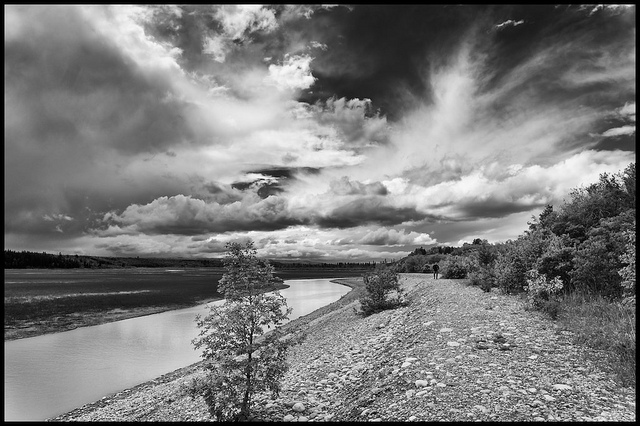
Copyright JM Schreiber 2013

The theory is that mood disorders are typically associated with “normal” periods but as most of us know, mania and depression can simmer under the surface, felt rather than observed for a long time. When symptoms burst through resulting in “abnormal” thoughts, actions and behaviours, those around us rarely understand that these are beyond our control. And because insight is impaired, when we are at our most unstable we are often the last to know just how far off the rails we have run. All this is further complicated when a mood disorder exists in conjunction with addictions or trauma or other chronic conditions.

Having a mood disorder is like living with ghosts.

But we own those ghosts. They are us. Everyone has them.

Ours just like to try to steal the stage, set the agenda, write the script and direct the show.

Maybe that is why I am drawn to so much fantastic literature lately… allowing the ghosts of others to distract me from my own.