
He walked so well here. The snow-covered mountains seemed so low and distant in the moonlight, and here and there touches of starlight glittered against the glossy-black nighttime ice. Such a walk was like a poem with rhymes and wonderful words; it remained in the blood like a poem. And just as with a poem you might learn it by heart, so to speak – and then feel compelled to come and look here again, to make sure that all was unchanged. And so it was alien and unattainable – yet homely and indispensable. And, finally, complete calm fell over Benedikt. A sense of security deep in his heart expanded and became all-encompassing, infallible: here he walked. He walked here.
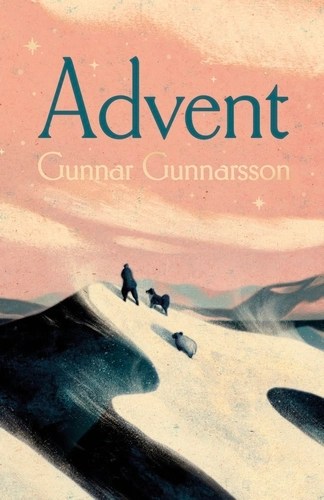
Compact, compelling, and perfect for the holiday season, Advent is a novella by Gunnar Gunnarson is one of the Icelandic author’s most beloved works. And for good reason. First published in German in 1936, then in Danish, and finally in Icelandic translation in 1939, this tale of midwinter adventure originally appeared in English as The Good Shepherd in 1940. Now, in advance of the Yuletide season, it has been released under its original title in a new translation from the Danish by Philip Roughton with an Afterword by Jón Kalman Stefánsson.
 Born in 1889, Gunnarsson was the son of a farmer in the Fljótsdalur district of East Iceland who showed an early interest in writing. At the time, Iceland was an impoverished colony under Danish rule, so in 1907, like other Icelanders who wished to pursue a university education, he moved to Copenhagen. Arriving with only a basic reading knowledge of Danish, Gunnarsson quickly mastered the language and would continue to write in it as he pursued a literary career. This had a significant impact on his work. First, although Gunnarsson’s writing was firmly rooted in the Icelandic landscape and culture, readers in his home country typically had to read him in translation (late in life he would dedicate to translating his work into his native language, leading to two—or more—translated texts to choose from). However, his popularity among Danish and German readers, not to mention the continental perspective afforded him by many years living abroad, gives his writing a different tone that that of his Icelandic contemporaries. He was speaking to a wider audience while drawing on themes and settings that brought the rugged—and to some, exotic—nature of Iceland to life.
Advent tells the story of Benedikt, a humble man who works as a farmhand during the summers and stays on during the winters to look after the sheep. He has a small outbuilding of his own for his horse, his sheep and the hay he mows on rented meadows. His is a simple life—half-farmhand, half-smallholder—not quite complete in either direction, yet it suits him. It leaves him, though, little time to himself, save for his annual Yuletide trek into the mountains to look for any sheep that may have been left behind on the high summer pastures. There are always some. This year will be his twenty-seventh trip; an important milestone. He was twenty-seven when he made his first run, and now, as a man of fifty-three, he feels his age. But with two of the finest companions he has ever had—Leó, his faithful dog and Eitill, his even-tempered, reliable wether—he has nothing to worry about, not even the less than favourable-looking winter weather ahead.
Here he was now, walking in snow, white on all sides as far as the eye could see, a greyish-white winter sky, even the ice on the lake was frosted or lightly covered with snow, only the rims of the low craters sticking up here and there drew larger and smaller black rings like a pretentious pattern in that snowy waste. But a portent of what? Perhaps these crater mouths said: Let everything freeze, stone and water solidify, let the air freeze and sprinkle down as white flakes and lie like a bridal veil, like a shroud over the ground, let the breath freeze in your mouth and the hope in your heart and the blood to death in your veins – deep down the fire still lives.
Gunnarsson’s protagonist, Benedikt, as a man for whom church was an integral part of community life, his thoughts often turn to the life of Jesus and his journey carries echoes of Christian imagery, most strikingly the regular reference to “The Trinity,” but here the term describes a man, his dog, and his wether. Our hero is a man long accustomed to a solitary life and even if there are hints that he once dreamed of more, he treasures this annual pilgrimage into the mountain wilderness alone. However, on this particular journey his task is delayed not only by unstable weather, but by men who seek his assistance in their own searches, for sheep in the first instance and for horses in the second. Both times, Benedikt is less than happy with the deferral of his given objective, yet one senses it is his compassion for lost animals that motivates him to divert his attention more than a concern for his fellow man. He is a man on a mission with an anniversary to mark no less.
In this way Gunnarsson builds complex layers into his relatively simple tale of a risky mountain adventure. Benedikt, along with Leó and Eitill, are each distinct and developed personalities. Against the harsh unpredictability of the Icelandic winter they are a well balanced team. Anything less and this particular mission to retrieve any lost or missing sheep could have ended in disaster. In his Afterword, Stefansson remarks on Gunnarsson’s remarkable ability to evoke the intensity of winter storms in the mountains, comparing his gift to that of Conrad’s descriptions of storms at sea, noting that both men left their native homes and wrote in a second language. However, Gunnarsson did eventually return to settle in Iceland and one clearly see that contemporary Icelandic authors, such as Stefansson himself, have learned much from his example.
Advent by Gunnar Gunnarsson is translated from the Danish by Philip Roughton and published by Penguin Random House UK.
 roughghosts