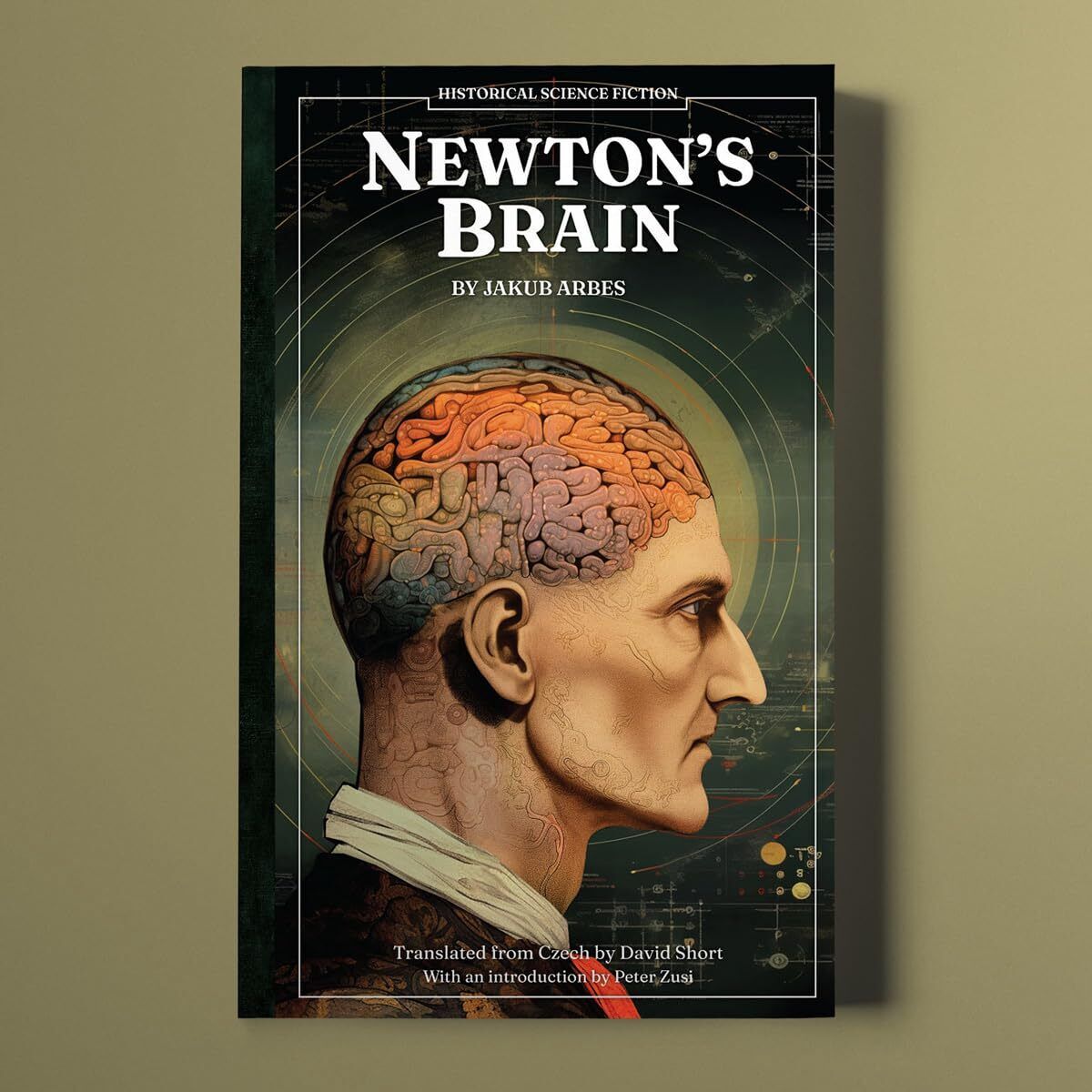
G. Wells’ first novel The Time Machine, published in 1895, has long been considered not only one of the earliest works of science fiction, but the popularizer of the notion of time travel. It was a concept Wells had explored in short fiction some seven years earlier, but in 1877, a full eighteen years before his landmark novel was released, a Czech writer and intellectual named Jakub Arbes (1840–1914) had already depicted a machine designed to peer into times distant in Newton’s Brain, a very short novel the author described as a “romanetto.” Now, as part of their new Historical Science Fiction series, Jantar Publishing has issued this underappreciated text in a new translation by David Short, complete with a fascinating introduction by Peter Zusi (as a note of interest, the earlier 1892 translation by Josef Jiří Král is available from Sublunary Editions).
 As Zusi indicates in his introduction, time travel narratives were rather popular in eighteenth and nineteenth century literature, but ghosts and supernatural influences were typically called upon to explain a protagonist’s encounter with past or future events. The time machine, by contrast, depends on scientific reasoning to lend a degree of credibility to the premise that one might disrupt normal chronological progress. For Arbes, Zusi suggests a very likely inspiration for the particular idea of time travel that underpins his story. In 1846, a small pamphlet called The Stars and the Earth; Or, Thoughts Upon Space, Time and Eternity was published in London and became a sensation. The work, attributed to Felix Eberty (1812–1884), a Berlin-born lawyer, author and amateur astronomer, is thought to have influenced Kafka and Einstein. It seems quite possible Arbes would have read it as well. Eberty takes the already accepted notion that the light we see from faraway stars has travelled a long distance so to look into the night sky is to look into the past, and argues that if one could travel sufficiently far from the earth, it would be possible to view our planet’s past, including all of human history. Arbes presents a similar notion, one that, for both men, assumes the ability to travel faster than the speed of light and the existence of a device powerful enough to permit the observation of small details over vast distances. Charming to today’s reader perhaps, but not implausible to nineteenth century audiences. And, Zusi points out that although Arbes takes more literary license in his work, he is actually more aligned a modern scientific perspective than Eberty whose goal was a greater understanding of God’s omniscience and thus limited to a Biblical timescale. Arbes’ universe is 30 million years old and, at least in this book, his view of human nature and progress rejects all mythological constructs. However, specific scientific considerations aside, the primary stylistic influence on the tale that unfolds in Newton’s Brain lies in the gothic mystery and macabre spirit of Edgar Allen Poe.
The narrator invites his reader to the “whimsical” tale he plans to tell from the allegorical graveside of a man whom he insists would have welcomed release from the sorrow and distress that troubles the human soul—a man who would not have wanted to be mourned:
The man of whom I speak was my friend from earliest childhood, and he died – or more properly fell – at the Battle of Sadowa as an officer in the Prince Constantine infantry regiment. His skull had been split in two by a Prussian pallasch…
This friend was the handsome son of the head gardener for the wealthy Kinsky family in Prague, while he, the narrator, was, by comparison, poorer and “hideous,” but the two young men had been close since boyhood. Both exhibited a lively enthusiasm for exploration and debate when they were young, and eventually they were each drawn to the sciences. However, being the plainer of the two, the narrator “leaned towards dreary, tedious and rarely amusing mathematics,” while his dashing companion pursued the more exciting natural sciences. Yet, his friend not only studied physics, chemistry, and mechanics, he collected and poured through volumes of arcane and obscure philosophical works as well—all with one singular objective: to master the art of illusion. He is, in fact, so obsessed that his formal studies suffer, a circumstance that ultimately causes his family, who know nothing of his passion for magic, to insist he enlist in the army.
Before leaving to join his regiment, the newly enlisted soldier collected all of the books and equipment he had purchased over the years and stored in the narrator’s room and had it carried away. Soon he is called into active service and their once inseparable friendship falls victim to the distance of time and space. Several years pass before the narrator hears from his friend again. Two letters arrive, the second containing an odd request to be fulfilled should he die. If his wishes are followed, his friend writes, they will see one another one more time.
Soon after, war is declared between Prussia and Austria. The next notice to reach the narrator is a letter from the parish priest in the town of Nechanitz, to inform him that a critically injured, unidentified young man has been brought in to his care. A letter found in the soldier’s uniform bearing our protagonist’s address was the only means by which they could track down his identity. The narrator travels to the town, recognizes his friend and is there to witness his burial. He returns to Prague devastated by the loss. In his grief, he resumes his once abandoned studies, now focusing his attention on applied mathematics and astronomy. But, of course, this is not the end of the story.
One night, the narrator’s friend appears at his door:
Without uttering a word, my friend stood there, motionless, while I was unable to tear my gaze from him.
His face was deathly pale, but his clear, blue eyes radiated life and a light, amiable smile played upon his lips.
“Good evening,” he said after a while and took several steps forward.
Catching the clink of a sabre I registered that he was wearing an officer’s uniform.
His friend insists that he escaped death, that the fallen soldier was another man altogether, and now, that very evening, he is hosting an event at the Kinsky chateau to which all of their friends have been invited. He must hurry back but invites the narrator to come as soon as he is able.
The evening at the chateau is strange, marked by elaborate illusions, the incredible assertion by returned or seemingly resurrected soldier that he has procured the brain of Isaac Newton and had it installed in his own skull, and a long speech to a room filled with officials, academics and theologians in which he systematically critiques modern society and tears apart the so-called advances of human knowledge and technology. Finally, he reveals the existence of a driver, realized with the assistance of the wisdom contained in Newton’s grey matter, that will allow him to travel back in time to observe selected moments from human history. Is this perhaps the greatest invention ever, or the most sophisticated deception?
Arbes’ narrative is moody and atmospheric, his narrator alert to his own emotional and psychological state. As he tells his tale, there is much room for speculation woven in the account. Cleverly, Arbes makes his time machine inventor a young man with an eccentric enthusiasm for magic, sleight-of-hand and a vast range of scientific and philosophical knowledge, practical and arcane alike. This allows for possible interpretations, closing none entirely. It is also an often biting commentary on religion, politics, education and, in particular, man’s capacity for violence. The Time Machine may be better known today, but while Newton’s Brain’s inventive hero sets his sights back to the very origins of human community and Well’s time traveller takes a journey into the incredibly far flung future manifestations of humanity, both men were skeptical about the promises of technology and the evolutionary potential of humankind.
Newton’s Brain by Jakub Arbes is translated from the Czech by David Short with an introduction by Peter Zusi. This attractively illustrated and generously annotated edition is published by Jantar Publishing. It is available in the UK now and will be out in North America next month.
 roughghosts