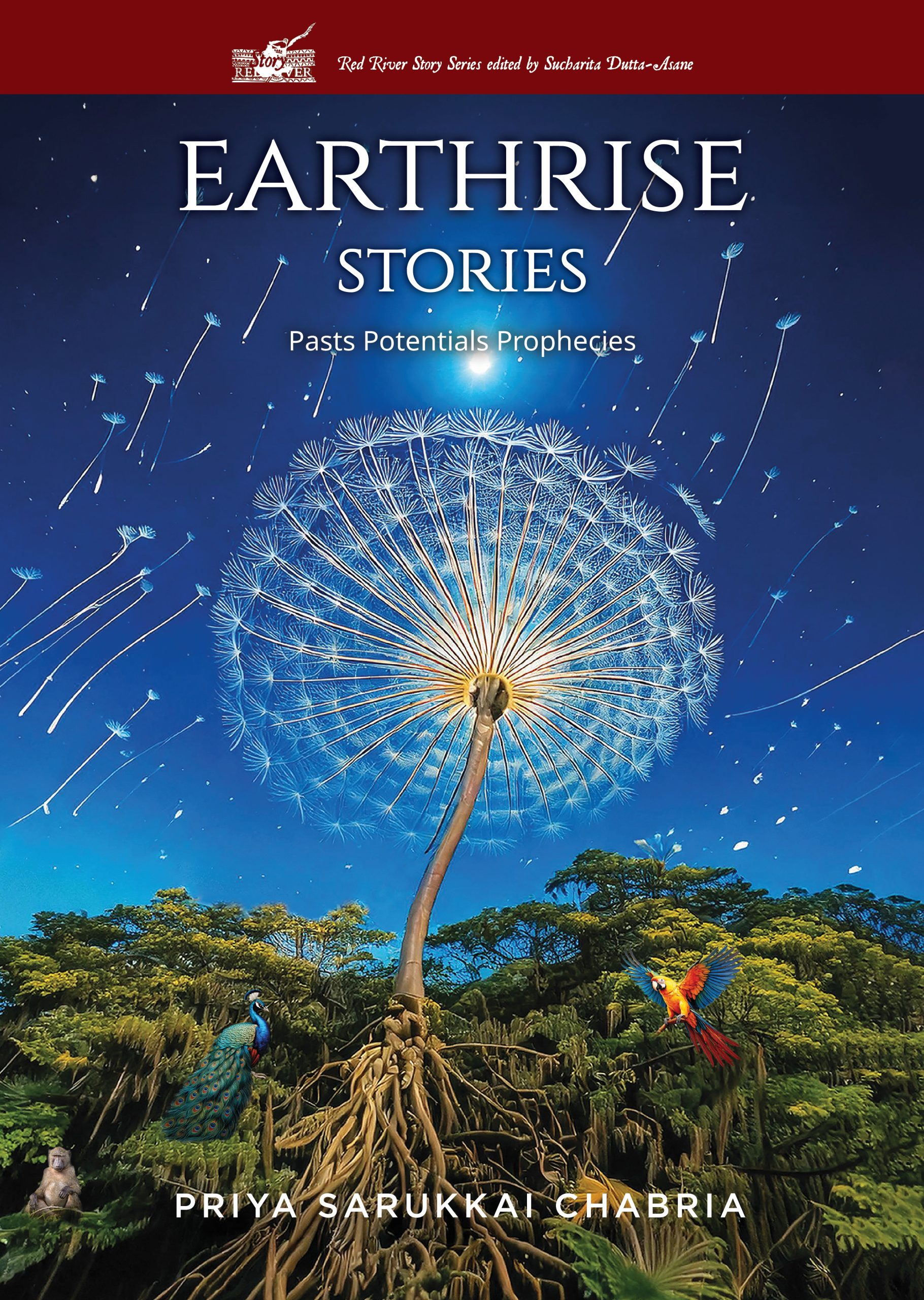
For all the possible and impossible futures: Earthrise Stories Pasts Potentials Prophesies by Priya Sarukkai Chabria

Of late, concern for the environment has fallen out of fashion in much of the world. Where I live, and in any other regions, oil companies, and forestry and mining interests exercise an outsize influence on governments, especially in a world of global economic uncertainty, fueling resistance to monitoring greenhouse gas emissions, investing in clean energy projects or promoting electric vehicles. It’s suddenly become too expensive, too inefficient to worry about the future. Besides, many insist that climate change is a hoax. So by the time we really feel the heat, so to speak, it will be too late to act. What stories will we, or rather our ancestors, tell to make sense of the damage done?  Will it even matter?

For Indian poet and writer Priya Sarukkai Chabria, the fate of our planet is an ongoing and vital theme. She sees it as a question that arises in the myths and traditions of a distant past, swirls around the influence of technology and artificial intelligence shaping our present existence, and reaches far into the future where an unknown realm of possibilities can only be imagined. Yet, she is prepared to explore new ways of thinking about and envisioning what we have come from and where we may be going. Now a wide-ranging selection of her poignant and thought-provoking fictional imaginings have been gathered in her new book, Earthrise Stories: Pasts Potentials Prophesies.
As a novelist and short story writer, Chabria has long sought expression through speculative fiction, typically with a strong Indian sensibility, and this collection highlights her strength in this genre, along with her distinct ability to flesh out the sensual intensity of her female protagonists, be they drawn from epic literature, or existing on a far distant timeline. But more than anything, these stories form a coherent project  in which the reality of climate degradation and what it means for the fate of the planet is a driving force. As she says in her Introduction:

I write stories of Earth, and some of the ways we could love her as she spins through our present dark time; the small gem of her seemingly weightless sphere spiraling through space, circling the sun like a prayer, sapphire and emerald as the eye of a dream, summoning tenderness.

Earthrise is divided into six sections, each one featuring a striking illustration by artist Gargi Sharma, and expanding in different spatial directions. “Past Re-Presented” is rooted in mythic times; “Now” searches for grounding in our ever-evolving present; “Ten Years from Now” turns to nonhuman life, natural and artificial; “In the Near Future” reaches deeper into the consequences for nature and a memory of humankind; “In the Far Future” contemplates the possible regeneration of a nearly dead planet; and, finally, “Prophesies that Come True” reintroduces a recognizably human narrator in in one story and offers a comet-focused cautionary tale in the other. Together, the eighteen stories that comprise this volume take the reader on a journey through time and space, marked by a  wide variety of shifting voices, styles, and tones.

The opening section re-animates tales drawn from Indian myth, legend, and literary tradition.  Characters like the celestial nymphs (aspara) Menaka and Urvaśī are realized as full-bodied sensual creatures rising above their passionate and tragic circumstances to set commonly accepted records straight. Episodes from the Mahabharata and the Ramayana are re-imagined with multi-dimensional, even cosmic, elements to at once reinforce their timelessness and set a foundation for many of the stories to follow.

The mood changes abruptly, however, as we enter the realm of the present day. The stories in “Now” are playful and inventive in style, but darkness and warnings lurk in their narrative themes. War, migration, economic turmoil, ecological devastation, and the increasing presence of robotic and artificial intelligence all feature here. There is even a lecture—or the draft of one—about the promises of a technologically driven future in one of my favourite pieces, “Cockaigne A Reappraisal (Draft) by Dr Indumati Jones (To be presented at UTIIMDS),” a text complete with the professor’s own personal notes to self:

With augmented AI inputs that analyse large amounts of financial data this sector is being steered towards making more predictive decisions in the stock market, and can tailor options to meet the investment patterns of specific financial firms. (Add examples. Quote sources?) On a lighter note, (smile here) Photoshop will be relegated to the past as in-camera devices will automatically correct flaws. Power outages like the one I’m currently experiencing will be out-dated — pun intended! — (smile here) as various AI driven units will be linked to a central intelligence system – as is already occurring in certain Smart Cities worldwide.

Dr Jones’s cynical optimism aside, the atmosphere that dominates the four stories in this section is ominous.

Ten years on, things are no better, flora and fauna are in serious decline (the author setting a fictional report in her hometown of Pune, even) and hopes that damages might be undone are outsourced to the services of a LoveBot  who can customize a dream, but has no power to make it come true. Moving on, further into the future, the Eco-Lit exam that makes up the content of one of the stories of the next section, leaves no question about ecological outcomes, but the prose in other tales becomes more poetic, dream-driven and, in one story, “The Princess: A Parable,”  folkloric. But the hard reality of the potential fate (or fates) of the Earth and the life she once sustained cannot be denied.

Yet, this is where Chabria’s stories of Earth take a detour from the classic dystopian formula. Although she leaves no question about the destructive tendencies of man and the fragility of life on our planet, when we reach the far distant future, there is the hint of a utopian possibility, however unlikely (and unlike anything we have ever known) that might be. In the two penultimate stories, she envisions variations on a world where life at its most fundamental cellular level has been preserved, integrated with novel notions of consciousness, historical awareness, and the means to reproduce or self-evolve. In this sort of speculative realm, the poetic, passionate energy that fills Chabria’s female protagonists charges her post-human narrators. “Paused,” for instance, imagines a planet where proto or potential lifeforms that can decide how they wish to evolve. But it is a lonely existence, and evolving is a process fraught with challenges. After an aborted attempt, her narrator retreats in a panic:

I trigger TEMP TORPOR in myself. It causes shuddering standstill of all activities. Cessation shocks my systems. Quieten down, please, down. Alarm still volcanoes. Shuush, shuuhh. Quieten to hill size. Rolling boulders. Be still, shuush. Become pebble size. Still, be still. Be spore. Be a drop of silence, a bead of spreading stillness. My systems slow, calm. I’m sliding into deep sleep; almost a hibernating pod again. Scan the damage. I must create low energy compounds to coat the membrane till it can sustain survival. I’m barely born but must manage so much!

Clearly, earthly recovery will be a slow and painful, but re-birth, in this scenario, could be intentional, not accidental. What then?

Earthrise presents many questions, and offers no clear solutions (except, of course, the ones we’re already boldly ignoring). Yet, in drawing on such a vast array of inspirations, from mythology, history, science—natural, physical, ecological— and, of course, poetry, Chabria has crafted a collection that values life, all life, not just the hair-covered, supposedly “Wise Ones.” It is sad and hopeful—a warning, a promise, and a prayer.

Earthrise Stories: Pasts Potentials Prophesies by Priya Sarukkai Chabria is published by Red River Story. (Available worldwide through Amazon.)

Dramatically, melodramatically, or obliquely: American Abductions by Mauro Javier Cárdenas

. . . no, Antonio says to his daughters during dinner, Americans can’t imagine the conditions, and if they can’t imagine the conditions, they can’t imagine themselves as refugees, and if they can’t imagine themselves as refugees, they will conclude that refugees are different from them, a different species, Eva says, they read in the news that a different species from Central America have to flee their homes and that they’re coming here, and that we’re abducting their children to teach them a lesson, life is hard and then we die, Ada says. . .

There is something distinctly unsettling about reading the latest novel by Ecuadorian-American writer  Mauro Javier Cárdenas on the eve of Trump’s second term—Racist in Chief, anyone?—especially with tech billionaire Elon Musk on his arm assuming they haven’t broken up by then. Projected into a future that now seems shockingly close, American Abductions envisions a US in which the mass deportation of Latin American migrants, not just those who are illegal but naturalized citizens and sometimes even their children, is a large scale, technologically advanced, industrialized, and profit motivated operation. It consumes the waking and sleeping hours of its unfortunate targets and tears their lives apart in distinct yet similar ways. Antonio, the divorced cubicle-bound data analyst hero of Cárdenas’s last novel, Aphasia, who was trying to write a novel while juggling  commitments to his ex, his daughters, his mother and sister, plus a couple of girlfriends, has, in this scenario, been abducted and deported to his native Colombia. He was driving the girls to school when immigration officials apprehended him, a scene recorded by Ada, his eldest, on a video that subsequently went viral. When we catch up with him, decades have passed and his health is failing (he will die but continues to appear in recollected scenes from the past or via recordings of the many interviews he conducted with fellow deportees over the years). His daughters are grown. His youngest, Eva, a conceptual artist, joined him in Bogota after finishing university and has been there for seven years, while Ada has remained in San Francisco where she works as an architect. Add to this a varied cast of Latin American exiles and their families connected through either Antonio’s ongoing interview project and /or the lucid dream workshops of an online doctor, and you have the basic sketch of this dynamic and original work.

Cárdenas is a passionate devotee of the long sentence, producing multi-page strings of thoughts, reflections, and dialogue that tend to shift mid-stream—watch those commas, those “he says,” or “she thinks”—demanding attention while providing ample room for humour, recurring themes, and often biting commentary. But he is not simply obsessed with word count, an objective that in itself can lead to the proliferation of hopelessly unnecessary, redundant clauses. Rather, his sentences seem to propel themselves with an intrinsic energy that never overstays its welcome. There was, he admits in an interview for Minor Literature[s], a method guiding the writing of this book:

I wrote every sentence in American Abductions the same way. I started each sentence with a human impulse that I attempted to exhaust within the same sentence. This attempt to exhaust could be called In Search of Unexpected Linkages, with the caveat that this doesn’t translate to anything goes since the human impulse at the beginning determines the radius of operations. This approach also doesn’t allow for me adding a reference or an image three months later because that would disturb the progression of the sentence, which is based on the linkages previously generated. I typically spend one week on a 1,000-word sentence. Every day during that one week I read the sentence from the beginning so that I can ground myself on the opening impulse and what has already been generated. During that one week I have to read widely and wildly but in the vicinity of the radius of operations, which is as vague as it sounds — more Ouija board than research — though obviously I also do primary research (you would be surprised by how many facts are included in the opening sentence, for instance).

If that sounds like a recipe for a forced and artificial exercise it is anything but. This is a serious, albeit futuristic, novel that is unafraid to tilt at uncomfortable truths. There are continuing and developing threads and characters, whose stories reflect the fear, isolation, and (quite literal) dreams of those directly impacted by the anti-Latin American agenda of the “Pale Americans.” Central to this are, of course, Eva and Ada who are not only deprived of their rather eccentric father at a young age, but are unable to be together when he is sick or after his death, as they decide to continue his work. But there are other strained or separated families as well.

The subject matter—especially in light of the increasing antipathy and hostility toward immigrants in the Global North—may be grim, but this is a playful, absurdist novel nonetheless. Curious data and scientific facts are woven in to the narrative and literary references abound, some direct, such as the discussion of texts by Leonora Carrington, Bernhard, Borges, and Sebald; others less so, such as the adoption of the names of authors, musicians, artists, and Bolaño characters as intentional pseudonyms or nicknames for intelligent technologies. Sentence by sentence, each chapter builds on those that proceed it to create an intelligent, entertaining and, dare we say it, unnervingly prophetic novel.

American Abductions by Mauro Javier Cárdenas is published by Dalkey Archive Press. An excerpt can be found at Minor Literature[s].

Cloaked in Literature: Clone by Priya Sarukkai Chabria

In the years that I have been maintaining this blog, I don’t believe that have written about any book that might fall into the category of science or speculative fiction. I probably haven’t read much in recent years. As my attention has shifted to translated and more unconventional literature, I have set aside less time for the type of books I used to pick up as what I might have considered casual or escapist reading. Which sounds, I’m aware, like a little snobbishness and a lot of equivocating. But I don’t intend it that way, however, if one is not well read within a particular arena, writing about or reviewing a book becomes more difficult. The inclination is to simply read for pleasure, as if that is somehow a bad thing. Is literature supposed to hurt? Of course not. By this point in my life I like to think I’ve earned the right to read—or not read—whatever I want. Jump ship after 30 or 50 pages if I the book’s not working for me. Or to be surprised by a book I was less certain about.

In recent years there has been, it seems, a rush of speculative and apocalyptic themed fiction, drawing authors and readers from across the literary spectrum. I have tended to avoid it. I came to this book, Clone, almost by chance, when I was in Mumbai earlier this year and made plans to meet up with the author, poet and translator Priya Sarukkai Chabria at the Kala Ghoda Festival. Neither of us knew much about the other beforehand. A few hours over coffee and cake later and I’ve come to consider her a good friend. So although we have not discussed this book at all (I actually went to hear her lead a panel discussion on translating ancient literature), it is only fair that I consider this post a response rather than a formal review. As I’ve already indicated, I’m not sufficiently well-read in dystopian fiction anyhow. However, it’s also fair to say I was completely captivated by the scope and passion of this tale of an engineered clone “evolving” within a rigid, dispassionate world that is as fantastic as it is terrifyingly plausible.

The novel is set in a highly stratified twenty-fourth century India, where a select group of Originals lead a protected life of privilege and guarded luxury serviced by a vast array of clones bred from their own DNA, often mixed with or fortified by genetic material derived from animals. Divisions between classes of beings, or life forms, are strictly controlled. Museums exist to guard art and history from curious visitors and elaborate blood sports are a popular entertainment. It is, from the outside looking in, a world order long since divorced from the very qualities that faith, philosophy, and literature would have associated with humanity. In fact it would seem that the stirrings of these forgotten ideals, filtered through a vestigial genetic legacy that has resisted attempts to contain it, is the greatest threat to those in power. However, mutations keep arising.

Our narrator, Clone 14/54/G is, she insists, not a mutant. What sets her apart is something more unsettling. Her consciousness is changing. She remembers. The memories she seems to be accessing are desired by some and dangerous to others. Her Original, Aa-Aa was a writer living in the late twenty-first century, now being made manifest in her fourteenth generation likeness, cloaking her in Literature, so to speak. But Aa-Aa was a controversial figure who met an untimely end mid-way through an important public address. Her intended message died with her and Clone 14/54/G is seen a potential conduit to that message, for good or ill.

In a society dependent on unquestioned obedience and compliance, and designed to enforce it, poetry and stories are subversive elements. For our Clone, an early sign that something is amiss comes when she begins to experience unexplained compulsions and strange “visitations.” Like inhabiting a dreamscape although clones are not supposed to be able to dream, she finds herself caught up in stories—sometimes as a human, sometimes as an animal—reliving a life from a long lost time. These visitations which will later comprise a significant portion of the book, echo historical and mythological themes reaching far back into Indian history. They not only threaten the rigid consistency of the narrator’s programmed existence, they speak to the ineffable power of stories, to the poetry of our DNA.

Clone 14/54/G’s initial response is to wish these unwelcome intrusions away. Her sense of her place in the “Global Community’s” order of reality has been challenged. Originals alone have life, Firehearts who were created to play an empathic role have presence, and Superior Zombies claim existence, but Clones simply “exhibit actuality.” However, as words and ideas begin to come to her, to make their way into her experience of this actuality, her sense of her own reality is altered, or less certain. She responds whenever feasible by reducing her mode of function. But this strangeness does not simply affect her feelings. Her body is also responding:

Beneath my overalls I grew hair. At work, I made no error. I was allowed full rations. I was living in two worlds. Is this what is meant by loneliness? That you don’t belong to any world. Not the old one. Not the new. You don’t even seem to belong to yourself.

But as her awareness continues to evolve, she is relieved of her former worker role, and removed to a holding facility where she is afforded certain luxuries and encouraged to foster a connection with her Original. Her adjustment is not without reservations as the routines she knew are pulled away. And she is subjected to real pain, frequently pushed to her physical limits as the months pass. For support she has the Fireheart clone Couplet, an attentive almost insect like-creature assigned to assist in her recovery of Aa-Aa’s memories. Meanwhile, a handsome Original known only as The Leader, takes a particular interest in her progress and soon they become lovers. Her situation becomes at once more tenuous and more exciting. To what extent is she being played? By whom? To what ends? And is there anyone or anything she can trust, especially her own increasingly volatile and passionate heart? For example, after making love one day, she is haunted by questions that never would have troubled her before. What does it mean, for example, to be aware of the fact that she is alone?

Who is now speaking—Aa-Aa or me? Why do I wish it not be her?

“Clone 14/54/G” is no longer enough. I am more—and less—than I was. Less sure, less safe, less isolated. More curious, more in pain, more resolute about my uncertainties. With more words at my command.

The strengths of Clone lie in the strong voice of the narrator who comes to be known as Aa-Aa Clone 14/54/G and the realization of a multi-faceted, artificially manipulated society without laborious details or explanations. Aa-Aa Clone 14/54/G can only tell the story as she knows and understands it, nothing more. Her narrative moves from the focused and contained, yet conforming perspective of being whose entire world has been formed along established lines, to one whose humanity, if you will, starts to break through in fits and starts. The passion and spirit of her Original, and the characters whose stories she carries, simmers slowly, gradually building steam, but is never an entirely natural fit. This is not a Cinderella story. Too many horrors await, too many questions remain unanswered. Finally, the form, incorporating tales drawn from the accumulated memories of a distant past—the storyteller’s true legacy—is unexpected and effective; the language poetic and powerful.

Clone by Priya Sarukkai Chabria is published by New Delhi-based Zubaan Books, and distributed outside India by University of Chicago Press.