
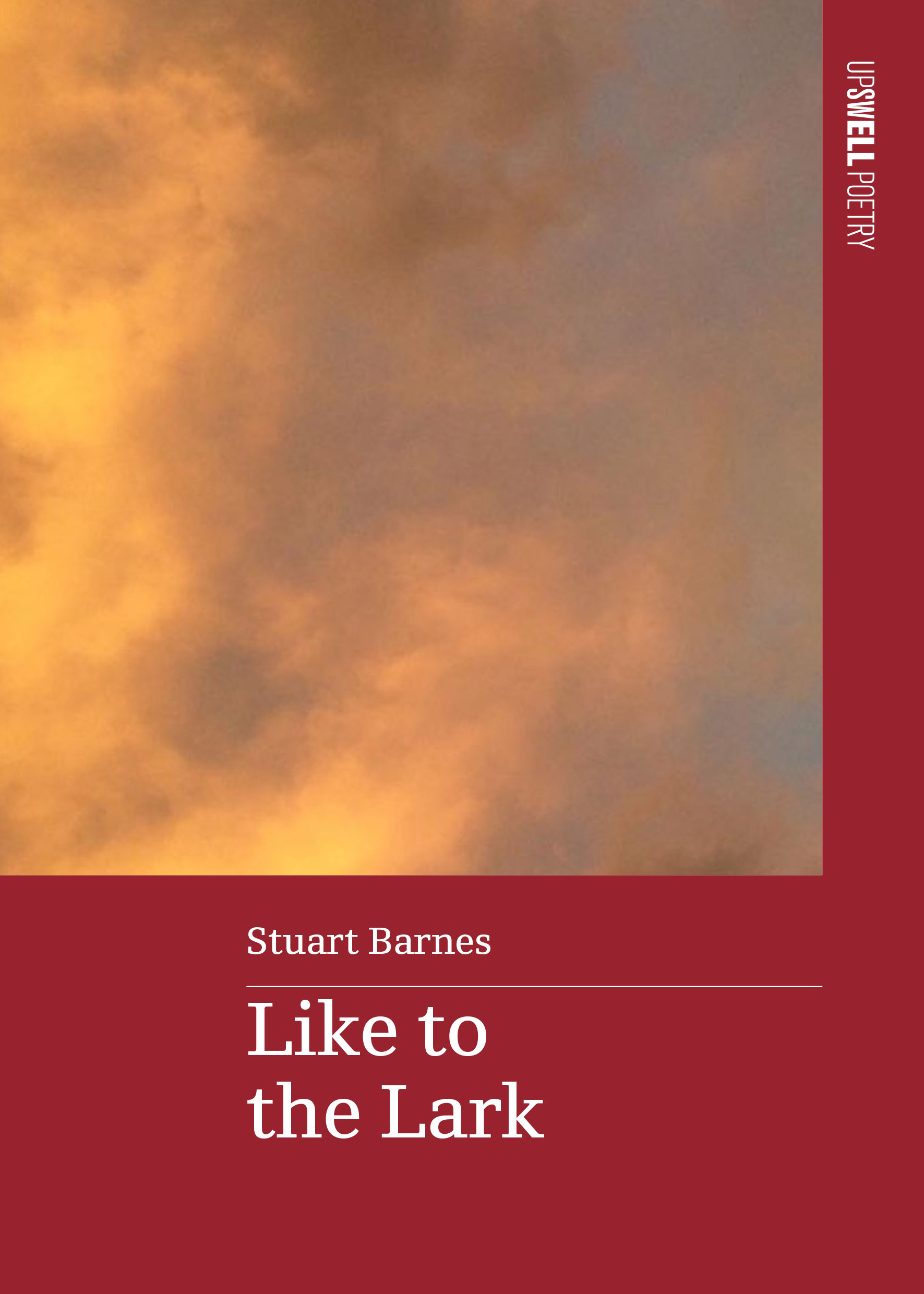
It has been six years since I first read Australian poet Stuart Barnes’ debut poetry collection, Glasshouses. I don’t know how many times I have recommended the book in the meantime—whenever someone asks for suggestions of contemporary poets doing original work with form, or someone inspired by pop music, his is the first name that comes to mind. And now, with his second collection, Like to the Lark, he is continuing to expand the idea of form, exploring what it can do and where it can carry him. Ever open to queering the expectations of rhythm and rhyme, it is always exhilarating to engage with his poems—so much so, in fact, that one might not immediately appreciate just how much sorrow, grief and anger has led to the shaping of some of these words.
 As with Glasshouses, Barnes is generous with notes acknowledging the poets, artists and resources with which he is in conversation in particular poems, but in this new collection he has also included a very informative section titled “Notes on Form” within which he talks about the forms he employs, including two of his own creation, and some of the relevant context and inspiration guiding his work. He opens by addressing what form means for him:
Like to the Lark’s working title was ‘Form & Function’, after Photek’s drum & bass record of the same name. Music and sound, form and transformation underpin the collection; its cornerstone is the sonnet (‘from Italian sonetto, “little song,” from Latin sonus “sound”’). ‘Form’, writes Felicity Plunkett, ‘is concerned with de- and re-arranging, working between what has gone and what is to come. It is about connection and generation.’ Form is Gwen Harwood’s ‘trellis’ and ‘fine pumpkins’. It is stave and symphony, wooden last and Ferragamo Rainbow Sandal, scaffold and Golden Gate Bridge. Every form flaunts its uniform, kaleidoscopic or otherwise.
Form, then, is not simply looking back to classic constructions. Even though Barnes’ first love and trusted space is the sonnet, he enthusiastically embraces both traditional and recent structural creations to erect the scaffolding within which he can seek to find expression.
Like to the Lark, which takes its name from Shakespeare’s “Sonnet 29,” opens and closes with ghazals that speak to the state of the world, in politics and nature. The poems in between often draw heavily on ecological imagery, but this is not imply that he believes poetry, especially in its formal variants, is necessarily bound to lofty romantic or natural themes. By contrast, he often delights in unlikely sources for his most traditional offerings. For example, he salvages material from consumer information for migraine and depression medication to craft sonnets (something he has done before) and engages in vigorous wordplay to create prose poems. Inspiration can be found in gritty pop culture motifs or a scroll through GRINDR. But such playful exercises mix with pieces that are, in turn, serious, bold, sentimental and vulnerable. As ever, the true power of Barnes’ poetry lies in the way form, subject matter and the influence of musicians and other poets intersect in his work.
Barnes has addressed life as a gay man and the reality of homophobia before, but Like to the Lark directly confronts issues that are not always welcome, even in queer poetry, such as the stigma of HIV/AIDS, grief and loss, and his personal experiences of rape. “Sestina: Rape” (which dispenses with the sestina’s traditional six end-words in favour of one word—rape—and words that are its true rhyme) is honest and angry: “No such thing as male rape / flared. No rape report, no rape / kit. When I spilt the pith of this rape / three sweethearts laughed in my face.” He admits that he bent the sestina’s strict six-word repetition pattern in an effort to try to desensitize himself to one especially painful word. It’s a practice he repeats with “Pain” and “Love” in a couple of other sestinas.
Given the intensity of emotion he wishes to express with respect to these difficult subjects, it is no surprise that the two original forms Barnes introduces in this collection, also appear in gay themed poems. The terse-set, a pun on the tercet, is composed of at least three tercets with a strict ABC rhyme, but each line is restricted to three syllables. The forced precision is playful but intense, ideal for the poems “Sketching Aids” and “Dinner with S. M. at Tandoori Den.” Both involve the same man, an ex-boyfriend, the first inspired by memories of their relationship in high school, the latter recounting a dinner years later, prior to his death from AIDS. The other new form, he calls a flashbang. This explosive, disorienting form appears in a poem called “Killing Bill or Whatever the Hell His Name Is (Battle Without Honour or Humanity),” that depicts the cruel reaction an HIV+ man receives from a lover. The first half erupts on the page (as best it can be reproduced here):
No one expected the second coming
out
—a burst rubber, a premature
BOOM!
PEP, you echoed. I’ll drive you to the local
clinic
first thing in the
morning.
His speechlessness a stun
grenade,
ignored calls
blast
mines. Minutes
later,
GRINDR’s miss-
iles.
Barnes writes that he was encouraged to invent new forms of his own through the experience of working with the duplex form created by American poet Jericho Brown. Described by Brown as “a ghazal that is also a sonnet that is also a blues poem,” the duplex seems a perfect fit for Barnes’ natural energies, allowing him plenty of room to riff on meanings and engage in punning and wordplay. Like to The Lark includes eight duplexes, with serious, fanciful and ecological themes. Four are voiced by native Australian plants such as Eremophila ‘Blue Horizon’ which opens:
I’ve always adored the deft desert,
its transformative blues and solitude.
I transform the bluesy solitude
of winter—I polish small gold trumpets
—gold tinted blue tongues polish off my trumpets
I raise my hands—lanceolate and blue.
New to the duplex myself, I really enjoyed these pieces. The other form that I particularly love in Barnes’ hands, is the terminal, an invention of Australian poet John Tranter that takes the end word of each line of a source poem to generate a new poetic creation. Here Barnes’ love for one of his key muses, Sylvia Plath, is reflected in two of his terminals. “The Pardoner” which borrows end-words and inspiration from her “The Jailer” is another poem addressing the poet’s experience with date rape, while the vivid “From the Morning” takes its end-words from Plath’s “The Swarm” and its title from a song by Nick Drake. Along with Plath and Drake, Barnes is, as usual, engaged in conversation with other poets including Shakespeare, Yeats, Auden and Gwen Harwood, and musicians including The Smiths, Kate Bush and, another important muse, The Cure’s Robert Smith.
The work of a mature and confident poet, Like to the Lark has me, as someone with little formal understanding of poetry, excited about the possibilities of—and less intimidated by—form. To the untrained reader and casual poet, it is easy to feel anxious about what makes a poem good, especially when caught between those who embrace and those disparage strict adherence to classical forms. But reading Stuart Barnes is proof that a poem can follow (or invent) rules without being unnecessarily opaque. Rather, poetry can be both fun and profound and, even better, inspire one to acquaint or reacquaint oneself with the inspirations that surface between (or at the end of) the lines.
Like to the Lark by Stuart Barnes is published by Upswell Publishing.
 roughghosts