
I want to clarify things for myself first. What I write now, and what I shall write, isn’t a novel or an autobiography and it isn’t addressed to anyone. It would be logical not to have it published as a book, but I don’t know. I shall let myself address itself as it desires, without rules, I will not change names to make myself think that I am writing a work of literature, and I shan’t cobble together a framework. I shall tell things as I told them to my young friend.
These are the directives the narrator of the first volume of Elias Khoury’s Children of the Ghetto sets for himself as he abandons his past literary ambitions to dedicate himself to his own story. But as he allows memory, investigation, and reflection to guide his pen, he is inadvertently, and unintentionally, moving toward something much grander even if the result, My Name is Adam is presented as an unedited collection of writings never intended for publication. In a post-dated fictional introduction, Khoury claims that these notebooks were passed on to him after the death of Adam Dannoun, a Palestinian born falafel seller living in New York City, by a mutual acquaintance, Sarang Lee, who was the young friend Adam refers to above and a student of Khoury’s. By his own admission, Adam himself was neither a friend nor an admirer of the famed Lebanese novelist. It was his contention that Khoury had “stolen” the stories of his friends and used them to write his epic novel Gate of the Sun which had then been turned into a movie. When Khoury comes to possess Adam’s texts—which include a series of attempted approaches to a novel he had hoped to write, along with an extended autobiographical effort that combines remembered detail with information gathered from a range of sources—his first inclination is to rework the material into a formal novel and pass it off as his own. At the last minute though, he decides to simply send Adam’s writing, as is, to his publisher in Beirut.
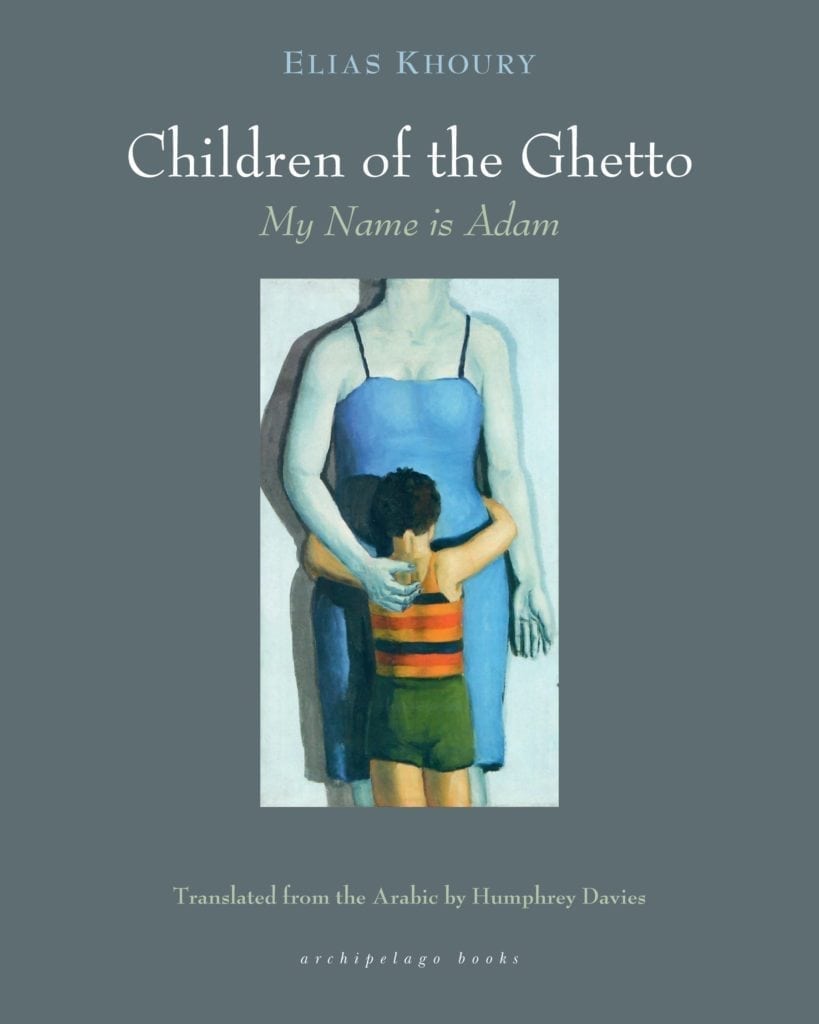 The resulting novel is a masterful, unconventional work, and a complex, multilayered meditation on the nature of memory—individual and collective—truth, and the search for meaning. Adam is a man trying to find himself within the history of his family and his own people. Although he is only in his fifties, he has already decided he wants to die, but first he needs to write his own story, not for posterity but for his own ends. He had long dreamed of writing a novel based on the tragic fate of seventh century Yemini poet Waddah al-Yaman, a man driven to a silent death, buried alive for love—an effort preserved in its formative stages in the earliest sections of My Name is Adam. But this task is set aside for his personally directed endeavour as the result of two events: an unexpected meeting with Blind Ma’moun, an important figure from his childhood who reveals an unsettling truth about his parents, and the screening of the film based on Gate of the Sun in which he sees the story of Dalia, a woman he once loved. He realizes that he must reclaim his story, and that of his friends, from the darkness of the past and the distortions of literary accounts.
I don’t like playing games with life. We aren’t heroes of novels that our fates and stories should be played around with like that. I’m not a child and I hate heroes. I’m just a man who has tried to live and has discovered the impossibility of doing so. I’m not saying life has no meaning, because meaning has no meaning and looking for it seems to be boring and trivial. I’m a man who’s lived all his life in the postponed and the temporary.
Yet, to resolve this suspended state, even if he is only writing toward his own death, the tale he will need to address is one that involves loss, historical tragedy, assumed identity, and ultimately, self-imposed exile from his homeland.
The central focus of Children of the Ghetto I: My Name is Adam is the brutal massacre at the city of Lydda in July 1948 and the trials of the months that followed when the remaining Palestinian survivors were forced to live in an area enclosed within barbed wire fences, described, by the Jewish Israeli soldiers guarding them, as the “ghetto.” Adam, thought to be the first child born within this space—hence his unconventional name—was an infant during this period, but he grew up as the child of a honoured martyr and carried with him a legacy born of the stories told to him by his mother and many others. Blind Ma’moun’s late revelation shatters the foundations of his identity (even if it was something he was never quite at ease with) and drives him to work his way back to lay bare the details of one of the many horrifying and disturbing incidents that accompanied the forced formation of the new Jewish state. When the IDF moved into Lydda—an ancient town recognized as the martyrdom site of a figure revered by Orthodox Christians and Muslims alike, Saint George or Al-Khadr—hundreds of residents were killed and 50,000 were forcibly displaced. But, that is just the beginning, Adam knows, recalling, Blind Ma’moun’s powerful New York University lecture some fifty years or so after the massacre:
“I shall not fall into the trap of saying that the Nakba was a unique historical event. History, ancient and modern, is a series of catastrophes afflicting numerous peoples. I might tell you the story of the corpses we had to collect from the alleyways, fields, and houses of Lydda, or I might tell you about the men who were executed in al-Tantoura and how the soldiers of Israel’s Alexandroni Brigade ordered the Palestinian men of the village to dig their own graves using their hands—but what benefit would there be in that? The issue isn’t just the crime of the expulsion of the Palestinians from their land, because a bigger crime followed—the crime of the imposition of silence on an entire people. . . the silence imposed by the victor on the vanquished through the power of the language of the Jewish victim, which dominated the world, meaning the West, following the crimes of the Second World War and the savagery of the Nazi Holocaust. No one listened to the cries of the Palestinians, who died and were dispossessed in silence. This is why literature came to forge a new language for the victim, or in other words to proclaim a literature of silence, and to take us, with Mahmoud Darwish, to ‘wherever the wind blows.’”
As a child of the Nakba, Adam believes that only by going back to his own origins can he hope to make sense of where he comes from and who he is, and begin to understand the relationships and choices that have shaped his life. His autobiographical journey may have started with a cynical attitude toward the notion of “meaning,” but as he fills the pages of his notebooks with memories and research, the more existential questions he asks, of himself and those he loved. It is not just the unspeakable pains his mother endured or the secrets that may have been kept from him that trouble his inquiry, he is also struck by the resilience and resourcefulness of the inhabitants of the Lydda ghetto who are forced to secure their own food and water, and share limited resources and accommodation. He wonders at the human capacity to keep living against the odds.
Because this a work that evokes the often unstructured gathering and reworking of remembered elements, “derived from the scraps of stories that I patch together with the glue of pain and arrange using the probabilities of memory,” Adam’s narrative is one that tends to circle back on itself, digging deeper, and going farther with each turn, while bringing up references to aspects of his youth and adult life that he continually places aside as “a story for later.” If that sounds frustrating, it is not, for the momentum is maintained as he pushes closer to a fuller picture of the extent of the massacre, the deprivation that ensued, and the deeply buried scars borne by those who survived. And, of course, in light of the current situation in Gaza, the parallels are clear even though, in 1948, the displaced still had a place to go and the escaped had a place to run to.
My Name is Adam is an imaginative, prescient novel that lives within the literary, artistic and historical threads of Palestinian history. Adam is likewise well-versed in Arabic and Israeli literature, while at the same time being aware of himself as both a protagonist and an insecure writer. “Am I merely a story, fashioned out of words?” he asks. He is much more. And his story, beyond his early years in the Lydda ghetto, will cross paths with that of the occupier—he will change his identity and pass as an Israeli Jew (“from the ghetto,” implying Warsaw) for a period of time, revealing his truth only for love. But that is, one would guess, primarily a tale for book two. In the meantime, as he is composing his autobiographical account, in wintery New York City, years after leaving the Middle East, he is writing to reframe a Palestinian identity that goes beyond simply making falafel and other authentic dishes. He is writing, he says, to forget. Perhaps he also is preparing to make peace with the past, but if so, that too awaits the second volume.
Children of the Ghetto I: My Name is Adam by Elias Khoury is translated from the Arabic by Humphrey Davies and published by Archipelago Books. Children of the Ghetto II: Star of the Sea will be released in November 2024.


I have a copy of this and I’m even more excited to read it after reading your review – Khoury is a wonderful writer. This volume got a UK publication and hopefully volume 2 will follow suit (though no sign of it yet).
LikeLiked by 1 person
It’s so good. Not a fast read due to the unusual mode of storytelling, but so effective. I haven’t started Book II yet though I have a review copy. It seems to adopt a third person narrative, but I’m keen to see how Adam’s youth and adulthood is explored after all of the references he’s made to it. The story is definitely incomplete with the first volume alone so I hope a UK release is forthcoming.
LikeLike
It sounds like essential reading for our time (for all times, likely). And how exciting to have just read the first volume and to know that the second is coming out soon.
BTW, yesterday I finally received an order I placed quite some time ago, for a book you recommended that might have had some similar themes (memory, belonging, truth?): Home by Andrea Tompa. (But, I’ve not read either, so they could be entirely different books about entirely different themes. heh)
LikeLiked by 1 person
Knowledge that the second volume was coming out was the push I needed to finally read Khoury after having meant to for years. And I’m so glad I did. I hope you enjoy Home which is different, of course, but also a book that deals with memory and, naturally, hone.
LikeLike