
Believe me, I know how dangerous it is to dream of Azorno. Believe me, I know how dangerous it is. I have known Azorno long enough to realize that it’s not dreams that come true.
Danish poet Inger Christensen, in her essay “It’s All Words,” insists that: “ . . . poems aren’t made out of experiences, or out of thoughts, ideas, or musings about anything. Poems are made out of words.” To some extent, the same may also apply to her fiction. Words are formed into sentences, and the accumulation of these sentences appears to describe a certain reality—the environment of the story—within which a character or characters exist. But the world into which the reader enters is not always what it seems. Consider the phenomenon of the unreliable narrator. Christensen’s Azorno might then be considered a novella with multiple unreliable narrators, one of whom, Sampel, is a famous author and one, Azorno, the main character in his latest novel, and five women—Katarina, Randi, Louise, Xenia, and Bet Sampel—each of whom insists, at some time or another, that they are the woman the main character meets on page eight. Oh, and did I mention that each of these women is pregnant, by the same man?
 What makes this clever experimental novella so engaging—and disorienting—is Christensen’s exploration of the interaction between language, perception, and reality, the primary theme driving all her writing. It is unclear who is actually narrating (and presumably writing) the novel we are reading. Phrases, descriptions, settings and circumstances continually repeat, evolving as the story unfolds, echoing through the apparent voices of multiple characters, the accounts they give, the letters they write to one another, and the experiences they have. Just when you think you know where you are, reality shifts again and you are forced to reorient yourself. Even the mysterious narrator does not seem to have control of the narrative:
How in the world to take control over the progression of a story that from the beginning has simply contained a concealed desire to communicate something that would catch their attention, but then turned out to be to their liking, to such an extent that they swallowed it raw and later had to throw up the indigestible remains and, in the company of friends and acquaintances, regard them as the consequences of an incomprehensible but harmless disease. In this way I quickly lost touch with my story, and what began on my part as a downright lie could easily slide toward something seriously close to the truth.
We have, then, a puzzle, a narrative nested within narratives, not exactly like a Russian doll but bound with a logic of its own. Although there is a conclusion reached at the end of this structured maze of mirrored, reflected, and misleading sentences, one would almost have to leave a trails of breadcrumbs and work back from end to beginning to sort out just how all the pieces, so scattered at the outset, eventually fall into place. The temptation at first reading is to attempt to keep track of the letters, conversations and accounts that build, one upon another, making note of the dates, places, objects and motifs that are layered one on top of another to try to determine exactly who the narrator is and which one of the characters is actually the author, especially if, as is sometimes suggested, another character’s voice is openly adopted by the writer to carry the narrative. It’s a slippery terrain. It may be best, perhaps, to simply let go and follow the story as it leads you through its own strange world, one that is simultaneously real and unreal.
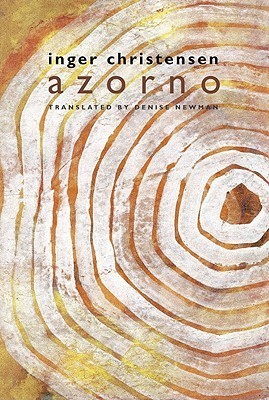
Azorno by Inger Christensen is translated from the Danish by Denise Newman and published by New Directions.

 roughghosts
What an apt cover illustration then! I don’t know if I would enjoy this or perhaps only admire it, as I would definitely have that urge to start note-taking under those circumstances, and, maybe, as you say, that’s not the right approach to fully appreciate it. How long is it?
LikeLike
It’s only 100 pages and best read in one or two sittings. And there is a solution at the end and I was really pulled into it as the story progressed, but it would not be for everyone I imagine. For an experimental novella though it is very accessible and fun.
LikeLike
I very much appreciate her work, and have read nearly everything she has written. But
“ . . . poems aren’t made out of experiences, or out of thoughts, ideas, or musings about anything. Poems are made out of words.” must take the prize for being so disingenuous. It was fashionable to say this sort of thing once. It was when materialism was shoving itself into the spotlight.
What are ‘words’ in themselves? Try to think of words without the mind’s interaction, and you get… nothing. Words are the pathways and synaptic firings between memory of experience, past encounter with their written and spoken meanings, and our immediate responses.
Ahem, sorry about that.
LikeLiked by 1 person