It may seem hard to imagine that a single poem (or sequence of poems) extending over 200 pages could become an instant hit upon publication, embraced by critics and the public alike, but that is exactly what happened when Danish poet Inger Christensen released what would become known as her masterwork, it, in 1969. What, you might wonder, does this simple pronoun, “it,” refer to. It might be simpler to ask what “it” does not refer to, for here it is simply the personal pronoun for the impersonal verb “to be”—as in “it is.” Danish, like English, necessitates such a construction, so this epic, moving as it does from the most basic elements, expanding in relation to one another, on into a world formed and named in its process of coming into being, and finally differentiated into individual, experiential existence, is a grand orchestral exploration of the nature of life. But it is also a piece that pulls you into to its rhythms, echoes and images. In Denmark it has become so iconic that sections have been set to music and certain lines from it have entered the daily lexicon.
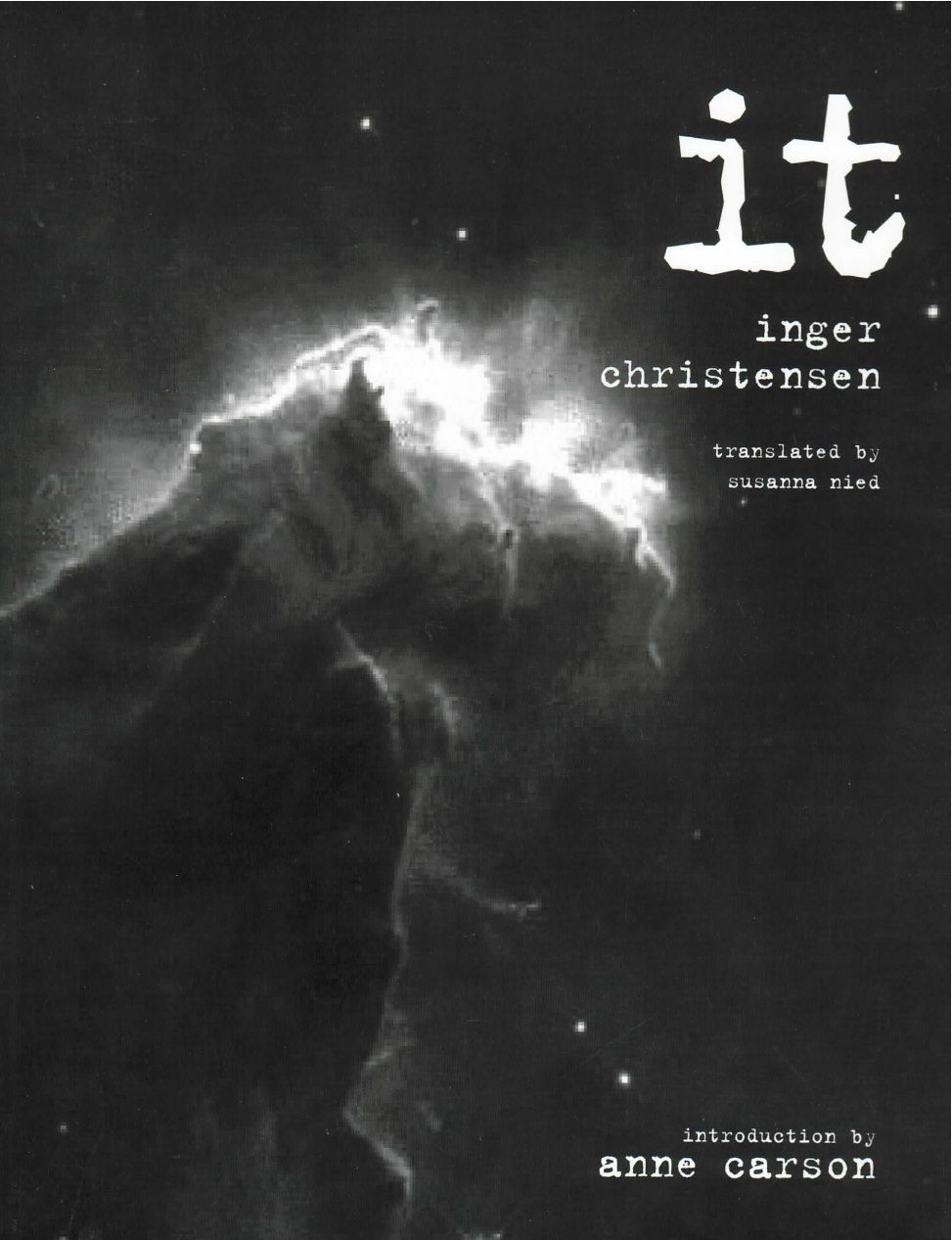 In her introduction to the 2006 English translation by Susanna Nied, poet Anne Carson views Christensen as a contemporary counterpart of Greek epic poet Hesiod combining elements of his hymn of creation, Theogyny, and his moral guide, Works and Days: “Her det [it] is at once a hymn of praise to reality and a scathing comment on how we make reality what it is. The dazzled and the didactic interfuse in det.” However, the requirement for a personal pronoun for “to be” which does not exist the same way in Greek, means that her cosmogony is also a cosmology—a condition made explicit in the structure and realization of it. In a 1970 article, “In the Beginning was the Flesh” (quoted by Carson but since made available in its entirety in the essay collection The Condition of Secrecy), Christensen talks about some of the thinkers and artists, including linguist Noam Chomsky, whose ideas contributed to the genesis of what she a began to realize would be a creation poem:
Then I started thinking a little about this sentence: “In the beginning was the Word . . . and the Word was made flesh,” I thought, what if we could think the unthinkable: that flesh could speak, that one cell could signal to another, so that the whole inarticulate world suddenly partook in the following impossible (to human awareness) experience: In the beginning was the flesh, and the flesh was made words . . .
To maintain a hold on the duality of these two paradoxical conditions, she started to write as if she wasn’t there, “as if it (“I”) were just a bit of flesh talking, a bit of protoplasm, acted as if I were just following along, while a language, a world, took shape.” She called this part, the opening of her work, the time before consciousness, PROLOGOS. However, although it first emerges as a pre-sentence entity, the poems that comprise this section follow a strict mathematical formula. Each line consists of 66 characters (in the original Danish) and there is one 66 line poem, two 33-line poems, three 22-line poems, six 11-line poems, eleven 6-line poems and so on until the final set of sixty-six single-line poems. (The translation is unable to preserve the character count of each line, but does keep the number of lines.) Thus, PROLOGOS sets the cosmological grounding for the poem to follow, moving from the most fundamental elements—beginning, of course, with “It. That’s it. That started it. It is. Goes on. Moves. Beyond. Becomes.”—and moving through abstract form and function, slowly evolving over time. Cosmic. Geological. Natural. Communal. And, finally, individual.
It’s come around. Come to stand on its own, confront itself. To disengage from the mass and stand out. It’s engaged in an evolution, shifted its stance, attained eminently engaging expression. Has pursued itself and accidentally found itself. As a natural result. Has come to stand for itself. And can begin by itself. To experiment with sets of freestanding, free-floating expressions. Occasionally with straight-swimming ones. Dreaming. In another world. To imply itself.
(from PROLOGOS)
The main body of the poem, LOGOS, explores the word as creative principle, or, as Christensen puts it: “The place where things are consciously staged, put into action, into relationship.” It contains three sections, STAGE, ACTION, and TEXT which are each further divided into eight subsections of eight poems each (Christensen, as ever, loves mathematical and musical structure). The inspiration for the subsections came from a work titled Præpositioners teori (A Theory of Prepositions) by Viggo Brøndal, an attempt to classify the words languages use to show relationship. She selected:
eight terms that could stay in a state of flux and at the same time give order to the indistinctiveness that a state of flux necessarily must produce: symmetry, transitivity, continuity, connectivity, variability, extension, integrity, and universality.
And thus, the stage was set, so to speak.
It is perhaps not surprising that the poems that comprise the first section, STAGE, are more varied in structure and form than those we will see later, order comes with time. Words are at work: “The words / created their own states of being / made a world out of ‘world.’” (STAGE, symmetries, 7), but it not a smooth operation. Here the imagery moves between descriptions of natural processes, and the intentional creation of sets, painted and varnished to “represent” mountains and scenery. A tension exists between what is and the way it can be expressed:
And when it’s said that words fly
(like birds that fill an end-
lessly vanishing space)
it’s probably to conceal the fact
that words are not one
with the world they describe.
Words do not have wings.
And neither do they flower nor will
but they take potential flowers
and set them in a garden
which they then set
in an image of a garden
in an image, etc.
The words stay where they are
while the world vanishes
This is a criticism of the way language is used
Because it’s a criticism of the way things are.(from STAGE, connectiveness, 1)
When “I” becomes part of the dynamic, the relationship between humans and language becomes more complex, and existential questions begin to arise. This first part also introduces a wide variety of images, motifs, and refrains that will recur throughout the work as a whole, providing a coherency to it when read and experienced (as it is meant to be) as a single long poem.
With ACTION and continuing on through TEXT, Christensen introduces more structure—employing both formal and experimental forms— to the poems within each subsection, adopting a consistent line count, verse pattern and rhyme, if relevant, for at least the majority of the eight poems (Susanna Nied’s award-winning translation preserves form and rhyme whenever possible), thus adding an ever-shifting musicality to the poetry. Thematically, the net she casts is wide, taking in the natural world (deserts, forests, gardens), human awareness (self-identity, hope, despair, sex, death), and community engagement (cities, hospitals, factories). Her vision encompasses the personal and the political, always returning to the power of language, the fundamental quality of the word, creating and mediating the world as we know it, alone and in relation to others:
A society can be so stone-hard
That it fuses into a block
A people can be so stone-hard
That life goes into shockAnd the heart is all in shadow
And the heart has almost stopped
Till some begin to build
A city as soft as a body(ACTION, symmetries, 8)
Throughout the ACTION section, one can see the influence of the 1960s on Christensen’s worldview and some of the imagery she employs. Of course, the more political and economic currents change, the more they stay the same. Poetry is timeless and this vibrant, life-affirming epic aims to reach beyond the limits of time—as does language—and as such, the third part, TEXT, offers poems that begin to speak to passion and meaning in living and loving. The tone, if not strictly prescriptive, carries positive energies. There are no promises that things will be easy or pain-free, but it is worth trying, even in a world that contains darkness and corruption.
After the fourth morning I seek
the lips’ speechless expressionAgain and again I stand completely
still so the wheel goes around and
there’s no cause for panicWhat you gave my thought is no-
where, with a body that’s a
gift to the earthWhat you gave me is pure rest / restlessness
My passion: to go further
(TEXT, variabilities, 4)
By the close of this section, the “I”, the speaker, has come to an understanding of her interconnectedness with the world, and all that it contains.
Then, finally, comes the EPILOGOS. Beginning and ending with “That’s it” this piece works its way through the many shades and facets of fear we encounter as embodied beings, to slowly embrace words as the very cells of the body, and ultimately find freedom in letting go:
Erotic attempts
when the body
in its blind
sexual
activity
strives to be invisible
the cells are words
when the body
is lost
in it all
and lost
as it is
persists
survives
surpasses
itself
and its limits
the cells are words(from EPILOGOS)
This is a work that, the deeper you get into it, benefits from longer, sustained reading sessions (especially if inclined, as I tend to be, to move slowly through a collection of poems). Although any one of the poems in this extended, structured sequence could stand on its own, they speak to one another, repeating and re-imagining phrases and imagery—a quality that tends to mark Christensen’s poetry and prose—so that the reading builds its own exhilarating momentum. it is an experience.
it by Inger Christensen is translated from the Danish by Susanna Nied with an Introduction by Anne Carson and published by New Directions.

 roughghosts
Carson seems an ideal candidate to write about a work like this. Your project is really taking on some momentum. You must be really enjoying the intricacies that emerge, the more you explore?
LikeLiked by 1 person
I had expected this work to be especially demanding given its length, but that was not my experience. I am now drawing close to the last few books, mostly poetry, available in English, but it has been rewarding.
LikeLike