
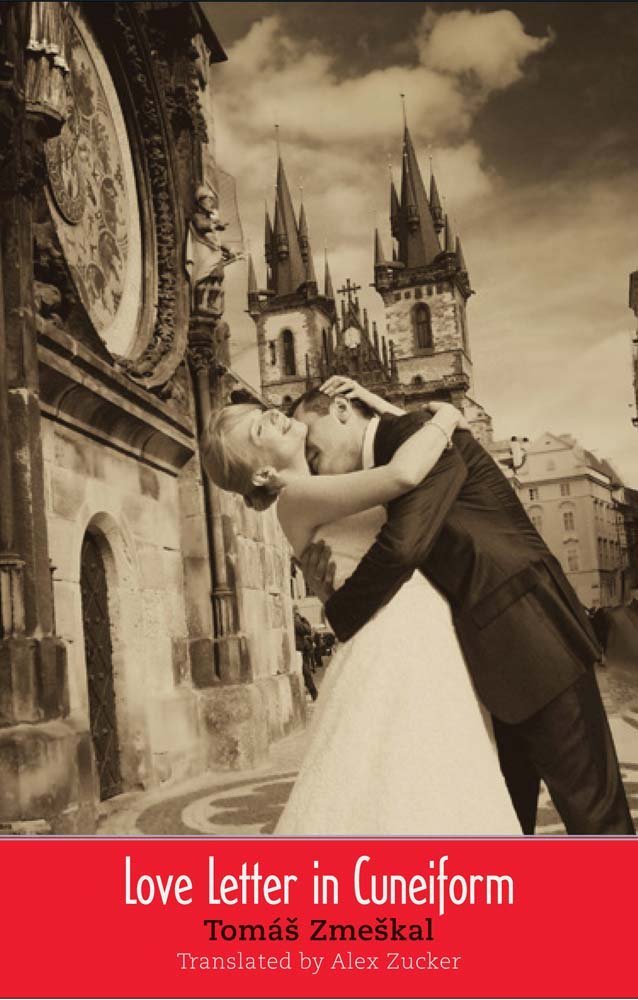
The novel begins with a wedding.
Alice and Maximilian exchanged rings and kisses, and signed a document confirming that the state of matrimony was primarily a contractual arrangement, which at the moment was of course the last thing on the newlyweds’ minds. After the ceremony, the priest invited the wedding party to the sacristy. Now, whether they liked it or not, Alice and Maximilian were on their own in the world. They answered everyone’s questions, chatting about the declining quality of sacramental wine under the communist regime. Alice joked and laughed with her friends, while Maximilian drank a toast with a bottle of slivovice, which, as usual on occasions like these, somebody suddenly seemed to pull out of nowhere, but through it all the metallic lace of their new situation slowly began to envelop them, closing in on them, fragment by fragment. Slit by slit the lacework net descended on them, enveloping them, protecting them, sealing them off.
Actually, there will be two weddings, because only the civil service later in Prague can be recognized by the law. But in the time between the two ceremonies, the couple and their friends and families gather in Alice’s parents’ apartment where her father’s friend, Dr. Antonin Lukavský, has a surprise in store. He has commissioned the eccentric pastry chef Marek Svoboda (who we will soon learn is also the doctor’s patient at the psychiatric hospital where he works) to prepare a cake for the festivities. And what a cake it turns out to be—an elaborate three-tiered marzipan castle of mythic proportions depicting, from top to bottom, the heavenly heights, the earthly realm, and a rich chocolate hell. So although it may be billed as a family sage, it’s clear from the start that Tomáš Zmeškal’s Love Letter in Cuneiform will be anything but ordinary.
 For one thing, Alice and Maximilian’s marriage is not the central focus and the “metallic lace” enveloping their new marriage does not prove very resilient because, after the birth of their son Kryštof, it unravels quickly. Rather, it is the marriage of Alice’s parents, Josef and Květa which runs the course of the novel, from the end of the second world war through to the early years of the 1990s, even if they themselves are separated and then estranged for most of those years. Love is a complicated affair for all, it seems. Meanwhile, as the family drama unfolds in a strange and sometimes disturbing fashion, Svoboda the pastry chef regales his doctor with fantastic visions that span both time and space. The result is an ambitious, layered work that is by turns tragic, philosophical, and absurd.
Zmeškal was born in Prague in 1966 to a Czech mother and a Congolese father. In 1987, he was granted permission to leave Czechoslovakia and travel to London, but when the Iron Curtain fell two years later, he chose to stay on in the UK to study English language and literature. Finally, in 1998, he decided to resettle in his home town where he soon began work on what would become his first novel. Following a lengthy search for a publisher, Love Letter in Cuneiform was finally released to widespread acclaim in 2008, with an English translation by Alex Zucker following in 2016. As Zucker notes in his Afterword, original reviewers responded to this unique, award-winning novel with efforts to place Zmeškal within the context of Czech post-Velvet Revolution literature. But that might be too limiting. Zucker argues that it also makes sense to look beyond the boundaries of the author’s homeland as well, indicating that Love Letter’s distinct labyrinthian construction and mythogenic qualities call to mind Borges, whereas an underlying “paranoia and slippery identity” may even suggest Philip K. Dick. It is, to be fair, a work that defies attempts at simple summaries, and is, in fact, perhaps better approached without an overly detailed road map.
The love story of structural engineer Josef Černý, lover of classical music and passionate devotee of the slide rule, and his wife Květa may be the central thrust of the novel, but the narrative does not proceed chronologically. Rather, it unfolds in fragmented pieces with shifting styles, forms, and voices. Letters of varied types, including a formal appeal to authorities to address a past crimes and lengthy romantic plea in cuneiform script, take up some of the key aspects of the story, while a forged letter does irreparable damage. But this is no epistolatory novel—the letters form only part of the picture and go only one way—nor does it confine itself to Josef, Květa, their daughter, grandson, and a few friends and extended family members. There is also the side story of the pastry chef, the most eccentric character in a cast of idiosyncratic individuals who not only terrifies a would-be thief with his bizarre marzipan creations, but entertains the good doctor with his detailed psychotic visions. He tells of a strange, manipulated existence in the Arizona desert, a journey to ancient Persia, and the assignment to repair a mysterious device in a Prague hundreds of years in the future. By bending expected storytelling conventions, vastly expanding the time scale, and playing with genre, Zmeškal crafts a tale that is not only heartbreaking and human, but that opens up plenty of space for questions of good and evil, immortality and death, belief and atheism, and of course, the endurability of love.
Josef first met Květa when he and his friend Hynek Jánský were at University during the war. Both men took a liking to her, but she chose Josef. Then, in the early years of their love affair, Josef was introduced to cuneiform through an odd coincidence. He learned in a class that his birthday, November 24, 1915, corresponded exactly with the date that Czech orientalist and linguist Bedřich Hrozný announced to a meeting of the German Oriental Society that he had deciphered the language of the ancient Hittites, a people who lived in Anatolia (present day Turkey and Syria) three thousand years ago. This sparks his interest in the curious wedge shaped script that originated in Mesopotamia but was adapted by other cultures, and the idea of solving the riddle of a previously unknown language. When he shares it with Květa, she tells him she is certain he could do the same. “She had a better imagination than I did,” he confesses, “she always has, and over time I learned not to oppose her using logical arguments and facts.” So it becomes his secret mission to crack some as yet untranslated language. Or at least learn to read cuneiform.
Josef and Květa marry after the war ends and welcome Alice, their first (and only) child, in 1950. But their old friend Hynek soon plots his revenge. The communist government has taken advantage of his “talents” of persuasion and punishment, and promoted him accordingly. He arranges for Josef’s arrest and ultimate imprisonment on obscure charges. As a result, Josef will be gone for the first ten years of his daughter’s life. Uncertain what to do, Květa turns to Hynek hoping he will help her free her husband and thus begins one of the most deeply disturbing aspects of the book—a prolonged and brutal relationship that, when it is later exposed, will drive Josef and Květa to part shortly after Alice’s wedding. Alice stays in her family apartment to raise her son after her own marriage ends , Josef spends most of his time at the rural house where he grew up, and Květa moves in with her aging Aunt Anna, an outspoken spinster with an opinion on everything. And life goes on, fraught with heartbreak, misunderstandings, and stubborn resolve. Alice is caught between her parents, while Josef forges an increasingly deep bond with his grandson. Finally, the Iron Curtain falls and a newly independent nation and its citizens are left to find their bearings in a world of new possibilities.
Some reviewers of the translated text have suggested that the novel loses its intensity in its later chapters, but it is perhaps more accurate to describe what occurs as a change in tone as threads of the story begin to converge. The central characters—Josef, Květa, Alice, and the seemingly indestructible Aunt Anna are all getting older. Kryštof, now an adult, has become accustomed to the countryside where he has spent so much time and has set his sights on marriage to a girl his grandfather insists on calling “the blonde.” But into the mix comes a distant cousin, Jíří (or George), a young man of Czech heritage, related to Aunt Anna but born abroad and raised in England, who arrives to experience his ancestral homeland now that the Iron Curtain has fallen. He stays with Alice and works in the city, but his regular letters to his sister offer his impressions of their ancestral nation and its peculiarities (not to mention the oddities of their relatives) often revealing more of the evolution of Czech society and the transition from communism to capitalism than he realizes. This is yet another layer that Zmeškal deftly weaves into his broader narrative tapestry.
Love Letter in Cuneiform is a novel that challenges and exceeds the norms of a multigenerational family saga at every opportunity. Josef and Květa’s love story has a grand, tragic arc to it that mirrors the kind of conditions—unfaithfulness, cruelty, misunderstanding, separation, failed attempts at reconciliation—that often tear lovers apart in mythological traditions. In an interview with Words Without Borders, Zmeškal confides: “I love old stories and myths, and I think that whatever changes in the world, we still live similar lives, though in different circumstances, of course.” That spirit comes through. This is a novel that is on one level very much bound to the history and politics of Czechoslovakia (as it was known from 1918 through 1992) through the second half of the twentieth century, while, on another level, it is a larger-than-life and often very funny tale of love, loss, wisdom, madness, and evil—though not necessarily in that order. Throughout, its unique energy is sustained in translation with Zucker’s careful, and at times creative, attention to the subtleties and playfulness of Zmeškal’s language.
Love Letter in Cuneiform by Tomáš Zmeškal is translated from the Czech by Alex Zucker and published by Yale University Press.


I just bailed on this book – could not connect with the characters or story at all. The marzipan wedding cake was the most interesting thing so I knew it was time to let go. Based on your review, I made the right choice 😁
LikeLiked by 1 person
Fair enough, I can appreciate that response. 🙂 I found it a much more absurd work than I had expected which was right up my alley.
LikeLike
On the other hand, at least there was cake?
LikeLiked by 1 person
A novel that begins with a wedding: now I’m trying to think, how often does that happen. It feels as though even that decision is designed to upset/overturn our expectations a little.
What brought this one into your stack just now? I looked it up, it’s not the easiest book to find. Of course. heheh
LikeLiked by 1 person
I bought it years ago on the strength of the translator, the title, and the uniqueness of a black Czech writer. But I decided I finally needed to get to it because I learned the translator was working on another of this author’s books—I think it’s his memoir about trying to seek out his African roots.
LikeLike