A catalogue of farewells: Every Time We Say Goodbye by Ivana Sajko

. . . I want to record all this, I want to write down that everything is all right, the end of the world is behind us anyway, no machine guns in sight, only the signs of another oncoming flood, it’s early, and at the other end of the train tracks she’s gradually woken up by the seagulls, and the room in which she opens her eyes looks different, in her slumber she may not even comprehend  what’s made this difference, she looks around and realises I’m no longer there, I’m gone at last. . .

The early hours of his journey to Berlin are intentionally cinematic: the protagonist of Ivana Sajko’s short but intense novel, Every Time We Say Goodbye, is on a train, notebook in hand, imagining his present circumstances—he has just left his long-time partner behind—as an echo of a scene from Lars von Trier’s film Europa, dramatic and tragic. He longs for a message to come through on his phone, but he knows it won’t, the relationship he has left was already as good as over after unravelling for a long time. As the hours and days pass he will have plenty of time for self-reflection, regret and heartache. He is on his way to the city where their romance began a decade earlier, hoping to try to start his life over again.
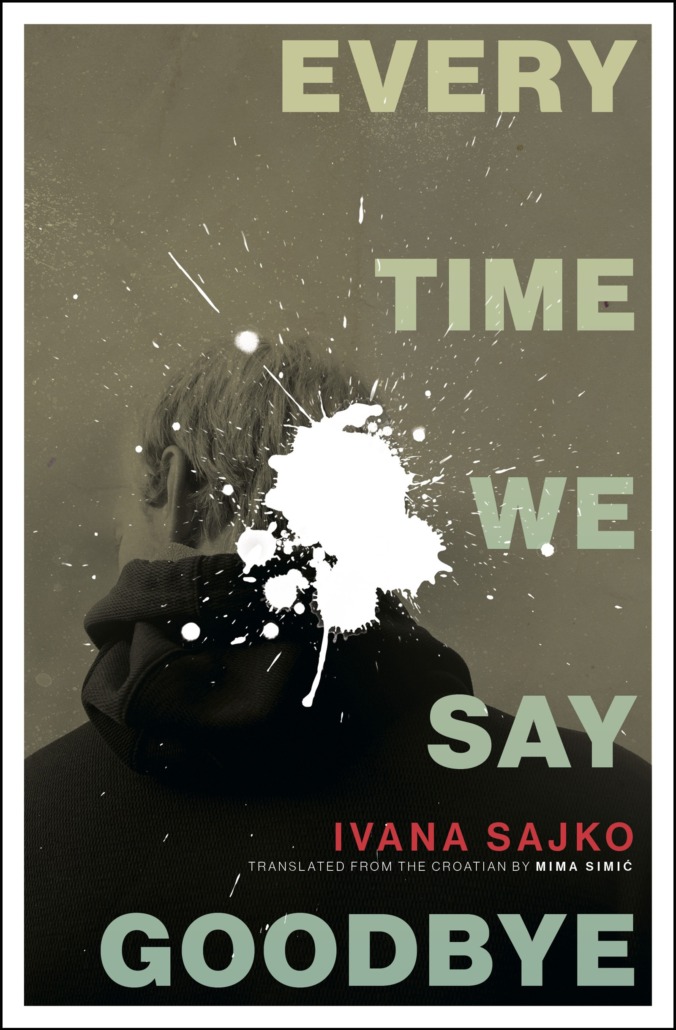
Unfolding in long unbroken sentences that stretch, section break to section break, for four, five, six pages or more, our narrator, a former journalist and self-described failed writer, will attempt to put together the broken pieces of his life, from childhood through to the painful dying days of the love he has lost, hoping that the words coursing through his mind will somehow find their way to the page and break the drought that has crippled him, professionally and emotionally for a long time. It is as if he is slowly and systematically acknowledging and letting go of the unfinished fragments of his past:

. . . every goodbye is a little death, each one clinging tightly to what it leaves behind, and each deserves its own photograph, its own legend, its own notebook. . .

Moving from the immediate observations and interactions that mark his journey, to experiences that shaped his near and distant past, his soliloquy sweeps through many personal, social, and political themes  as the miles and stations pass. He recalls his dysfunctional family, the father who left home only to meet a sorry, isolated end, the grinding  poverty that forced his mother to seek work in Germany, leaving her sons with their grandmother, and the once-close relationship he shared his brother, now lost to a small-time criminal existence somewhere, he’s not sure where. On a broader plane, war in the Balkans, the migrant crisis, economic upheavals destroying communities, the impact of the pandemic, and the question of his own failure to hold to a commitment to fight injustice all come in and out of view along the way.

The relentless nature of the narrative style heightens the emotional intensity of this novel, allowing for an in depth portrait of one man’s past and present to emerge in a relatively limited space. But there is, at the same time, a certain vagueness to the locations of the events that occur outside Germany. Beyond Berlin, where in his memories her protagonist maps out a network of named streets and intersections, Sajko avoids particularity in reference to exactly where  he lived when he was growing up or in the years immediately prior to his departure (we only know it was a coastal community). She says she prefers to write about Europe more generally rather than her native Croatia specifically. But the wars and displacements that have shaped recent Balkan history inevitably shaped her narrator’s younger life too. At one point his internal monologue vividly captures the visceral experience of life under military and psychological siege:

At first, a mass was compressed into the shape of a wall, and only later, in this wall’s shadow, did individual fates and names gradually become detectable, could we observe how the war disintegrated into its elementary particles, infiltrating homes and corners like the bubonic plague; nights and days fused into a constant half-sleep, the mattresses grew soggy with sweat and worry, small apartments constricted, their toxic air smothered the inhabitants, these conditions bred fear and infection, movement was curtailed, curfews were enforced, civil guards patrolled the streets; suffering was collective, yet on the elementary particle-level each person grappled with their own fate while they monitored everyone else and anyone could turn against anyone. . .

The unending sentences and deeply internalized nature of Sajko’s style not only grants Every Time We Say Goodbye its power, but also presents a special challenge for a translator. Mima Simić, who previously translated Sajko’s earlier Love Novel, has known the author for a long time and both are Croatian women living in Berlin, but she admits that capturing, in translation, the intensity of the content and form of her work can be a demanding experience. Nonetheless, the lengthy passages flow very smoothly, losing none of their impact. However, one quality that is lost in English is the specifically gendered nature of the narrative. Croatian, as a Slavic language, has three genders—masculine, feminine, and neuter—that shape the way one has to speak, but open the possibilities for how one can write. Sajko, who is also a playwright, chose to write this first person monologue in the masculine gender which, she admits, “altered the course  of the novel as it unfolded” and “helped me to step outside myself” and appreciate the way language “truly makes us who we are.” For her writer on a train, words will be, he hopes, a life line to new existence.

Every Time We Say Goodbye by Ivana Sajko is translated from the Croatian by Mima Simić and published by Biblioasis.
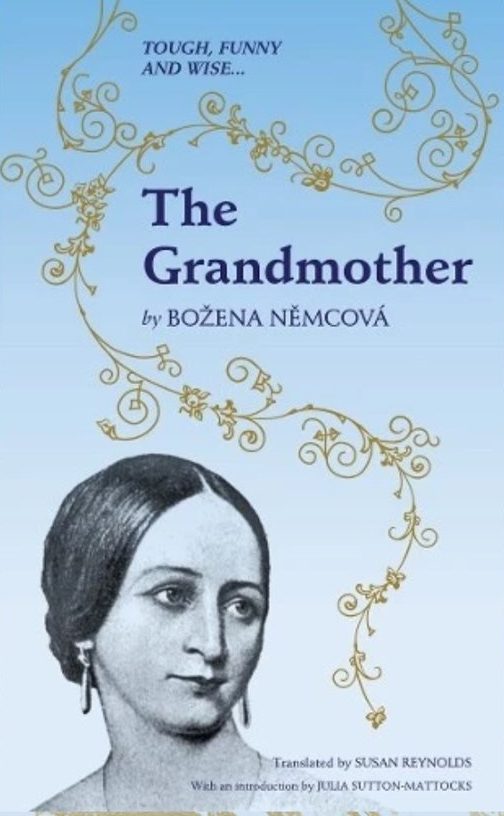
There goes a happy woman: The Grandmother by Božena Němcová

The premise of the novel regarded as a classic of nineteenth century Czech literature is as simple and unassuming as its title. An old woman enjoying a quiet life in a mountain village surrounded by friends receives news that her eldest daughter is returning to Bohemia from Vienna where she has lived for many years now that her German husband has taken on a position in the service of a princess who owns an estate in the area. However, because she will be alone with the children for the better part of the year while their father works in the capital, she invites her mother to join her at the rural residence where the family will now be living. The woman is somewhat reluctant to leave her home, but it is difficult to resist the opportunity to finally meet her four grandchildren and be part of their lives. And so, in the latter years of her life, the heroine of The Grandmother by Božena Němcová (1820?–1862), takes on a new role and title, earning love and respect that will extend far beyond her family.

When she first arrives in a wagon bearing her few possessions—spindle and spinning wheel, small painted chest, basket holding four chickens, and bundle with two kittens— the children, accustomed to life in the big city, are stunned by the sight of this simple woman in a peasant’s outfit and white kerchief:

The children stood as if frozen to the spot, and it was only at their mother’s command that they offered their rosy cheeks to Grandmother to kiss. They couldn’t get over the unfamiliarity; this was a grandmother different from all those they had seen. No wonder that they kept their eyes fixed on her! Wherever she stood, they walked around her, weighing her up from head to toe.

They examine her strange clothing and investigate her pockets, but in no time she has won their hearts and devotion, and she, in turn, soon makes herself at home. But she never compromises her daily routine, or abandons her habits and convictions. She is also warmly welcomed by others in the community and before long everyone has taken to  calling her Grandmother, only occasionally using her given name. They turn to her for advice, especially the young women, and although she is illiterate, she holds in her memory a wealth of stories, prayers, herbal remedies, and traditional recipes for seasonal celebrations.  She is the ideal Grandmother, but a gently subversive one, in her own modest way.

As Julia Sutton-Mattocks tells us in her introduction to this first English language translation of Němcova’s beloved tale, The Grandmother has often been described as a sentimental evocation of the author’s own rural childhood as there is some overlap in the names and circumstances of her history and her fictional creation. But, she suggests, although there is some value to that interpretation it is both reductive and complicated by the myths that have arisen around  Němcova’s life. Exceptionally well educated for a woman of her class and time, she was engaged in political and social concerns, and an early feminist with strong views on marriage and the value of free love. However, it is also important to understand the context within which she wrote. In the late eighteenth century, the Czech National Revival arose as a response to the increased Germanization and dismissal of Czech cultural and language that had occurred under the Hapsburg Emperors. This nationalist movement encouraged literature that celebrated Czech culture, history and legend. Although the Revival was falling out of favour by the time The Grandmother was composed in the 1850s, the novel clearly reflects Revivalist themes—romanticization of Bohemia and a deep interest (fueled by Němcova’s extensive ethnographic study) in folk festivals and traditional lore—and presents a portrait of a time that would have already seemed tinted with nostalgia.

The Grandmother is an episodic tale, with each chapter centred on an event, a visit, a holiday or feast celebration, or a story recounted by Grandmother or one of the other key characters. Outside of the immediate family there are a few significant subplots, like the troubled courtship of Kristla, the inn-keeper’s daughter, the affairs of the Princess and her charge, Countess Hortensie, and most tragically, the story of the wild woman Viktorka who lives in a mountain cave and wanders through the forest, long after she was apparently driven to madness in her youth.  But uniting it all is the old woman with her wisdoms, her idiosyncrasies, and her particular charm.

Long set in her ways, Grandmother holds fast to her old-fashioned peasant’s dress with the skirts, aprons and starched caps. She gets the children up each day and leads them through their prayers, but refuses to help them dress, having no patience with all the buttons and fasteners. She takes over the household tasks that interest her and leaves the rest to others. Never having seen a doctor in her life, she collects, purchases, and keeps an extensive array of herbs, and has an answer for any ailment that might arise. She is devout, with many a spiritual saying to share, but she holds her religious standards to herself alone, preferring to carry herself in all matters with a measure of humility and dignity.

Always conscious of her social class, her personal appeal frequently crosses the typical boundaries of status, often to the dismay of those who jealously guard such things. She is, for example, modestly at ease with the Princess who comes to stay at the manor each summer, even surprising, perhaps, her noble acquaintance with the famed military leaders she has chanced to meet in her lifetime. She met Emperor Joseph when she was a child, and later spent fifteen years in Silesia while her husband was serving in the King in the Prussian Army. But when her beloved Jiří died of a gunshot wound during the invasion of Poland, leaving her with three young children, she returned to Bohemia and raised her family with the help of her parents. Grandmother wanted to be home. She is strongly attached to her native land and language, but recognizes that not all will feel the same. She accepts her daughter’s German husband and when her younger daughter falls in love with a Croatian man she marvels at how the young are finding love across national boundaries, reflecting not only a certain openness that has come with age, but also her creator’s interpretation of a nationalist perspective that is evolving.

Although to contemporary readers, The Grandmother bears the hallmarks of solid, traditional storytelling that brings to life a rich rural culture marked with a seemingly endless parade of holidays and feast days (and at times strange customs), in its day it signaled a shift toward a more modern form of novel, securing its importance in Czech literature. It is familiar to almost anyone growing up in Czechia, and reading it I could only imagine that for many contemporary youth it might feel ponderous and old-fashioned as a required text, but coming to it from outside the culture and much later in life, I found it to be a remarkably well-paced, moving story with a most fascinating female writer behind it. For that matter, the fact that the classic Czech novel of the nineteenth century should be one written by a woman is not as unlikely as it may sound, because Czech women writers were welcomed and encouraged to add their voices to the literature that was being developed at the time. “To this end,” Sutton-Mattocks tells us, “women’s writing was promoted to such an extent that some Czech men writers even felt it was in their interests to publish under female pseudonyms.” Now that is something worth noting!

The Grandmother by Božena Němcová is translated from the Czech by Susan Reynolds, with an Introduction by Julia Sutton-Mattocks and published by Jantar Publishing.

And she ruled: Queen by Birgitta Trotzig

Through the darkness swept the beam. Capturing – releasing: capturing  – releasing. So deep the darkness when the light released its grip, like falling down through a well, darkness, no end; sleepers were struck by the light as if by a knife; again darkness, all the while they were on their way into darkness downward and downward, whirling, falling. Without pause the lighthouse beam swept across ever-new light-unstruck never-seen waves.

Queen, by Swedish writer Birgitta Trotzig (1929–2011) is an expansive exercise in grey: the landscape, the sea, the central characters all feature in shades of grey that run from the muted, milky white, to the sombre, murky black. But, amid all this greyness lies a tale of stark, mythic intensity that turns with its own tragic beauty. It is a love story, albeit a damaged one, in that the love that holds it together is both fierce and repressed, arising not with warmth but in agony, as if happiness is an unimagined possibility. And yet, as we read it we do hold out hope.

This luminous novel, vividly translated by Saskia Vogel, opens with the arrival of an odd-looking, child-like woman, a widow from America, who is bound for a farm in a village on the eastern coast of the county of Skåne in southern Sweden. It is November of 1930 and the Great Depression is spreading across the world. Exactly who this woman is, and how she is connected to the once-proud farm to which she has been sent, we will not know until later. But her arrival will prove pivotal for the two middle-aged siblings awaiting her appearance with curiosity and distrust.

The farm in question belongs to the Lindgren family. It had once been a large and prosperous venture but at the time this tale begins, at the close of the nineteenth century, it is slowly falling into disrepair, and its sprawling pastures are being sold off piece by piece.  Johan Lindgren, who inherited the thriving farm from his father, finds himself ill-suited to the task of caring for it. He is a man who “did not much love people, they were too heavy, something about them was unsurmountable to him.” Instead he loved animals, especially horses. Lacking the energy to dedicate himself to the work of the farm, he spirals into a cycle of selling assets and acquiring debt. His wife, never a strong personality, weakens and fades into the background after a postpartum illness that never fully fades. Thus it falls to the eldest child, Judit, to carry the load, in the field and in the home. She is stern and responsible, while her brother Albert is shy and sluggish, and Viktor, the youngest, is restless and untamed.

From an early age, Judit is aware that she bears the responsibility of caring for everyone around her: “She never had much time to be a child, but neither did she value such things: her soul had been old and mature from the start.” She rises under the burden, standing straight, tall, unbreakable. She earns the name Queen young and carries the crown boldly, even as her kingdom shrinks and decays around her. But there is a harsh emotional cost, planted early, when at the age of twelve she becomes surrogate mother/sister to her youngest brother Viktor, with whom she instantly bonds. Trotzig vividly depicts the moment everything shifts for her Queen. Sitting on the ground holding the newborn baby, Judit suddenly sense a fissure open in her world. She weeps and weeps, then stops. Her expression closes over:

But deep within that which is locked up the weeping continues. The gray features harden, the gaze becomes clear, dark, tearless. Deep down the weeping continues. Stifled it bores itself ever deeper downward, vanishing undermost in the deadest layer of earth underneath hidden crumblings, through stone chips down in the desiccated rock-hard packed stratum of the ground. There the weeping could no longer be heard, it had vanished from sight and sound, far down in the invisible, in dead earth it whimpered and sobbed.

Viktor, the infant she adores and raises as if he were her own, is a challenge. Their father takes an immediate and unreasonable dislike to the child, unleashing regular beatings on the boy. At school he causes trouble, and as he grows up he becomes more uncontrollable and wild. He does his military service but returns a drinker and gambler. He impregnates a couple of local girls. Finally, when he decides to head to America to build a life for himself, Judit greets the news with a mix of sadness and relief.

Viktor arrives in New York City in 1920, at a time when opportunities abound and he makes his way from one job to another, a journey that ultimately takes him through the southern US. But when economic pressures begin to build he finds his way back to New York. He will never return to Sweden. Meanwhile, back home, Judit and Albert struggle to keep what’s left of the farm going.  Well, more accurately, the Queen does. As the siblings age they are increasingly cut off from the rest of the local community, together viewed as an oddity. And then the stranger from America arrives.

Observed intimately and yet with a calculated distance—one longs to get beneath the surface, to understand what and how the characters are truly feeling if they even know themselves—the protagonists never speak directly. They belong, after all, to a place where silence reigns, where little is said, but rumours pass on the wind. The narrative sweeps across landscapes, rural and urban alike, with an existential heaviness, leaving a tapestry woven of soil, sand, and sea, of lives, limbs, and longings. Time is unforgiving. Years pass. Decades pass. Losses seem to mount. Yet, Trotzig continually reminds us to place our trust in language. Against a plot that is often sketched out with limited details, she intuitively knows when and how to amplify an emotional condition with intense vivid imagery. Life is not easy, but as her characters are pushed further into themselves and against one another, always at risk of becoming too hard or too weak and vulnerable, new cracks appear when one least expects and slowly, a little light seeps in.

In her Afterword, Norwegian writer Hanne Ørstavik tells how she came to know of Trotzig’s work and how it saw her through a difficult transitional period in her own writing, ultimately allowing her to write The Pastor. A brilliant novel of haunting landscape, with characters trying to come to terms with life and death in different ways, one can see the influence. It is exciting to know that Archipelago will be releasing at least three more of this enigmatic Swedish writer’s novels in the near future.

Queen by Birgitta Trotzig is translated from the Swedish by Saskia Vogel, with an Afterword by Hanne Ørstavik, translated by Martin Aitken, and published by Archipelago Books.