
Imagine a travelling fair in a small provincial town, complete with all of the expected food stalls and amusements. And there, amid the festivities, stands a small unassuming structure with a sign advertising it as a panoptikum—a wax museum. But when our narrator steps inside, there are no heroes or historical figures waiting for him. ‘What is this?’ he wonders:
But because I have handed over my copper coin at the entrance, I go to take a closer look at the wax figures lined up along the walls, and gradually I begin to recognise familiar faces . . . Yes, it’s as if I’ve seen them somewhere before . . .
But when? And where?
I linger in front of one or another of the wax figures and scour my memory. And this small fairground wax museum no longer seems quite so meaningless . . .
This museum of ordinary people is the perfect entry to the fictional world of Jewish Romanian writer Ludovic Bruckstein (1920–1988). The heroes and heroines of his short stories are the everyday folk who encounter life’s joys and sorrows in their own, often unexpected, ways. Strange, sad, or funny, the tales collected in Maybe Even Happiness—drawn from the last two decades or so of his life—owe their charm to the magic of a gifted storyteller.
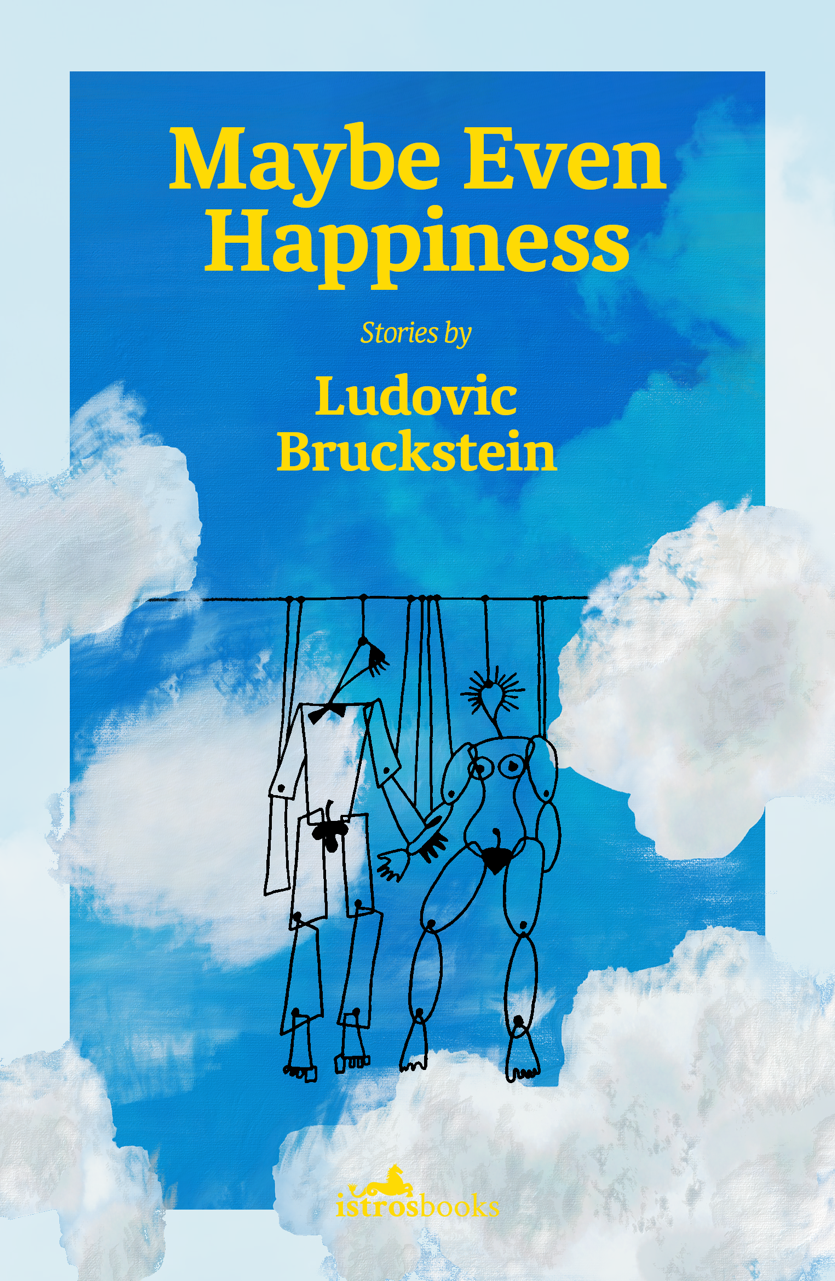 Born in Munkacs, Ukraine (then Czechoslovakia), Bruckstein grew up in Sighet, a town in the district of Maramures in Northern Transylvania, where his father owned a small factory. In 1944, the family was deported to Auschwitz, where Bruckstein was transferred on to Bergen-Belzen, followed by a series of forced labour camps. At the end of the war, he returned to Sighet to find that one brother was the only other member of his family to survive. Unable to leave Romania once the Iron Curtain fell, he began writing plays and then short stories. After he was finally able to emigrate to Israel in 1972, he continued to write fiction, publishing a number of novels, novellas and short story collections. The thirty-four stories in this volume are selected from several of these collections. Divided into three parts, 1967-1969, 1970-1979, and 1980-1987, each section of the book opens with a return to the small fair with its ramshackle panoptikum, and features quirky abstracted illustrations by the author’s son, Alfred M. Bruckstein.
With the odd angel, jester, or acrobat tossed in for good measure, these are the stories of tailors, office workers, engineers, and others often caught in dead-end jobs, loveless relationships, or solitary existences, who respond to the challenges life throws at them in their own, often hapless ways. Some fall into despondency, others are led astray by unrealistic ambition, while yet others find stubborn contentment within the confines of everyday reality. Some aren’t even really sure what they want. Bruckstein’s narrative style is straightforward and conversational, often playing on repetition, and his characters—all assigned distinctive features or tendencies— are treated with candid warmth and humour. Many of the stories are short, no more than a few pages, and very often the endings are tinged with a little irony, or even left unresolved. Like life itself.
There is a story, for example, about a man with a fondness for hats, as mark of honour and social standing, who purchases a new hat—“A soft, dark brown, very sober hat.” But as he makes his way home wearing it, he encounters several of his acquaintances who fail to acknowledge him, or even turn agitated expressions in his direction. Each time he wracks his brain to try to determine what he could have possibly done to deserve such treatment. And each time, an incident comes to mind. A mix of horror and anger begins to build in him until he reaches his house where, to his surprise, his wife does not even register that he is home. . . until he takes off his new hat.
One of the more whimsical tales, “The King’s Fool”, carries a deeper political commentary. Here a jester who has been floating, a disembodied soul, in Heaven for an unknown length of time (for what is time in Heaven?), becomes nostalgic for Earth and wishes to return to see how those who have followed in his profession are making out. With a gentle push he begins to float downwards (or is it upward, who can tell?) towards the earthly globe acquiring a skeleton, flesh, and skin, not to mention his jester’s regalia, along the way. He walks until he finds an inn where he orders himself a roast chicken and a glass of wine. Nothing seems changed, until he strikes up a conversation with a nondescript man eating soup. He wants to know what’s new and how His Majesty the King comports himself. The man laughs and tells him they haven’t had a king for a long time; they now have a president:
‘Then how is His Majesty your President? Good? Bad?’
‘Good or bad? He’s the same as every other president. . .’ Then, after casting a suspicious glance all around and assuring himself that nobody could overhear, he added, ‘And his lordship thinks that if he eats his fill, then the whole nation is full. . .’
‘But what does his fool tell him?’ asked the fool, intrigued.
‘His fool? What are you talking about?’ asked the citizen, in astonishment at the question.
‘What do you mean? The president’s fool, his jester. . .’
The citizen laughed in great amusement:
‘Our president doesn’t have a fool!’
The king’s fool stared at him, wide eyed with fright’
Through this, and a second encounter with a citizen who places all his faith an opposition which would, once it came into power, likely offer more of the same, the jester comes to realize that there is no one in this new system without questionable motivations who can give a president an honest read on a situation and be listened to (even if initially earning an angry kick to the backside for his trouble). His entire value as a trusted, if unlikely advisor would be null and void in this new world. Or worse, he would be locked up as a madman.
Elsewhere we meet a mild, unassuming middle-aged man who decides after failing to succeed in much, or satisfy anyone—his boss, his wife, his son—that he will commit suicide. Suddenly, the knowledge that he could be gone, maybe the next day or the day after, lifts the weight that he has carried for so many years and alters the way he sees the world. And, in spite of himself, his life starts to change. A personal no-deadline suicide pledge has made all the difference.
Then there’s the tailor who slaves away in his small shop eleven months of the year, living as frugally as he can, so that for one month he can return to his home town, spend generously, hobnob with all the “Important” people, and truly be “somebody.” Once a year. Or the young couple who have, through her job at the Anonymous Shareholding Company, been given the opportunity to stay at a five star hotel—”at a reduced rate, with payment in installments”—and they are so enamoured with their room, and the peace and quiet it offers, that they have no desire to venture outside it. Or, the middle-aged divorced, widowed, or otherwise single men and women, lonely and looking for love (or at least a little sex), who are not really sure what they want or are willing to give up to get it. Whatever it is.
Bruckstein’s stories have a definite fable-like quality to them, but his narrators and protagonists are recognizable, contemporary figures, navigating office jobs and relationships, with dreams and disappointments. And even though it would be misleading to imply that all of these tales have a positive undertone or happy ending, there is something very enjoyable about spending a little time in the company of a master storyteller when there is so much negative news in the world.
Maybe Even Happiness by Ludovic Bruckstein is translated from the Romanian by Alistair Ian Blyth and published by Istros Books.
 roughghosts