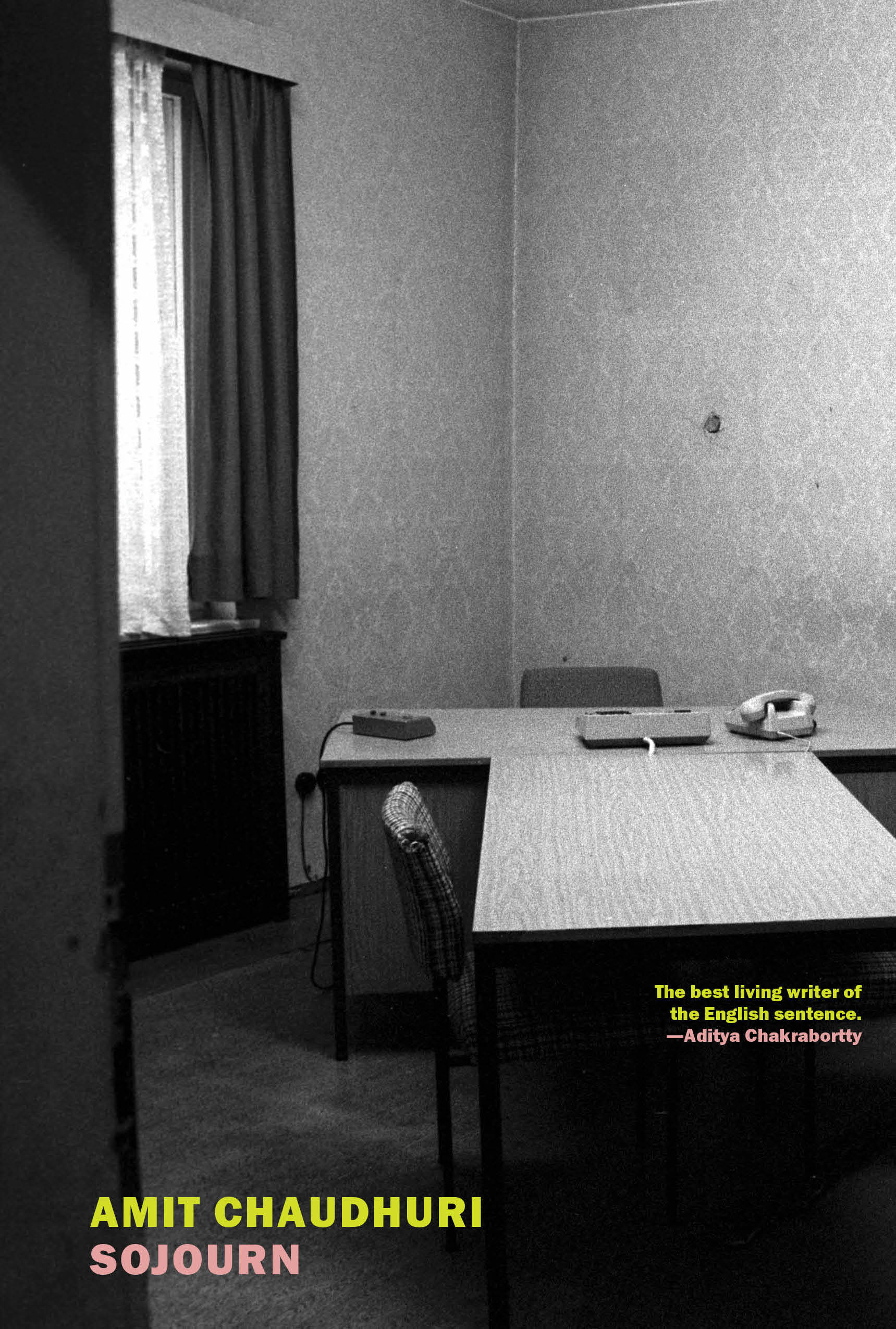
“Most of the things you ‘recognise’ you’ve never seen before” Sojourn by Amit Chaudhuri

From the opening passages of Amit Chaudhuri’s quiet, lugubrious novella Sojourn, one can already sense that his unnamed narrator, an Indian writer on a four month visiting professorship in Berlin, is slightly out of sync with the world around him, but it’s not clear if it’s simply the strangeness of his environment or some unease he carries with him. It’s not even his first visit to the city, but little seems familiar. He constantly requires directions and gets lost easily. There is, however, a subtle tension running through this lowkey narrative that gradually builds into something more disorienting in this portrait of a man’s shifting relationship to time and place as he enters mid-life.
The year is 2004, fifteen years after the fall of the Wall, but its shadow persists; former demarcation lines and vast areas not yet cleansed of their link to a dark past remain. Residents are inclined to point them out to visitors as if sharing the city’s history with a certain wistfulness, while the narrator tends to react to these spaces as if they hold a connection to an interruption of time in a city that now, after reunification, is still finding its footing.

At his first official function, just days after arriving, our protagonist meets Farqul, the self-styled Bangladeshi poet who appoints himself as his guide and guardian during the early weeks of his stay. Their conversations are peppered with snatches of Bangla. A journalist with Deutsche Welle, Farqul is an elusive yet ubiquitous figure—or perhaps, furtive, as the narrator speculates on their first encounter—who is a well-known exile and appears to be well-liked among members of Berlin’s immigrant community. He had emigrated to Germany in 1977, two years after being kicked out of Bangladesh for writing a blasphemous poem. Prior to leaving India he had spent a rather fractious interlude among the literati in Calcutta where he met and was apparently aided in his move to Berlin by none other than Gunther Grass. (The narrator simply conveys this information without question.) He is a generous, if eccentric, host. He not only shows the narrator around, but helps him get outfitted for the coming cold weather.

Farqul – in the excitement of being in your company – was a man who liked to share. He gave you food; he stood next to you in solidarity when you tried on jackets; he would have shared cigarettes and his flat if I’d been a smoker or needed a room; he might offer his woman. He didn’t create a boundary round himself, saying, ‘This is mine; not yours.’ As long as he was with you he was in a state of transport.

Yet when Farqul suddenly disappears without notice, the narrator flounders a little. Most of the acquaintances he makes through the university remain casual, but he does have the hint of an affair with a German woman who unexpectedly reaches out to him after having attended his inaugural lecture. She tells him she loves India (“I’m wary of Europeans who ‘love’ India – an old neurosis”) and their liaison, for what it’s worth, develops rather uncertainly. The narrator is often uneasy; he seems to be unwilling to exercise any agency. Rather, he tends to drift without commitment. As a result, those who come into his life with whom he may have grounds for connection—social, academic, romantic—have to be persistent if any kind of relationship is going to develop.

He also, for some reason, maintains a distance from the German language. His housekeeper speaks no English and the simple German phrases she uses with him he claims to understand only through her accompanying gestures. He seems content to exist in the city without being able to interpret the conversations around him—to revel in the meaning conveyed by the music of the language rather than its vocabulary or grammar:

They go on about the rebarbative sound German makes, but individual words and names have greater beauty – more history – than English can carry. I entered Hackescher Markt in my mind’s eye five or ten minutes before reaching there. ‘Friedrichstrasse’ had come up in a dream recently, as a port of arrival. Kristallnacht was transparent, broken. I woke up to words and didn’t bother with the language.

Certainly his sojourn in the city is necessarily brief, but his passivity is notable, as is his unwillingness to acknowledge how unmoored he is. That is, until he begins to become disoriented and experience blackouts. The narrative becomes more fragmented as he  loses himself navigating an unfolding layout of streets and network of train stations:

The trains emanate sorrow. Not like humans. The humans, in fact, are distracted and impatient. The trains aren’t alive in the way we understand the word. But they feel.

Domination of steel: steel smoke, steel sky.

This book has an intentionally unfinished feel owing to the fact that the narrator’s own mental state seems to be unravelling as his time in the city nears an end. We learn little about his earlier life because he admittedly feels disconnected from it himself, making for a mysterious, yet beautifully written tale of one man’s estranged sojourn in Berlin.

Sojourn by Amit Chaudhuri is published by New York Review Books.
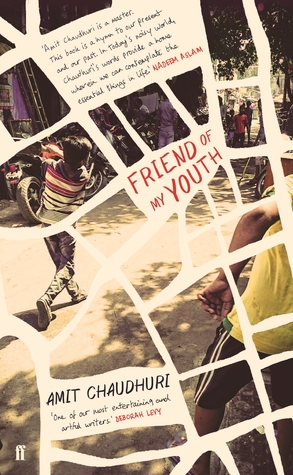
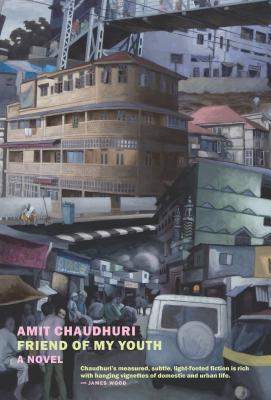
“The streets were never really mine”: Friend of My Youth by Amit Chaudhuri

Although he claims to feel no nostalgia, the narrator of Amit Chaudhuri’s most recent novel, Friend of My Youth, carries a wistful melancholy that can really be understood in no other way. It comes through in his discomfort and his attempt to articulate a mixed affection for and estrangement from the city in which he grew up—Bombay. Chaudhuri has woven a close line between his own life and the experiences and qualities he grants his characters before, but here he blurs it completely, even playfully. His protagonist is an author named Amit Chaudhuri, who is in the city to promote his latest release, The Immortals. If this is, on some level, a metafictional mechanism to reflect on the question of the relationship between an author and his narrator, it is exercised in such a light-handed, controlled, mildly self-deprecating manner, that it never risks becoming distracting or annoying. Chaudhuri is a restrained, thoughtful writer, and Friend of My Youth offers so much more. Set against the urban gridwork and landmarks of South Mumbai, a city, at the time, still recovering from the horror of the 2008 terrorist attack on the Taj Mahal Hotel, it is a quietly insistent meditation on the ways we try to make sense of our own personal and geographic histories over time.

From the beginning, the narrator confesses to an ambivalence toward his former hometown:

I feel a sense of purposelessness—is it the ennui of the book tour or book-related visit? Not entirely. No, it pertains to Bombay, to being returned to a city where one performed a function, reluctantly. Reluctance is fundamental. You don’t plunge into growing up; it happens in spite of you. Then, one day, it’s done: you’re ‘grown up’. You go away. Back now in the city of my growing up, there’s nothing more that can happen to me. I embrace a false busyness. I suppose I’m living life. Without necessarily meaning to. It doesn’t occur to me that the visit is part of my life. I believe I’ll resume life after it’s done.

But, although he has been back to the city many times in the decades since his family had moved back to their native Calcutta, and he himself had gone on to study and teach in the UK, there has always been one grounding constant—a friend from his school days, Ramu. On this occasion he learns that Ramu, whose life has been defined by drug addiction, is in intensive rehab and cannot be visited. Their friendship is strange, an attraction of opposites, one who would go on to achieve a degree of literary success and middle-class normalcy, the other troubled and stalled, unable to completely shake his demons, now in his fifties, still living in his family home with his sister. Theirs is an often awkward camaraderie, bound to a small geographical space in a city that has, over time, expanded exponentially beyond the confines of what has become known as South Mumbai. When Ramu is not there, Amit discovers that without this particular conduit to his past, whose eyes he had relied on, he is forced to encounter Bombay anew, even alone.

As the narrator traces his way through the city, a reflective uncertainty, a searching for words, underlines his thoughts. The prominent, well-known landmarks are laden with the hallmarks of his own idiosyncratic life history, from the restless eagerness to leave in adolescence and youth, to the regular returning, each opening shades of a city he knows he never really knew. How much, he wonders, was his inability to really see the city he grew up in rooted in a conviction that his origins as a Bengali prevented him and his family from ever full belonging, and encouraged his belief that his destiny lay elsewhere. If you feel, at heart, that you do not own a city, how can you truly see it?

So he is trying to make sense of his relationship to the city—and through that, to the shifting currents of memory and nostalgia that continue to haunt us all as we grow older. Ramu’s absence looms large. Who we believe we are is always, to some extent, measured and understood against the trajectories, real or imagined, of others.

I know I’ll see Ramu again. But it’s as if I won’t see him again. I’m thrown off-balance—but also surprised. I didn’t know I’d react like this. Ramu isn’t the only close friend I have. But it’s as if my sojourn in Bombay depends on him. ‘Depends’ is the wrong word: I haven’t come here because of him, to delve into his whereabouts. But the surprise I’ve mentioned is related to my astonishment at being here. ‘Astonishment’ denotes how you might start seeing things you hadn’t noticed earlier, but it could also mean becoming aware that you won’t see them again.  As I turn into Pherozeshah Mehta Road and then left into the long stretch of DN Road, I know I won’t see Bombay again. That is, I will see Bombay again, but not the Bombay I’m looking at now.

Toward the end of the book, two subsequent visits do bring Ramu back into Amit’s life, neither resolving nor further alienating his connection to the city. There is something oddly comforting in their unlikely location-specific friendship, one that speaks to the ineffable qualities of our own connections to the people and places that we leave, but can’t quite leave behind. This is a novel as much about loss and aging, as it is about recognizing that there are connections that perhaps we never really had, no matter how much time we spent with them.

I took this book to India with me, planning to read it in advance of my own recent visit to Bombay but, as it happened I did not open it until about a month after my return. Although familiarity with the city is by no means necessary, even a brief encounter will add an extra dimension because this is a novel so clearly linked to space. For those who know the city well, it will be potentially an even richer experience. I spent three days in the Fort area of South Bombay, visiting a few of the common tourist sites like Gateway of India and Marine Drive and attending several events at the Kala Ghoda Festival literary venue, the fabulous garden of the David Sassoon Library. I used Horniman Circle and Flora Fountain as guideposts and got lost in Churchgate, not realizing I was entering a train station (in my defense, the entry said “underpass” and I assumed I would avoid crossing one of the city’s notoriously congested roadways). All of these features or locations appear and it was fun to be able to immediately bring them to my imagination—mind you, without the emotional gravity with which Chaudhuri so effectively paints them.

Friend of My Youth by Amit Chaudhuri is published by Faber & Faber in the UK and New York Review of Books in North America.