
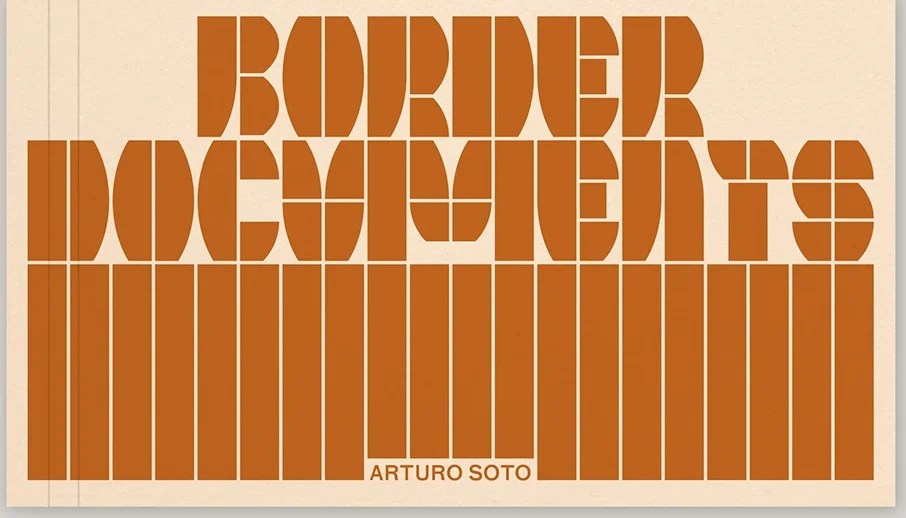
Considering the escalating tensions on the Mexico – US border, heightened even more under the present American administration, Mexican photographer and writer Arturo Soto’s new photo book, Border Documents, is an especially opportune release. The images belong to today; the texts to another time. The late fifties through the late seventies, to be exact. They reflect the environment in which his father grew up in the deeply entwined sister cities of Juárez, Mexico and El Paso, Texas. That world has been irrevocably altered by social and political forces over the past three or four decades, but this uniquely personal project sets out to attempt to “see” echoes of a remembered past in the urban landscape of today. The challenges arise not simply from the passage of time, but from the reputation, both earned and exaggerated, that this area now bears. As Soto points out in his Afterword:
People acquainted with Juárez, particularly those outside of Mexico, tend to know it for its infamies. The femicides of the late nineties cemented an infernal image of the city amply propagated in pop culture. A few years later, the ‘war on drugs’ further precipitated the erosion of civic life, which encouraged the media to focus its attention solely on the gruesome side of things. Such a narrow understanding renders everyday life invisible, putting it at risk of being lost. The past cannot be restored, but it can be conjured for insight to understand past and present lives.
The presentation of Border Documents is clean and spare. (See selections here.) Two-tone school photos of the senior Soto from the sixties and seventies line the inside of the front and back covers. Stark black and white photographs, taken in Ciudad Juárez and El Paso in 2016, appear as almost ghostly images of the streets and neighbourhoods of his childhood and youth. They are characterized by harsh light, sharp angles, lonely vistas. Parked cars are common, but few people are in sight (notably there is one where the photographer’s shadow stretches out from the lower right corner). By contrast, the accompanying vignettes are populated with a vivid cast of friends, classmates, grandmothers, siblings, parents and other relatives. The juxtaposition of the chronological collection of memories, anecdotes, and musings filled with life in all its shades of joy and discontent against contemporary images of the settings where they once took place demonstrates the complex reality of the environments in which we grow up and the degree to which they are both preserved and lost over time.
A case in point, border crossing. Apart from being a source of employment opportunities for Juárez residents, legal or not, El Paso was also a destination for amusements, such as a trip to the zoo, or, more commonly, a place to acquire goods and access services otherwise unavailable at home. An early memory from 1958 captures a child’s early impressions of the experience:
We took the transnational trolley to shop at JC Penney, everyone’s favorite store. The journey felt tediously long despite the short distance because of the long immigration line. They even forced some passengers to get vaccinated before letting them in. Overheard conversations had led me to believe things were much nicer on the other side, but everything looked more or less the same once we reached El Chuco. Over time, I found reference points that sparked my imagination along the route. Some of my favorites were the old customs building, the Spirit of St. Louis replica above a cantina and the clay figures of sleeping Mexicans flanking Don Marcos Flores’ house. A former municipal president, he had a gift shop close to the Santa Fe bridge. My grandma Esther cashed the money my aunt wired her from Los Angeles there. Don Marcos, always at the entrance, greeted her by name, which made me feel distinguished.
However, the photograph that faces the above memory depicts, from across the cracked pavement of West 4th Avenue, a plain, all-purpose structure with its available services painted right onto its front wall in English and Spanish—Copies, Fax, Foto, Income Tax, Public Notary, Medicare, Medicaid. Hard to picture such a destination sparking a child’s imagination today.
Some of the photographs captured appear to closely align with the accounts of the relative freedom afforded by a makeshift cement and brick playground in a barrio defined by specific streets and bridges. Perhaps these scenes are little changed with time. Of course, not every photo has a story, though each one has a location indicated. Likewise, not every story is matched to a photo. Soto’s father’s anecdotes carry enough humour, wisdom, and empathy to form vivid portraits on their own. He recalls, for example, a near spiritual crisis on the occasion of his First Communion with his sister Elsa in 1963. His mother was able to find him a second hand outfit and, with luck and a generous repayment plan, a most elegant new dress for Elsa. Simply clothing the outside, however, was not enough:
My peace of mind and the purity of my soul proved harder to secure. Some distant relatives were in town, and my cousin kissed me while playing a game. I felt very conflicted. This happened after my confession, and we had just been instructed on the consequences of receiving communion in a state of sin. I went back to the church and explained myself to the priest. He laughed and made me promise not to do it again but assigned me no penance. Liberated, I bought an orange from the market, feeling closer and closer to heaven with every slice I ate.
Life was not easy—along with the typical boyhood and adolescent adventures, and misadventures with friends and siblings, there was an alcoholic uncle, a father inclined to infidelity and other challenges—but the reflections Soto’s father shares show a distinct compassion or understanding, even if it is filtered through an adult’s appreciation of his younger self. One can see why his son who grew up listening to his stories would be inspired to encourage him to engage in this project even if some memories would be destined to transcend the physical spaces in which they were formed:
I keep a sad memory of the Cine Reforma. I watched there El Señor Doctor when Cantinflas was at the height of fame. Since overselling tickets was standard, I had to watch it on my feet. At some point, I thought I recognized someone a few rows ahead, but it wasn’t until the credits rolled that I made out my uncle Carmelo, a subject of constant gossip in our family. My dad used to say that his sister, the fearful Aunt Berta, would seize Carmelo’s salary. On Sundays, she would give him just enough for a newspaper, a shoeshine, and a movie ticket. I always thought my dad exaggerated the situation, but I confirmed my uncle’s capitulation was true that day.
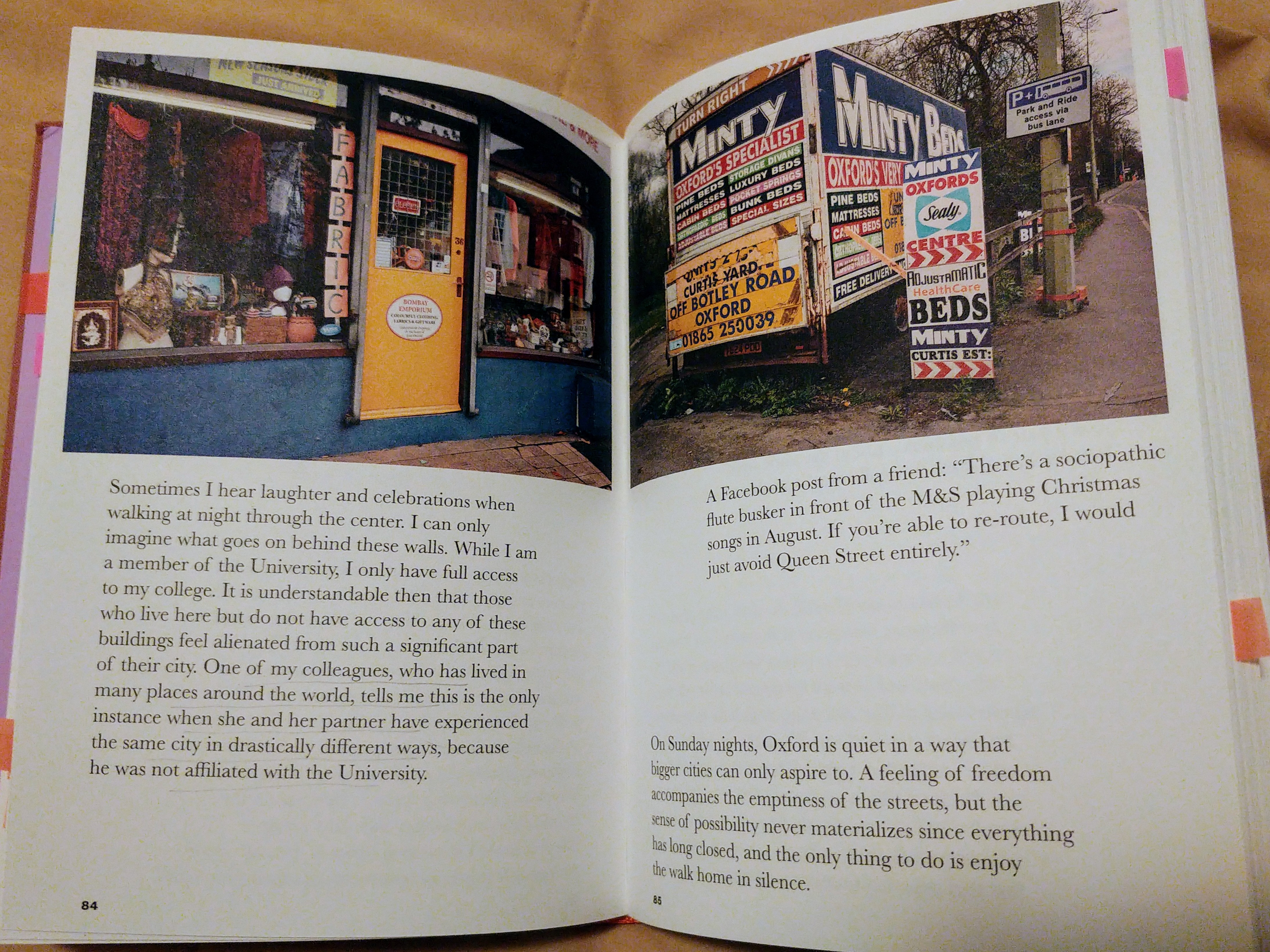
As in Arturo Soto’s earlier work, a strong thread of social commentary is woven into the relationship between images and commentary. He is drawn to challenging the existing assumptions about a place by focusing on the ordinary to expose the everyday reality overshadowed by the outsized image an urban centre may otherwise project. His last work, A Certain Logic of Expectations (see my review) was the outcome of his time spent studying for his PhD in Fine Art at Oxford University during the BREXIT years. But rather than focusing on the famed campus environment, he turned his camera on the other Oxford, the working class community that belongs to a geographically larger but psychologically and socially distinct space from the hallowed University environs. Of course, he views this world from the perspective of a Mexican outsider who can’t help but marvel at how relatively safe and clean even the “rough” parts of town feel. However, with this new collaborative project, he is exploring an urban environment he frequently visited while growing up in Mexico City, but that always felt at odds with the images his father’s anecdotes had conjured. In revisiting these streets, avenues and corners, Soto allows his camera to offer a visual counterpoint to the record of his father’s memories and the result is a very powerful—and personal—documentary that crosses borders, both temporal and political.
Border Documents by Arturo Soto is published by and available from Eriskay Connection.

 roughghosts