A few months ago, I was invited to write a response to a new novel by South African author Eben Venter for knaap.brief, a weekly queer newsletter that publishes work in Afrikaans and English. I have been sticking to my own private corner of the literary universe for the past few years, so this invitation was both unexpected and welcome. There was a time when I read a lot of South African literature—and I still have shelves full of books waiting—so I was familiar with the author and had heard some very good things about his latest work. This seemed a good opportunity to read the novel and write for an editor again. However, since the request was for a response rather than a formal review (though the approach was left to me), I allowed myself to bring the personal into my essay as this book, which is set primarily in the Eastern Cape Province, inevitably brought back both good and painful memories of time spent in the same region with a very dear friend who has been gone now for more than seven years (remembered here).
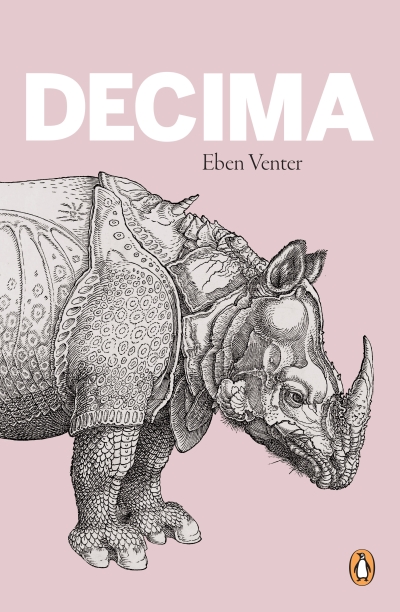 The novel, Decima, revolves around the disturbing historical and contemporary conditions threatening rhinoceros in general, and one aging female black rhino in particular. It is also the story of the love between a son and his mother, and about loss and grief. Skillfully balancing memoir, fiction, history, and natural science, Venter creates a story that lingers long in the imagination—and one that refuses to prioritize the human experience of the world. The perspective of Decima, the rhino cow at the centre of this tale, is essential and effectively evoked.
The animal is, as Venter imagines her, intelligent, sensitive, and alert. Solitary but not isolated from either her own kin or the other creatures with whom she shares her environment, she moves her massive bulk through the veld, seeking food, water, and shade. Decima’s reality is gently anthropomorphized, or rather, translated for a human audience.
My full response to this singular novel can be found here. (Also reproduced below if you’re unable to read it on the site.)
Decima by Eben Venter is published by Penguin Random House South Africa. An Afrikaans edition, translated by the author, is also available and both can be obtained outside South Africa as e-books.
As Boundaries Blur (published at Knaap.brief, 02/18/24)
Dear Wemar
Facing the empty page, I have been wondering for words for more than a week now.
I have been invited to respond to Decima, the latest novel by Eben Venter. Respond. I was told that it does not have to be in the form of a conventional review which, in a way, would be much easier. Reviews have an internal logic and form; reviews, at least in my practice, require a certain neutrality in language and tone. Ideally, a review is about the book, not the reviewer. I respond when I cannot help but stand in my own way and make “I” statements, and when it comes to this inventive and deeply affecting novel, I have a lot I want to try to say.
First off, I am not South African, but a number of years ago I did spend a few weeks in the country, primarily in the Eastern Cape, with one of the best friends I have ever been blessed to know—an incredibly gifted super-butch dyke who has been gone now for over seven years. It was Ulla who first introduced me to Eben Venter’s Trencherman. She would have just loved this book; she would have related to Decima. So this review is for Ulla. After all, it is a book about love, and a book about loss. I loved her like a sister, but I couldn’t save her life.
Decima is a slippery text. Memoir, fiction, metafiction, natural science, history and social commentary all fall into place in a fragmented yet fluid narrative. Fragmentary works are somewhat fashionable, but too often they are forced, as an author tries to shoehorn so many clever facts and ideas into some kind of cohesive whole. However, when they flow effortlessly, the writer in me gets excited—at once caught up in the story and marvelling at how the pieces fit together so naturally. Decima works because the author allows himself, or a faintly fictionalized version of himself, to hold the continuity of the narrative. He lives in Australia but is back in his native South Africa, staying with his aging mother at her home in a Port Elizabeth seniors complex, while he conducts research for the novel he intends to write about the fate of the rhinoceros. As he gathers information he travels to townships and nature reserves and national parks. His memories regularly take him back to his rural childhood, and briefly, in more recent years, to New York and Belgium. His historical inquiries take him to Nepal and to a shipwreck off the coast of Europe, and cast a harsh light on the colonial exploits of King Leopold II of Belgium and the big game expeditions of Theodore Roosevelt. Along the way, he steps aside as needed to invite fictional characters—researchers, natural medicine practitioners, kingpins and middlemen—to expose the network and the demand that fuels the trafficking of rhino horn.
That is just a very rough sketch of the kind of web Venter weaves, moving continuously from place to place, across time, from fiction to fact and back again. But central to it all is a rhinoceros cow, the eponymous Decima, orphaned as a young calf when her mother was killed, and now the aging matriarch of her own crash—her decedents—who live amid the rolling hills of the Eastern Cape’s Great Fish Nature Reserve. One of a dwindling number of critically endangered black rhinos, Diceros bicornis, she passes her time eating, sleeping, watching and waiting.
But we do not simply observe her, we inhabit her world. From the inside. And this is the true magic that sets this novel apart from any other eco-fiction I’ve read.
I will admit I was cautious when I learned that this was a narrative that slipped into the mind of a rhino. It’s always a dangerous game to attempt to adopt an animal-eye view (and Venter does focus on the rhino’s eye early on in his detailed imagining of the drowning of a frightened captive rhino torn from its Himalayan home, meant to be delivered as gift for Pope Leo X) but without Decima’s perspective we would really only have half of what is a very complex story. The animal is, as Venter imagines her, intelligent, sensitive, and alert. Solitary but not isolated from either her own kin or the other creatures with whom she shares her environment, she moves her massive bulk through the veld, seeking food, water, and shade. Decima’s reality is gently anthropomorphized, or rather, translated for a human audience. Her awareness of her surroundings, her ability to gather information from the scents she picks up in the breeze or left in the dung deposited by other members of her crash, and her attention to the shifting angle of the sun and the cycles of the moon reveal a rich inner existence. As the full moon nears, her anxiety grows. She knows that the greatest threat she and her kind face is from a kind of creature that is not native to her space and that the moon’s full force will leave no place to hide.
The complexity, the shades of grey, that emerge in this multifaceted tale lie, of course, entirely on the human side of the equation and the reach is wide, across continents and centuries. Venter wisely lets these factors arise without resorting to obvious moralizing. Some villains are clear, some well-meaning folk might risk being overzealous, and those tasked with the direct protection of threatened species know the obstacles they are up against. However, if it is somewhat daring to attempt to take a reader inside a wild animal’s mind, Venter also opens up the thoughts and motivations of two poachers, both from economically deprived backgrounds, who have their own reservations and fears about the dangerous task they agree to perform.
As the novel progresses, the boundaries between the author’s research, his memories, his relationship with his mother, the facts he has gathered and the fictional characters he has met or imagined into being, including Decima herself, blur. Tension builds as the events leading up to the inevitable encounter between poachers and rhino take centre stage. In the aftermath, the narrative falls back into the realm of what feels more solidly memoirish. That is, we return to the story of the narrator as author and son with a mother who is aging and alone.
On its own, Decima is an exceptionally impressive novel, one that is very difficult to let go of even weeks after one is finished. I hope it gets more attention outside South Africa—here in Canada it is only available as an e-book—but, at the same time, as a work that Venter composed in English (and self-translated into Afrikaans), it reads with a rich South African tone and flavour. Usually, a South African book written in or translated into English, then edited for publication in an international market can be linguistically neutered to the point where there’s not even a bakkie in sight. This is not the case here. And, on a more personal level, my reading experience, and my response the this book, has unleashed a flood of memories: the long bus trip from Cape Town to East London and back, an afternoon at Addo Elephant National Park where we were the object of fascination for a juvenile rooikat, and watching the sun burst into flame over the sour veld, night after night, with a friend who, in the end, could not outrun the black clouds that chased her. So, even if there is a qualitative difference between what I might call a response and a review, sometimes the boundaries between the two are not that clear after all.
Oh, and having had a glimpse of the world through Decima’s eyes, I’ll never think of the full moon the same way again.

 roughghosts