
I think I hear the dawn azan much earlier than it is supposed to sound. The world, spaced out, is speeding down some derelict highway in time. And long before my attic visions start, Shimo, I am thinking it is time that happens to people. We talk about having and saving and wasting it as if it is ours to work with, but really it is we who are time’s property. It molds and meddles with us, changes us without our knowing, so that one day we wake up with no idea who we are. And suddenly the life we’ve lived is no longer ours.
Youssef Rakha’s latest novel, his first composed in English, explores the remarkable, multi-dimensional life of a strong-willed, enigmatic woman, set against the tumultuous years of recent Egyptian history, from the mid-fifties through the January Revolution of 2011 and its aftermath. But to put it like that sounds too simple, too conventional, for the tale that The Dissenters unleashes. Not content to embark on a straightforward narrative (which would not be his style anyhow), Rakha has chosen to tell the story of Amna Hanim Abu Zahra—Nimo to her friends, Mouna to her husband and children—through the memories and hallucinatory visions of her eldest son Nour. In the wake of his mother’s death, his grief-tinged, ecstatic narrative unfolds in a series of letters to his estranged younger sister Shimo in California. He wishes to share with her the understanding of Mouna, their mother, that he has gained through the strange rift in the fabric of time that has allowed him, within the confines of the cramped attic of the their family home, to slip into her earlier existence, living, reliving or closely observing her experiences, even those from long before he was born.
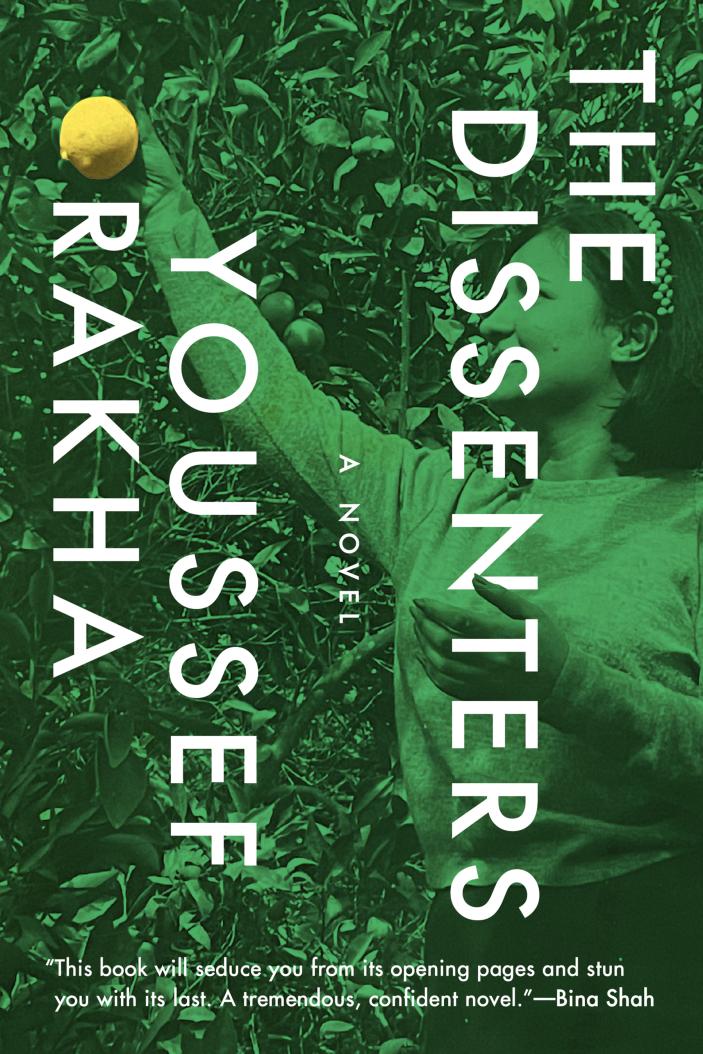 The Dissenters is, then, essentially a one-sided epistolatory novel consisting of three long letters with an interlude stolen from Mouna’s own notebook. Nour engages his sister directly and imagines her responses, but the apparent silence on her end provides no indication whether his dream-inspired insights will manage to heal, as he hopes, the unresolved rupture between mother and daughter that precipitated Shimo’s unannounced departure from Cairo years earlier. However, it would seem that this is not the only loose end Nour is attempting to tie up. He is a forty-five year-old journalist who returned home to live with his mother after his divorce in 2010, and there is much that he must resolve with respect to his own life and his relationship to his country.
Moving between more recent, post-revolution events to which Nour—and in one section Mouna herself—can speak directly, and the attic revelations that reach back further into the past, Rakha unwinds a tale that works with, and against, temporal framings to create a narrative that slowly builds to reveal a full, multi-dimensional portrait of a singular woman and the shifting political, social, and civic world around her. Nour’s earliest visions take him back to 1956 when his mother, a teenager still known as Amna, is deprived of a chance to take her baccalaureate exams and forced to marry a forty year-old man her family has selected. The awkward marriage will remain unconsummated and ultimately be dissolved, which allows young Amna the opportunity to finally pursue her dream of going to college.
There she will meet Amin, the young Communist lawyer who steals her heart and gives her the name “Mouna,” but their newfound joy is short-lived, as he is arrested and imprisoned a few short months after they move in together. The years of their separation, Nour tells his sister, see their mother exercising a new confidence and independence as she finishes school and enters the workforce. As a modern, stylish Egyptian woman, her friends and colleagues call her “Nimo.” When Amin is released from jail, a diminished and disillusioned man, she continues to work, even finding herself, for a time, acting as a secret agent. And then, at last, in 1969 Nour is born. By the time her second child, another boy, arrives, Mouna is again transformed. She has remade herself as a pious, middle-class Muslim mother.
The alternate thread of Nour’s correspondence with his sister, who is thirteen years younger than he is, explores more recent family matters including their parent’s comfortable estrangement, their brother Abid’s sadistic tendencies, and the circumstances that seem to have caused Shimo’s relationship with her mother to become strained and then permanently broken. But the primary focus is the dramatic impact that the 2011 revolution had on their mother. It seemed to awaken a long dormant political spirit in Mouna, giving her a new purpose and a new life. On February 11, the night Mubarak stepped down from power, Nour walks home from Tahrir Square and is distraught to find that she is not there. Immediately his mind goes to all manner of horrors, imagining her lying in a puddle on the sidewalk. And then, she appears, holding a flag, smartly dressed, her headscarf gone:
—You’re home early Mouna trills, the premillennial warmth of her voice restored.
Now my mother is smiling for real: an expression utterly unlike the baraka she used to project going about her devotional duties. I haven’t seen such peacefulness in her face since before Baba died. She stands waving her flag, then steps over the puddle that no longer shows her dead.
—I couldn’t stay home on a day like this, now, could I, she says. Besides, I just took the Metro to Kast El Ainy and walked to Tahrir. C’était incroyable, ya Nour. Hold your head high, you’re Egyptian, we chanted. But it wasn’t just a chant, you understand. It was real.
Soon, however, Mouna becomes aware of a strange and disturbing phenomenon. Something that others do not seem to register. Suddenly women are jumping off roofs and out of windows. She begins to investigate, finding a few others who also seem to be aware of this unusual trend. She even tries to recruit Nour, encouraging him to report on the situation. He doesn’t know what to make of the Jumpers, but she sees a truth in their tragedies. These ill-fated women become a mystery, and then an obsession, even a madness, that fuels Mouna’s final years as the promise of the revolution turns again to upheaval and violence.
This ambitious, hypnotic novel tells a story that is very intimate, turning at times erotic or violent, but it is about much more than the life of one woman. For one thing, the conscious incongruity of having a complex woman’s life recounted and, at times experienced, through the vessel of a man sets up an interesting dynamic, speaking as it does to the shifting roles and restrictions that impact women in Egyptian society from an unlikely angle. Of course, The Dissenters also addresses the price paid by anyone who defies political and social conventions, and highlights the challenges of navigating the forces of power for one’s own safety or (as in the case of Abid who joins the Secret Police) one’s advantage. Thus, Mouna’s story is much much larger than she is. As Nour confides to his sister:
But I’m no longer talking of my mother, am I. I’m talking of the Mother of the World. Surely you know that’s what Egypt is called, dear sister. At moments like this it seems as if Amna Abu Zahra is a fractal of our country, her biography a variation on its history, a version of the same story.
Finally, although Rakha is writing this novel in English—a language Nour and his sister share—his prose carries a strong Egyptian flavour. Many Arabic terms and expressions are woven into the text without comment or glossary (one can always look them up, mind you), and because Mouna was educated in French schools growing up and continued to use the language in her working years, French phrases regularly appear in her speech. This distinctive voice, in conjunction with the rhythmic flow of a narrative structure that blends the fantastical possibility of Nour’s visions with the reality of his own need for understanding and reconciliation, makes for a compelling and exceptionally rewarding read.
The Dissenters by Youssef Rakha is published by Graywolf Press.
 roughghosts