As we live by metaphors so we die: The Limit by Rosalind Belben

Ilario watched Anna waiting to die.

For months on end he is forced to sit beside a person whom he loves—very much—whose poor head must be filled with thoughts, and images of death.

Spare and unflinching in its depiction of an unconventional love and a most conventional death, Rosalind Belben’s The Limit presents the story of a middle-aged English woman, prematurely aged and ravaged by cancer, and her much younger Italian seaman husband, as the one gradually loses her ability to function and the other copes with his feelings of growing distaste and deepening love for his ailing wife. It is one of the strangest books I have ever read, but one that, beyond its often coarse, blunt descriptions of both lovemaking and illness—sex and death—lies a portrait of an unlikely love affair grounded in a shared sensibility that defied the many sharp contrasts between them and that will endure beyond the grave.
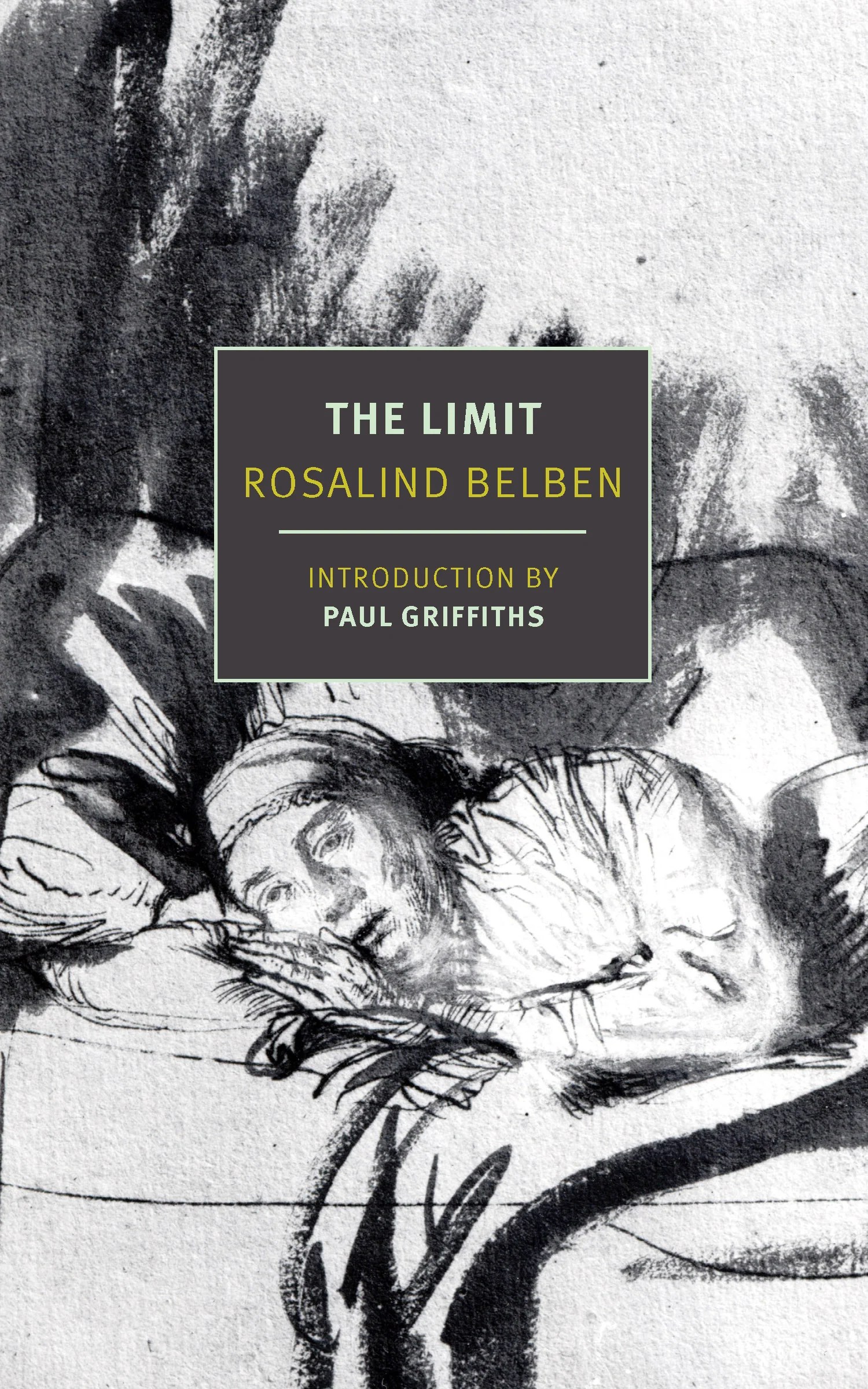
As Paul Griffiths notes in his helpful introduction, The Limit, Belben’s third book, first published in 1974, was a marked departure from her first two. Although other writers were, in the 1970s, determined to “shake” up the English novel, Belben’s writing “was like no other and remains startling half a century later.” Her narrative style is idiosyncratic. Temporality can be compressed or expanded in unexpected ways, syntax continually surprises, and sentences are often abruptly shortened or laced with a series of colons. Perspective shifts abruptly from third to first person, slipping in and out of Ilario’s or Anna’s thoughts, depending on the chapter. And the chapters themselves are thematic, with each theme repeated three (and in one case, four) times, but they do not follow a regular sequence, nor are they chronological but together they build in intensity and intimacy, in spite of, or perhaps because of, the often harsh bluntness of the narrative with its moments of ugliness and beauty.

Belben’s themes—Transmigration, Rapture, Grief, Sea-Change, Childhood, Future—all take their titles from definitions found in the Hamlyn Encyclopedia World Dictionary.  The Rapture chapters, for instance, are titled “The Carrying of a Person to Another Place or Sphere of Existence,” Grief is “A Cause or Occasion of Keen Distress or Sorrow,” Transmigration becomes “The Passage of a Soul at Death into Another Body.” Yet as lofty sounding as these chapters may sound, Anna and Ilario are not believers:

God had been disposed of long ago.

Neither she nor I acknowledged the divinity. Our faith lay in mankind, not in its mythical maker. She showed little sign of abdicating conviction for a god she spent her life denying. We agreed upon the possibility of a different reality: but that did not leave Anna any hope.

Thus she embarks into a dark journey, one which her husband must now help her navigate, but on dry land his seaman’s skills leave him feeling ill equipped. In their relationship, Ilario confesses, she had always directed and guided his way. “Without a wife, without her, I am nothing, I am useless. Was always useless.”

Anna’s side of the narrative is internalized. She is past conversation; she thinks of dying. Her memories carry her back to childhood and to earlier times in her marriage. But the man attending to her at home or sitting at her bedside in the hospital barely registers in the present. He is alone—save for the passing companionship of other husbands visiting their own sick wives and awkward interactions with Anna’s siblings. Yet as time passes, he feels closer than ever to the “elderly” woman slowly fading away. His wife.

The Limit is not an easy read: Ilario’s descriptions of Anna’s body, in their intimate moments and his later ministrations in her final days, are frank, at time uncomfortable, but oddly not without a certain tenderness. Meanwhile, Anna’s childhood memories hint at the pain and dark secrets in her respectable English family:

Protect me from my mother. Make my father beloved come alive.  Rise: my dog from the dead. But prayers are seldom if ever answered. Anna is born in 1922 (twenty years will pass before his birth): childhood proves unsatisfactory, an unsalutary experience: and to it the Anna grown up is irreversibly linked, to it pieces of her now are related: they are part of her score yet do not, repeat not, determine her whole works. Simply, her machinery lacked oil in the past. I hate my mother.

She revisits disturbing events from her youth, their lasting impact. When she meets Ilario, it is unsurprising that she is forty and still a virgin. Yet, it is the unlikely love that binds this odd couple together that makes this novella so intriguing.

One can imagine that in choosing a partner so different in age, culture, and class, Anna is freeing herself from the constraints of her family background. We don’t know enough about Ilario’s past to know what might have first attracted him to this plain, older woman. “An iron maiden. Forged in a landscape of snow.” But, scenes  drawn from their decade of marriage indicate strong mutual interests. They both harbour a love of travel and a love of the sea. Anna, before illness overtakes her, is a sturdy, adventurous woman,  unbothered when she and Ilario find themselves facing a man dying of leprosy in North Africa, nor does the threat of a tempest at sea frighten her. Quite opposite, in fact. The Sea-Change chapters each offer snapshots of their time together away from England, of their shared companionship in calm and in adversity, but the third such chapter is especially exhilarating. Ilario as a young captain, awakes to find his ship facing a life threatening storm at sea—all while his wife is onboard:

Ilario wished she could be spirited to landfall. He noticed a glittery expression: she adored the crisis, the whole situation. Not a clue did she have, la poverina, unreal in an unreal world. Addicted to unreal drama.

He assesses the heavy and unstable loads down in the hold. Orders them secured and secured again. Comforts his experienced bosun whom he knows well:

Fear not: soon we shall plough on through our appalling conditions, trusting a stability we in reality don’t possess. He smiles, loving his ship and his wife, his wife and his ship: Ilario takes heart. The tops of the waves already sprinkled the bridge: it could hardly be mere spray. But he relaxed, eating a marmalade sandwich.

Ilario’s love is steadfast.  Sometimes its strength even seems to surprise him. And as the Future chapters show, even as other adventures and women cross his path, no one can dislodge the place Anna continues to hold in his heart. Illness and death, dying seen from the inside and from the bedside, may be the central focus of this novella, but at heart it is a story that demonstrates just how inexplicable and enduring love can be, a work not soon forgotten.

The Limit by Rosalind Belben with an Introduction by Paul Griffiths is published by New York Review Books Classics.
You say you want a revolution? The Revolutionaries Try Again by Mauro Javier Cardenas

DROOL: I wish we could have gone to Stanford together, Leo.

MICROPHONE: I haven’t thought about you in years.

DROOL: We could’ve spiked our Who’s Most Pedantic with courses on phenomonlogy,  econometrics, non-retrogradable rhythms.

MICROPHINE: Only what end continues, pig.

DROOL: I would’ve been happier staying in Guayaquil with you and arguing with you about everything.

MICROPHONE:  Yet another half truth.

DROOL:  I’m sorry Leo I . . .

MICROPHONE: You really think you have to confess all this to me?

DROOL:  Everything’s implicit and not implicit.

MICROPHONE: Do you feel better now?

DROOL:  Momentarily. No.

MICROPHONE: How many times do you have to re-imagine a heart-felt reunion until it replaces  the memory of our paltry reunion?

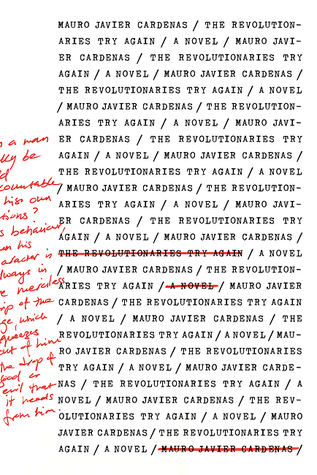
The attempt to write a review of Mauro Javier Cardenas’ debut novel, The Revolutionaries Try Again, in the aftermath of Donald Trump’s election as President of the United States, finds me a little at a loss for words. Fortunately, Cardenas is never at a loss for words. Words tumble forth, careen across the page, distort the lines between English and Spanish, (falling entirely into Spanish for two short chapters extolling, if titles be trusted, grandmotherly advice), and, sometimes, sometimes he offers snatches of dialogue, scripted even. This is a multi-voiced celebration of language, capturing in its best moments, the complicated mess of thoughts, emotions, and memories that course through the minds of his protagonists.

revolutionariesThe beating heart of The Revolutionaries lies in nostalgia for the idealism of youth, and the loss of faith in one’s ability to be a force for change. It is, essentially, about growing up, and the inevitable sadness that entails. Yet old dreams, it seems, die more readily for those who have the least to lose; whereas they crumble in agony for those who have little to begin with, and thus the most to lose.

The central character is Antonio. Upon graduation from an exclusive Jesuit-run boy’s school in Guayaquil, he had had the good fortune to be able to leave Ecuador, to study at Stanford University. In the US, he soon fell in love with avant-garde music and flirted with the notion of becoming a pianist. By the time we meet him he is working as a database analyst, projecting a life built on myths that draw on the appeal of his Latin American exoticism. He allows others to imagine he comes from a family of great wealth, and strains his credit cards to dress the part. He is living the migrant’s life of fantasy-meets-reality and it’s taking a toll:

I drink so I can bear talking to people, Antonio wrote. I acknowledge my conversational alcoholism. The more people converse with me, the more alcohol I am bound to imbibe. My liver, that most handsome of organs, was heard gossiping to my other organs about the absurdity of my social neurosis. Thank god my kidneys stood up for me and said shut up liver, you’re drunk again.

When his childhood friend Leopoldo calls him from Ecuador to report that there has been a coup and suggest that perhaps it is finally time for them to have a horse in the political game, Antonio heads home after twelve years away. What unfolds, more than productive action moving forward, is a replay of past memories, mediated by banter between the two friends, and featuring cameo appearances by other members of their former social group. They fall into using old nicknames, and rekindle past glories and grievances. Behind it all is a deep nostalgia for a time in their lives when their faith was grounded in a belief that they could make a difference in the world. As adolescents, under the guidance and inspiration of their beloved Father Villalba, the boys would visit the ill and catechize to the poor—they harboured a sense of being chosen, and Antonio even dreamed of becoming a priest for a while.

A third friend whose story plays out against those of Antonio and Leopoldo, is Rolando. He had not enjoyed the same relative financial advantages as the others, and together with his girlfriend Eva, he is struggling to broadcast a little reactionary radio program for better or worse. Their concerns are more immediate, the risks they take are greater, and even if the effect is small, they are actually trying to do something. But their relationship is complicated by unspoken losses—Rolando’s sister’s escape to America and Eva’s brother’s disappearance and death.

This is a novel that is looking back and stumbling forward at once. Little progress is made. That is the point and that is not the point. The realities of Ecuador’s political and economic uncertainties are an ever present backdrop, one that steps forth with particular brutality toward the end in the stories of the two female characters. But all of the main male characters seem to be mired in their own pasts, for all their vain talk of revolution. What rises to the surface is a profoundly human blend of nostalgia, loss, guilt, casual racism, sexism, and masculine insecurity. But there is also humour. This book is a startlingly infectious read.

To bring the story to life, Cardenas employs a wide range of narrative techniques from the modernist to the boldly experimental–slipping in and out of perspective and style as needed to keep a strong link to the interiority of most of his key characters. One chapter which follows Antonio’s thoughts upon his return to his mother’s home in Guayaquil, consists of a single sentence extending over twenty pages. Elsewhere, too, long sentences—interrupted by asides, imagined banter, or stretches of dialogue—are common. Here Antonio, preparing to meet with Leopoldo for the first time since his return, thinks back to their teenage games (Drool and Microphone were their respective nicknames):

… although Antonio doesn’t remember the exact content of the Who’s Most Pedantic exchanges by Don Alban’s cafeteria, he does remember that their game consisted of refuting each other about everything, spoofing the pompous language of the demagogues, priests, themselves, digressing manically about reforms they would enact to transform Ecuador—external debt, what is?—Leopoldo shaking Antonio’s hand whenever he won and declaring Always Above You, my friend, and if Leopoldo were a woman, Leopoldo would have been at ease in Antonio’s life in San Francisco because all of his friends in San Francisco had been women, as opposed to his former life at San Javier, where all his friends had been teenaged boys who expressed their affection by taunting each other with homophobic insults or misogynistic interpretations of the language between husband and wife—where’s your husband, Drool?—Microphone’s at home ironing my shirts, where else?—and if Leopoldo were a woman Antonio would be able to say, I’ve missed you, Leopoldo…

The tone is decidedly different when the narrative turns from Antonio, Leopoldo and their more privileged classmates, to focus on Rolando and Eva. Here the pace is even more frantic. Their protest is immediate—on radio airwaves and street corners. With rumours that El Loco, the flamboyant former President, Abdalá Bucaram, who ruled Ecuador for less than a year in the mid-90s, might be returning, Rolando reaches out to the poor and dispossessed on his makeshift radio station:

Ladies that’s the perfect segue to our contest about what would you like to call our interim president?—Puppet of the oligarchy—Very nice Doña Aurora—Pompous pajorreal—We’re warming up folks—Bestia con terno—Keep them coming comrades—Radio Nuevo Día / la radio al día—Up next how to cook a seco de chivo without the chivo—Baah—Speaking of chivos—El Loco is said to be returning from exile in Panamá—Who’s voting for that thief?—If you tell me you’re voting for Loco I’ll go loco—Has anyone seen the mansion of this leader of the poor?—Call now!

By engaging a range of narrative voices—at the personal and the socio-political level—visions of romantic idealism meet the harsh realities of class division. The shifts in perspective and energy keep The Revolutionaries Try Again moving at sharp pace, yet for all the sensation of being in freefall, Cardenas’ novel is, in fact, a tightly orchestrated achievement. In an interview published at Electric Lit, Cardenas shares a spreadsheet tracking the characters, conversations and narrative styles employed in one scene of the book. And this attention to detail at the formative level is what makes this cacophonous work succeed. Transitions between monologue and dialogue, present and past, are so smoothly handled that the reader is swept along with the sheer literary enthusiasm. But make no mistake, this is a novel that is as enjoyable to read as it is fundamentally melancholy and devastating at its very core.

The Revolutionaries Try Again is published by Coffee House Press.

Wrestling with Rhys: Reflections on reading Voyage in the Dark

I debated leaving this book undiscussed, unfinished even. It is not in my nature to write negative reviews but I am not certain my reaction to Voyage in the Dark, my selection for the Jean Rhys Reading Week, counts as negative as much as it stands as disappointed. I felt it was worthwhile looking into why this book and its author did not work for me as I had hoped it would, especially when, at one time, I did read and enjoy several of her books. If anything has changed, of course, it is me. I am not the same reader I was thirty years ago and, if there could have been a worse time for me to entertain the company of Voyage’s protagonist Anna Morgan, this past week would be hard to beat.

voyageWhen we meet Anna, the young narrator of Jean Rhys’ 1934 novel, she is eighteen, going on nineteen, and working as a chorus girl. Transplanted to England from her childhood home in the Caribbean, she paints a picture of a country that is bleak, cold, rainy and unwelcoming. She meets Walter Jeffries while she is on tour and once she is back in London they connect and initiate an affair. Anna takes this development in stride, as if it is both her due and her fate. She tolerates the sex and relies on the money he provides her to pay her board in a series of rooming houses and buy herself clothing. If her feelings are conflicted, it is difficult to tell. If anything she comes across as inordinately indifferent:

Of course, you get used to things, you get used to anything. It was as if I had always lived like that. Only sometimes, when I had got back home and was undressing to go to bed, I would think, ‘My God, this is a funny way to live. My God, how did this happen?’

Happiness is at best a vague notion, elusive when she vaguely tries to grasp at it. Only when Walter leaves for an extended business trip, severing their relationship upon his return, does Anna feel “smashed.” She makes attempts to reach out to him, to win him back, but what does she really miss? His arms or his money? It is hard to be certain.

Anna is always cold. She blames it on her origins in a hot climate, but the chill runs much deeper. In contrast to her persistent obsession with the monotony of her English surroundings, memories of her life in Dominica are presented in richer, more vivid terms. They are shot through with a melancholia that does not speak to childhood nostalgia alone–there is a sense that her emotions are complicated–but these passages allow for some of my favourite moments in the book:

All the way back in the taxi I was still thinking about home and when I got into bed I lay awake, thinking about it. About how sad the sun can be, especially in the afternoon, but in a different way from the sadness of cold places, quite different. And the way the bats fly out at sunset, two by two, very stately. And the smell of the store down on the Bay. (‘I’ll take four yards of the pink, please, Miss Jessie.’) And the smell of Francine – acrid sweet. And the hibiscus once – it was so red, so proud, and its long gold tongue hung out. It was so red that even the sky was just a background for it. And I can’t believe it’s dead….And the sound of rain on the galvanized-iron roof. How it would go on and on, thundering on the roof…

Rhys’ prose is strikingly spare and unaffected. It works well when she is looking back, or when the narrative occasionally falls into brief periods of stream of consciousness. The personality of secondary characters, if not necessarily sympathetic, are rendered with stronger brush strokes than that of the young woman at the centre of the narrative. And this is where the Voyage in the Dark becomes an effort for me as a reader.

Anna’s extraordinary passivity is a hallmark of the novel, as are the abrupt flashes of impatience and pride that periodically flare around others. She can be fickle, petulant and self indulgent. None of these factors are a problem, together or apart; what seems lacking is a context in which to understand her attitude and behaviour. For many readers I suspect this elusive quality of Anna’s character is where the interest and appeal lies. I found that despite moments when I was ready to re-evaluate my response to the text, Anna’s hollowness, apathy and vanity would test my patience again.

When she muses “I was thinking, ‘I’m nineteen and I’ve got to go on living and living and living,” her reflections echo a person struggling with depression, and that may be a fair interpretation, but it doesn’t hold weight for me in spite of passages like:

It’s funny when you feel as if you don’t want to do anything more in your life except to sleep, or else to lie without moving. That’s when you hear time sliding past you like water running.

Anna holds no responsibility for anything that has happened to her in her short life. She is miserable and expects everything to be handed to her. That’s fine, there are people like that and I do not expect characters to behave in manner that I approve of or to be likeable. But in modernist fiction I anticipate a measure of believability that, for some reason, is lacking for me here.

This is, I caution, my own idiosyncratic response to a book that I realize is beloved by many. I can understand how, in my early twenties, living with an as yet undiagnosed mood disorder, as an ostensibly female person keen to find female characters and writers that resonated with my own alien understanding of my gender identity; Jean Rhys’ novels and female characters could have held a strong appeal. From this vantage point in my 50s, I suspect it is more my experience with mental illness, personally and professionally, than my cross gendered path that account for my difficulty pulling myself through this short novel. And then, I am also mourning the suicide of a dear friend who battled a soul crushing depression for more than a year before finally taking matters into her own hands earlier this month. Against that backdrop, Anna’s persistent gloominess was, shall we say, cold comfort.