
I think, it doesn’t matter where I am, whether calm or with nerves shot to pieces, in the mountains, in towns, sleeping well or sleeping badly, it doesn’t matter, I am quite lost, wherever I am. I want to surrender. I wish to retire. I am tired. I’m not disappointed, but I can’t cast my mind any farther, I’d prefer to draw it in and keep it in a bag. (from “Exile”)
Rosalind Belben is not a writer who is inclined to make it easy for her readers or, rather, she does not entertain characters or narrators who are easily accessed, nor does she shy away from indirect, deliberately obtuse sentences that disregard grammatical niceties. Her protagonists can be blunt and unsparing in their observations, especially of themselves or other people, while at the same time possessing an uncanny eye for the intricacies of the natural world and an uncommon compassion for nonhuman life. But they often seem to become distracted on their way from one thought to another, making it difficult to follow exactly where they are going, understand where they coming from, and figure out where the lines between memories, dreams, and ordinary experience intersect.
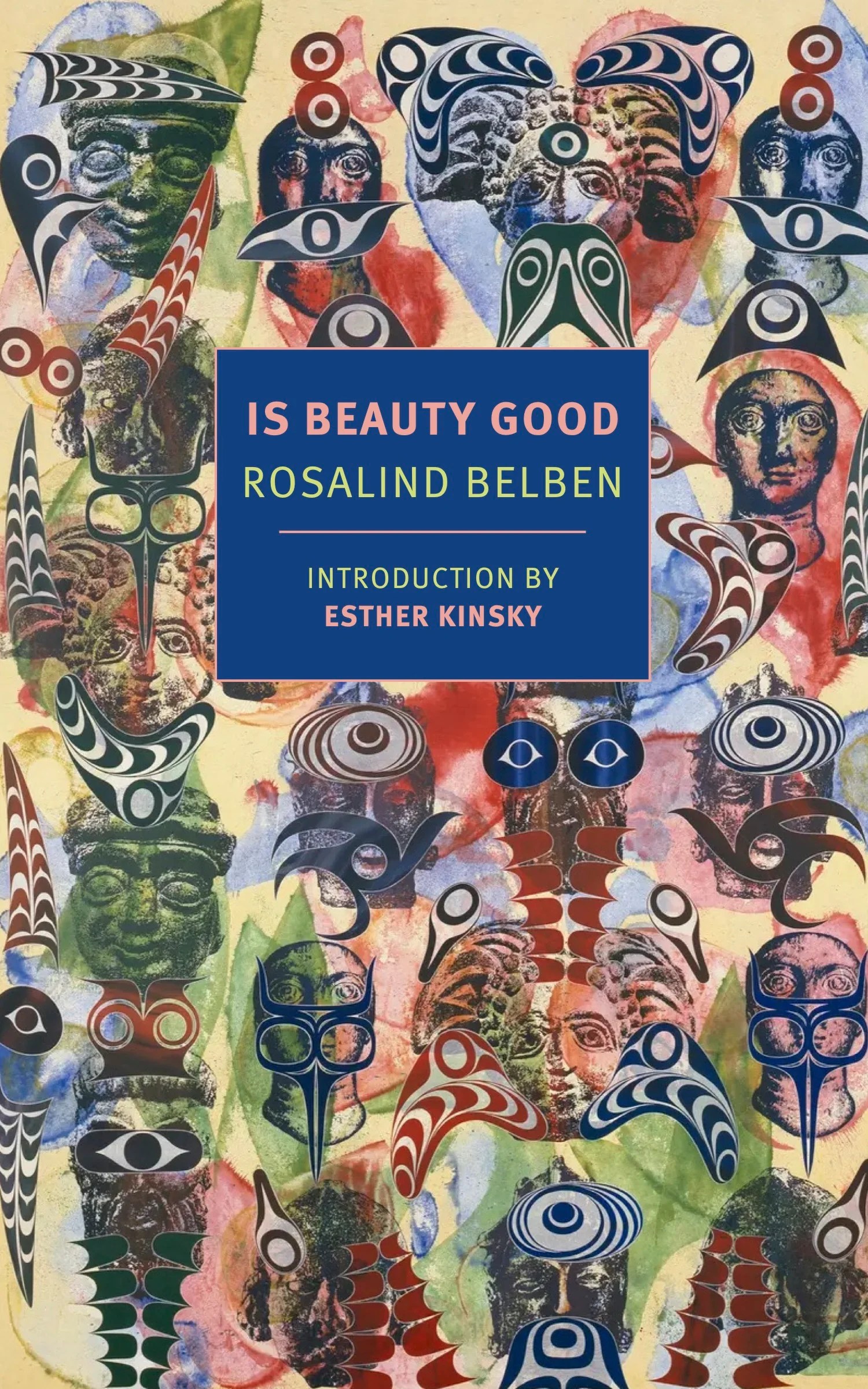
This is especially true with the latest of her books to be given a new lease on life, her 1989 novel, Is Beauty Good. Note the absence of a question mark. For a writer who, with her 1974 novel, The Limit, graphically explored the physical deterioration and decay of the body of a woman dying of cancer, “beauty” may seem an unlikely subject for her to centre. But, even in that work, a beautiful, if unconventional, love affair lay at the heart of the story. In Dreaming of Dead People (1979), her complicated narrator’s often bitter journey to embrace a self-styled spinsterhood, includes a vividly recounted idyllic detour. And, at the end of the day, beauty is a relative quality. Its potential goodness even more so.
For some of the characters who appear in the thirty-one short pieces that comprise this unconventional work of fiction—neither a typical collection of short stories nor a multi-voiced narrative revolving around a sequence of inter-related events—whether beauty is good does arise as a question or consideration, but more often the matter is less obvious, it may lurk around the edges or be conspicuous in its absence. The protagonist of the first entry, “The Nightmare” addresses the question most explicitly. Fritz is a guard at the Berlin Wall who wonders, in conversation with a friend, “what use is a sense of beauty, if it brings also a sense of ugliness and repulsion and distress when we’re faced with things which offend it?” Do we overlook the beauty inherent in that which repulses us? If that which is ugly or painful serves a warning, can beauty thought to be morally good? The ugliness of the environment he lives and works in exhausts him; would it not be better to be unburdened, free of notions of beauty, like the dreaming horse?
Each of the chapters opens cleanly, without introduction, and ends on a poetic note of some sort. Settings range from Berlin, to English gardens, to alpine landscapes, and most of the accounts that unfold are self-contained, if often fragmentary in nature, though a few will later resurface to be seen from another angle. Narrative form is varied as Belben employs both direct and indirect monologue to pull her characters’ thoughts and voices to the surface. Some passages unfold in a single, flowing sentence or unbroken paragraph, while others tend to the conversational, or feature choppy, short phrases as memories and observations tumble out atop one another. German words and expressions arise from time to time, without translation. And, in the third section of the book—“The Great White Worm: from the deaf man’s conversation book”—grammatical structure starts to break down altogether, with the increasing appearance of random capitalization and the frequent contraction of words to just few letters. The shifting style and form can require some concentration to follow the intended meaning, but it makes for a more dynamic and immersive reading experience.
If there is a quality that seems to unite the many characters we meet, the many minds we pass through in this polyphonic, multifaceted novel, it is one of longing tinged with melancholy. As if beauty, intangible and elusive, is an emotion. One that defies any concept of universality. Belben’s protagonists often seek some kind of release in nature, looking for solitude, escape or, like the three year-old hero of “The Insatiable Wheel” furiously peddling, alone on his tricycle, day after day, a mountain that will ever remain out of reach. There’s Olive in “Shooting the Bolt,” who can’t abide other women, who finds their understanding of what it means to be a woman somehow alien and distasteful. She forges her own natural company among berries and currants, tending them with care and ushering them toward their natural destinies in jams and puddings.
Olive is attached to the fruit cage, she spends hours on her hands and knees, weeding, or wading up to her armpits in the raspberry canes, rasp berries remind her of horses’ lips, soft fruit, apparently, is fierce and brave and stands up, she had only to wriggle her fingers through the wire of the old door, to reach the bolt, one isn’t truly locked in the fruit cage, but how, she thought, do I get out of being a woman, it is repugnant, she lay down in the last of the dew, the currants slowly subsided in the colander.
Elsewhere, there’s an outing with a ghostly Hölderlin, and several encounters with horse-angels. And dogs. Dogs appear frequently in the waking and dreaming lives of more than a few protagonists, and feature in their ethical and aesthetic reflections. “Florus” is a love letter to a beloved pet, now gone; the aging narrator of “Pfaueninsel” tells of caring for an equally aged boxer when its owners are away; and the ornery bedridden character gathering her thoughts in “The Shy Elt” reports regular dreams about dogs that she struggles to make sense of:
I drm! every knight. of dogs, puppies. Of doing sthing wrong with thm, I carry armfls of pups swhere & I have WORRY over thm. I have to carry armfls back, I wake before I cn, I’m not so clevr cn you explain tht, it wld be nice to have an inklg bec. I drm it too reg. for comfort, we’ve nevr had dgs. 0 to do with thm. Pups. I’d be happ. to drm of cats. And 3 nights ex 5 I have thm myself! Or I guess thats how they must be born, they have no othr mothr you see, it embarrsss me, in the drm. Your not squeamish are you
Is Beauty Good with its brief, mostly unrelated chapters, few extending beyond four or five pages, highlights Belben’s propensity to inhabit the more uninhibited thoughts of ordinary people without the runway a longer work of fiction affords. It can feel exhilarating and unnerving to move from one scenario or account to the next. One is encouraged to listen closely, invited to reread. For the strangeness. For the familiarity. For the poetry. In her Introduction, Esther Kinsky describes the appeal perfectly:
The voices and visions play tricks and offer surprises, and there’s a sense of humour even when tragedy is lurking in the wings. But they also expose fundamental problems of communication, the vulnerability and inconsistency of our common currency of language, its helplessness. Belben’s writing catches something at the root of human existence, a state between dream and reason where all sense of belonging is suspended, making way for longing to define the self. It is also a state between words, concerned with the tiny stillnesses, the white spaces harbouring endless possibilities without which language couldn’t exist.
It is, perhaps, within these tiny stillnesses that notions like “beauty” and “goodness” can be hinted at, even if explication remains just out of reach, just on the tip of the tongue, or as is too often the case, in the emptiness left when only their opposites remain.
Is Beauty Good by Rosalind Belben with an Introduction by Esther Kinsky is published by New York Review Books Classics in North America (August 2026) and by And Other Stories in the UK (July 2026).

