
Burn. The sight of beauty sets me on fire. I once read of the burning tremor of fear which the lover will suffer when the eye perceives a likeness of eternal beauty. Burn.
To read Daniela Cascella is to be swept into an ongoing conversation within a maze of words, of voices, of images, of moments that catch one off guard, inspire, alarm. Her writing is energetic, continually in motion, seeking, questioning, listening for echoes in time and space.
I have been reading her work for more than a decade now, but have only written about one of her books on this site. Even now, fear of stumbling over my own words, has me wondering if justice can be done. Back in 2017, I responded to Singed with a personal reflection on her influence on my own attention to the words I read and write and returning to that post I am struck by my opening paragraph:
Daniela Cascella is a literary ecstatic. She engages with the word—written, spoken, sung, depicted—at an essential point of being, at that place where the spirit, soul, or daimon resides.
A literary ecstatic. That description was valid then, and even more so vividly now three books later.
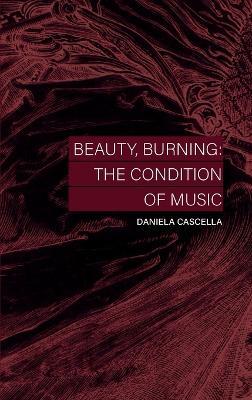
Her most recent work, Beauty Burning: The Condition of Music, which is itself in conversation with her previous three volume, is an infectious essay that asks What is beauty? A burning question but one that seeks not an examination of that which may be defined as beautiful. Rather, it creates, in its rhythms and rhymes, the sensations, the tensions, the intensities that make the existence of beauty possible. The answer then, she tells us on the very first page, is “the condition of music.” But this book does not write about beauty or music. It does, however, begin with music:
The condition of music is a phrase written in 1923 by Mary Butts in her journals, as she yearned for being beyond and before words, yet wrote nonetheless: a condition haunted by, and longing to find words as forms in circular motion and cyclical transformation. Likewise these pages are written in circular ways which sometimes may evoke or hold a rhyme, sometimes a psychic rhyme, sometimes a repetition, in a prose that goes astray only to return to its beating core.
Cascella’s writing has an almost alchemical quality. As an Italian-British writer working in her nonnative language, she has an open, playful approach to words. She has an acute ear for sounds and takes advantage of homonyms, heteronyms, and neologisms to finetune the multifaceted meanings and musicality of her prose. Repetition and the recurrence of quotes and imagery create a choral effect, building an increasing strength and coherence to the disparate references she pulls together as her text progresses. That progression, though, is very organic, halting, inquisitive, and keenly felt.
Her touchstones, that chorus of voices and inspirations that echo throughout Beauty Burning are many and varied. Some she has engaged with at length in earlier texts, others arise briefly but in passing leave their mark. Quotes from Osip Mandel’stam are important, but she also interacts with the words Clarise Lispector, Christina Campo, Marlene van Niekerk, Maria Gabriela Llansol, Dante, Lászlo Krasznahorkai, Roberto Calasso, and many more. (And, as many of these encounters are made possible through the invaluable work of translators, she thanks them all by name in her acknowledgements.) But in this book, three individuals were essential, as she describes it in her dedication, in setting the tone. They are avant-garde American fashion designer Rick Owens, and two Canadians, philosopher and visual artist Vivian Darroch-Lovowski, and poet and philosopher Tim Lilburn. Three diverse creative souls with whom she feels a special spiritual connection.
This is the kind of chemistry that fuels Cascella’s writing, perhaps more passionately and explicitly here than in her previous books. And I’m sure you know the experience. She is referring to daemonic encounters, those intense sparks of recognition that fire an aesthetic energy and conversations in the aether may be ignited. “Conversations in the aether are heard in reading and formed with the distant, with the dead.” That is, that sensation that the words you are reading you have heard, known, before you meet them. And it need not be confined to writing, perhaps it’s a moment in a film, or a piece of art, that ignites that spark. And sometimes it burns.
In the beauty of the encounter that burns, wounds, and prompts, at first I am speechless, so to articulate words here means learning to know the wound those same words pierced in my throat, the wound which first muffled my voice then made me regain it in the impetus of desire, stitched and broken, difficult, present, necessary. On encountering (on hearing) Vivian’s Voice of Hearing I learned my wound, my burning, my centre, my circle. From the very first page a sense of recognition, as if the future had come to greet me carrying the weight of a deep past.
One can feel the intensity of Cascella’s connection to Darroch-Lovowski’s writing which in turn, opens an avenue for me to again approach Voice of Hearing with a fresh appreciation for what is happening in a work that I may not have been prepared for on my own first encounter (which is, in itself, the beauty of discovering or rediscovering writers and artists through the appreciation of others—and how that same spark of recognition can send us down endless rabbit holes).
In Tim Lilburn, a very different type of writer, a poet and essayist deeply inspired by nature, the Desert Fathers and early thinkers and mystics of the Church, Cascella finds “the voice of reading, re-reading, repeating, in kinship.” Again the connection is immediate:
It was as if we often had underlined the same phrases in the same books, had been drawn to the same thinkers and writers who constantly questioned the borders of language, although we had done so under different timelines and circumstances, coming from different places, going in different directions.
In writing, writing in circles, in listening, reading, communicating, engaging, Cascella winds her way toward a fuller sense of understanding what is burning at the heart of the questions that haunt her. It is a journey, no perhaps wandering is a better word, driven by desire, pain, and guided by a whisper that she suspects was born before her lips. And one that inspires me to be more attentive to the voices I hear, and return to writing, even if in circles, because certain words do not take leave from me, not I from them.
Beauty Burning: The Condition of Music by Daniela Cascella is published by Erratum Press.
An excerpt from the opening passages of this book can be found at Minor Literature[s].


Sounds marvellous, Joe. I know what you mean about wondering if you can do a book justice, but I think you’ve done so here!!
LikeLiked by 2 people
Thank you, Karen. It’s always good to know I’ve made some sense!
LikeLiked by 2 people