As we know, it’s all fun and games until somebody loses an eye

We have all heard this expression, probably said it ourselves if we are parents. Somehow, today, as we continue to simmer in the aftermath of the news of Robin William’s tragic suicide on Monday, this is the thought that keeps coming back to my mind. For those of us who live with the very harsh reality of a mood disorder his death holds a special poignancy. So does the inevitable, endless discussion that only unexpected celebrity death seems to be able to generate.

I am presently on sick leave after a severe manic episode and although I feel the worst of my own suicidal ideation has passed, the extreme mixed state I passed into as medical resources were amassed to put the brakes on my mania was the worst I have known to date. I relied heavily on the local Distress Centre at all hours of the day and night and as much as practical on my elderly mother and young adult children. Otherwise I was intentionally and completely ostracized by my employer and they have yet to follow up on my well being. Still I feel fortunate. Robin Williams and countless others are not so lucky.

In the wake of his death, everyone seems to be turning in to look at the darkness haunting so many seemingly outgoing, humorous, entertaining and outgoing individuals. It seems to me like the attention is so keenly focused on depression and addiction. But when he was working all out, brimming with manic energy the danger signals were just as evident. But we were too busy laughing, crying, and being entertained to be concerned. It’s all fun and games…

Another public media post mortem comment that disturbs me is the observation some people have made that he seemed to hide behind his characters, whether in his improvised comedy or the countless powerful and engaging individuals he portrayed on screen. From this they extrapolate  that it is as if he was hollow inside. As if only an individual so empty and devoid of being could ever be driven to take his or her own life! I am no expert on Robin Williams, I never met him, but I would not be surprised to learn that he was a deep and intensely private man. Probably shy and insecure too.

For many people who grow up with an inclination to conditions on the mood/anxiety disorder spectrum, there is often a lot of social isolation. I know from my own experience and that of my son, social interaction does not come naturally to some of us. The need to compensate can drive such people to the creative arts – drama, music, literature for example. Likewise such individuals can be drawn to academic pursuits where energy and intellectual drive can lead to striking success. After all, there can be long periods of essentially “normal” function, especially if one avoids the trap of alcohol or drugs as a means to cope.

From my own recent experience, it seems to me that our western society, rewards the mildly manic. Over the past nine years I worked at a small agency where I routinely held the largest and most complex caseloads and took on any extra assignments placed on my desk. I developed programs, trained staff. I was rarely sick and frequently had to struggle to squeeze my allotted vacation time in before year end. I loved my job.

At home I was a single parent with two teenagers, each with their own special needs. There was whole full time round of responsibilities that fell into play outside the office. Then about a year ago things at work got crazy. The Director was exhibiting signs of significant cognitive decline and it was left to myself and a junior staff to monitor and report on the increasingly toxic state at the office while the Board of Directors tried to decide what to do.

As senior management I took the brunt of the responsibility, workload and, ultimately, abuse. I became irritable, overwhelmed and distressed – big time manic. Although I had always been open about my bipolar diagnosis no one recognized the warning signs until a chance comment about how fast I was talking hit me like a ton of bricks. I immediately pulled myself out but by then it was too late. And it is all still seen as entirely my fault, my failure to control my behaviour.

I wasn’t funny, no one was laughing and I am the only one who lost an eye, figuratively speaking of course.

In the early weeks of my sick leave I remember thinking that if I took my life, maybe my employers would realize how truly sick I had become. Of course it would have only reinforced my madness and saved them the complication that as a disabled person I have human rights protection.

Loveable madness is remembered fondly. Margot Kidder digging garbage out of an alley is not. On a more horrific level, the nice ordinary person who seems to suddenly snap and takes the lives of family or strangers is not. However mental illness is a critical subject that we cannot afford to ignore.

After all, it’s all fun and games until somebody loses a life.

R.I.P Robin Williams

For the love of gravy

Today I am thinking about gravy.

There is a dish which has become ubiquitous in Canada – fries smothered with gravy and cheese curds – the French Canadian artery clogging delight called poutine. Many years ago when I lived in Ottawa it was a treat to cross into Québec, follow some back road instructions to a truck, seemingly parked in the middle of nowhere and order the authentic dish complete with cardboard container and plastic fork. Personally my tastes have changed in 30 years, so while some version resembling poutine can be found at most of your favourite fast food haunts, but I will leave you to it. My kids, on the other hand, love gravy – with or without the cheese curds.

poutineToday my wish for my son is gravy. At 24 he has been struggling with an addiction to alcohol for several years. He is aware that underlying the addiction is the mood disorder that knits so much of our family together. Yet his experiences in anything resembling conventional mental health care have been quite horrific for an intelligent, gifted child. As far as he is concerned, alcohol is preferable to medication or therapy. I can appreciate where he is coming from but I chose to take my risks with the prescribed meds and I have been spared the temptation to turn to alcohol that has marked many other family members over the years. Not that it has prevented me from falling ill again but life has no guarantees.

Living with mental illness is not easy. Addiction adds to the burden. But I love my son unconditionally and understand that, in the end, his life is his own and he is the only one who can really come to terms with his own blessings and curses.

Lately we have been fooling ourselves with the idea that he can maintain a minimal alcohol intake and get by. However, this morning after a night of heavier drinking and the inevitable conflict such situations evoke, he finally admitted that he cannot live without alcohol and that it is interfering with everything he wants in life. He poured out every remaining drop and gathered all the empty cans and bottles to return.

Will it hold? It is a critical start, as close to bottom as I have seen him reach to date. So I want to offer him gravy. Poets, artists, musicians and writers who nursed their muse with alcohol or drugs are well known and a tragic number paid a steep price. But I want to offer my son Gravy, a poem composed by the incomparable Raymond Carver after a diagnosis of cancer. Although illness took him early it was not for alcohol – that was a battle he won and was rewarded with the time to create a body of poems and short stories that have inspired and moved so many. And that is a victory he celebrated as, of all things, gravy:

No other word will do. For that’s what it was.
Gravy.
Gravy, these past ten years.
Alive, sober, working, loving, and
being loved by a good woman. Eleven years
ago he was told he had six months to live
at the rate he was going. And he was going
nowhere but down. So he changed his ways
somehow. He quit drinking! And the rest?
After that it was all gravy, every minute
of it…

Excerpt from Gravy by Raymond Carver,                                                                         All of Us: The Collected Poems, edited  by Tess Gallagher, Vintage (1996)

Time – too much or never enough

During the past year, I was haunted by an overwhelming pressure that I needed to be able to slow down, take stock of my feelings. I was becoming aware of a wall coming down between myself and my emotional grounding.

At work a toxic environment was brewing as our director became increasingly paranoid and unstable. My daughter was trying to impress an unreasonable employer at her own workplace while, at home, my son who has long struggled with his own mental health and addiction issues was going through an especially difficult, potentially violent series of conflicts with friends. Just to keep my head above water I was going through the paces. A familiar process. Single parents tend to develop this coping skill.

It is strange how life gives you time to reflect when you need it the most.

Summer grassAlthough I have lived with the ups and downs of a mood disorder for most of my life, a full manic break and diagnosis did not come until I was in my mid 30s. Until that time I felt like I was lost at sea, battling waves I could not put a name to, but hanging on and, as much as possible, faking my way through the years. After all, unless you know better, you figure that everyone else is essentially doing the same thing.

With the diagnosis and other critical underlying issues that subsequently came to light, my life started to make sense. I felt I had some answers, some sense of a guideline. It was not an easy prescription and there were costs, including the end of a long marriage, but I prided myself that I had persevered, that I had survived. Although I was late to the game I was able to build a career that allowed me to support my children, buy home and start to put away some money for the future.

Now the reality of the diagnosis has cruelly returned to confront me leaving me unable to know if returning to the job I had is either possible or even desirable. I find myself re-evaluating what I want for myself.

Something that haunts me this go round is the notion that people with mental illnesses, bipolar in particular, have a shorter life expectancy. Although the reasons, methods of study and populations under consideration is not clear this is not a factor I ever considered before. Funny thing, we are bombarded with the message that we have to be prepared to support ourselves financially for longer than previously expected and yet we see people die prematurely – of natural or unnatural causes – all the time.

Fact is, life offers no guarantees.

Read. Travel. Write.

Either everything has meaning or nothing has meaning.

Too anxious to read?

It should be a luxury to be freed from the demands of a regular work schedule, with no shortage of books to read and time to stop and reflect on where one is at in life. In fact that is the mandate, so be it, of my present circumstances. I am on sick leave with no pressure to return to the workplace and an expectation of a reasonable income to see me through the next few months. At the moment I know I am too fragile to consider working anywhere and my employer has been less than forthcoming as to whether they foresee a place for me in the future. I just know it would be reckless to engage in any employment related discussion or decision making for a while yet. So I find myself with time on my hands.

I should be reading more. Yet I feel like I read more when I had barely a minute to spare.

I have been cocooning myself with stacks of books and, like any book addict, have continued to browse for and purchase more. I have four underway – two old school paper format, two electronic – one serious literary, one non-fiction, one genre fiction and a collection of short stories. Each one is excellent but I seem to be struck with some inability to stay put without great anxiety building and the sense that I should be somewhere else. Or rather in some other book. So I put down one and pick up another.

Sometimes I try to take a walk, grab my neglected camera hoping to find inspiration, or at least distraction, in these gorgeous summer days. That’s what I did today, but I happened across a sidewalk sale outside the most fantastic bookstore along my way and came home with six more books!

I’m not used to anxiety. It seems to eat away at an ability to focus in a way that neither the ups or the downs of my regulated mood disorder ever has. The overwhelming sense of unease, the unknowns, the uncertainties appear to be keeping me from finding solace in the written word.

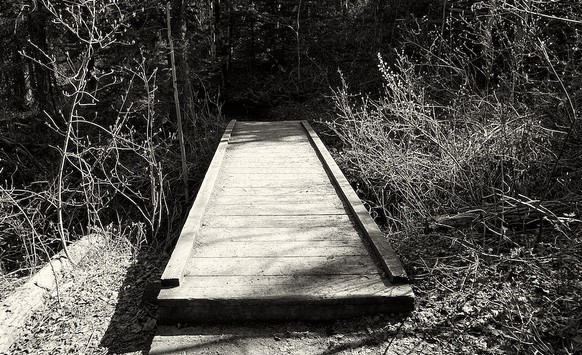
Boardwalk into the darkHopefully this shall soon pass because it would be a crime to worry away such valuable reading time.

Negotiating tangled emotions

The aftermath of madness leaves its own measure of grief.  Because the manic end of the bipolar experience is by nature expansive, the episode is rarely one that occurs in isolation. At the very least, strange, anxious and pressured calls are made. Sometimes to strangers. Sometimes to those you know. Friends and families may observe the cracks as they start to spread. The first tremors may be intermittent. They can look like occasional or periodic moments of stress – the bad days anyone can have. When things start to spiral out of control I suspect it is already too late. For the person inside the experience, the pressure, the racing thoughts, the inability to sleep or find relief from the escalating crisis becomes a space in which all perspective is lost.

And generally there is damage.

At the most severe there can be serious physical harm, violence toward the self or others. More typically major manic episodes impact relationships, bank accounts or jobs, sometimes beyond repair. Yet in the middle of it all is a person who is very ill, who will need time to recover physically and emotionally for whom there is frequently very little understanding or sympathy. Especially when they are isolated.

14629062611_de5f459467_zAs I struggle to cope with the rotating cycles of sadness, embarrassment, anger and fear following my recent breakdown I am aware that because no one from my workplace has contacted me, no one has any idea how severely ill I have been. They just remember the last days of fractured functioning before I was finally able to get away from the office. Four weeks later I am exhausted, still unable to regulate my sleep and uncomfortable driving beyond my immediate neighbourhood. When I am deemed well enough to return to work my employers will be able to imagine this “illness” was all a convenient ruse and I have reason to believe it will be held against me. The nine years I worked there and the senior management position I held under increasingly toxic work conditions will mean nothing because it was always an environment in which your work was never acknowledged or appreciated. My mistake was to care enough to stay because I believed in the work we were doing.

The emotional roller coaster is the worst. It is interfering with the comfort and enjoyment I have always found in reading and photography. It finds me moaning and wallowing in self pity when I’m not trying to push grief and anger behind me. And my young adult kids and 80 year-old mother deserve a break from having to listen to it all.

And I would much rather be blogging about books and ideas, not the black heartache of depression.

Stubbornly reading through a breakdown

With sincere apologies to David Mitchell, I have been reading myself through the crest and early weeks of the fall of a mental health crisis with his novel The Ten Thousand Autumns of Jacob De Zoet. Probably not fair to him or me. I am not a speed reader but I can7141642 generally manage 4-5 books a month. I embarked on this voyage with the Guardian Reading Group in early June and finally closed the last page today.

I know that reviews were mixed when this book was published in 2010 but I would not suggest this as a companion for a manic episode. It was not bad or entirely uninteresting (though I confess I preferred the graphic turn of the 18th century medically graphic scenes, shades of Patrick O’Brian’s Aubrey–Maturin novels where you have to wonder how anyone survived the surgical interventions, let alone the nautical warfare). Although the era and setting of this historical – and for Mitchell of Cloud Atlas fame –  remarkably straighforward tale I think it could have been much more coherent and tightly paced.

I think that I stuck to this book more as a testament to myself that I could pull myself through this period of turmoil which has left me depressed, angry and confused as I sit on sick leave and wonder if my career is in shambles. I was afraid that if I stopped reading, even with the idea that I might return at a later date, I would be giving in to the mass of tangled emotions that my breakdown has left me struggling with. Some level of normalcy has to be maintained and, at this time it has meant reading.

So where now? Something shorter, something magical I should think.

Reining in the manic mind

Manic thinking is big thinking. Massive. As mania progresses it becomes impossible not to become overwhelmed by the hugeness of the circumstances you perceive them. It is not unusual to feel caught up in the frantic spin of galaxies, astronomical or closer to home. Thinking is logical but as speeds ramp up, your judgements and interpretations can slide off the rails. The first time I was seriously ill, back in my 30s, I am sure there were some very grounded personal and even hormonal factors at play but, in the spectacular end I was experiencing definite delusions.

They say you mercifully forget those moments of rambling, crazed phone calls, strange behaviours. The kids crying in their rooms. The morning the ambulance finally arrives. I have not been blessed by such amnesiac elements.

With my recent breakdown, the stressors building to the moment of collapse were situational, profound and prolonged. They built over months, a year maybe. Then the roller coaster crested and the decline came on rapidly. And I was the last to notice. My workplace had been through a period of turmoil but as we tried to move forward I became increasingly obsessed by the massiveness of the work that I felt needed to be done to pull the agency together and make up for years of underfunding and failure to plan for the future.

My anxieties may not have been entirely misplaced. But I could no longer stop and see the good, to measure the necessity to take one step at a time and realize that moving forward is a process, not an emergency. I was so consumed with the forest that I lost sight of the trees.

Rainy day solitudeAs I am beginning to heal I am aware that I am still prone to a significant measure of massive thinking but I am also starting to doubt myself. I find myself wondering if the entire nightmare was of my own making. I have to remember that I was not the only staff member to express serious concerns, and that everyonewas impacted by the stress. One co-worker has battled stomach ulcers, another who is never ill was laid low by the flu for weeks.

I almost lost my sanity.

Terrors, somewhere inside we all have them

I tend to think of myself as someone who treasures solitude, perhaps because my normal work world and home context, offer scant moments when I am ever truly alone. Now I suddenly find myself in a situation where I am recovering from a near breakdown, unable to travel far without being overcome by fatigue and vertigo and, so it seems, my work colleagues are under instruction to refrain from all contact with me.

Now if I was off work due to some tangible medical ailment, oh you know, a physical injury or illness or some other condition necessitating tests, scans and possible surgery, I would be able to expect calls, cards, hospital visits. Instead I am in a virtual isolation chamber. I have a mental illness and suddenly the years of highly productive contributions I have provided to my employers seem to have been rendered null and void. A crushing ball of loneliness to which I am entirely unaccustomed sits in the pit of my stomach. Would anyone even notice if I failed to return save for the mass of paper I left behind on my desk?

One might wonder how the workmates of the unnamed narrator of Seven Terrors made sense of his failure to return to the office when, after the dissolution of his marriage, he took to his bed and refused to emerge from the confines of his bedroom for nine long months. That is exactly where this dark gothic tale by the Bosnian author Selvedin Avdic begins.seventerrorsfrontcover_50acc7efa1d7c_250x800r

Long listed for the brilliant Impac Dublin Award for 2014, I read this book a few months back but I find its haunting mystery and curious endnotes continue to resonate with my present frame of mind. Translated by Coral Petkovich and published by Istros Books in 2012 (re-released in 2018 with an introduction by Nicholas Lezard), it is the sudden visit from the daughter of a former colleague that drags our apparent hero from his self imposed exile. She beseeches him to help her locate her father who has been missing for years and intrigued, perhaps more by the young lady than any curiousity about his friend’s fate, he agrees. Thus he embarks on a most dingy and disorienting detective adventure.

Set in 2005, the war in Bosnia a decade earlier is a constant presence throughout the book. Although few events are recounted directly; the memories, mythologies and  human losses linger in the bitter winter wind, seep through cracks in the plaster and creep across the floorboards. With a clear nod to Borges, Kafka and others this dark tale is an entirely contemporary fantasy. Yet as the investigations turn to the missing journalist’s interest in coal miners, Bosnian mythology begins to play a strange role and our narrator’s sanity (already questionable one might argue from his bedsit starting point) becomes increasingly  ungrounded; even as he tries to make sense of himself and the truth behind the dissolution of his marriage.

It is strange how magic, reality, fantasy and fact can mingle in literature – and for this purpose I am excluding fiction that fits explicitly into fantasy and horror genres where such mutability is a given – but capital “L” Literature, which being a bit of a bookish geek is my typical but not exclusive, terrain. Yet in real life, that life we are forced to venture into outside the covers of a book, there seems to be some caveat on TRUTH as if that was even an objective possibility. And what is crazy anyway? When I work with a survivor of brain injury I can sense the difference between psychosis and confabulation and the inability to lay down new episodic memories. But if, under exceptional professional stress, I became agitated, overworked and frustrated is my sanity at stake? I heard no voices, had no visions but I sure was moody and irritated.

I should think that my fictional Bosnian friend burying himself in his bedsheets for nine months was in worse shape than I but as a character he is a fascinating narrator to spend time with. Or so I thought. And obviously enough people agreed to nominate Seven Terrors for the Impac Dublin Award which draws its nominations from the selections of a wide range of international libraries.

As I agonize over my eventual return to the workplace following this recent breakdown I find myself returning to the most fascinating series of footnotes and endnotes that make this Bosnian novelist’s slim volume so extraordinary. Among those notes is an actual list of seven terrors and, for those of us who are inclined to anxiety, blank pages so that you can helpfully add some more of your own. I will leave you with his seventh:

7. Fear of loneliness and darkness
Better to write and describe it like this – fear of                                                           loneliness or darkness. It’s all the same, they both devour.

Turn on the light and read this book.

What lies ahead?

Along the forest trailI took this photo almost a month ago. This trail near my home runs up and down along a steep embankment above a major river running through the large modern city I call home. It exists as an oasis of mountain magic lingering east of the Rocky Mountains. Today I could not possibly negotiate my way over the ubiquitous tangles of roots that emerge without warning on such forested trails. Although my health improves every day, I am stunned by how devastating the process of recovering from the brink of a full manic break has been on my ability maintain any degree of physical equilibrium. At the worst I was toppling over at a moment’s notice and hobbling along after my 24 year-old son as if I was in my 80s or 90s. This morning I actually managed a 10 block walk to Starbucks on my own. I no longer lose my balance when I turn my head and could even stoop to photograph a few renegade alley flowers along the way. Maybe I will even make serious headway in the novel I was reading before I crashed a few weeks ago.

But the question then begins to take on a more critical long turn.

What lies ahead?

And is this a path I am prepared to commit to knowing that the dysfunctional elements that ultimately contributed to my break down are deeply embedded into the structure of the work environment that I am, at this time, expected to return?

If I hated my job, the answer would be simple. But for nine years I loved my work, looked forward to the challenge, cared deeply for the cause, the clients, my co-workers and community colleagues. However, sometimes hard work and achievements mean little if the last impression you leave is of someone who is over tired, over worked and processing at lightening speed. You are assumed to be crazy, not ill. And labels once granted still await even once you cross the bridge to recovery.

Roughed up ghost

I started this blog with the idea that it would be a medium for some idle musings, some reflections on some of the random topics that attract my attention. Maybe the odd book review when something really grabbed me and deserved a little verbal leg up.

Then, not even a month after my modest entry into the wold of blogging, life has inserted its own stubborn editorial prerogative. I have crashed, head on, into a brick wall.

JMS 2012

The wall you see here is a memorial remnant to mark the location where a major hospital that was deemed redundant was collapsed in a most spectacular implosion. The government orchestrated the event in a zest to balance the books with total disregard for the awkward fact that that people do get sick. I took this photograph two years ago simply as an artistic statement. Then last week I allowed an illness I have long lived with to bring me to the brink of hospitalization.

I have bipolar disorder. It’s not a secret and I rarely give it a second thought. Diagnosed after a most spectacular manic break in my mid-30s I responded well to medication and never looked back. To appreciate the genesis of this recent setback one has to look back a good year and a half. For nine years I have worked with small not-for-profit agency serving adults with brain injuries. I have loved my job. We help people accessing benefits, advocate for services, and adjust to the sudden impact that severe injury brings to the survivor and their families and friends.

But lately there had been something out of sorts. The Executive Director began forgetting to issue invoices and pay bills. His behaviour became increasingly erratic and unpredictable. As the senior management staff member my workload multiplied as I sought to cover his shortcomings and meanwhile, on behalf of the staff, I had to try to encourage the Board of Directors to issue at least some kind of thorough review. Instead they paid him out, congratulated themselves on a job well done and left it to myself and another key staff to fill in the gaps. With such an increasingly unmanageable forest of papers and emails threatening to bury me alive I brought work home and worked through the evenings and weekends. Sleep all but evaporated and soon I was, well, running on high octane. And not in a good way.

The realization that I was on the doorstop of mania was a shock when I discovered my empty pill case. I had been stable for 18 years. Under medical advice I have requested stress leave but it has become clear that the mental health stigma is alive and well. Of course it doesn’t help that as my mood escalated my behaviour began to appear increasingly bizarre. I can’t take that back, but such is the illness. Consequently I have been referred to as unstable, unreliable, incompetent. It is unlikely that a return will be feasible.

As the longest serving staff member, my heart and soul were bound to the vision of this agency. At this moment, my ghost is not only roughed up, but fractured. And I am not even a strong believer in a soul but there is some soul-shaped hole in my heart right now.

Will mental illness ever be understood as an illness of the body like any other?