Look closely, wait: Seeing Further by Esther Kinsky

Early in her latest novel, Seeing Further, German writer Esther Kinsky sets out the parameters for the narrative ahead, for the story she intends to tell, the theme she wishes to explore:

There are two aspects of seeing: what you see and how you see it. This investigation into seeing further will involve only the question how. It pertains to the place that the viewer takes. It concerns point of view and remove from things and images, from the action, proximity and distance, vastness.

She, or rather her narrator, goes on to discuss this aspect of seeing, especially in relation to the cinema, but also with respect to other means of framing what we can view—windows, binoculars, open vistas—but it is the shared experience of the cinema that holds special attraction for her. This fondness began in childhood and has accompanied her throughout her various travels and relocations over the years, even as she acknowledges that it is competing with the convenience and privacy of smaller personal screens. But, of course, this is Esther Kinsky, and if the cinema is a space ideal for an examination of the how of seeing, her strong sense of place, sensitivity to natural or manmade landscapes, and generous appreciation of unique individuals also allow for perceptive descriptions of what her protagonist sees around her and the people she meets.
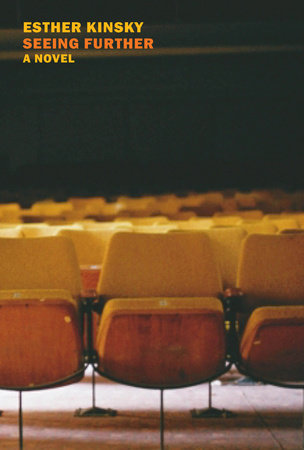
The narrator is living in Budapest when she comes across an abandoned cinema that seems to present her with an irresistible opportunity in a village in the open flatlands of southeastern Hungary known as the Alföld.  She had set out on a weekend adventure with the intention of taking photographs, but found herself confronted with a landscape that defied the camera’s frame. A vastness that presented a certain unphotogenic emptiness. She finds a place to spend the night while a storm rages outside. The next morning, uncertain where she is, she to explore the small town in which she has awoken. It is a Sunday:

A few cyclists, most of them women, rolled quietly past and then turned around to face me and stared, which nevertheless did not upset their equilibrium; unperturbed they proceeded onwards, skilfully balancing on their shoulders or the handlebars of their bicycles their hoes, rakes and spades. I felt foreign under their gaze, cut free from all contexts of familiarity and belonging. A strange sensation, yet it pleased me.

In this strange community she is aware of a sense of having seen similar scenes before. A sort of memory or images called from the past—perhaps somewhere in the Po Basin area of Italy, perhaps in a book or a film. And then she finds the old cinema building. A relic of a time gone by, now standing forgotten: “A splendid cinema in a no-man’s land of possibilities.”

Back in Budapest, a city with a wealth of cinemas, she becomes absorbed in thoughts of the magic of film, and before long she is back in what she refers to as the mozi village, mozi being the Hungarian word for cinema. She walks back and forth in front of the abandoned building until someone inevitably stops and asks if she needs help. She tells him she would like to see the cinema and he asks if she wants to buy it. With little hesitation she responds that, yes, perhaps she would like to buy it.

This is, then, the story of one woman’s dream of reopening a cinema and rekindling an interest in the forgotten joy of gathering together to share the experience of watching a film, engaging the act of seeing further. Jószi, the cinema’s former projectionist turned bicycle mechanic gets caught up in her enthusiasm and becomes her accomplice. She devotes herself to getting the building cleaned, repaired, painted and ready for its revival. Parts are sourced for the projectors. It’s a slow process, one that involves her eventual relocation from Budapest to the village. An interlude tracing the life of the mozi village’s original projectionist and the founder of the larger, now disused cinema, serves as a history of film in the region, from the early days of silent films as a travelling attraction carried from village to village and projected in tents, to the introduction of talkies, the impact of the Great Depression, and the eventual expansion of cinemas from the cities into smaller towns where they became vital venues for community entertainment. But times have changed. And so have people.

There were no spectacles to help me decipher it all, but I could see, observe, look closely, wait. Wait and see. Yet I still had faint doubts about whether this cinema would ever again be a space where one could sit, look closely, see, wait and see, in order to learn something about what once took place here between the screen and the gaze. The consensus today was that everyone came from far away, from a world unaccustomed to the cinema gaze, all of them projectionists at their own private screens, who chose the cinema as an exception, who were accustomed to seeing in their own private space, alone or with a few trusted fellow viewers. The cinema was always a place to which you brought your own solitude, but it used to be that you did so knowing you would take your place among other solitary people; you travelled to the cinema, hungry for film, and left sated, brushing against the outside world along the way.

Slow moving and inevitably Sebaldian, with many original black white photographs, this is a work that combines the narrator’s love of the cinema and appreciation of the possibilities that watching a film with others on a large screen offers, with a fictionalized account of the birth, death and attempted resurrection of a small town cinema. Kinsky’s work is often called autofiction and although there is always a strong sense of place, landscape, and experience running through her narratives, it is not wise to conflate the author with her narrators. The setting of this work, the endless plains of eastern Hungary is familiar. Her more conventional first novel Summer Resort is set there, so Kinsky is no doubt drawing on a real-life sojourn in this region, perhaps in the mid-2000s, and an actual cinema project of some sort (as the photographs attest), but as ever, very little of the narrator’s (and by extension the author’s) personal background or history is revealed beyond a few childhood reflections. Why is she in Hungary? What does she do for a living? Kinsky’s narrators tend to shadow her own life, but clear boundaries are invariably retained. Autofiction, on the other hand, tends to be a much more self-focused, sometimes even self-obsessed medium. It is Kinsky’s ability to focus on her attention on familiar emotions—leaving, grief, loss, nostalgia—within a richly detailed landscape while maintaining a measured invisibility that makes her narrators and her novels so intriguing.

Seeing Further by Esther Kinsky is translated by Caroline Schmidt and published by New York Review Books in North America and Fitzcarraldo in the UK.
“Most of the things you ‘recognise’ you’ve never seen before” Sojourn by Amit Chaudhuri

From the opening passages of Amit Chaudhuri’s quiet, lugubrious novella Sojourn, one can already sense that his unnamed narrator, an Indian writer on a four month visiting professorship in Berlin, is slightly out of sync with the world around him, but it’s not clear if it’s simply the strangeness of his environment or some unease he carries with him. It’s not even his first visit to the city, but little seems familiar. He constantly requires directions and gets lost easily. There is, however, a subtle tension running through this lowkey narrative that gradually builds into something more disorienting in this portrait of a man’s shifting relationship to time and place as he enters mid-life.

The year is 2004, fifteen years after the fall of the Wall, but its shadow persists; former demarcation lines and vast areas not yet cleansed of their link to a dark past remain. Residents are inclined to point them out to visitors as if sharing the city’s history with a certain wistfulness, while the narrator tends to react to these spaces as if they hold a connection to an interruption of time in a city that now, after reunification, is still finding its footing.

At his first official function, just days after arriving, our protagonist meets Farqul, the self-styled Bangladeshi poet who appoints himself as his guide and guardian during the early weeks of his stay. Their conversations are peppered with snatches of Bangla. A journalist with Deutsche Welle, Farqul is an elusive yet ubiquitous figure—or perhaps, furtive, as the narrator speculates on their first encounter—who is a well-known exile and appears to be well-liked among members of Berlin’s immigrant community. He had emigrated to Germany in 1977, two years after being kicked out of Bangladesh for writing a blasphemous poem. Prior to leaving India he had spent a rather fractious interlude among the literati in Calcutta where he met and was apparently aided in his move to Berlin by none other than Gunther Grass. (The narrator simply conveys this information without question.) He is a generous, if eccentric, host. He not only shows the narrator around, but helps him get outfitted for the coming cold weather.

Farqul – in the excitement of being in your company – was a man who liked to share. He gave you food; he stood next to you in solidarity when you tried on jackets; he would have shared cigarettes and his flat if I’d been a smoker or needed a room; he might offer his woman. He didn’t create a boundary round himself, saying, ‘This is mine; not yours.’ As long as he was with you he was in a state of transport.

Yet when Farqul suddenly disappears without notice, the narrator flounders a little. Most of the acquaintances he makes through the university remain casual, but he does have the hint of an affair with a German woman who unexpectedly reaches out to him after having attended his inaugural lecture. She tells him she loves India (“I’m wary of Europeans who ‘love’ India – an old neurosis”) and their liaison, for what it’s worth, develops rather uncertainly. The narrator is often uneasy; he seems to be unwilling to exercise any agency. Rather, he tends to drift without commitment. As a result, those who come into his life with whom he may have grounds for connection—social, academic, romantic—have to be persistent if any kind of relationship is going to develop.

He also, for some reason, maintains a distance from the German language. His housekeeper speaks no English and the simple German phrases she uses with him he claims to understand only through her accompanying gestures. He seems content to exist in the city without being able to interpret the conversations around him—to revel in the meaning conveyed by the music of the language rather than its vocabulary or grammar:

They go on about the rebarbative sound German makes, but individual words and names have greater beauty – more history – than English can carry. I entered Hackescher Markt in my mind’s eye five or ten minutes before reaching there. ‘Friedrichstrasse’ had come up in a dream recently, as a port of arrival. Kristallnacht was transparent, broken. I woke up to words and didn’t bother with the language.

Certainly his sojourn in the city is necessarily brief, but his passivity is notable, as is his unwillingness to acknowledge how unmoored he is. That is, until he begins to become disoriented and experience blackouts. The narrative becomes more fragmented as he  loses himself navigating an unfolding layout of streets and network of train stations:

The trains emanate sorrow. Not like humans. The humans, in fact, are distracted and impatient. The trains aren’t alive in the way we understand the word. But they feel.

Domination of steel: steel smoke, steel sky.

This book has an intentionally unfinished feel owing to the fact that the narrator’s own mental state seems to be unravelling as his time in the city nears an end. We learn little about his earlier life because he admittedly feels disconnected from it himself, making for a mysterious, yet beautifully written tale of one man’s estranged sojourn in Berlin.

Sojourn by Amit Chaudhuri is published by New York Review Books.

If such a thing is possible: Star 111 by Lutz Seiler

Maybe at twenty-six he was already too old to seriously go about becoming a poet.

The fall of the German Democratic Republic was rapid and unexpected. As other communist regimes in Eastern Europe began to disintegrate, the East German government tried to maintain control, but in early November 1989 a mistaken announcement led to the sudden opening of border crossings through which hundreds of thousands of East German residents would soon pass. This is where Star 111 by German poet and writer Lutz Seiler begins.

Twenty-six year old Carl Bischoff has just been summoned from Leipzig to his home town Gera in the state of Thuringia. The telegram, dated November 10, reads “we need help please do come immediately,” but as he waits for the train, he has no inclination that all the childhood securities he once imagined were unassailable are about to be upended. His parents, Inge and Walter (Carl has long addressed them by their first names), waste no time announcing their intentions. They are going to take advantage of the crumbling state of the GDR and cross the border. Now. This is, they tell him, a dream they have long held and, should the precious opportunity be short lived, they plan to leave promptly. They will head for the refugee camp at Giessen, and then split up to better their chances of finding suitable lodgings and employment on the other side. Carl’s assignment is to stay behind and look after the apartment. He will be the rearguard. But left behind, Carl finds he is at a loss, confused by this sudden inversion of what he imagines the parent-child dynamic should be and worried about his middle-aged parents who by rights should be the ones at home worrying about him.

His age is critical. Carl will repeatedly question what it means to be in his mid-twenties as if there’s some kind of high-watermark that he’s worried he has already missed. He has completed military service, learned a trade, and spent a few years at college, but he is without direction. His dream is to become a poet. Yet, when he is called home, he is apparently recovering from a breakup and a breakdown—something he alludes to but does not discuss because there’s no time. His parents’ departure is so immediate and unnerving that it entirely usurps whatever crash course he might have been on. But, even if it leaves him temporarily unmoored in a world that is rapidly changing, it does offer him a chance to chart a new direction for himself. After a few weeks in Gera, trying to keep a low profile while working his way through the preserves in the cellar, Carl is beginning to bottom out. So he loads up his father’s beloved Zhiguli with tools, a sleeping bag, and some provisions, and heads to Berlin. He has no particular destination in mind. He is simply following a fantasy founded on little more than a few poems set in that mythical city, seeking, as he will later describe it, “the passage to a poetic existence.

Arriving in East Berlin, Carl tries to get his bearings, picks up the odd unofficial taxi fare, and sleeps in his car. But, with winter settling in it’s a bleak—and cold—existence. Before long he falls ill. When, freezing and feverish, he happens to find his way through the rear door of a cinema, he suddenly steps into another world. So to speak. He finds himself in the company of an odd collection of individuals, led, it would appear, by a charismatic man they call the Shepherd—the owner or companion of a goat named Dodo—who nurse him through his illness and welcome him to their breakfast table, impressed in no small part by his car with its trunk full of tools. His tools?

“No, no Zhiguliman, you don’t have to explain anything here. More than a few people are on the move in this freshly liberated city. The whole world is being parcelled up anew these days—but if you’re looking for something permanent. . .”

Carl is not certain what he is looking for, or what something permanent might even mean. If stability cannot be assured in unstable times, he wants whatever it is the handful of men and women around him seem to have—community. And it seems to be on offer:

It was as if he were already part of a pack, as if he were of the same breed. Everything seemed already embedded according to a long-standing plan and leading toward the only logical conclusion. It was a strange feeling. It was the presentiment of a legend (if there is such a thing, thought Carl), on the point of taking him to its profound, all-embracing “once upon a time.”

It is, in fact, just the beginning. He settles into a spartan empty apartment and soon finds a place among a group of misfits, artists, and anarchists who are systematically occupying abandoned buildings, hoping to take advantage of the shifting political and social terrain to craft a kind of anti-capitalist utopia amid the ruins of a damaged urban landscape before others come to reclaim it. His bricklaying skills secure his place.

Over the months that follow, Carl will oversee renovations, begin to work in the Assel, the  café the Shepherd sets up, and embark on a romantic relationship with, much to his surprise and naïve delight, a woman from his hometown. Meanwhile, the progress of his parents is revealed regularly, but only insofar as his mother’s letters allow him to it piece together through what is shared, or more critically, what is left unsaid. For months after he had dropped them off at the border, there had been an unsettling silence. Then, once he has relocated to Berlin, the missives begin to arrive, secretly rerouted through the post office in Gera. For a long time Inge and Walter are apart (“separately after Giessen”, as planned), and the latter’s whereabouts are unknown. On her own, Inge proves to be remarkably self-sufficient, working and making social connections until Walter is finally found and the couple are reunited. From that point on, Carl’s father will rely on his computer programming skills to build toward the shared future they envision. Inge’s cryptic comments and idiosyncratic expressions imply that there is a greater game afoot, but Carl is being kept in the dark. But then, many months will pass before he finally confesses that he has abandoned his post as rearguard.

As Carl constructs a life for himself in Berlin, building relationships with others, testing his emotional boundaries, and tracing a regular path through the streets of his dilapidated neighbourhood, one central focus drives his days—the need to write, to dedicate at least some time to poetry. With a little promising feedback, he fantasizes about the day he will publish a book of his own poems. Yet, with all the uncertainty (and opportunity) that a rapidly evolving Germany promises, for Carl writing is a discipline that exists on its own ground away from it all. He is a purist, not a documentarian:

So-called reality and its abundance (“the most exciting times of our lives,” as everyone was claiming)—it would never have occurred to him to write about it, not even in a journal, never mind that he clearly wasn’t in any state to keep a proper journal (with regular entries). The main question was whether or not the next line would work. The next line and its sound preoccupied Carl, not the demise of the country outside his window. If the poem didn’t succeed, then life wouldn’t either.

It’s not an easy path to follow, but it’s one that sustains him when everything falls into place  and one that devastates him when life runs off the rail and words fail to come.

Decidedly autobiographical in nature, Star 111 is a tale of self-discovery, a portrait of a young man seeking to define his identity as an adult and as a poet against a backdrop of rapid change when, for a moment, all the old rules have been suspended before inevitably being rewritten and reshaped by capitalist interests. Seiler’s limited third person narrative with its frequent parenthetical refrains and clarifications, captures Carl’s insecurity and self-doubt as he navigates this strange terrain. It also facilitates the integration of a wide range of eccentric characters: members of the Shepherd’s “pack,” his neighbours, co-workers and customers at the Assel, his lover and her young son, and the many people he encounters vicariously through his mother’s regular updates. Essentially, then, this is a novel about family—natal, accidental, and imagined—and the forces that gather to form and inform one’s independent being. The “Star 111” of the title refers to the popular transistor radio that was the centrepiece of Carl’s family life when he was a child. The memories of it that haunt him reflect the strange longing that tends to set upon us when life conspires to force us to accept that not only are we truly grown up (whether or not we feel like it), but that our parents are independent adults too. As Carl spends a lot of time re-evaluating his relationship with Inge and Walter, he will wonder whether he ever really knew them at all. Or they him.

Lutz Seiler is, of course, like his protagonist, a poet first and foremost. This can be seen in the way his chapter titles are picked up in the text, often in the closing line, but more explicitly in his attention to the sounds and the rhythms of language. Translator Tess Lewis—who also translated his first novel Kruso which she describes as forming a sort of diptych with Star 111—writes in her Afterword of the challenge presented by his “ability to capture the minutiae and texture of a vanished world in rhythmic, lyrical prose.” She pays particular attention to the various registers in the original reflecting the different tenors of West and East German bureaucracy, varying speech patterns associated with social class, and the lines of poetry by a host of other poets that echo through Carl’s imagination. When words with multiple meanings afford the author an onomatopoeic flexibility that cannot be fully replicated, Lewis found she sometimes had to make alternate word choices, knowing the full affect could not always be maintained. This is not a loss noticed in the English reading though. The sense that this is a moment in time that will not last long and will never come again is captured so vividly through Carl’s adventures (and misadventures), not to mention those of his parents, that it feels, above all, like a privilege to be along for the ride.

Star 111 by Lutz Seiler is translated from the German by Tess Lewis and published by New York Review Books in North America and by And Other Stories in the UK.