Those days on the road, I wrote with a pencil. The faint inscriptions of provisional memories made my notebooks seem like fallow territory. I would spend hours before bed recording variations of my experience, keeping no version of myself from the page. Yet, even if that were possible, it saddened me to write each day without a clear vision of whom I addressed. How long would it take for letters of my alphabet to form an impression, moving from reading eye to sensuous heart?
Of late I am drawn to curious projects that bring together memory, image, and environment— projects that blur the parameters of literary classification, where memoir, photo essay, travelogue and storytelling blend. To books like Nigerian writer and art critic Emmanuel Iduma’s enigmatic The Stranger’s Pose. Described in his Acknowledgements as an “imaginative gesture” extended to “the many lives that entered mine,” this collection of seventy-seven segments (or chapters?) has its basis in actual trips through several African countries that the author made, either on his own, or with a varying group of photographers, writers and visual artists as part of the Invisible Borders Trans-African Photographers’ Organization. However, by allowing his reflections to form in the “twilight worlds between experience and memory, fiction and criticism” and presenting them with a curated selection of black and white images, in many of which he is the staged and central figure, Iduma invites the reader to join him on a lyrical journey, one that is at once elusive and absorbing.
 There is, about halfway through the book, a map tracing out a pathway from Addis Ababa, westward through Nigeria, onward to pass up through Senegal, Mauritania and into Morocco. A simple scattering of place names, white text on a black background, connected by curving dotted lines. A geography of dreams. The recollections and remembrances that link these far flung cities tumble forth without chronological or spatial connection, but they do not exist in an emotional or political vacuum. Border crossings can be fraught, stories of the fates of migrants fleeing north toward Europe are shared, religious and ethnic tensions simmer, and language barriers hinder communication and require dependence on translators.
Our restless wanderer is a contemporary African flaneur. An openness to experience infuses his reflections. He is acutely sensitive to the human tableaux he observes, to the eccentricities of the photographers and artists he seeks out, and to the resonances of the stories he is told. He is attentive to the body language and facial expressions he encounters, both in images and in person. At the state library in Enugu, which resembles a dusty study hall more than anything, he finds an extensive archive of newspapers dating back to the 1960s. Inspired to seek out accounts of the events immediately preceding the death of Ken Saro-Wiwa in November 1995, he traces the daily photographic record in The Guardian, examining the subtle indications of shifting emotion in the grainy images. Watching a stranger on a bus in Addis Ababa practice smiling at his reflection in the window, he turns to notice that, in the glass, his own countenance could be taken for unhappy. Turning back his eyes meet the other man’s and now, in his face, feels he recognizes himself:
But faces aren’t mirrors. Suppose we look long enough at others to discover their secret impulses, could we understand our own in the process?
His intention throughout is to capture his thoughts and experiences. We are never simply travelling in the present tense. Every journey we take stirs memories from the past, and extends into an unknown future. Travel reframes the idea of home in many different ways. And Iduma, of course, is a writer. As such, this is not a voyage without literary guideposts. Amos Tutuola, Ben Okri, Breyten Breytenbach, Italo Calvino, Isabelle Eberhardt, John Berger and more are called on to contribute tales to this extended meditation.
The segments that comprise this book range from a few sentences to several pages. Some describe encounters and experiences, some revisit childhood memories, some imagine stories. He describes dreams and writes notes to some of his travelling companions, looking back at their shared moments. And sometimes he simply describes a photograph which, incidentally, may or may not be included in the book. The camera is a mediator, in individual interactions and as a transformational exercise. Relatively few of the photographs are actually taken by the author himself (thus none are reproduced in this review) and the ones in which he appears form an especially interesting counternarrative.
One hand holds my shoes; the other is raised, a few inches from my face. I approach a fenced mosque, with my shadow falling across its entrance. One part of the gate is shut, leaving space for a single entrant. The walls and the fence are brownish, just like the sandy ground, but with a darker hue. On the highest deck, three-horn speakers point in different directions: frontwards, leftwards and rightwards. A man glances towards the exit. I doubt he sees me. But he is looking in the direction of the photographer.
The image we are shown, exactly as described, is black and white, the surfaces of mosque stark in the harsh light. How, one must ask, does Iduma fit into these photographs, tall and striking, often dressed in white, walking or standing against storefronts, alleys, and walls? He is the stranger posed —itinerant, restive, trailed by a sense of displacement, heartbreak, and loss. When asked in an interview what he hoped a reader might take away from this book, he replied:
Below each encounter something trembles under the surface, inarticulate. I wrote the book thinking of anonymity as a method, in order to speak to an audience besides those whose stories I was retelling, and whose lives I was conjuring. I hope the reader might be able to meet me at the intersection of my life and those I write about.
It is this ineffable quality that comes through and makes A Stranger’s Pose such an affecting experience. In a line with the work of Teju Cole who writes the Foreword, and yet with its own distinct style and voice, this is a book for anyone who welcomes the idea of navigating the invisible borders that lie between travel, memoir, fiction and photo essay.
A Stranger’s Pose by Emmanuel Iduma is published by Cassava Republic Press.

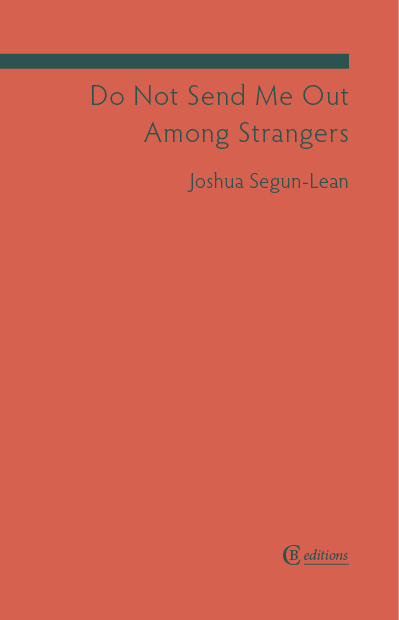 Do Not Send Me Out Among Strangers is a collection of brief journal entries—observations, accounts, and recollections—nested among a series of harsh black and white photographs of soil, rock, and debris, marked with occasional tufts of vegetation. Numbered and time stamped, these images are titled “Field Notes.” This is the visual record of the search that occupies Segun-Lean’s lockdown days: he has been tasked with the dispersal of his father’s ashes. He thinks back on their strained relationship and his insecurity about the responsibility he has been given. Meanwhile, friends are falling sick with Covid; some are even dying. A journey of grief lies in the stillness of this book.
 roughghosts