
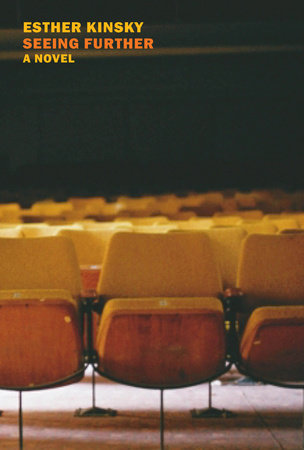
Early in her latest novel, Seeing Further, German writer Esther Kinsky sets out the parameters for the narrative ahead, for the story she intends to tell, the theme she wishes to explore:
There are two aspects of seeing: what you see and how you see it. This investigation into seeing further will involve only the question how. It pertains to the place that the viewer takes. It concerns point of view and remove from things and images, from the action, proximity and distance, vastness.
She, or rather her narrator, goes on to discuss this aspect of seeing, especially in relation to the cinema, but also with respect to other means of framing what we can view—windows, binoculars, open vistas—but it is the shared experience of the cinema that holds special attraction for her. This fondness began in childhood and has accompanied her throughout her various travels and relocations over the years, even as she acknowledges that it is competing with the convenience and privacy of smaller personal screens. But, of course, this is Esther Kinsky, and if the cinema is a space ideal for an examination of the how of seeing, her strong sense of place, sensitivity to natural or manmade landscapes, and generous appreciation of unique individuals also allow for perceptive descriptions of what her protagonist sees around her and the people she meets.
 The narrator is living in Budapest when she comes across an abandoned cinema that seems to present her with an irresistible opportunity in a village in the open flatlands of southeastern Hungary known as the Alföld. She had set out on a weekend adventure with the intention of taking photographs, but found herself confronted with a landscape that defied the camera’s frame. A vastness that presented a certain unphotogenic emptiness. She finds a place to spend the night while a storm rages outside. The next morning, uncertain where she is, she to explore the small town in which she has awoken. It is a Sunday:
A few cyclists, most of them women, rolled quietly past and then turned around to face me and stared, which nevertheless did not upset their equilibrium; unperturbed they proceeded onwards, skilfully balancing on their shoulders or the handlebars of their bicycles their hoes, rakes and spades. I felt foreign under their gaze, cut free from all contexts of familiarity and belonging. A strange sensation, yet it pleased me.
In this strange community she is aware of a sense of having seen similar scenes before. A sort of memory or images called from the past—perhaps somewhere in the Po Basin area of Italy, perhaps in a book or a film. And then she finds the old cinema building. A relic of a time gone by, now standing forgotten: “A splendid cinema in a no-man’s land of possibilities.”
Back in Budapest, a city with a wealth of cinemas, she becomes absorbed in thoughts of the magic of film, and before long she is back in what she refers to as the mozi village, mozi being the Hungarian word for cinema. She walks back and forth in front of the abandoned building until someone inevitably stops and asks if she needs help. She tells him she would like to see the cinema and he asks if she wants to buy it. With little hesitation she responds that, yes, perhaps she would like to buy it.
This is, then, the story of one woman’s dream of reopening a cinema and rekindling an interest in the forgotten joy of gathering together to share the experience of watching a film, engaging the act of seeing further. Jószi, the cinema’s former projectionist turned bicycle mechanic gets caught up in her enthusiasm and becomes her accomplice. She devotes herself to getting the building cleaned, repaired, painted and ready for its revival. Parts are sourced for the projectors. It’s a slow process, one that involves her eventual relocation from Budapest to the village. An interlude tracing the life of the mozi village’s original projectionist and the founder of the larger, now disused cinema, serves as a history of film in the region, from the early days of silent films as a travelling attraction carried from village to village and projected in tents, to the introduction of talkies, the impact of the Great Depression, and the eventual expansion of cinemas from the cities into smaller towns where they became vital venues for community entertainment. But times have changed. And so have people.
There were no spectacles to help me decipher it all, but I could see, observe, look closely, wait. Wait and see. Yet I still had faint doubts about whether this cinema would ever again be a space where one could sit, look closely, see, wait and see, in order to learn something about what once took place here between the screen and the gaze. The consensus today was that everyone came from far away, from a world unaccustomed to the cinema gaze, all of them projectionists at their own private screens, who chose the cinema as an exception, who were accustomed to seeing in their own private space, alone or with a few trusted fellow viewers. The cinema was always a place to which you brought your own solitude, but it used to be that you did so knowing you would take your place among other solitary people; you travelled to the cinema, hungry for film, and left sated, brushing against the outside world along the way.
Slow moving and inevitably Sebaldian, with many original black white photographs, this is a work that combines the narrator’s love of the cinema and appreciation of the possibilities that watching a film with others on a large screen offers, with a fictionalized account of the birth, death and attempted resurrection of a small town cinema. Kinsky’s work is often called autofiction and although there is always a strong sense of place, landscape, and experience running through her narratives, it is not wise to conflate the author with her narrators. The setting of this work, the endless plains of eastern Hungary is familiar. Her more conventional first novel Summer Resort is set there, so Kinsky is no doubt drawing on a real-life sojourn in this region, perhaps in the mid-2000s, and an actual cinema project of some sort (as the photographs attest), but as ever, very little of the narrator’s (and by extension the author’s) personal background or history is revealed beyond a few childhood reflections. Why is she in Hungary? What does she do for a living? Kinsky’s narrators tend to shadow her own life, but clear boundaries are invariably retained. Autofiction, on the other hand, tends to be a much more self-focused, sometimes even self-obsessed medium. It is Kinsky’s ability to focus on her attention on familiar emotions—leaving, grief, loss, nostalgia—within a richly detailed landscape while maintaining a measured invisibility that makes her narrators and her novels so intriguing.
Seeing Further by Esther Kinsky is translated by Caroline Schmidt and published by New York Review Books in North America and Fitzcarraldo in the UK.
 roughghosts