
Writing poems is just as much a mysterious miracle. Not that there’s anything mystical or ceremonial about it. Or anything religious. It’s a neutral miracle, so to speak, granted in advance, because in the process of writing we need to use language in its whole, indissoluble connection with reality. It’s that connection with reality that’s a mysterious miracle. And that’s what poetry has to enter into.
It is clear from the essays collected in The Condition of Secrecy, that Danish poet, novelist, and essayist Inger Christensen (1935–2009) was not only in love with words, but that she understood language—and the way we seek to give meaning to the world—as part of the dynamic process of nature. For those who are already familiar with the experimental writer’s poetry and fiction, this collection offers insight into her view of the world, which was heavily influenced by a lifelong interest in science, mathematics, and linguistic theory, and the questions she was inclined to ask about her own engagement with language. For those who are new to her work, myself included, her philosophical musings and poetic investigations are no less interesting, and may well serve as an invitation to explore her work further—and fortunately there is a good selection currently available in English translation with more forthcoming this year.
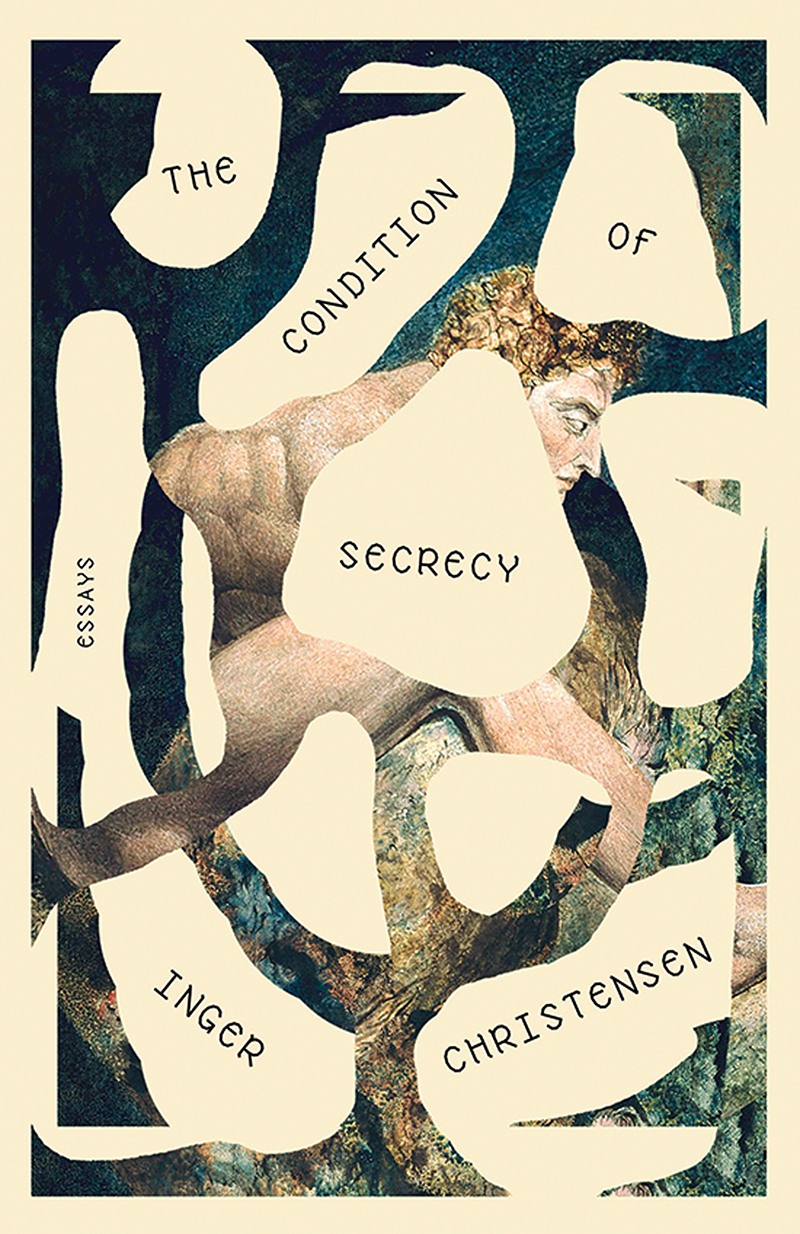 What is most immediate in this compilation of essays, originally published across four decades, from the 1960s through the 1990s, and arranged intentionally rather than chronologically, is the sheer force of Christensen’s intellectual curiosity. At its most basic, it is a book about writing and meaning, but a book by an original inventive poet trained in German, mathematics, and medicine, who read six modern and two ancient languages. And, as a child of the Second World War, social and political concerns are never far from her mind. The Cold War and the fear of nuclear annihilation casts a clear shadow on a number of pieces. So, although this volume only numbers 138 pages, Christensen encourages her reader’s close engagement with ideas as she herself works her way through her own questions about the world and the way we find meaning in it through language.
Words are, of course, essential and she has a wonderful way of employing them. Her opening sentences are often quite special. “Interplay,” an essay about coming to understand time and one’s place in history as a child in Denmark at the end of World War II, begins:
When I was nine years old, the world, too, was nine years old. At least, there was no difference between us, no opposition, no distance. We just tumbled around from sunrise to sunset, body and earth as alike as two pennies.
Another piece, one of several more explicitly about words, meaning, and form, especially in the art of poetry, “Silk, the Universe, Language, the Heart,” opens:
Silk is a noun. All nouns are very lonely. They’re like crystals, each enclosing its own little piece of our knowledge about the world.
This playful essay, in conversation with the Ars Poetica or Wen Fu of Chinese poet Lu Chi (261–303 AD), examines the personalities of nouns, adjectives, adverbs, and verbs, along with the ever important prepositions that hold them in relation to one another.
Another essay that explores the interconnectedness of words, meaning, and writing poems, “It’s All Words,” moves from an analysis of what it means to say: “The word creates what it names” with all its Biblical overtones, through an existential (and anthropological) notion of naming the world into existence, to try to answer the question of why poetry is not a common practice when it requires no special tools beyond a paper and pen.
As it is right now, when the world has existed for so long, words come from everywhere, and they’re never there for the first time. Not only that. Although there may not be an infinite number of them, nor an infinite number of combinations, nevertheless there is an inexhaustible landscape of words, there are more than any one individual could manage to travel through. This is where it ends and where it begins, if a person is going to write poems: in the imagined concept of this mysterious landscape. For poems are created exclusively from words.
What makes this piece especially intriguing is that it leads into a discussion of the creation of one Christensen’s most inventive book-length poems, Alphabet. She began collecting words and then, in her gathering, she happened to come across Fibonacci numbers, a formula of increasing numbers that describe a pattern present in the growth principles of many plants. By employing this structure, she had a framework upon which her poem could eventually grow and bloom.
Most of the essays in this volume are short, some are only a few pages long, but midway through, the longest piece, coming in just shy of 30 pages, marks a turn of focus to more philosophical and political themes—not without abandoning talk of writing poetry and fiction, mind you. “The Regulating Effect of Chance” is an extended discussion of the role that chance plays in the world—fundamental, as she sees it, in accord with Jacques Monod’s Chance & Necessity—and in our experience of the world, our tendency to assign a notion of fate or destiny, and our understanding of art, creativity, imagination and much more. The later essays turn their attention to subjects such as the nature of truth, the depiction of night and, in a futuristic and somewhat fatalistic effort, “Snow,” the idea of the inevitability of nuclear winter.
This collection is one that I have owned for a number of years, without any previous experience of Christensen’s poetry or prose. Several times I pulled it from the shelf, but it did not seem that the time was right. Now I am especially keen to read her poetry. There are four volumes available in English, all translated, like The Condition of Secrecy, by Susanna Nied who enjoyed a close collaborative relationship with Christensen when working on her poetry. So, all things in good time; the words will be waiting.
The Condition of Secrecy: Selected Essays by Inger Christensen is translated from the Danish by Susanna Nied and published by New Directions.
 roughghosts