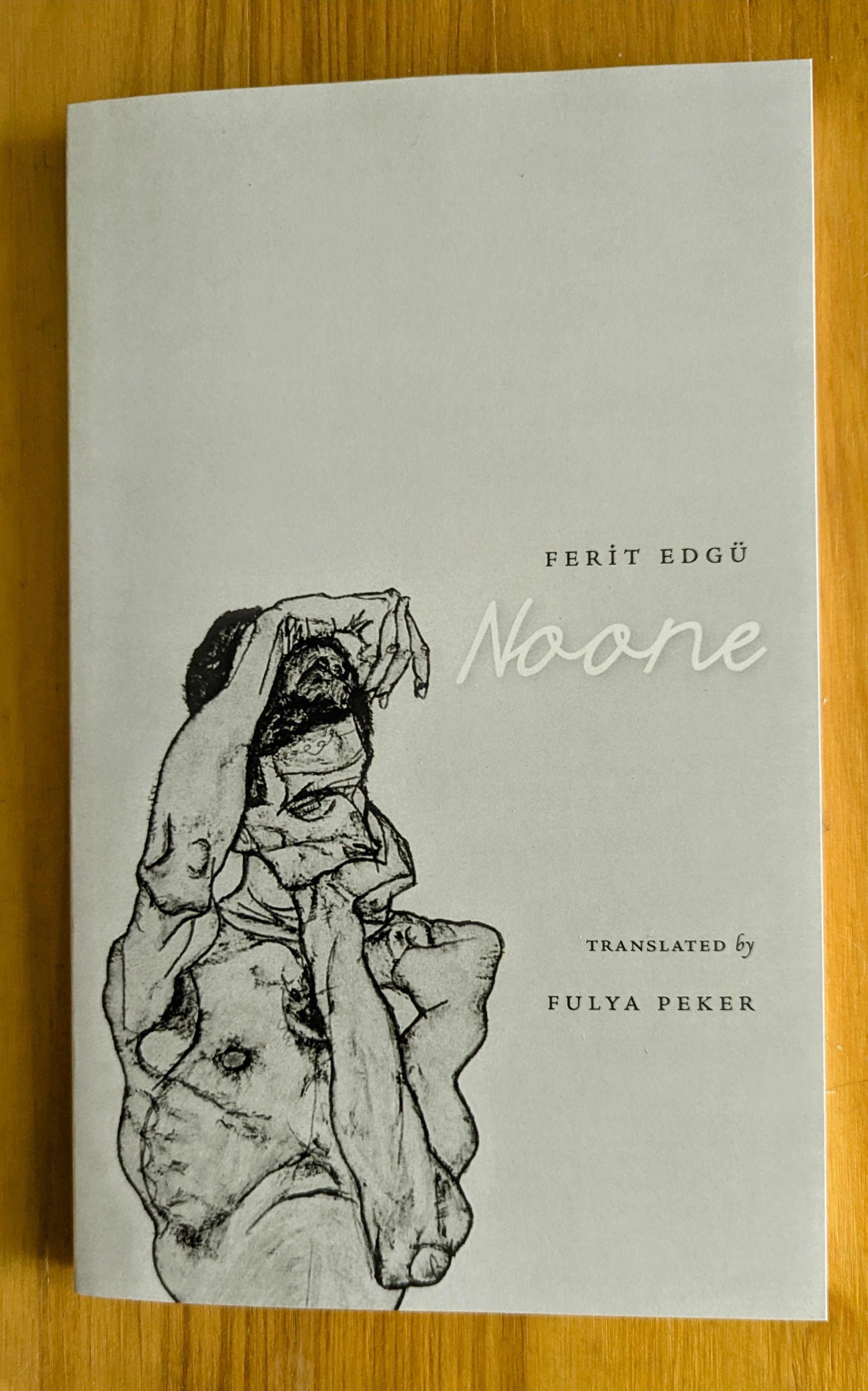
Our loneliness is always plural: Noone by Ferit Edgü

What do you want me to do? says the First Voice.
I want you to talk a little more, says the Second Voice.
Wasn’t it enough? says the First Voice.
Not yet, says the Second Voice.
What should I tell you? says the First Voice.
Anything. Everything, says the Second Voice.
So hard, says the First Voice.
I know, says the Second Voice. But it’s worth trying.
You mean to work our memory? says  the First Voice.
Yes, says the Second Voice. Our scabbed memory.
I don’t remoment anything, says the First Voice. I can’t remoment anything important. Things I remoment are all broken.

Noone, by Turkish writer Ferit Edgü, opens with a chorus of voices, each with an ascribed character or quality—the Initial Voice, the Alwaysasking, the Broken, the Ramshackled, and so on—setting the stage for the unconventional narrative that will follow. Part I finds us alone with two apparently distinct voices, the First and the Second. It is the depth of winter and the voices converse, debate and remoment—a most striking way of saying remember—as they sit together in a dark and cold dwelling somewhere in a remote mountainous region. Outside wolves and dogs howl. Snow falls without respite. And nearby there are others, village residents who, do not share the same language or culture. The Voices interact to pass the time, waiting for the long winter to end and the roads to open. But are they two disembodied voices, two distinct individuals, or one man trying to find company within himself?
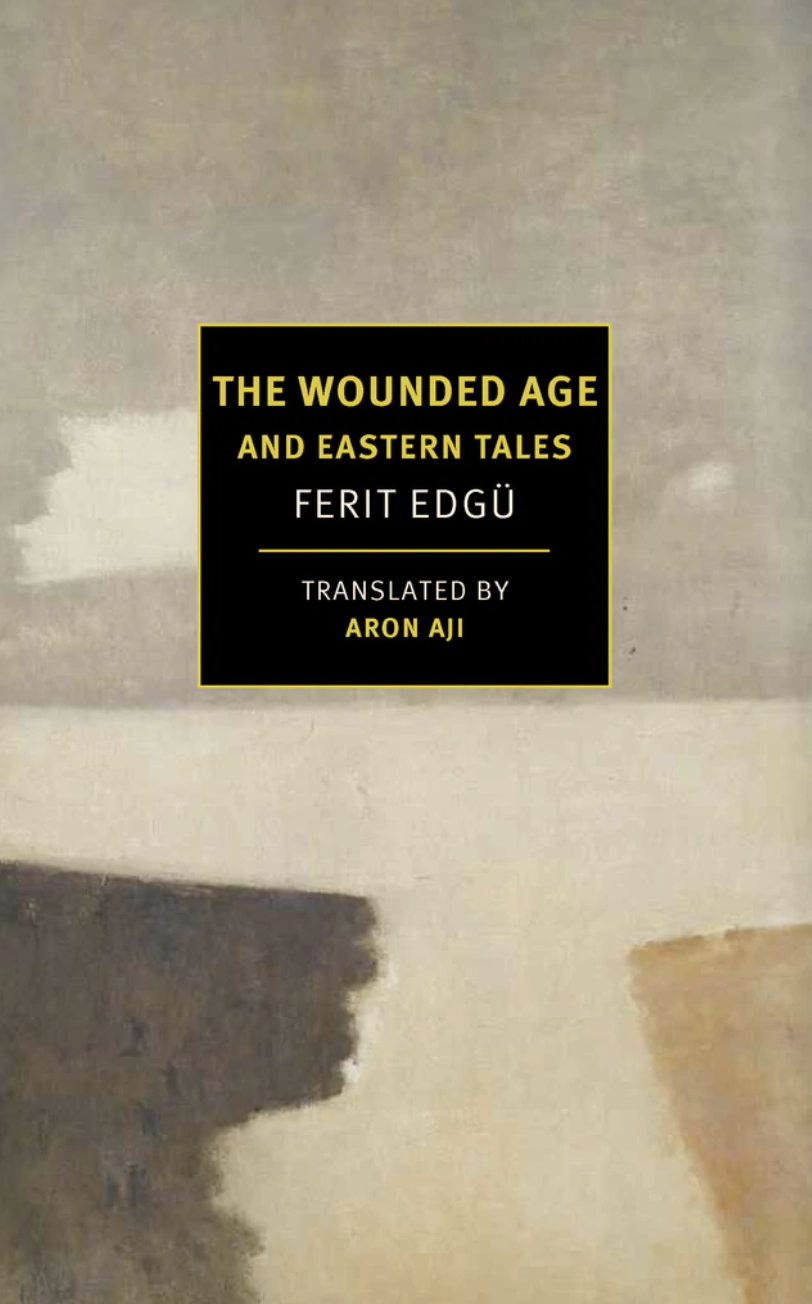
This spare novella, which was composed over the span of ten years, from 1964 to 1974, is a response to what Edgü has referred to as the most transformative experience of his writing life—the nine months he spent, at the age of twenty-four, teaching in the village of Pirkanis in an isolated part of the province of Hakkâri in southeast Turkey. This region, his time there, and its more recent bloody history has influenced much of his writing, including the 2007 novella and 1995 short story collection published together, in Aron Aji’s English translation, as The Wounded Age and Eastern Tales by NYRB Classics. This volume was a runner-up for the 2024 ERBD Literature Prize which will hopefully bring attention to this earlier book. Work on what would become Noone was actually begun while Edgü was in Hakkâri, but the fact that it took him a decade to complete it implies that a certain amount of time and distance was required to articulate and make sense of what had been a profoundly disorienting experience, and, as he says at the outset: “transform a monologue into a dialogue.”

The abstracted doubled character that emerges and recedes during the first part of Noone—the “we”/ “I” / “you” of the First and Second Voices—often resembles a world weary soul, an exile who has travelled far and wide and now finds himself on this mountain top, uncertain how he got there. The Voices share stories, dreams, and memories, often provoking, confusing, or irritating one another. For, as translator Fulya Peker says in her lyrical introductory Note:  “Noone compels us to consider the politically imposed idea of ‘the other’ and how this ‘other’ is not somewhere outside, external to us, but within.” To this end, the use of the grammatically incorrect spelling for “no one” is telling. The translator does not explain this decision or its relation to the original Turkish title Kisme, but because the word appears to function as both a pronoun and a noun, it is an affecting choice. Along with “remoment” and an ongoing shifting tapestry of pronoun usage—you, we, I, he—Edgü is repurposing language, perspective, and narrative in a manner that reflects the shifting personal, psychological, social, and political territory within which his story unfolds.

The second part of the novella, while still featuring the two Voices, steps outside of the snowbound dwelling, at least initially, to offer an account of the protagonist’s arrival in Pirkanis, a village comprised of only thirteen houses and one hundred people, so isolated it is ultimately accessible only by horse or on foot. It is an impoverished community with strange traditions, an unfamiliar tongue, and at least one potentially suspicious resident. Life is hard, death is always near at hand, and loneliness takes on a whole new meaning for the outsider who has come to provide medical support. As loneliness begins to take its toll, the isolation is stark and haunting:

He takes a book Opens He quits without reading
He takes an envelope Opens He tears up the letter and throws it away before getting to the end
He opens the lid of the stove & throws the letter on top of the fading ashes
Again he returns to his mattress
Again his eyes are fixed to a spot on the wall
No
His lips are black and blue
Black and blue lips (only) tremble
His teeth are chattering
Dogs are again howling outside
A stranger is approaching
Or the wolves are coming down again

With no period no comma no question with no ending dead night goes on like this in fragments

An interlude like this, in which the dialogue of Voices is temporarily silenced, feels heavy, intense. Our exiled hero is naked. Stark, spare, and poetic, Noone offers an existential, dramatic portrayal of extreme isolation, not only that of the central character, but of the people he finds himself among.

Noone by Ferit Edgü  is translated from the Turkish by Fulya Peker and published by Contra Mundum Press.

That black night: Engagement by Çiler İlhan

Her hair was like her name. Dark as the night. Cloaking her to the waist. Bilal had been smitten by this hair while still a boy. This he told to Leyla many years later. When she reached the age of twenty, and continued to reject all her matches—including the son of an uncle a few weeks previously—her father Cemal had decided to give her in marriage to Tahsin, a relative from town, so she would not end up ‘stuck-at-home.’ The second he heard, Bilal jumped into his Renault and gulped down seventy kilometres of road quick as a pill. In this village, men know to stay away when the man of the house is gone.

Engagement by Çiler İlhan has all the qualities of a folktale. Set in a small Kurdish village in southeastern Turkey, known simply as “Our Village,” it unfolds over the course of sixteen hours. For one family it’s an auspicious day. The engagement of eldest daughter of Fatma and Cemal is to be celebrated that evening and the entire village is invited to join the festivities. But in the nearby “Other Village,” villainous plans are being made to upset the proceedings. And that’s putting it mildly.

These two villages—caught in a complicated nest of intermarriage, property disputes, and blood feuds—are at once timeless and yet very much part of the twenty-first century. Located in an area neglected by the state, life in these isolated, impoverished communities is simple. Traditional technologies and customs dominate the lives of most of the families, but there is also wealth in terms of land, mineral rights, and agricultural goods to be fought over and defended. Consequently, most of the men are required to participate in regular scheduled guard duty, a task for which they are heavily armed.

The playful, fable-like narrative, delivered by a mysterious omniscient narrator, carries an ominous tone. Reference is repeatedly made to the “incident” that lies just ahead. Complications are hinted at, assertions and accusations that will be made in its aftermath are alluded to, long before any description event itself. You know that something horrific and deadly is coming and that awareness fuels the growing tension. Meanwhile, at the home of Leyla, the bride-to-be, the women go about their preparations with excitement and dedication. Yet, there is a missing ingredient. Leyla’s younger sister Maral has forgotten to purchase the eau de cologne traditionally splashed on the hands of each guest as they arrive for the feast. Since she has other tasks to attend to that day, it falls to her cousin Halil  to secure the required scent.

On his way out to purchase the perfume, the young man is kicked when Chunky the cow is unexpectedly spooked. He hits the ground hard, causing a headache that will trouble him throughout the long hot day.

It is true that Halil’s mother saw him as clumsy fool, but he must have had a capable side too, for how else would he have been one of only three people to give the shroud the slip on that black night? The rest would be buried in the village graveyard he was nearing on his journey that day.

We learn that Halil had had a close call with death when he contracted meningitis as a child and, that he is now a distractable daydreamer with his teenage heart set on Maral. When he finds that he is unable to secure the necessary ten bottles of cologne locally, he is forced to walk all the way to Other Village. When he finally reaches the rival village, home of the evil, violent Osman and his band of brothers, Halil is surprised to find two dolls, representing a bride and a groom, hanging from the branches of the old sycamore in the town square. When he asks those he finds sitting there about the dolls he is treated as if he is seeing things, as if he is crazy. It is not the first time he will doubt his senses.

Throughout the day, a strange, unsettling atmosphere haunts Our Village—omens are witnessed and sudden dust storms blow up, but there is no consensus about any of these reported happenings. Both Maral and her mother Fatma feel anxious, their stomachs in knots. But the community is, of course, already a curious place, peopled by eccentric characters and home to “more than its fair share of crazies and cripples.” This is the inevitable result of the long standard practice of cousins marrying cousins. Residents are tightly connected by blood, but that is not sufficient to assuage long simmering conflicts between family groups. In fact, it may only make it worse. It certainly makes the events that will stain this dark night ever more tragic.

With this spare, haunting novella, Çiler İlhan has crafted a lyrical little tale that packs a devastating punch. No matter how many times the wily narrator refers to the coming “incident,” it is impossible to be prepared for the evil that descends on the engagement party. But the true depth of the horror portrayed in this folktale lies in the author’s Afterword where she puts her story into context.

Engagement by Çiler İlhan is translated from the Turkish by Kenneth Dakan and published by Istros Books.

“Here, on this mountain, there’s the living and the dead.” The Wounded Age and Eastern Tales by Ferit Edgü

Years later, as I leaf through the notebooks,
I see that these people and I,
who didn’t speak each other’s languages,
had understood one another.
I don’t know what language we had I common,
nor do I want to know.
Our common language didn’t change them
but it changed me. I’m sure of it.
Every passing day returns to me the traces
of our shared life in that mountain village;
I see them. I live them.
And these words I’ve been scrawling through the years
are those traces, words wounded like me.

Hakkâri is a province in the southeast corner of Turkey with an overwhelmingly Kurdish population and a long history of violence and displacement amid the various ethnic and tribal communities that have called the area home over the years, up to the present military subjugation of insurgents fighting for an independent Kurdistan. It is a rugged region comprised of mountains, steppes and deserts drained by the Great Zab River and it is the setting, a character in its own right even, in much of the fiction of Turkish writer Ferit Edgü, including the two texts published together by New York Review of Books Classics as The Wounded Age and Eastern Tales.

In 1963, after graduating with a degree in fine arts and philosophy, the then twenty-four year-old Edgü was assigned, in lieu of military service, to a nine-month teaching post in the village of Pirkanis in an area of Hakkâri so remote it could only be reached on foot or by horseback. The experience would be, by his own frequent admission, the most transformative of his writing life. For a young man raised in Istanbul who went on to study in France, it must have been a shock to arrive in such an isolated location, but, as the quote above, taken from the preface to his 1995 collection of short fiction, Eastern Tales, shows, the differences between himself and a people with a culture and language so foreign to him somehow melted away. He was never able to return in person, but his characters, narrators and stories have continued to find a life there.

Edgü’s narratives are, in manner that seems appropriate to the harshness of the environment and the simplicity of the lives of the people of Hakkâri Province, characteristically stripped to the bare essentials. His language is spare and unadorned, often reading as a kind of prose poem, with each sentence or two appearing on a new line. He is quoted in the translator Aron Aji’s Afterword as follows:

I want nothing superfluous in my writing. Texts cleansed of details; the event giving rise to the story distilled to its concisest form…. I’ve tried to do away with narration, fictionalization, similes and metaphors…. I cannot stand metaphorization… [or] descriptions built with ornate words, long, unbearable sentences that serve as signs of an author’s mastery…. Just as we have freed writing from psychology, we must free it from metaphors and similes (nothing resembles anything else).

He relies rather on voice, perspective, and tone, allowing dialogue—internal or external—to carry the narrative force. Meanwhile, the same words tend to appear again and again—bear, wolves, dog, snow, mountain, people—this repetition or, if you prefer, intentionally limited or controlled vocabulary has an incantatory effect.

The present volume consists of a novella, The Wounded Age (2007) and Eastern Tales (1995), a collection of four short stories and seventeen minimal or micro-fictions. The reverse chronological placement is apparently designed to foreground “the trajectory of stylistic distillation” typical of Edgü’s work. The novella is the account of an unnamed narrator who returns to report on a crisis in the same mountainous region he once visited in his youth. According to an essay in The Nation, the inspiration was the Halabja Massacre on March 16, 1988, when Iraqi troops attacked the Kurdish town of Halabja with mustard gas and nerve agents, killing up to 5000 residents and injuring many thousands more. As survivors tried to flee over the border into Turkey, they were blocked by the army. Edgü had wanted to cover the situation but his editors felt it was too dangerous for him. So he relied on his memories of the place and its people. Thus, the incidents depicted in The Wounded Age do not reference any specific event or location (although the border is a key element), and the horrors captured on the faces of the adults and children the reporter encounters and their accounts of rivers of blood filled with corpses speak volumes.

They come in wave after wave. Down the mountains, down the rocks.
Women, men, children. A human deluge.
Some come carrying saddlebags. Others, rifles. Their women and children on mules. Or their wounded.
Not their dead. Those they’ve buried.

Unfolding in short segments, through conversations he has with survivors, army officers, and his patient guide and translator, Vahap, the reporter gradually pieces together a larger tapestry of loss, dislocation, and destruction. He listens. He photographs. His dreams and nightmares attempt to fill in the gaps.

Where’s my mother? Where’s my father? My brother, my sisters?
Where’s my dog? Where’s my house? Where’s my village?
Where are my mountains? Where am I? Where’s here?
Desolate. Eerie emptiness. But a voice kept screaming these questions.
I wanted to photograph this voice. The one asking the questions. That’s why I was sent here. I could hear the voice but saw no one to whom the voice belonged.
Since I couldn’t photograph the questioner, I’ll photograph the questions, I said to myself. And so I did.

The stories collected in Eastern Tales tell of a proud people, with simple lives shaped by landscape and tradition. Sometimes the narrator is an outsider, a teacher or in one instance an architect, who has come into the community with a particular role to fulfil, but other tales belong solely to the people themselves. The longer pieces tend to contain somewhat more descriptive detail than the spare and poetic novella, but most still rely on dialogues—with the attendant confusions that tend to arise between villagers and anyone from outside, be it a larger town or a distant city—or unaffected monologues to carry the thrust of the narrative. In the ultra-short pieces, this is stripped down further. Life in this corner of the world is hard, but it is met by its inhabitants with a stoic fatalism that is well honoured through the sharp focus and stark beauty of Edgü’s prose.

The Wounded Age and Eastern Tales by Ferit Edgü is translated from the Turkish by Aron Aji and published by NYRB Classics. It has been short listed for the 2024 ERBD Literature Prize.