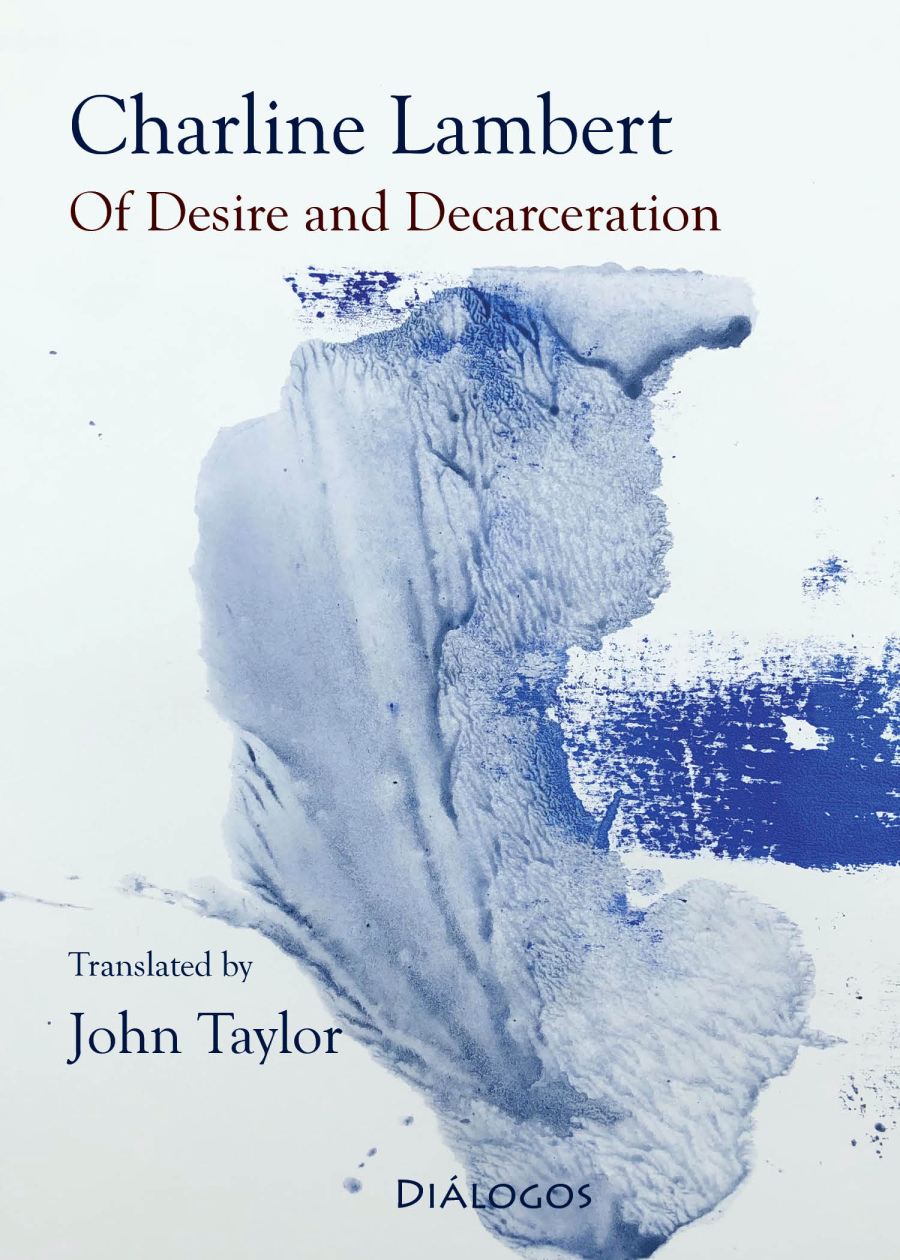
When a poet’s work first appears in translation, it is rarely more than a single volume or an edited selection. Even then, it can take decades for a prominent foreign language poet to be finally be translated and published in English. But for young Belgian-Francophone poet Charline Lambert (b. 1989), the situation is quite different—her first four books of poetry (originally published between 2016 and 2020) have recently been released in one single, dual-language volume titled Of Desire and Decarceration. As her translator, John Taylor, explains in his Introduction (an earlier version can be found online here):
The motivation for bringing forth this substantial corpus is that the four books respond to each other, grow out of each other. They are like stages—beginning with the evocations of bewitchment, temptation, restraint, and detention besetting Ulysses, Circe, and Penelope in the poet’s first book, Hemp and Ivy—of an ongoing quest to grasp the mysteries of desire and gain insight into its innermost relationship, not only with the body, but also with language.
Her work is vibrant, ecstatic, alive—rich with imagery drawn from mythology, philosophy, nature, science and physiology. As someone very familiar with Taylor as a translator and a poet, I can see why he was so immediately captivated by her emotionally and linguistically inventive poetry which he has brought into English with such care and attention.
 To read Lambert’s first four books—each an extended sequence of verse and poetic prose pieces—in sequence is to experience the poet’s deepening exploration into questions of identity, where an embodied self-expression is examined at the minute, physiological level in concert with an expansive metaphysical self-realization within an external world of earth, wind and water. Although subject, voice, and form shift as one moves from volume to volume, her writing is typically spare, and the same essential human forces—desire, solitude, spirit, joy—are present, even if they may be the source (or the outcome) of struggle and pain, while her occasional use of uncommon, even esoteric, words reflects the limits and the potential of language to capture complex states of being—in the body, the mind, and the world. There is a tension in the interplay of all these elements that courses through her work, finding new expression with each successive book.
Her first book, Hemp and Ivy (Chanvre et Lierre), as noted above, reimagines Ulysses’ encounter with Circe and brings Penelope in to the drama. All three characters struggle with desire and temptation in their own ways. For Ulysses, bound to his mast, his desire and the lengths he must go to avoid a tragic fate is depicted with vivid intensity:
. A desire swarms, coming from even farther
than the esophagus, a desire rounder than the
navel, more burning than the urethra. A resonant
canalizing desire, which widens the dikes of the
arteries and erodes the epidermis. It will later
become a song, if it is not hemp.. Circe’s fate is a patient fate.
*
. Naked ivy on the mast, a column of climbing
vertebrae.
. In volutes of breath and nervous arabesques,
he hoists himself into the sky.
. He unfurls his great back muscles of wing or
verve.
From this mythologically themed excursion, Lambert’s work turns towards a more abstracted poetic examination of the themes and questions that inspire her. Her second book, Dialyzing (Sous Dialyses) turns on her idiosyncratic approach to language. As Taylor indicates: “Lambert’s writing, which often appeals to scientific and medical terminology, also sets into motion a poetic and self-analyzing process of ‘dialysis.’” Akin to the medical functions and procedures associated with the term, her subject here is removing an element from her body—physical, emotional, or mental—examining, processing, purifying it through the act of writing and returning it to the embodied form in which she exists. “She is ‘dialyzing’,” hence the title as Taylor has chosen for his translation. This sequence of poems also begins to hint at the struggle to break down the boundaries between the body and the self, a theme that will be explored more directly in her next book.
Lambert’s poetry is perhaps at its most explicitly scientific here, witnessed in the incorporation of unexpected natural and physiological terminology in striking ways as her subject explores the intricacies of her own desires in a manner that blurs or escapes the limitations of the physical form and merges with a natural environment:
. At the edge of a cliff, potent dialysis, she
fights over the infinite with the ocean. But they
breathe at the same gill.. Their breath escapes, enters through a crack,
dashes to lose itself in the volutes of her pleura-
colored dress.
There is a breathless intensity to her verse that is especially evident in this sequence as her subject repeatedly loses, dissembles, and reconstructs herself in a windy, watery, earthy space:
. She unstitches each vertebra from her
spine, carries out the denuding of her neck, her
windpipe, her thighbone.
. Erects them into a new nudity of columns.
. Anchors it in soil, and watches herself grow.
But in the end, she is enveloped once more.
With her third book, Decarceration (Désincarceration), Lambert seeks to redefine identity and existence beyond the prison of embodied existence. The idea of breaking free from an incarcerated state of being (incarnation) is openly explored now in succinct, precise verse, addressed to “You”—a movement, at least in the progressive reading experience, closer to the speaker’s own self. The fleshy matter of the body has a limit that can seem impossible to override, so the first step is to free the language you employ to define your being:
You are a countable solitude.
You are a light shattered
into beams.You are
A barely recognized fire.*
You want to decarcerate the language from you,
decar–cerate these words from your plexus
and every day
you elucidate a knot.
The struggle to emerge is a tension between solitude and longing as a path to both self-identification and transcendence. It is critical to be free to form and shape yourself before being named, defined by a body and a pronoun.
Before evaluating
the situation,draw up an inhuman
report*
Re-forming oneself as meander, winding
into the maze before
the accident,before having to be called
something.
This poetic invocation is open and affirming, and can be understood in more than one sense. In his introduction, Taylor speaks of the many challenges he encountered in his attempt to preserve or replicate the distinct word choices, puns, and double entendres that Lambert revels in. I would suggest that, as a primarily but not entirely unilingual Anglophone reader, one’s appreciation of her poetry is not dimmed for the inevitable loss of some of the allusions and word play. As for her fondness for unfamiliar words and scientific terms, many are essentially the same in both the French and English versions, and my dictionary did see considerable use, something which only served to enhance my reading experience (and vocabulary).
Finally, with A Salvo (Une salve), Lambert’s fourth—and in this context, final—volume, her poetic quest reaches a certain degree of resolution, and an understanding of Taylor’s impulse to translate and present these works together as one becomes clear. Again the voice shifts, as the poet’s speaker adopts an imperative tone, addressing the sensual and physical experience in relation to a natural and cosmic reality. An intense, incantatory rhythm propels this relatively short sequence, with its recurring double-stranded refrain “Inhabit the night / Enter the sea.” This is established in the opening pages as a rejection of the soul crushing cage of darkness:
Never again sight, its eyes aborting the horizon,
. that rude roughness in the psalms of the hand
. from which the song of the clouds is removed.
And an invitation to a kind of whole body rebirth in the water:
Washing oneself–while seeking a flesh in which
. to be, a skin to embody oneself in. A swim.
. A lapse of time. A parturient’s dawn. Then,
. nothing will better express thickness than
. fraying and fleetingness.
The strength of A Salvo lies, not only in its sustained energy—as befits its title—and in Lambert’s own maturity as a poet, but, in the deep satisfaction that arises from reading it as the culmination of the existential quest that unites her first four books of poetry. What a joy it is to have them together in one volume.
Inhabit the night—and these crystals of being,
. emaciated out of deterioration, become meteors.
Enter the sea—and what you have already
. experienced, decimated into a thousand
. scintillations, becomes a sparkling splinter.
Of Desire and Decarceration by Charline Lambert is translated from the French by John Taylor and published by Diálogos.

 roughghosts
A wonderfully, descriptive piece of writing in your critique !
Thank you. Her work is so descriptive and unique. A fantastic form of poetry.
LikeLiked by 1 person
Thank you! I do struggle to write about poetry so I tried to let her verse speak for itself. It’s a wonderful book.
LikeLike
If you are struggling when you write about poetry, I don’t see signs of it in your work (but how generous of you to admit it).
This sounds like a demanding read to me, and I wonder if you found yourself having to reread quite a bit, or whether it simply flowed for you as a reader.
The idea of a dual-language volume, and one including four volumes of work? Fantastic. I wish more presses took that approach.
LikeLiked by 1 person
I don’t always review the poetry I read, especially if i worry that I am supposed to “get” it in a particular way. This eview took me days to pull together especially because it does contain four books. I did not find it a demanding read, her work is very spare and each poem or prose piece was rarely more than a handful of lines. It’s quite abstract and beautiful. I chose to look up some of the medical/scientific terms (which are used in unusual, poetic ways) and I did refresh my memory of Odysseus/Ulysses and Circe and the Sirens though.
It is amazing to have the four volumes published together, thanks, I’m sure, to a translator willing to advocate for it.
LikeLike
I am curious how much “reading around” you do, to sit with, and write a review, like this. Does it sometimes feel like you spend more time reading “around” the work than with the the actual work? I appreciate your explaining which aspects you pursued (the definitions, the mythologies, which I loved as a student but still muddle as a reader) because I want to more fully engage with writing like this too. Sometimes I decide I’m not the right reader for a book, because it seems to be beyond me, but maybe I just need to try harder? heheh Hopefully you know what I mean.
LikeLiked by 1 person
In this case, apart from reading the detailed introduction and looking up some of the esoteric words (which I would want to do anyhow), what took me a long time with this review was to find quotes that capture a sense of the language and determine how to write about a book that contains four interconnected books. I wrote it in fragments and then put it together from the perspective of my reading experience of it as a progressive project. Of course, I usually write in a way that leaves open the way another reader can come to a text, especially with poetry.
LikeLike
Thank you! That second part is familiar, from prose reviewing, so I will try to spend more time with terms and word selection, and see if that improves things for me: I have gotten lazy about looking up definitions, and I think I should also reread supporting material instead of expecting it will stick/resonate with just a single reading when I’m new to the author (or new to their time and/or place as well). Right now I’m reading the trace anthology about translation you recommended and that, too, has me thinking a lot about word choices and detail-oriented reading.
LikeLiked by 1 person