
Since reading The Condition of Secrecy, a collection of essays by Danish poet and writer Inger Christensen (1935–2009) In January, I have set out to read one of her works each month until I run out of available volumes. This past month was largely absorbed by working for and worrying about the Canadian Federal election which has just passed, so my reading was scattered at best, and most suited to poetry and short fiction. I am squeezing this brief reflection on this single-poem volume, Butterfly Valley, as National Poetry Month draws to a close. Note that this is a dual-language edition, whereas the US edition from New Directions entitled Butterfly Valley: A Requiem contains this same translation by Susanna Nied, Christensen’s longtime poetry translator, along with three other medium-length poems, but does not include the original Danish. I intend to get that book eventually, however I would suggest that having the original and the translation face-to-face allows a reader to appreciate the complexity of Christensen’s achievement as it is possible to gain a sense of the musicality and rhyme structure present in the Danish, even though it would be unsatisfactory to attempt to reproduce that fully in the English.
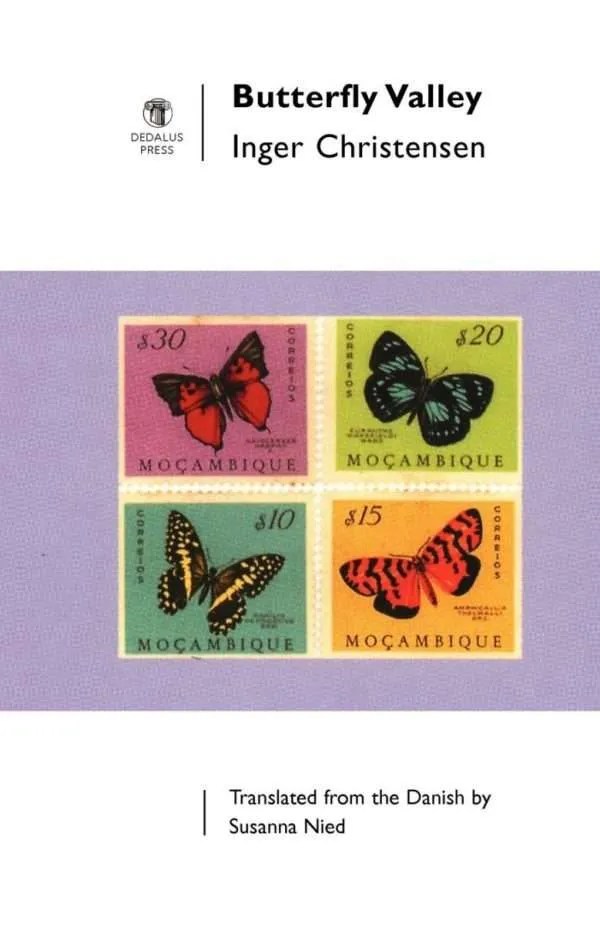 “Butterfly Valley” is a fifteen part sequence of sonnets, the first fourteen linked by first and last lines which are then gathered form the final powerful poem. Christensen was a lover of form, structure, and imagery drawn from science and nature. Musicality was also very important. These qualities all come into play with this sequence which features the fourteen lines of the sonnet presented as two quatrains and two tercets with the rhyming pattern: ABAB CDCD EFE GFG (several follow ABBA CDDC in the first two stanzas). The poems are linked by repetition—through the first fourteen sonnets, the last line of each sonnet becomes the first line of the following one. VI, for example, closes with:
Here gooseberry and blackthorn bushes grow;
whichever words you eat, they make
your life butterfly-easy to recall.Perhaps I will cocoon myself and stare
at the white Harlequin’s sleights of hand,
delusion for the universe’s fool.
And VII begins:
Delusion for the universe’s fool
is the belief that other worlds exist
that there are gods who bellow and roar
and call us random tosses of the dice
The fifteenth sonnet is composed of all of these repeated first/last lines, in order, with the typical rhyming pattern maintained. Each individual sonnet is thus crafted with an eye (and ear) to the finale.
Within this sequence, a host of colourful butterflies rise and fall through the Brajcino Valley’s noon-hot air. Christensen, who believes that poems are composed of words, first and foremost, employs butterfly-related imagery and the names and colours of different species, directly and metaphorically, along with a mythologically-tinged sensibility. But her themes are the very human, even existential, reflections on life and death, love and loss, art and nature.
When with their image-language, butterflies
can use dishonesty and so survive,
then why should I be any less wise,if it will soothe my terror of the void
to characterise butterflies as souls
and summer visions of vanished dead. (X)
As ever, Inger Christensen’s poetry is an intricate and articulate celebration of language, meaning and life itself. This slender volume highlights these qualities well.
Butterfly Valley by Inger Christensen is translated by Susanna Nied and published in a bilingual edition by Dedalus Press.

 roughghosts
I love hearing about new reading projects, especially when they are so different (but still interesting) from my own. I wonder, have you ever been tempted to start learning a new language (even if it never came to be) because a particular a writer so struck you? I feel like parallel text editions really get me thinking about that. (That trace press anthology, with the Arabic and Tamil essays and the side-by-side bits really got to me.)
LikeLiked by 1 person
When I was visiting India regularly I did try to learn Hindi, but would not be able to read it. With the uneasy state of the world right now, my travel lust is greatly subdued. I think of studying language more as a healthy brain exercise and, to that end, I should consider French or German where I have at least some grounding and an interest in literature in both. But discipline… 🙂
LikeLike