The right book at the right time: Just Like Someone Without Mental Illness Only More So

“There are no people anywhere who don’t have some mental illness. It all depends on where you set the bar and how hard you look. What is a myth is that we are mostly mentally well most of the time.”
– Mark Vonnegut, MD 

A couple of years ago I happened to hear an interview on CBC radio, as part of a series on mental illness. I was, at the time, of the mind that my own issues with mental illness were well managed. A present fact but a distant reality. However, something about this conversation stayed with me.

The guest was Mark Vonnegut, son of the late author Kurt Vonnegut Jr. Mark grew up in Cape Cod, in the years before his father’s writing brought fame and fortune. I listened with interest to his very personal account of how, despite diagnosis with a serious mental illness, he applied and was accepted to Harvard Medical School. He went on to become a respected pediatrician. After my breakdown this summer I debated returning to the the fine accounts, like An Unquiet Mind, that had originally guided me to an understanding of my newly acquired label. Then I remembered Mark’s memoir Just Like Someone Without a Mental Illness Only More So and within minutes it was on my Kindle. But I only decided that I really needed to read it this weekend as my symptoms and anxieties continue to persist.
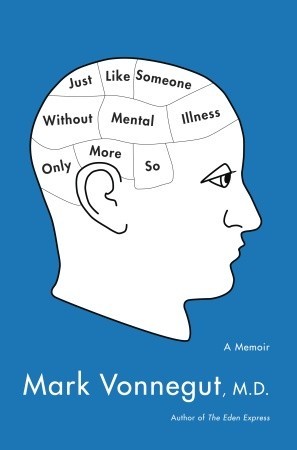
7816284Mark writes in an honest and matter of fact way about the trail madness has left through his family, tracing a legacy of depression, suicide and alcoholism going back generations. His mother heard voices and received message from license plates but once the episode passed she was able to rationalize it. When Mark’s aunt and uncle died within a month of one another leaving four troubled orphans, his parents took them in even though they had neither the money nor the capacity to manage. His oddly prescient mother had been stockpiling supplies for their arrival in advance, as her helpful voices had advised.

Mark was a loner spending a lot of time fishing and playing imaginary games in the woods around his home in Cape Cod. The oldest child of the family he grew up poor in the fallout of the the Depression. His father was a ineffectual used car salesman for many years. Mark was 21 before his father became a rich and famous author seemingly overnight.

Caught up in the hippie movement of the 60s, Mark followed many of his peers to Canada to join a commune in BC. He lived off the land, contemplated the meaning of life and experimented with drugs. And that is where he first encountered his own voices. In 1971, at the age of 23 he experienced three major psychotic breaks that landed him behind the locked doors and plexiglass windows of a Vancouver hospital.

“Among the things I grew up thinking about mental illness was that it was caused by other people or society treating you badly.I also knew that once people were broken they didn’t usually get better and the ones least likely to get better were paranoid schizophrenics, which is what I seemed to be.”

Retrieved by his father, Mark returned to the US where, with ongoing treatment, he continued to recover. The voices faded to the background. He published a book about his experiences and articles advocating for an understanding of mental illness as a biochemical condition, in strong opposition to the RD Laing inspired philosophy that was popular at the time (and has recently resurfaced). Somewhere along the way he decided that he wanted to go to medical school himself. Against all odds, and with pathetic math and science marks, he applied to one school after another. Incredibly Harvard gave him a chance.

Over the years that followed, Mark dedicated himself to his studies and his internship. By this point he had recognized that he was bipolar (not a schizophrenic who responds to lithium as he had been told), but even then, the schedule of an intern is grueling. During these years he also married, bought a house and started a family. The model of normal and healthy he figured his mental health issues were history.

Then 14 years after his third psychotic break, several years into a successful pediatric practice, the voices returned to taunt him. The trigger was his realization that he was fueling his high stress schedule with a two pack a day smoking habit along with 5 or 6 beers, half a bottle of wine, a few shots of bourbon and a sleeping medication to round off the day! Hardly a surprise then that his effort to quit cold turkey should trigger a psychotic break.

Although he sensed things were falling apart he resisted seeking help in a hospital. Driven by an absolutely irrational fear planted in his head by his voices he attempted to throw himself through a third story window. The window smashed but he fell back into the room. Unfortunately he ended up in a straightjacket on a gurney in the hallway of the very hospital where he had completed his internship and taught a course.

Although my own manic resurgence following an extensive period of wellness was somewhat less dramatic than Mark Vonnegut’s, it is only a matter of degree. Yet in time he was able to return to work and it has now been more than 25 years since his last manic break. His ability to rebuild his life and career even in the face of abject humiliation is an inspiration. And I am fortunate that I have neither smoking or alcoholism to contend with. But his story stands as stark reminder that with bipolar you must take the medication that keeps you stable and monitor your own level of energy. If we become complacent we risk an unwanted replay, no matter how long we have been well.

This book was published in 2010, so It was not available when I was first coming to terms with my diagnosis. Perhaps if I had read it when I first heard the interview I might have been able to head off my more recent experience. But then again, a manic person is a slow learner because that high just feel so good. Especially in contrast to the draining and  despondent opposite end of the cycle.

I would recommend this memoir to anyone interested in mental illness, especially those who understand what it is like to experience psychosis. Its casual, relaxed style makes for an easy read but, as a practicing physician, Vonnegut has some depressing observations about the decline of health care in his own country. Most importantly though, he leaves those of us who live with mental illness with a sense that we can get better, we can stay better and if we fall, we can get up and move forward.

That is exactly what I need to remember right now.

Making peace with our ghosts

There is a question tends to haunt those of us who live with mood disorders, especially in the early months of adjusting to a diagnosis or in the aftermath of breakdown:

Who Am I?

There is this persistent fear that, if the highs and lows of this “disorder” should ever hit equilibrium, what will be left?

And will that stable “me” be the real me or a medicated artifact?

Copyright JM Schreiber 2013

The theory is that mood disorders are typically associated with “normal” periods but as most of us know, mania and depression can simmer under the surface, felt rather than observed for a long time. When symptoms burst through resulting in “abnormal” thoughts, actions and behaviours, those around us rarely understand that these are beyond our control. And because insight is impaired, when we are at our most unstable we are often the last to know just how far off the rails we have run. All this is further complicated when a mood disorder exists in conjunction with addictions or trauma or other chronic conditions.

Having a mood disorder is like living with ghosts.

But we own those ghosts. They are us. Everyone has them.

Ours just like to try to steal the stage, set the agenda, write the script and direct the show.

Maybe that is why I am drawn to so much fantastic literature lately… allowing the ghosts of others to distract me from my own.

Leaving the Atocha Station – The neurotic American poet in Spain

I recently read Ben Lerner’s acclaimed first novel Leaving the Atocha Station. I bought the book in 2012 but had put it aside, uncertain I wanted to spend time with a narrator I expected to be a misanthropic American slacker poet slouching his way through the streets of Madrid. When I happened to catch the replay of a CBC radio interview with the author my interest was rekindled, especially in light of my recent breakdown and the therapeutic comfort I have been finding in poetry.

indexSure enough our narrator Adam Gordon is an ambivalent and emotionally insecure young poet who has chosen to spend a fellowship year in Madrid. Ostensibly his aim is to explore, in verse, the impact of the Civil War on Spanish society although he seems to have precious little direction or inclination of how to begin his project beyond attempting to improve his comfort with the Spanish language. He seems to have a cultured skepticism in the value of art and the validity of the artistic experience which in turn causes him a healthy dose of self loathing. He passes his days smoking hash and cigarettes, while relying on the security of tranquilizers and mood stabilizers. He reads Tolstoy, Cervantes, and John Ashbery. Beyond that he parties and awkwardly attempts to conduct love affairs with two Spanish women.

The resulting novel is a surprisingly humourous and engaging exploration of the struggling artist who refuses to struggle. Adam spends much time trying to make sense of what his new Spanish friends are saying and attempting to compose the facial expressions that he assumes will be appropriate for the circumstances. If in doubt he hides behind the prop of a cigarette. Yet it is not only the dislocation of being in a foreign country that accounts for Adam’s feeling of always being one step out of sync. He also believes himself to have bipolar disorder although it is never entirely clear that this is a confirmed diagnosis or a justification for the little yellow and white pills that he relies on. I’m not certain if Lerner, himself an established poet, is playing with the idea that neurosis is an essential element of the artistic process. Nonetheless Adam embraces it fully, manipulating his medication to ramp up the production of poems for a Spanish translation without any real sense if he is producing anything of worth.

Ultimately he crowns this phase of intense creative production with a grand manic splurge, thanks to his parents’ credit card, to impress one of the women he imagines himself in love with. An insanely expensive dinner and a night at the Ritz Carlton coincides with a tragic early morning blast at the busy Atocha Train Station, the 2004 attack by Islamic militants that killed 191 commuters. The street protests and the involvement of Adam’s wealthy young Spanish friends in the demonstrations and elections that follow this terrorist attack serve to force him to ground himself, even just a little.

The most engaging aspect of this book for me was the continual sense of self consciousness that pervadesAdam’s thoughts, plays with his confidence and keeps him from ever feeling that he is at home in any setting. His anxiety causes him to sabotage his potential relationships (or at least believe he is sabotaging them). He is alternately cocky and absolutely certain everyone else is humouring him. He spends time composing his face, adopting poses and pulling himself together in public settings. If you have never lived with a mood or anxiety disorder such obsessing might seem like poetic license. I found it uncomfortably familiar.

And those little pills Adam keeps reaching for… I have had to rely a lot on those myself lately.

As we know, it’s all fun and games until somebody loses an eye

We have all heard this expression, probably said it ourselves if we are parents. Somehow, today, as we continue to simmer in the aftermath of the news of Robin William’s tragic suicide on Monday, this is the thought that keeps coming back to my mind. For those of us who live with the very harsh reality of a mood disorder his death holds a special poignancy. So does the inevitable, endless discussion that only unexpected celebrity death seems to be able to generate.

I am presently on sick leave after a severe manic episode and although I feel the worst of my own suicidal ideation has passed, the extreme mixed state I passed into as medical resources were amassed to put the brakes on my mania was the worst I have known to date. I relied heavily on the local Distress Centre at all hours of the day and night and as much as practical on my elderly mother and young adult children. Otherwise I was intentionally and completely ostracized by my employer and they have yet to follow up on my well being. Still I feel fortunate. Robin Williams and countless others are not so lucky.

In the wake of his death, everyone seems to be turning in to look at the darkness haunting so many seemingly outgoing, humorous, entertaining and outgoing individuals. It seems to me like the attention is so keenly focused on depression and addiction. But when he was working all out, brimming with manic energy the danger signals were just as evident. But we were too busy laughing, crying, and being entertained to be concerned. It’s all fun and games…

Another public media post mortem comment that disturbs me is the observation some people have made that he seemed to hide behind his characters, whether in his improvised comedy or the countless powerful and engaging individuals he portrayed on screen. From this they extrapolate  that it is as if he was hollow inside. As if only an individual so empty and devoid of being could ever be driven to take his or her own life! I am no expert on Robin Williams, I never met him, but I would not be surprised to learn that he was a deep and intensely private man. Probably shy and insecure too.

For many people who grow up with an inclination to conditions on the mood/anxiety disorder spectrum, there is often a lot of social isolation. I know from my own experience and that of my son, social interaction does not come naturally to some of us. The need to compensate can drive such people to the creative arts – drama, music, literature for example. Likewise such individuals can be drawn to academic pursuits where energy and intellectual drive can lead to striking success. After all, there can be long periods of essentially “normal” function, especially if one avoids the trap of alcohol or drugs as a means to cope.

From my own recent experience, it seems to me that our western society, rewards the mildly manic. Over the past nine years I worked at a small agency where I routinely held the largest and most complex caseloads and took on any extra assignments placed on my desk. I developed programs, trained staff. I was rarely sick and frequently had to struggle to squeeze my allotted vacation time in before year end. I loved my job.

At home I was a single parent with two teenagers, each with their own special needs. There was whole full time round of responsibilities that fell into play outside the office. Then about a year ago things at work got crazy. The Director was exhibiting signs of significant cognitive decline and it was left to myself and a junior staff to monitor and report on the increasingly toxic state at the office while the Board of Directors tried to decide what to do.

As senior management I took the brunt of the responsibility, workload and, ultimately, abuse. I became irritable, overwhelmed and distressed – big time manic. Although I had always been open about my bipolar diagnosis no one recognized the warning signs until a chance comment about how fast I was talking hit me like a ton of bricks. I immediately pulled myself out but by then it was too late. And it is all still seen as entirely my fault, my failure to control my behaviour.

I wasn’t funny, no one was laughing and I am the only one who lost an eye, figuratively speaking of course.

In the early weeks of my sick leave I remember thinking that if I took my life, maybe my employers would realize how truly sick I had become. Of course it would have only reinforced my madness and saved them the complication that as a disabled person I have human rights protection.

Loveable madness is remembered fondly. Margot Kidder digging garbage out of an alley is not. On a more horrific level, the nice ordinary person who seems to suddenly snap and takes the lives of family or strangers is not. However mental illness is a critical subject that we cannot afford to ignore.

After all, it’s all fun and games until somebody loses a life.

R.I.P Robin Williams

For the love of gravy

Today I am thinking about gravy.

There is a dish which has become ubiquitous in Canada – fries smothered with gravy and cheese curds – the French Canadian artery clogging delight called poutine. Many years ago when I lived in Ottawa it was a treat to cross into Québec, follow some back road instructions to a truck, seemingly parked in the middle of nowhere and order the authentic dish complete with cardboard container and plastic fork. Personally my tastes have changed in 30 years, so while some version resembling poutine can be found at most of your favourite fast food haunts, but I will leave you to it. My kids, on the other hand, love gravy – with or without the cheese curds.

poutineToday my wish for my son is gravy. At 24 he has been struggling with an addiction to alcohol for several years. He is aware that underlying the addiction is the mood disorder that knits so much of our family together. Yet his experiences in anything resembling conventional mental health care have been quite horrific for an intelligent, gifted child. As far as he is concerned, alcohol is preferable to medication or therapy. I can appreciate where he is coming from but I chose to take my risks with the prescribed meds and I have been spared the temptation to turn to alcohol that has marked many other family members over the years. Not that it has prevented me from falling ill again but life has no guarantees.

Living with mental illness is not easy. Addiction adds to the burden. But I love my son unconditionally and understand that, in the end, his life is his own and he is the only one who can really come to terms with his own blessings and curses.

Lately we have been fooling ourselves with the idea that he can maintain a minimal alcohol intake and get by. However, this morning after a night of heavier drinking and the inevitable conflict such situations evoke, he finally admitted that he cannot live without alcohol and that it is interfering with everything he wants in life. He poured out every remaining drop and gathered all the empty cans and bottles to return.

Will it hold? It is a critical start, as close to bottom as I have seen him reach to date. So I want to offer him gravy. Poets, artists, musicians and writers who nursed their muse with alcohol or drugs are well known and a tragic number paid a steep price. But I want to offer my son Gravy, a poem composed by the incomparable Raymond Carver after a diagnosis of cancer. Although illness took him early it was not for alcohol – that was a battle he won and was rewarded with the time to create a body of poems and short stories that have inspired and moved so many. And that is a victory he celebrated as, of all things, gravy:

No other word will do. For that’s what it was.
Gravy.
Gravy, these past ten years.
Alive, sober, working, loving, and
being loved by a good woman. Eleven years
ago he was told he had six months to live
at the rate he was going. And he was going
nowhere but down. So he changed his ways
somehow. He quit drinking! And the rest?
After that it was all gravy, every minute
of it…

Excerpt from Gravy by Raymond Carver,                                                                         All of Us: The Collected Poems, edited  by Tess Gallagher, Vintage (1996)

Time – too much or never enough

During the past year, I was haunted by an overwhelming pressure that I needed to be able to slow down, take stock of my feelings. I was becoming aware of a wall coming down between myself and my emotional grounding.

At work a toxic environment was brewing as our director became increasingly paranoid and unstable. My daughter was trying to impress an unreasonable employer at her own workplace while, at home, my son who has long struggled with his own mental health and addiction issues was going through an especially difficult, potentially violent series of conflicts with friends. Just to keep my head above water I was going through the paces. A familiar process. Single parents tend to develop this coping skill.

It is strange how life gives you time to reflect when you need it the most.

Summer grassAlthough I have lived with the ups and downs of a mood disorder for most of my life, a full manic break and diagnosis did not come until I was in my mid 30s. Until that time I felt like I was lost at sea, battling waves I could not put a name to, but hanging on and, as much as possible, faking my way through the years. After all, unless you know better, you figure that everyone else is essentially doing the same thing.

With the diagnosis and other critical underlying issues that subsequently came to light, my life started to make sense. I felt I had some answers, some sense of a guideline. It was not an easy prescription and there were costs, including the end of a long marriage, but I prided myself that I had persevered, that I had survived. Although I was late to the game I was able to build a career that allowed me to support my children, buy home and start to put away some money for the future.

Now the reality of the diagnosis has cruelly returned to confront me leaving me unable to know if returning to the job I had is either possible or even desirable. I find myself re-evaluating what I want for myself.

Something that haunts me this go round is the notion that people with mental illnesses, bipolar in particular, have a shorter life expectancy. Although the reasons, methods of study and populations under consideration is not clear this is not a factor I ever considered before. Funny thing, we are bombarded with the message that we have to be prepared to support ourselves financially for longer than previously expected and yet we see people die prematurely – of natural or unnatural causes – all the time.

Fact is, life offers no guarantees.

Read. Travel. Write.

Either everything has meaning or nothing has meaning.

Too anxious to read?

It should be a luxury to be freed from the demands of a regular work schedule, with no shortage of books to read and time to stop and reflect on where one is at in life. In fact that is the mandate, so be it, of my present circumstances. I am on sick leave with no pressure to return to the workplace and an expectation of a reasonable income to see me through the next few months. At the moment I know I am too fragile to consider working anywhere and my employer has been less than forthcoming as to whether they foresee a place for me in the future. I just know it would be reckless to engage in any employment related discussion or decision making for a while yet. So I find myself with time on my hands.

I should be reading more. Yet I feel like I read more when I had barely a minute to spare.

I have been cocooning myself with stacks of books and, like any book addict, have continued to browse for and purchase more. I have four underway – two old school paper format, two electronic – one serious literary, one non-fiction, one genre fiction and a collection of short stories. Each one is excellent but I seem to be struck with some inability to stay put without great anxiety building and the sense that I should be somewhere else. Or rather in some other book. So I put down one and pick up another.

Sometimes I try to take a walk, grab my neglected camera hoping to find inspiration, or at least distraction, in these gorgeous summer days. That’s what I did today, but I happened across a sidewalk sale outside the most fantastic bookstore along my way and came home with six more books!

I’m not used to anxiety. It seems to eat away at an ability to focus in a way that neither the ups or the downs of my regulated mood disorder ever has. The overwhelming sense of unease, the unknowns, the uncertainties appear to be keeping me from finding solace in the written word.

Boardwalk into the darkHopefully this shall soon pass because it would be a crime to worry away such valuable reading time.

Reflections on a most intriguing Booker nominee – The Wake

6898212431_742cf14ae7_zSo the Booker Prize Longlist for 2014 was announced this week and, as much as I like to think that this is a list that does not hold quite the same seal of approval and impact that it once had for me I must confess that I am a sucker for these lists all the same. Generally, over time, I do manage to read more more than a few of the long and or short listed titles, and in doing so, I am invariably exposed to authors I might not have otherwise read. I am not likely to radically alter my looming to be read list just to have a go at a few of these titles in advance, but I did want to take a moment to look back on the most unlikely contender and, as it happens, the only one of these books that I have already read. The Guardian review that brought this title to my attention was so deeply intriguing I just had to read it as soon as possible. I have only just learned that it was a crowd sourced project, a factor that makes its appearance on the Booker Longlist that much more, shall we say, against the norm.

The Wake by Paul Kingsnorth is an historical novel set in the years immediately following the Battle of Hastings from the perspective of the very ordinary and simple farm and townspeople who were watching the world they knew turned upside down by a foreign invader. The magic of this amazing tale comes through a very creative and effective use of language. It is written entirely in a shadow tongue designed to evoke the feel and mindset of Old English while retaining accessibility for those of us who are not OE scholars. It may sound like a gimmick but the approach actually affords a unique immersive experience.

WakeKingsnorth relies on much authentic vocabulary without being unnecessarily rigid, while recreating the syntax and common spellings of Old English (using only the letters in use at the time). As a reader it takes a while to develop a feel for the language. At the beginning I found myself translating the directly in my head, the way I do with my rudimentary French, but soon that process fell away. It helped when I discovered that there was a most illuminating author’s note on the reasons for his approach to creating this language and I would suggest that a reader review this early on. I read the book on a Kindle as that was the only edition readily available in Canada at the time so I did not realize the supplementary sections, glossary and extensive bibliography existed until I was well into the book!

What takes this small novel beyond a purely literary or historical exercise is the skill with which Kingsnorth brings his chosen narrator to life. Buccmaster of Holland, is a proud socman or freeman landholder, who leads a small band of self-styled greenmen in guerilla warfare against the Norman invaders. They make for a rather motley crew and our leader is no Hollywood inspired superhero. As the tale unfolds we become increasingly aware that this coarse, paranoid, prejudiced man is clinging to a deeply superstitious tradition that was on its way to being replaced by Christianity long before the French arrived. We find ourselves bound to an increasingly delusional man with dark secrets of his own. Kingsnorth himself describes this novel (his first) as a post-apocalyptic tale set 1000 years in the past. Of course it also has strong echoes in the vast number of occupations and conflicts, large and small, that continue to haunt communities and cultures throughout the world today.

I first read this novel three months ago and loved it. However I look back on it with some measure of discomfort as I now continue to come to terms with the fall out of from a serious manic episode. In the leadership role I held at my workplace I became increasingly stressed under mounting pressure and, although I can’t remember, I must have seemed erratic, irritable and well, unstable. The truth of madness, is that you cannot see it from inside. For a long time you may sense that something is wrong but in the end you lose all insight and judgement. The narrator who guides us though The Wake, is a complex troubled character, but given his challenges and his panic at seeing his world – on the fundamentally economic and spiritual level – slipping out of his grasp, his sanity is at stake. I cannot imagine I would have fared any better.

Literary prescription: The Sound of Things Falling

I am now a few weeks beyond the significant manic episode that has ground my life and work to a halt and precipitated a sudden crash into depression, anger and frustration. The crisis did not happen overnight and the healing will take time but I feel some measure of relief that my ability to lose myself in a book has been returning. Some additional anti-anxiety meds are helping too but I am trying to remain open to literary whims – reviews, suggestions from readers I respect, stray quotes that catch my attention. It seems to be critical medicine for me.

Fortunately there is also that wellspring of rewarding fictional riches, The International Impac Dublin Literary Award. Each year nominations are commissioned from public libraries around the world to create an extensive longlist from which a shortlist of 10 titles is ultimately drawn. It is inevitable that works in translation tend to feature prominently both  in the shortlist and among the archive of winners. Purists can argue over the Booker all they want, this is the award I watch.

winner_slide_2014This year’s winner, just announced in June, is The Sounds of Things Falling by Colombian author Juan Gabriel Vasquez, translated by Canadian Anne McLean. This book had been waiting on my ereader for some time, but in light of its recent honour, I thought it might be time for a closer look. A few pages in and I was hooked. Billed as a literary thriller I was expecting a perhaps an entertaining diversion from my own troubles but in truth I soon found myself  deep in a remarkably intimate account of the impact that traumatic experiences have on those directly effected and those around them in ways we often are powerless to predict or prevent. Whether the trauma results from actions chosen or events over which an individual has little or no control the fallout over days, month and years can lead to fateful decisions, ruptured relationships and deep wounds. At the core of this novel are two strangers, brought together through an act of violence who find temporary refuge in a sharing their own experiences of coming of age in Bogota at the height of the drug fueled wars of the 1970 and 80s.

Personally, as I struggle to make sense of the pressures, stresses and events that collaborated to make such a mess of my recent months, it is difficult not to vacillate between anger and regret. Although I know that mood disorders play havoc from the inside out and that the person who is suffering knows something is wrong, they may be slow or even unable to define the nature of the condition, and most certainly incapable of stopping it on a dime. Playing the “if only” card serves no significant benefit. As Vasquez’s narrator Antonio muses as he sets to record the experiences he wishes to share:

“There is no more disastrous mania, no more dangerous whim than the speculation over roads not taken.”

I was able to lose myself in this novel but it did not serve as quite the distraction I expected from a “literary thriller”. There was a disturbing real world resonance that I could not have anticipated. The Sounds of Things Falling is more than simply a title, it is an experience repeated and echoed throughout the novel. From a airshow stunt gone terribly wrong, to a fatal drive by shooting, to the devastating crash of a jetliner. Because a key character was a pilot, de Saint-Exupéry‘s The Little Prince also features as a beloved childhood tale. It was disturbing to imagine the little prince asking the pilot if he also fell out of the sky when bodies were literally falling out of the sky as Malaysia Airlines MH17 exploded over a disputed region of the Ukraine.

Trauma, small and personal or wide-reaching and global and all shades in between have always marked human existence. It divides and unites us in large and small ways. the complexity of that experience is, for me, one of the primary themes explored in this worthy literary award winner.

Negotiating tangled emotions

The aftermath of madness leaves its own measure of grief.  Because the manic end of the bipolar experience is by nature expansive, the episode is rarely one that occurs in isolation. At the very least, strange, anxious and pressured calls are made. Sometimes to strangers. Sometimes to those you know. Friends and families may observe the cracks as they start to spread. The first tremors may be intermittent. They can look like occasional or periodic moments of stress – the bad days anyone can have. When things start to spiral out of control I suspect it is already too late. For the person inside the experience, the pressure, the racing thoughts, the inability to sleep or find relief from the escalating crisis becomes a space in which all perspective is lost.

And generally there is damage.

At the most severe there can be serious physical harm, violence toward the self or others. More typically major manic episodes impact relationships, bank accounts or jobs, sometimes beyond repair. Yet in the middle of it all is a person who is very ill, who will need time to recover physically and emotionally for whom there is frequently very little understanding or sympathy. Especially when they are isolated.

14629062611_de5f459467_zAs I struggle to cope with the rotating cycles of sadness, embarrassment, anger and fear following my recent breakdown I am aware that because no one from my workplace has contacted me, no one has any idea how severely ill I have been. They just remember the last days of fractured functioning before I was finally able to get away from the office. Four weeks later I am exhausted, still unable to regulate my sleep and uncomfortable driving beyond my immediate neighbourhood. When I am deemed well enough to return to work my employers will be able to imagine this “illness” was all a convenient ruse and I have reason to believe it will be held against me. The nine years I worked there and the senior management position I held under increasingly toxic work conditions will mean nothing because it was always an environment in which your work was never acknowledged or appreciated. My mistake was to care enough to stay because I believed in the work we were doing.

The emotional roller coaster is the worst. It is interfering with the comfort and enjoyment I have always found in reading and photography. It finds me moaning and wallowing in self pity when I’m not trying to push grief and anger behind me. And my young adult kids and 80 year-old mother deserve a break from having to listen to it all.

And I would much rather be blogging about books and ideas, not the black heartache of depression.