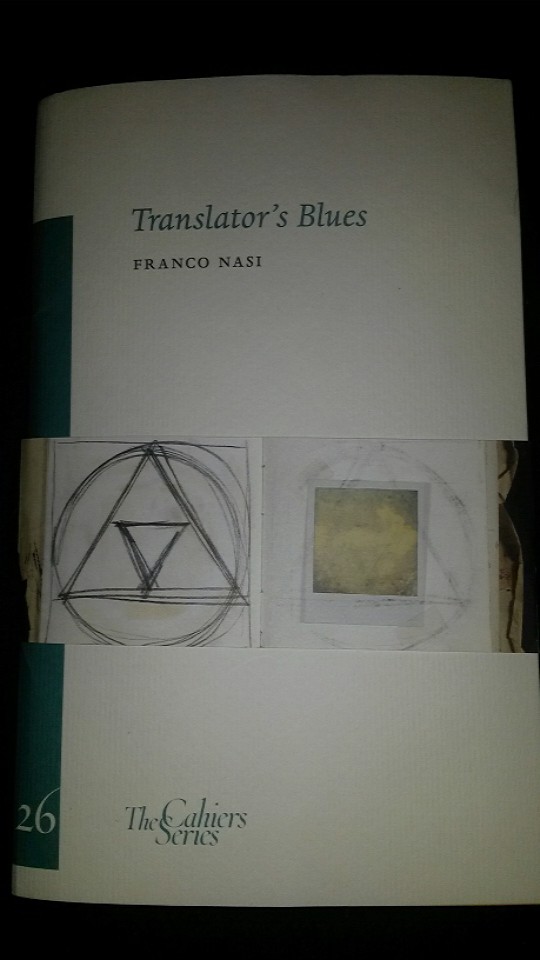
Words, the most vital gift: Translator’s Blues by Franco Nasi (The Cahier Series, #26)

Charged with the task of bringing a piece of text to life in another language, for another culture, and possibly also for another moment in time perhaps centuries after it was originally conceived and recorded, the translator stands armed with words alone: “imperfect, approximate, or a tad reductive”. But, employed with skill, sensitivity and creativity; words can facilitate a little literary magic.

2016-01-18 01.59.14Translator’s Blues, the latest addition to the Cahier Series of the American University of Paris (#26) is an imaginative discourse on the dilemma of translation – a meditation on the interplay between language and culture, facilitated through words; an elegy for what is gained and what is lost in the process. Italian translator Franco Nasi adopts the voice of a naive alter-ego who is, like his creator, a translator who hails from the province of Regio-Emilia where he was born and expects he will die. His home – with its mountains, Parmesan cheese factories, and cemeteries laid out like miniature cities behind high walls – is a place which makes sense to him, a world that is idiosyncratic but familiar. He is grounded there.

When he chances to befriend an American architect who is visiting his fabled region of Italy, he is offered an invitation to travel to the States in return. After a brief visit to Vermont, our translator finds himself in Chicago where his host is presently employed. As our erstwhile hero makes his way through the linguistic landscape of America he finds himself exploring of the boundaries of language that are blurred when one endeavors to navigate the tricky waters that lie between one culture and another. Through an account of his adventures and encounters he orchestrates, with insight and and a measure of impish delight, an argument that translation is, at its best, an inexact art form. However, rather than seeing that as a limitation, he celebrates the challenges, possibilities and rewards of bringing a piece of literature to new audiences that would otherwise be denied access by the borders of both language and culture.

Our narrator’s journey of discovery starts inauspiciously on a snowy Sunday morning in Chicago when he sets out to purchase non-alcoholic beer from a nearby shop. Bemused by his inability to procure alcohol of any description before 11:00 AM, he inquires of his host as to whether this is a daily reality or one confined only to the one day. He learns that it is, in fact, a law applying only to Sundays, to what are known as the “blue hours”. Blue. This is a word that has a special impact for our translator. He had just finished reading William H. Gass’ On Being Blue: A Philosophical Inquiry. He was given the book so that he could assess its suitability for translation. Thus it was with a translator’s eye that he read it, and he found himself rather out of his range. He was inclined to wonder if attempting to translate a book like this, with its multi-layered references to the significance of the colour blue, would be at all possible. References in some instances, such as those with sexual or potentially pornographic overtones, would likely be rendered nonsensical to a culture that tended to associate the same arena with the colour red. It would, he feared, surely induce in him a state of melancholy:

“… a malady that takes hold of you whenever, after a thousand false starts, you find yourself being invested by an overwhelming sense of inadequacy and impotence. This blue-tinged malady makes the translator wish that Babel and the multiplication of languages were only a legend, and that all the various languages in the world did not exist and had never existed. With melancholy comes nostalgia for an ur-language, in which all colours and all their meanings were the same for everyone, in which plants were identical for all and sundry; in which flowers, and sounds, and ceremonies, every object and sensation, and belief was expressed in a single, universal, manner, in which a rose was a rose was a rose.”

All the culturally and linguistically entrenched peculiarities of blue aside, Nasi allows the shade to colour, if you will, much of the exploration of the art of translation that follows. His translator is led, most immediately to a famous Chicago blues bar. As he soaks up the atmosphere and the music, he reflects on the translation of African traditional music to America, facilitated through the songs that black slaves brought with them. Typically based on a pentatonic scale, these songs are echoed in the adaptation of one musical “language” to instruments designed to the specifications and precision of the chromatic scale. As a consequence, notes tend to slip a little out of tune, to bend, and acquire the nostalgic, mournful tone, the blueness, that we associate with the blues. On his way home he contemplates the resonance between the music he has been enjoying and his craft:

“Could it be that any translation, if it seeks to be more than a cold and sterile transposition, must contain blue notes? A translation needs blue notes to hint at an elsewhere, at nostalgia, and with nostalgia the tension provoked by unappeased desire for whatever is distant and unreachable. As William Gass puts it, ‘So it’s true: Being without being is blue.’”

From this point on our hero chances to meet a well-known American poet who, it turns out, is seeking a tutor to help him improve his Italian. So the two begin to meet regularly. Over the course of their acquaintance the poet gives his new friend a volume of his poems. Seeing this as an opportunity to exercise his own English skills, with the added advantage of being able to check his success against the original author’s perceptions, the protagonist asks if he might translate some of the poems. The poet seems pleased with the resulting translations, even if they might at times be less than exacting. So talk of publishing the Italian versions arises and a publisher is sought. Suddenly the poet’s self-appointed “official” translator emerges and demands that a halt be put to the fledgling enterprise – after all, audiences are accustomed to one voice, to offer an alternative would certainly be disorienting.

Nasi’s translator backs down. But at the same time he wonders about the “versions” of writers such as Homer, Sappho or Aristophanes that already exist. He envisions the silence of the library where the respective translations must sit shoulder to shoulder on the shelves, to be broken once the lights are turned off and the key turned in the lock:

“Of a night, there must be some turbulence in the library stacks, what with all those competing voices. And it’s clear that the music does indeed change according to who is playing – and just as well too: what a bore it would be to hear over and over Beethoven’s ‘Eroica’ Symphony in the way it was played in public the first time, on 7 April 1805 in the Theater an der Wien. To translate is to betray – tradurre è tradire – and only through betrayal is a writer’s voice kept alive. To the liveliness of this voice in time will correspond the number of voices multiplying it, so permitting it to dialogue across the ages.”

Nasi goes on to expand on this fundamental idea. Looking at translation close to the source – that is, within the author’s lifetime – has a particular value, especially when the author is engaged in the translation process. However some authors, and Nasi points to a few of his fellow countrymen here, may run the risk of insisting on a degree of literal accuracy, as they perceive it, that could hinder an emotionally and culturally authentic transition to a foreign language. And to round out his argument he allows his alter-ego to experience the shock of receiving a copy of his own translated book, which is, in reality, the very book the reader happens to be reading. He fails to recognize it at first, his child released into the world now returning and standing at the doorstep – changed but somehow the same and possibly richer for the experience of immersion in another language and culture. Just as our Italian narrator returned from his own trip beyond the borders of Regio-Emilia informed and enlightened.

2016-01-18 01.57.27An essay within a most charming story, Translator’s Blues offers an entertaining, thoughtful reflection on the relationship between translators and the works they attempt to realize in another language and culture. With humour and a gentle wisdom, Nasi explores what can be preserved, what is lost, and the responsibilities that, he would argue, have to be surrendered in the process of translation.

Franco Nasi is a writer and translator who has taught Italian language and literature in the United States, and has translated into Italian a number of writers and poets including S.T. Coleridge, William Wordsworth, J.S. Mill, Billy Collins and Roger McGough. Translated by Dan Gunn and paired with illustrations taken from a notebook kept by Italian artist Massimo Antonaci, Translator’s Blues will be released in February, 2016.

Forged by suffering: Bloodlines by Marcello Fois

“All they have is their love: Obstinate, unyielding, banal and blind.”

I am not one for family trees. My parents met and married in New York City and moved to settle in western Canada almost 3000 kms from the rest of our extended family. I have changed my own name twice, and through my unique life history I have redefined my relationship with the tree from which I have fallen. In our modern era I suspect that is not an entirely uncommon experience for many. But in Sardinia at the turn of the twentieth century, family history – a bloodline – was a critical measure of a man’s place in his community and his corner of the world.

untitledAt the heart of Bloodlines, an epic tale told with charm and affection by Italian novelist Marcello Fois, lies a love story between two orphaned souls who endure a familial version of the Divine Comedy set in the author’s native Sardinia spanning the years from 1889 to 1943. Theirs is a tale of hard times, success, joys and unbearable losses – uniting their family and tearing it apart – as modernization, world wars and fascism mould and shape the world in which they live.

Michele Angelo Chironi and Mercede Lai are both orphans. He was rescued from an orphanage by a widowed blacksmith who saw in the boy someone who might provide companionship and an apprentice to his trade, while she had been taken into domestic employment at an early age. Their first encounter, in the chapel, is love at first sight. Their union, with no history behind it, holds the promise of building a new family line, a fresh start at the dawn of a new century.

“The Chironi family was the fruit of outcasts, of two negatives combining to make a positive, in itself enough to condemn their union as a rash one.”

They bring neither money nor prestige to the union but they have a certain advantage:

“…when they looked at each other, they had no inheritance to protect and not even a story to tell; they were at the beginning of everything: he an apprentice blacksmith and she already made of iron.”

Over the years, the family enjoys apparent successes; their business thrives as the town expands and the demand for wrought iron railings increase, their family grows and they have to expand their house. No small amount of envy is felt by townsfolk who resent their lack of claim to heritage in the area, while Michele Angelo fears that God is also expressing His displeasure at their worldly success as they suffer a series of cruel loses. He feels his efforts to build a strong family history continually threatened. Is it fate? Or is it simply that life is harsh?

The fledgling Chironi bloodline is granted a chivalrous element of glory through the “discovery” of an elaborate and exciting tale of a knight and a an Inquisitor which explains the origin of the family name from De Quiròn via Kirone to Chironi. This transmutation is facilitated though a story created, told and retold by the youngest son, Luigi Ippolito, the only educated member of the family. As he regales his parents and siblings with these heroic accounts, his father sees no need to admit that his last name is accidental, acquired from the Inspector General at the orphanage where he was raised.

“Though illiterate, he knew one fact that can never be taught: that it doesn’t matter if a story is true or false; the only thing that is really important is that someone should tell it.”

At just over 200 pages, the scope of this novel is epic. The spare, crystalline language is translated with poignant beauty by Silvester Mazarella. The landscape, the art of working metal, and the many measures of love – romantic, parental, filial and forbidden – shape the storytelling. There is much sadness and heartache here, but also an acknowledgement that the pleasures of life are many and essential, even if they tend to slip to the sidelines in the favour of the pains and horrors that dominate our histories. As such Bloodlines is a testament to memory, or rather, the act of remembering: choosing to remember or refusing to accept what has happened. The characters engage closely with their dreams, their ghosts, and their imagined selves as they attempt to forge a bloodline against all odds.

International Foreign Fiction Prize 2015: I knew nothing of this book until I saw the longlist. It is a seemingly simple tale that has worked its way into my affection the more I reflect on it. I am not certain whether it will make the short list but I am glad to have been introduced to this author and his novel.

The fiction of remembering, the realities of forgetting: New Finnish Grammar by Diego Marani

Copyright JM Schreiber, 2014

The damaged hero of Italian author Diego Marani’s first novel New Finnish Grammar, which was originally published in 2000, but only released in English in 2011 (translated by Judith Landry), is a mystery to himself and to those who find him. World War II is raging, when a badly beaten man is found on a dock in Trieste with no clue to his identification beyond a Finnish name sown into the collar of the naval jacket he wears. When emerges from a coma with, what would presumably be a severe traumatic brain injury, he has no memory and no ability to use language. He does know who he is or where he comes from but, by coincidence, the doctor who attends to him is a Finnish-German who has never overcome his own longing for his homeland. He becomes convinced that the best medicine for his amnesiac patient is to send him to Finland so that he can connect with what is assumed to be his land and language, and in doing so, retrieve the past that has escaped him.

maraniAs much as I wanted to love this book, this is where I started to have problems. Firstly, the storytelling approach is awkward. It is the doctor who takes on the task of
curating a selection of notebooks, journal entries and letters belonging to “Sampo”, our erstwhile Finnish patient, to both honour him and make amends. He frames and fills in the tale with his own reflections, corrections and assumptions. Somehow, we are asked to believe that a man with a brain injury severe enough to trigger such a complete loss of memory and language could manage to develop sufficient facility in a notoriously complex language to be able to report his earliest memories post injury, or even find his way around a strange city. Yes, his mastery of the language is never comfortable, he relies on his notebook and endless practice, and he is emotionally lost and eventually unable to find a grounding or the past he seeks. Meanwhile, the language and mythology of Finland were clearly chosen by the Italian linguist author as a template for the exploration of memory and identity, but I could just not suspend disbelief long enough to fully surrender myself to the story.

This is not to imply that there are not breathtaking moments in this novel. There is a heartbreaking sadness and loneliness that haunts our dislocated hero. As war closes in around him, he is the walking wounded, an invisible casualty in a place to which he so desperately wants to belong. But my practical side, the side that spent the last decade working with real survivors of traumatic and acquired brain injury, could not let go of the idea that the main character’s overall functionality did not mesh with his complete loss of identity and language. The assumption is that his memory loss is psychological in nature and that the return of language will release it. In reality though, his injuries would indicate traumatic causes and with such severe long term memory loss some elements would still typically remain intact, while short term memory would be greatly impacted hindering his ability to learn new things easily. A complicated “new” language? I find that especially hard to accept.

I suppose I will have to admit that I am not the ideal reader for this book. I don’t regret reading it and I am sure that there are moments that will continue to linger. Memory is one of the most fertile landscapes for a writer to explore. Even without the added impact of illness or injury, memory is a fleeting, nebulous and fundamentally subjective phenomenon. However, I opened New Finnish Grammar with too much experience with brain injury to fully appreciate the work. And, for that matter, I could not help but wonder how a reader with too much native experience with Finnish language and mythology would respond. Perhaps with an equivalent amount of skepticism.

I don’t know.