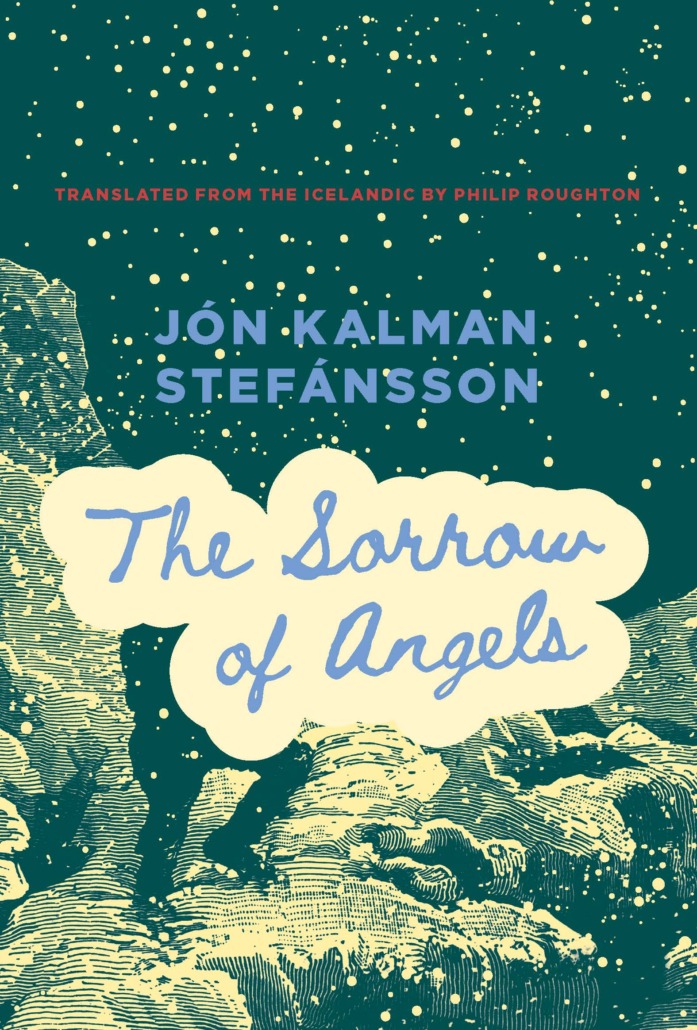
Here at the end of the world: The Sorrow of Angels by Jón Kalman Stefánsson

The boy sticks his head all the way out and his black hair whitens, the ground lies everywhere beneath a thick layer of the sorrow of angels, no grazing either in pasture or on beach, all the livestock kept inside and the farmers counting every hay-blade going into them, in some places little remaining but leavings  and the animals bleat and low for a better life, but the clouds are thick and no sound is carried to Heaven.

It is already April in this Icelandic village and there is no sign of anything resembling spring. The snow continues to fall and the winds blow cold. It has now been about three weeks since the unnamed protagonist at the centre of Jón Kalman Stefánsson’s Trilogy of the Boy made his way back to the small community following the tragic death of his best friend on a fishing boat, and he is now settling into a life he never imagined possible, surrounded by new friends—a somewhat eccentric family of sorts—with books to read and his first stirrings of real, if perhaps ill-advised, romantic attraction to the daughter of a wealthy local merchant. But this peaceful interlude will not last long.

The Sorrow of Angels, the second volume of the trilogy, can certainly be read as a stand-alone work, but Stefánsson does not waste time filling in many details to flesh out the events and characters, present or past, as he picks up the boy’s story, so starting with Heaven and Hell would not hurt. Both are great. Intense and thoughtful at once, if that’s possible. The first part of Sorrow is evenly paced, continuing with the same rhythm that marked the second part of Heaven and Hell, as we come to know more about the people who have taken the boy in—the strong-willed, mysterious Geirþrúður, her housekeeper Helga, and the blind old sea captain Kolbeinn—and other local figures. For an orphan tossed from farm to farm who, at nineteen, has already spent three winters out with a fishing crew, having a room of his own, surrounded by people who share and actively encourage his love of reading, is more than he could have ever dreamed of. Yet, when the postman Jens arrives from his latest delivery trip half dead, only to have his superior insist that he head right back out on an unfamiliar route through the endless winter’s storms, the boy is “volunteered” to accompany him.  For the postman, with an aging father and a developmentally disabled sister to support, the promised payout of this journey is too much to pass up. But for his friends, the idea of him taking on this mission alone in such extreme weather is a serious concern, so they decide that he will not go alone.

Once the two men are on their way, the mood of the narrative shifts, acquiring a sweep that echoes the vast landscape to be traversed. It very quickly becomes clear that Jens and the boy are temperamentally mismatched for the challenges that lie ahead. The older man prefers the silence of his own thoughts, while the younger man is inclined to want to fill the long hours with conversation, recitation of verse, and even song. Their trip, through blinding, brutal storms, over an unfamiliar terrain with unseen dangers and few places to take refuge, is long and they will be forced to rely on one another more than once just to survive. Through long, unbroken passages, Stefansson’s penchant for prose that is lyrical and melodic, heightens the inhuman conditions his characters face here at the end of the world—both those who live in this harsh region year round and those forced to pass through. He is a master at evoking ice, freezing skin, and the snow storms can distort time and space, carrying with it the real threat of ghosts that seem to emerge out of the whiteness to lead the lost to their deaths.

He stops, ceases to struggle onwards and stands still, forces himself to stand, though the temptation simply to sink is so alluring; he stands still and shuts his eyes. Now I shut my eyes, and if I’m meant to live, he thinks optimistically, then Jens will be standing before me when I reopen them. He stands with his legs spread wide so as not to be blown over and it’s incredibly good to have his eyes shut, as if he’s made it to unexpected shelter. The wind is certainly still blowing coldly against him yet it’s no longer of any concern to him. It has grown distant, it’s no longer threatening. It would be too easy, perilously easy to sleep like this; open your eyes, he commands himself, and that’s what he does. Opens his eyes to see a woman standing before him, just an arm’s length between them. Rather tall, erect, her head bare and her long, dark hair blowing over and from her stern face, her dead eyes penetrate his skull and drill themselves into the centre of his mind. Then she turns and walks away, against the wind, and he follows.

However, as the boy and the postman will discover, sometimes the dead have other intentions. Before their journey is over, they find themselves joined by a third man, and charged with the special delivery of a most unusual item through the most treacherous terrain they have yet encountered.

Like Heaven and Hell before it, The Sorrow of Angels combines the elements of an epic adventure with a strong musical sensibility. Stefánsson’s language is poetic, his characters are pushed to their limits—physically and emotionally—and the remoteness and ruggedness of the remote reaches of northern Iceland a century ago is portrayed with relentless intensity. A thoroughly enjoyable read. However, as the middle volume of a trilogy,  this book ends on a cliffhanger, it must be said, and it will be another six months or so before the final volume is released in North America in the spring of 2026. (It has been out for a decade in the UK, but it is always nice to have a matching set.)

The Sorrow of Angels by Jón Kalman Stefánsson is translated from the Icelandic by Philip Roughton and published by Biblioasis.

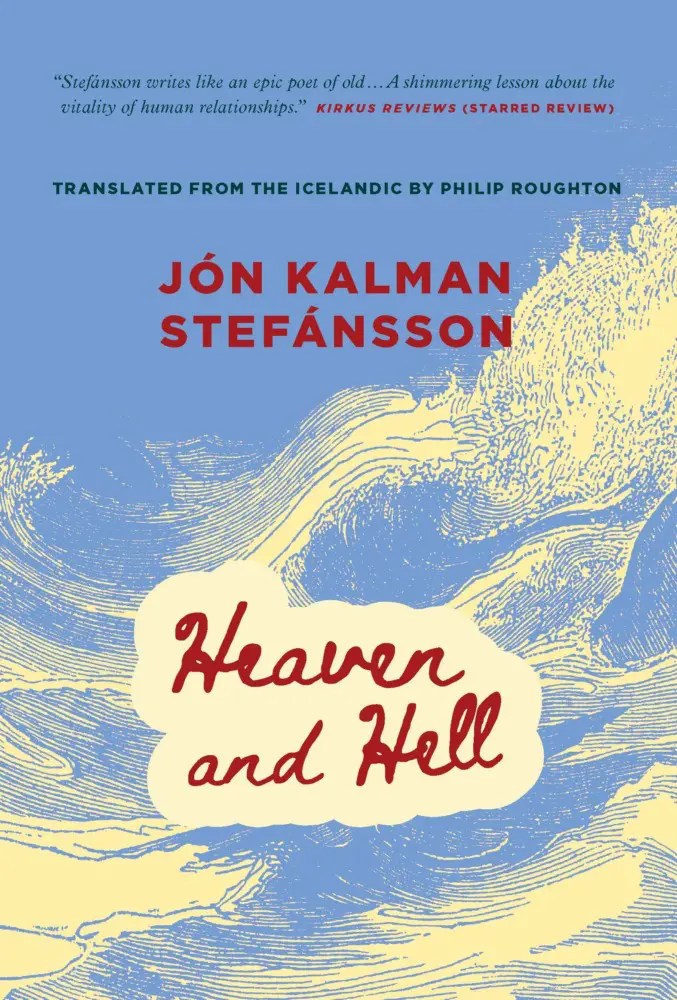
“How many years fit into one day?” Heaven and Hell by Jón Kalman Stefánsson

The sea on one side, steep and lofty mountains on the other; that’s our whole story in fact. The authorities, merchants, might rule our destitute days, but the mountains and the sea rule life, they are our fate, or that’s the way we think sometimes, and that’s the way you certainly would feel if you had awakened and slept for decades beneath the same mountains, if your chest had risen and fallen with the breath of the sea on our cockleshells. There is almost nothing as beautiful as the sea on good days, or clear nights, when it dreams and the gleam of the moon is its dream. But the sea is not a bit beautiful, and we hate it more than anything else when the waves rise dozens of metres above the boat, when the sea breaks over it and drowns us like wretched whelps. Then all are equal. Rotten bastards and good men, giants and laggards, the happy and the sad.

This theatrical landscape, evoked with such poetic intensity, sets the stage for an epic work that combines old-fashioned drama with contemporary literary sensibility, a tale of loss and bravery that makes for a truly glorious read. Somewhat disorienting in the early pages of the first volume of Jón Kalman Stefánsson’s Trilogy About the Boy, it’s not clear when the swirling narrative takes place, and where the protagonist—known simply as “the boy”—and his friend Bárður are in this snow-covered Icelandic terrain. Somewhere between heaven and hell, no doubt.

Heaven and Hell is a tale about the devastating power of the elements and the redeeming power of literature. It has an intentionally timeless, epic quality that is irresistible, thanks in no small part to an overarching narrative voice,  a first person plural chorus of the dead, that relays this story of the past, unfixed in time but set more than a hundred years earlier, “during the years when we were surely still alive.” An epic voice for an epic adventure. But the distinctive lyrical qualities reflect Stefánsson’s natural inclinations as a writer:

Poetry is very important to me; I started my writing career as a poet, published 3 books of poetry before I turned over to prose. In a way, I think that I use, though subconsciously, the technique and the inner thinking of poetry while writing prose; therefore, poetry lies in the veins of my prose. I think as a poet while writing as a novelist. I also see my novels partly as a piece of music, a symphony, a requiem, a rock or hip-hop song. There lies so much music, both in the language and the novel itself: its structure, style, breath. And the structure is for me just as important as the stories; one can sometimes call it one of the characters.

At the centre of this novel is a nineteen year-old orphan, the boy, whose father drowned when he was six, leaving his family separated. He and his brother were sent to board in different communities, while his mother and young sister would die before they could ever see one another again. But although his parents were poor, with limited education, their love of books and his mother’s letters filled with imagery drawn from science, helped foster in her son literary inclinations that would bloom under the right influence. That came through his friendship with Bárður, a young man several years older who introduced him to the beauty of poetry. When Heaven and Hell opens, the two are on their way back from a brief respite in the Village to the fishing hut where they are spending their third winter as part of a fishing crew. In his pack Bárður is carrying a loaned copy of Paradise Lost—a book that will soon cost him his life. As the crew is readying to take to the sea in the early hours of the following morning, Bárður will quickly slip back to commit a few lines of Milton‘s verse to memory, something to share with his young friend during the long hours ahead, but in his haste he will forget his waterproof. When a vicious storm arises, this mistake proves fatal.

When the boat finally returns to shore, the boy is devastated and cannot bear to stay. The captain’s wife helps him prepare for the long walk back to the Village and he slips away intent to return the borrowed book. He intentionally choses the more challenging inland route, haunted by the pain of his loss. He thinks about poetry and he thinks about death:

He trudges into the valley and Bárður is dead.

Read a poem and froze to death because of it.

Some poems take us places where no words reach, no thought, they take you up to the core itself, life stops for one moment and becomes beautiful, it becomes clear with regret and happiness. Some poems change the day, the night, your life. Some poems make you forget, forget the depression, the hopelessness, you forget your waterproof, the frost comes to you, says, got you, and you’re dead. The one who dies is changed immediately into the past. It doesn’t matter how important a person was, how much kindness and strength of will that person had and how life was inconceivable without him or her: death says, got you, life vanishes in a second and the person is changed into the past. Everything connected to that person becomes a memory you struggle to retain, and it is treachery to forget that.

The journey is difficult and dangerous, and the boy does not know what he will do once his mission is complete, but suicide is an option he contemplates. However, once he is back in the Village, he soon finds himself welcomed into what becomes an ad hoc, somewhat eccentric, family of sorts.

What makes this novel succeed so well, and makes it such an entertaining and invigorating experience tp read, lies in the musicality of the language and the strength of the characterization. On one level, there is the fundamental battle between man and nature—the former so small against the enormity and unpredictability of weather, water, and terrain— unfolding in seemingly endless sentences and long breathless paragraphs, followed by short sharp statements that stand alone. The epic sweep of these passages is reinforced by the otherworldy quality of the narrative voice. On the other level, away from immediate environmental threats, individual human interactions have a different tenor. Focus falls on certain striking features—perhaps body size, eyes, or hair—that set one person apart from another, the kind of cues people use to try to assess others. Dialogue is woven into the text without demarcation, much social motivation remains in the shadows, and distrust can be easily kindled. Life is tough in this remote part of Iceland, and so are the people who live here.

This release of Heaven and Hell has been a long time coming. First published in Icelandic in 2007, Philip Roughton’s English translation appeared in the UK in 2010 (MacLehose Press). Now, in 2025, Biblioasis has released the first two parts of The Trilogy of the Boy for North American readers—The Sorrows of Angels just came out—with the final part due next year. And although the books can be read independently, it doesn’t hurt to start right here with part one of this memorable epic tale in which epic poetry is a driving force, leading to death and reaffirming life.

Heaven and Hell by Jón Kalman Stefánsson is translated from the Icelandic by Philip Roughton and published by Biblioasis.

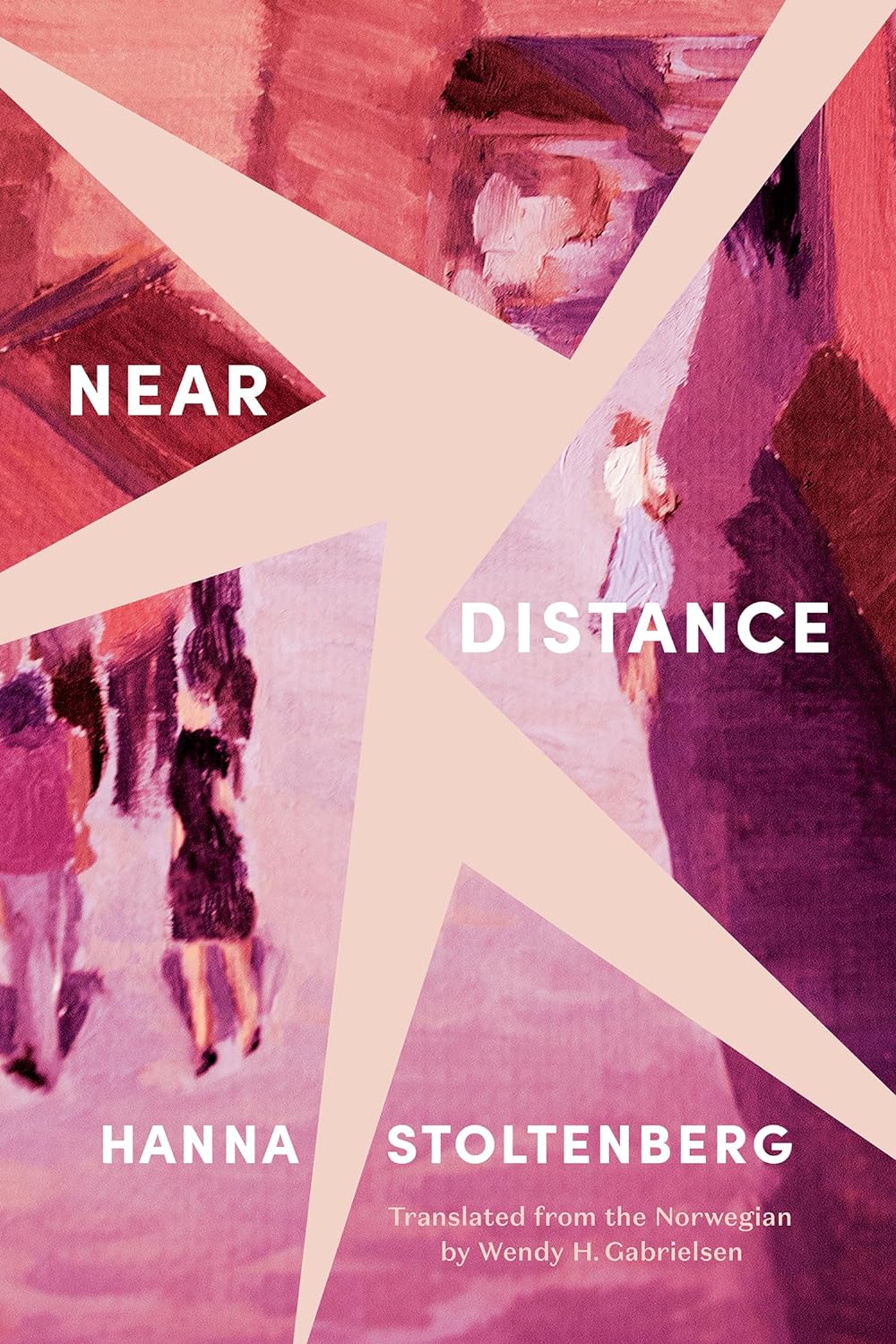
The space between who you are and the role you play: Near Distance by Hanna Stoltenberg

If one could paraphrase Tolstoy’s famed opening line of Anna Karenina within the context of just one aspect of the family dynamic, the bond between mothers and daughters, one might suggest that all happy mother-daughter relationships are alike, yet each unhappy mother-daughter relationship is unhappy in its own way. Or would the contrast be peaceful and conflicted? Or close and distant? For Karin, the protagonist of Norwegian writer Hanna Stoltenberg’s debut novella, Near Distance, the situation with her adult daughter would fit, as the title implies, into the latter set of contrasts. She and Helene are not close. They both live in Oslo but rarely see each other and, at least for Karin, this does not seem to be a problem. She is content working at a job that does not ask much of her and keeping her relationships of any kind casual:

The days have a regularity she enjoys. She rarely listens to music; she usually reads novels and online newspapers or chats with men from the dating website and fixes dates she either keeps or cancels, depending on how she feels on the day. Sometimes she sees friends, old colleagues, goes to the cinema or has dinner. She has no problem finding things to talk about and is a good listener, but afterwards she often feels distorted by her own words and wishes she had stayed at home. It doesn’t bother her to be alone. As long as your basic needs are covered – food, shelter, the possibility of intimacy – how much difference is there really between a good life and a bad life?

Yet, as much as she may tell herself otherwise,  one senses that there is a deep discontent within Karin, something she is aware of, but unwilling to address.

She had never really wanted to have children when she was growing up, so motherhood caught her off guard. When she found herself pregnant in her first year of university, she dropped out to devote herself to her new role, believing, at the insistence of Erik, the baby’s father, that they could make it work. And for a while it did. Gradually Karin began to drift away, restless and disconnected, ultimately falling into a loose affair that would trigger the dissolution of her relationship with Erik and strain her bond with Helene. Now that her daughter is grown and married with two children of her own, they rarely talk to one another. Until late one night when Helene calls to ask if she can drop by. She must talk. It can’t wait. Karin bows out on the man she’s just gone home with and meets her at the bar.

Helene is distraught. She has learned that her husband Endre is having an affair with the leader of a meditation retreat centre he has been frequenting and does not know what to do. Her daughter’s circumstances and her appeal for advice and assistance will lead Karin to reflect on her own past and revisit her fragmented memories of her relationship with Helene from her earliest years to the present. Questioning what she knows and what she doesn’t know. Soon an opportunity to explore this uneasy mother-daughter bond in a new light arises when Helene asks her mother to join her for a weekend away in London. She has already bought the tickets and made the hotel reservations, so Karin can hardly decline. This time together will reveal some things about both women, where they are in their lives, and how they got there.

This spare novella is a closely observed, well composed character study, with a sharp focus on the kind of persistent internal unease that can drive someone into themselves and away from those they care about. Karin is extremely self-conscious. She is always aware of how she thinks she is being perceived, relying on what she calls her “external gaze” to regulate her behaviour in relation to others. Whether what she believes she is projecting (or hiding) is really being perceived as she imagines is difficult to tell, because her thoughts and experiences mediate the close third person narrative. Meanwhile, she tends to be hyper-observant of those around her, continually taking in and assessing other people—fellow patrons at the bar, passengers on the plane, strangers seen on a London street:

In the central reservation by a pedestrian crossing, two women are hugging each other. Karin watches them while the taxi waits at a red light. They are both wearing turquoise uniforms under puffa jackets; one has her dark hair pinned up with a clasp, and it looks like she’s the one being comforted. They have white slip-on shoes which makes Karin wonder if they’re maids, nannies maybe? She has the feeling of having intruded on a story more dignified, more authentic than her own.

Karin’s vigilant nature, isolated as she is in her own mid-life existence, allows for the creation of rich, intense—and yet spare—narrative. Stoltenberg’s cool, detached prose is translated to a perfect pitch by Wendy H. Gabrielsen. As the book progresses, the scenes which alternate between Karin’s past reflections and present circumstances become shorter and tighter, heightening the tension especially as she and Helene appear to be at risk of losing contact with one another in the middle of a London night. But this is not a book with a neat conclusion, nor is it certain how much either Karin or Helene have gained beyond a slightly closer connection. Are they too different in nature? Or perhaps too similar? An inescapable feeling of loneliness and distance lingers, but without judgement. For a young author, this is a very confident debut and it will be interesting to watch her develop in the years to come.

Near Distance by Hanna Stoltenberg is translated by Wendy H. Gabrielsen and published by Biblioasis.

Folktales for a new world: Rain and Other Stories by Mia Couto

In the preface to his newly translated collection, Rain and Other Stories, Mozambican writer Mia Couto tells us that the stories we are about to read were written after his country’s long and bloody civil war. The conflict which erupted in 1977, two years after the African nation achieved independence from Portugal, would last for fifteen years, leaving over one million dead and devastating the country’s infrastructure. As the majority of the white Portuguese fled, they left behind an impoverished, uneducated population. Yet, where Couto had anticipated total ruin and destruction, he found that seeds of life and hope had survived. Not all was lost.

These tales speak to this land we are remaking and where we soak our faces in this rain of hope, this water of benedreamtion. Of this land where each man is the same, like this: pretending he’s here, dreaming of going away, imagining his return.

The twenty-six stories that follow are very short—most are but a handful of pages—and although they spring from the immediate aftermath of a contemporary battle, signalling the end of both Soviet-backed Cold War alliances and white domination in Southern Africa, the roots and spirits of these tales seem to run deep into the very bedrock of the earth. They are uniquely Mozambican and yet timeless. These are the fables, folktales, comic and magical imaginings of human folly and resilience. They are a telling of a shattered world back into being.

Couto, the winner of the Neustadt International Prize, and a finalist for the Man Booker International Prize, has an uncanny ability to create miniature worlds peopled with wonderful characters, images and happenings. In some tales war is still a present quantity, in others it is past but only barely. These are the people caught in the “transition from the tragedy of war to the misery of peace.” We encounter ordinary folk trying to deal with love, its loss, infidelity, old age, even an errant hippopotamus. Some tales are apocryphal in tone, others tragic, yet others simply enchanting. Throughout the collection, the accounts are seasoned with witticisms, aphorisms, and gentle wisdom.

“Blind Estrelinho” is an early and particularly captivating example. The title character is a “man of no moment,”entirely dependent on his guide Gigito Efraim to lead him through the world and open it to his unseeing eyes. And what a world it is! Little Gigito:

described what wasn’t there. The work he detailed was fantasies and fine-lacery. The guide’s imagination bore more fruit than a papaya tree. The blind man’s mouth filled with waters:
What marvellousity, this world. Tell me everything, Gigito!

When his young guide is taken away to war, the blind man’s world falls dark. Gigito’s sister arrives to take her brother’s place but she describes the world as it truly is, and Estrelinho’s loss is magnified. Until he discovers that a girl offers other, shall we say, insights. But the story does not end there.

Some tales are disturbing, like “The Flag in the Sunset” about a boy who, needing to bleed to dream, would ask his grandma to cut him. For his failure to salute the flag he meets an untimely and bloody end, taking another life with him, and haunting all who pass where the flagpole once stood—a resounding comment on forced allegiance, and the degree to which flags “detract from the celestial blues.” “Lamentations of a Coconut Tree” recounts the report, verified by the Nation’s newspaper, of the experience of the narrator’s friend Suleimane Ibraimo who, upon splitting the shell of a coconut finds that:

the fruit didn’t gush the usual sweet water, but blood. Exactly so: blood. But that wasn’t the only astonishing thing. The fruit cried and lamented in a human voice. Suleimane took no exaggerated measures: his wide-open hands dropped the coconut, the red stains spread. He stood there, dumbfounded and overwhelmed, spent. The shock made his soul vanish into the low tide.

The narrator rushes to help, finding his friend sunken but with all traces of the incident cleaned away. Naturally he is distrustful: “Doubt, we know,” he says, “is the envy that the unbelievable hasn’t happened to us.”

One of Couto’s real strengths lies in his ability to sketch out larger-than-life characters in the span of a few pages, like the man who worries about what his enjoyment of his formerly frigid wife’s newfound manly intensity says about him, the night watchman who confronts a hippopotamus ravaging a schoolroom or Professor Novesfora, the protagonist of “The Hapless Calculus of Happiness,” a mathematically minded man who weighs and measures everything, allowing algebraic operations to guide his world view:

He also divided out his affections in calculated doses, limiting love to its numerical equivalent. Love affairs, women, children: all those things were null hypotheses. Feelings, he was fond of saying, have no logarithm. For that reason, there was no reason to even solve the equation. Since he was a child, he’d abstained from affection. From an algebraic point of view, he would say, tenderness is absurd. Like a negative zero.

Until the day he falls for an underage student and all the calculations change!

Rain and Other Stories, is a rich and rewarding collection of fables that capture the cultural and ethnic diversity of post colonial Mozambique rebuilding itself after prolonged conflict between the Marxist government and right wing insurgents, each backed by outside players with their own agendas, had nearly torn the fledgling nation apart. Translator Eric M. B. Becker captures the sheer magic of Couto’s playful Portuguese, and his simple but powerful imagery. This is writing toward healing, toward a celebration of life, but with a clear caution that darkness is never far away.

Rain and Other Stories is published by Bibioasis.


Seeking redemption underwater: Blue Field by Elise Levine—My Rusty Toque review

November is destined to go out as it came in, with a link to a review published elsewhere—in this case, my thoughts on Elise Levine’s Blue Field which appears in the latest issue of The Rusty Toque. This is a book that I heard about when it was released earlier this year, and I was immediately intrigued. However, when I finally sat down to read it, having already committed myself to a review, my first impression was that this was not going to be for me. The first few chapters put me off a little, that is, they led me to think I would find Blue Field difficult to assess fairly. I don’t believe that one should avoid negative reviews, but I feel that, if appropriate, they should be constructive, and if a book simply is not to your taste, it’s very difficult to make any judgement about it one way or another. As John Updike said, and I am paraphrasing, you should not accept for a review a book you are predisposed to dislike or obligated to like.

Then I turned to the promotional materials that came with my review copy. Biblioasis, bless them, frequently include an interview with the author or translator and, with an opportunity to learn more about  Levine, her writing process and interests, I was so impressed that I decided to give her book a second chance. Perhaps because it is somewhat different than the type of book I’ve read lately, I found myself caught off guard by this tale of a woman who takes up cave diving in an effort to find healing after her life has been upended. She is not particularly likable, increasingly reckless, and trapped in an vortex of loss and grief that could cost her everything she has. However, the prose—vivid, pulsating with energy, alternately harsh and shockingly poetic—is finely tuned and relentless in its intensity. Won me over.

Blue Field by Elise Levine is published by Biblioasis.

To find out more, I invite you to check out my review at The Rusty Toque. And while you’re there check out some of the other excellent features in this issue.

Black Bread by Emili Teixidor—My Numéro Cinq review

My latest review for Numéro Cinq is now live. When I read for these reviews, the question that guides me is “What is interesting about what the author is doing (or trying to do) in this book?” I am listening to the language, paying attention to the structure, the voice, the tone, and asking what makes this work come together? What sets it apart? I am reading as a writer–an intuitive writer–unaided and yet unburdened by a formal education in literary theory.

Coming of age themed novels such as Black Bread by Catalan writer Emili Teixidor present a particular challenge. When a first person narrator is recounting events and experiences from his or her own childhood, my attention is focused heavily on narrative voice. I am always trying to determine where the narrator is standing in time relative to the story being told. I had the sense with Black Bread that the protagonist Andreu was writing from his later teens–just far enough away to have some perspective on the limitations of his understanding of the precarious realities around him, but close enough to recreate the innocence and naivete of childhood. It works, but the more absorbing, and I suppose the more effective the voice, the more difficult it is to describe how and why it works.

Here’s a taste of the review, please click through the link at the end to read the rest. A second link leads to an excerpt:

In the Shadow of Civil War: Review of Black Bread by Emili Teixidor — Joseph Schreiber

black-bread

There is an interlude, just shy of a third of the way into Black Bread by the late Catalan writer Emili Teixidor, where the narrator steps back from his childhood reminisces to question the nature of memory. He asks why some things stay etched on his memory while he has forgotten others completely, and wonders, “how can I know I have forgotten what I can’t remember?” He recognizes that some places, people and incidents fade quickly whereas sometimes a word can come back unexpectedly and ignite a flood of distant memories. These reflections appear as a curious break in a narrative marked by a degree of youthful naiveté, but remind us that the journey from childlike to mature understanding is uneven and necessarily distorted in retrospect. So, although it is never entirely clear just how far removed the protagonist stands from the experiences he is sharing, as his account continues his ability to hold on to his own innocence will increasingly come into conflict with the harsh realities of life in post-war rural Catalonia.

In recent years, much revisionist debate has been dedicated to exhuming questions of the true impact of the civil war and the Franco dictatorship on Catalan culture and society; “true”, that is, depending on where one’s interests lie. Against this backdrop, a novel like Black Bread, originally published in 2003 when Teixidor was seventy years-old, could easily be construed as an attempt to reclaim history through lived memory. That may, in part, be a fair assessment, but this novel offers much more. It is, on one level, a tender and sensitive coming of age story, one that filters the joys, fears, mysteries, and discoveries of the fitful transition to adolescence through the unaffected lens of childhood memory. Our narrator, Andreu, an astute observer of his own confused emotions, must learn to navigate a world filled with dark dangers and even darker delights. He knows there is much going on around him that he doesn’t understand—truths that he isn’t certain he even wants to understand. However, his growing awareness and conflicted reactions open space for an indirect but honest commentary on the realities of Catalan existence during this time. In this respect, the work can be seen in line with that of writers like Josep Pla and Mercè Rodoreda.

Continue reading here:

Read an excerpt here:

Uncovering a treasure in translation – Ondjaki

“Is that what tales from before were like a long time ago?”
“Yes, son.”
“So before is a time Granma?”
“Before is place.”
“A place really far away?”
“A place really deep inside.”
-Ondjaki

Last week I had the pleasure of reading Granma Nineteen and the Soviet’s Secret by the young Angolan author Ondjaki. This exuberant, magical tale re-imagines a dramatic event set in the community of Bishop’s Beach in the city of Luanda in the early years of Angolan Independence. The country’s first President, Agostinho Neto, has died and a curious, threatening project is rising on the beach. The Soviets are constructing a Mausoleum to the deceased President and, it is rumoured, the surrounding neighbourhood is scheduled to be demolished.

indexOur unnamed narrator is a young boy who lives with his grandmother in a community where a cluster of eccentric granmas are important and valued elders. Together with his friends Pi (known as 3.14) and Charlita, he embarks on a mission to save the day drawing on a worldview informed by spy movies, Spaghetti Westerns and Portuguese language soap operas. A colourful cast of supporting adults round out their adventure including Comrade Gas Jockey who mans a station with no fuel, crazy Sea Foam who is rumoured to have a pet alligator, the Cuban doctor Rafael KnockKnock and a Soviet official christened Gudafterov by the children as a result of his awkward use of the local language.

I learned of this book through the CBC radio program Ideas. In this extended interview, recorded live at the Blue Metropolis Festival in Montreal this spring, Ondjaki spoke of his childhood from which so much of this fantastic tale is derived. He insisted that in his early years, the socialist presence was simply a fact of life – they had a lack of electricity and running water – but it was normal and his childhood was happy. He talked with infectious enthusiasm about his family, his very early introduction to literature and fondness for Marquez, and the deeply ingrained understanding of the magical in the reality of everyday life in cultural mindset of his homeland. Within the week I had obtained and read the book. The tale was every bit as engaging and entertaining as I had expected.

But the greatest find for me personally is the small Canadian publishing house Biblioasis behind Granma Nineteen and the Soviet’s Secret. This book belongs to their small and select series of books in translation. Although he is recognized as one of the rising stars of African literature, Ondjaki’s work is not widely available in English to date. Biblioasis has published two of his novels, both translated by Stephen Henighan. I am very impressed by the results. A work like this depends so heavily on playing with language. Puns and intentional misrepresentations that work in Portuguese have to be re-imagined to work well in English and fortunately the translator was able to work closely with the author to bring the work to life with all its magical energy intact. As a Canadian I am embarrassed that I am only just discovering Biblioasis. I definitely intend to explore more of their offerings, both in their international series and in their English language Canadian titles.