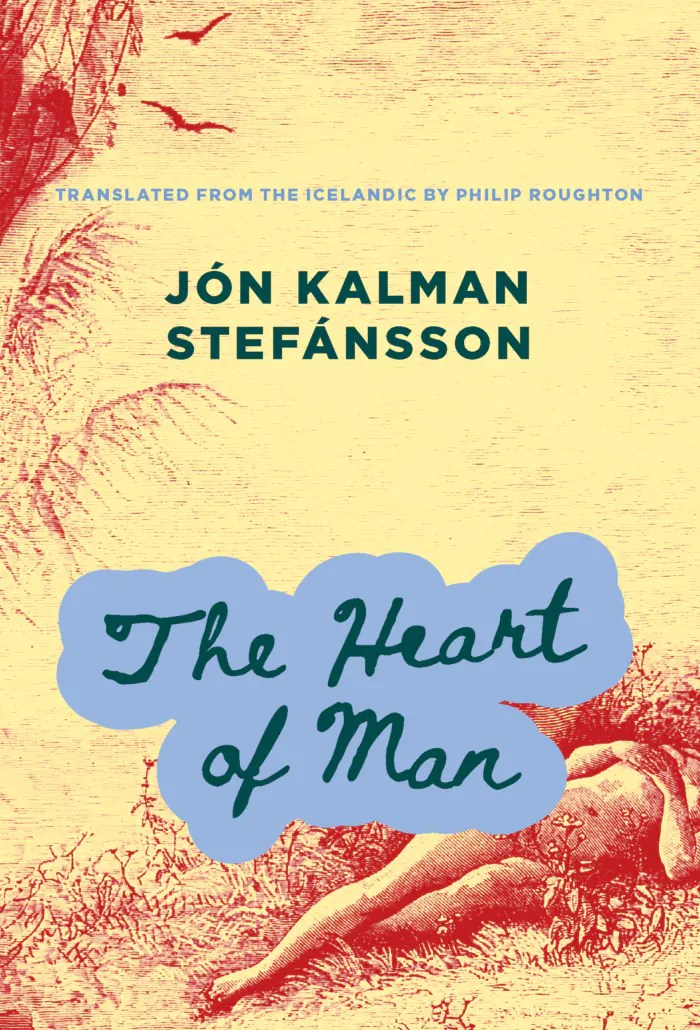
“Is your heart still beating? If so, how?” – The Heart of Man by Jón Kalman Stefánsson

There are very few things that man needs: to love, to be happy, to eat; and then he dies. Yet there are over six thousand languages spoken in the world — why do there need to be so many in order to make such simple desires understood? And why do we manage it so rarely, why does the light in words fade as soon as we write them down? One touch can say more than all the world’s words, that’s true, but the touch fades with the years and then we need words again, they’re our weapons against time, death, forgetfulness, unhappiness.

It has been a long, cold winter marked by hardship and loss, and now that the snow has finally melted and a reluctant spring settles in, it is the season when, as they say, a young man’s fancy turns to love. But in The Heart of Man, the third and final installment of Jón Kalman Stefánsson’s Trilogy About the Boy, his unnamed protagonist is not alone in his longings and desires. Romance, be it passionate or practical, is in the air, infecting more than a few lonesome souls and leading to some unlikely couplings amid tragedy, conflict, and confusion.
In each of the first two volumes, Heaven and Hell and The Sorrow of Angels, the most intense drama lies in the battle against the unforgiving elements of ice and snow during a winter that has held fast to a corner of Iceland well in to May. In the first novel, after witnessing the death of his only friend aboard a fishing boat, the sensitive nineteen year-old referred to simply as “the boy” makes his way to the Village to return a borrowed copy of Paradise Lost and finds himself taken into the home of Geirþrúður, a scandalously independent woman, and her companions Helga and the old, blind sea captain, Kolbeinn. Here he becomes part of a makeshift family, one where books and literature are appreciated. The second part follows the boy and the postman Jens as they cross a sparsely populated stretch of land to deliver mail to a community on the north shore. As storms rage, their struggle with the forces of nature hits a fever pitch, concluding with a terrifying accident.

When The Heart of Man opens, the boy is slowly regaining conscious awareness in a strange room. Jens is sleeping in the next bed. It seems that they had the good fortune to crash into the side of the doctor’s house when they lost control on their icy descent to the village of Sléttueyri, the intended destination of their trek across the frozen Icelandic landscape with a heavy mail bag and a most unusual parcel they picked up along the way. If he is surprised to have survived, the boy is even more surprised by Álfheiður who appears at his bedside with her short red hair and deep green eyes. He is smitten. But also confused, because back home he believed he had already lost his heart to Ragnheiður, the privileged daughter of an important local merchant and broker, even if she may never see him as a serious prospect. When he returns to the Village, she continues to tease and seduce him against her father’s explicit warnings, but the red-haired young woman on the northern shore still haunts the boy’s dreams. And then he receives a letter that asks: “Is your heart still beating? If so how?”

It’s beating like that of a drowning man, a wingless bird, how the hell should he answer this? Of course it’s important to receive a letter, to have a person consider it worthwhile to sit down and assemble words and have you in mind the entire time it takes to write the letter, to receive a letter indicates that you exist, that you’re closer to being light than darkness. Admittedly, not all letters are good, and some should perhaps never have been sent, never have been opened, read, some are full of hatred, accusations, they’re poison that will deprive you of your strength, they bring darkness and disappointment.

In this third volume of the trilogy, the terrain to be navigated is that of the human heart, and the boy is not the only one on such a journey. As a result the world of the Village expands and deepens as we come to know the townsfolk better. We witness the troubled power dynamics that exist between social classes, and between the sexes. One might also suggest that divisions between misfits and the accepted members of society are exposed, but to be fair, the environment and challenging living conditions of this part of the world attract and reward those who have their own distinct idiosyncrasies. There are many such characters here, each one with his or her dreams and disappointments, joys and despair. Yet, even with its multiple crisscrossing storylines, the tale never drags over its 400 pages thanks to the rhythmic force of the chorus of drowned ghosts at the helm. These timeless storytellers, fueled by longing, tend toward the melodramatic, lending an operatic quality to the narrative, but in turn allow the characters’ thoughts and actions to unfold with a degree of distance. They are relaying an account from the past, but action unfolds in the present. Dialogue is relatively succinct, woven into longer paragraphs or set aside in a scripted format, while repeated refrains reinforce the flow.

Stefánsson writes with the soul of an Icelandic epic poet, his grand romantic spirit and poetic prose is rooted in the sagas of the past but directed at a contemporary audience. His ghostly narrators, in telling the boy’s story, are reaching through a wound in existence to grasp at what they miss the most:

Yet no story can ever be told completely, or, how shall we say it; we inhale in the nineteenth century and exhale in the twenty-first. Time is an illusion; the only useable unit of measurement is life. People never change, regardless of the passage of time, what we call the years; fashions change, not mankind. But what pains us most is that we no longer exist, except in these words; they’re as close to life as we can come.

To read this tale, then, is to surrender to the music of the language, because the real question at its heart is: what is the worth of poetry and knowledge? The boy, orphaned after the death of his parents, has known years of hard labour on farms and fishing boats, but it did not come naturally. He was clumsy and prone to daydreaming. So, although his strength and endurance have been recently tested in his journey overland with the postman, it is the fact that he has been welcomed into a home filled with books and given a chance to learn, that truly gives him a sense of value. But will that be sufficient to resolve his internal conflicts and secure his future happiness? Is that even possible for anyone?

The Trilogy About the Boy does come to a dramatic conclusion at the end of The Heart of Man, but it is one that is not without ambiguity. Of all of the volumes in this trilogy, this is perhaps the one that reads best as a standalone work, but again, the pieces that fall together will have a stronger impact if the earlier books are read first. And, on what is turning out to be a very hot summer across the Northern Hemisphere, it might be just the right time to escape to a colder climate for a while.

The Heart of Man by Jón Kalman Stefánsson is translated from the Icelandic by Philip Roughton and published by Biblioasis.
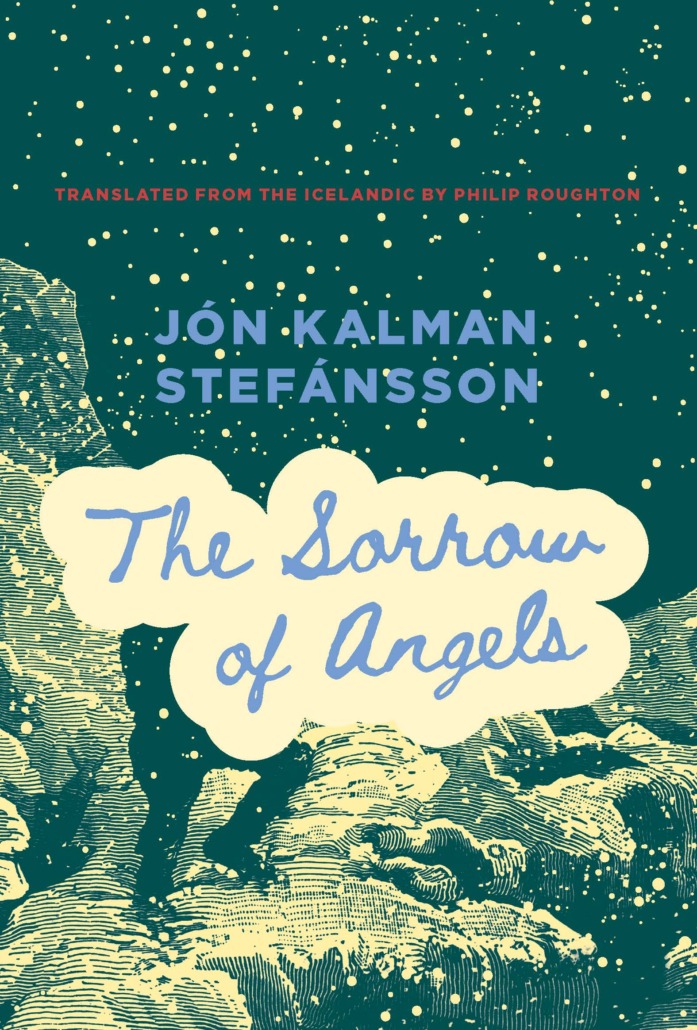
Here at the end of the world: The Sorrow of Angels by Jón Kalman Stefánsson

The boy sticks his head all the way out and his black hair whitens, the ground lies everywhere beneath a thick layer of the sorrow of angels, no grazing either in pasture or on beach, all the livestock kept inside and the farmers counting every hay-blade going into them, in some places little remaining but leavings  and the animals bleat and low for a better life, but the clouds are thick and no sound is carried to Heaven.

It is already April in this Icelandic village and there is no sign of anything resembling spring. The snow continues to fall and the winds blow cold. It has now been about three weeks since the unnamed protagonist at the centre of Jón Kalman Stefánsson’s Trilogy of the Boy made his way back to the small community following the tragic death of his best friend on a fishing boat, and he is now settling into a life he never imagined possible, surrounded by new friends—a somewhat eccentric family of sorts—with books to read and his first stirrings of real, if perhaps ill-advised, romantic attraction to the daughter of a wealthy local merchant. But this peaceful interlude will not last long.

The Sorrow of Angels, the second volume of the trilogy, can certainly be read as a stand-alone work, but Stefánsson does not waste time filling in many details to flesh out the events and characters, present or past, as he picks up the boy’s story, so starting with Heaven and Hell would not hurt. Both are great. Intense and thoughtful at once, if that’s possible. The first part of Sorrow is evenly paced, continuing with the same rhythm that marked the second part of Heaven and Hell, as we come to know more about the people who have taken the boy in—the strong-willed, mysterious Geirþrúður, her housekeeper Helga, and the blind old sea captain Kolbeinn—and other local figures. For an orphan tossed from farm to farm who, at nineteen, has already spent three winters out with a fishing crew, having a room of his own, surrounded by people who share and actively encourage his love of reading, is more than he could have ever dreamed of. Yet, when the postman Jens arrives from his latest delivery trip half dead, only to have his superior insist that he head right back out on an unfamiliar route through the endless winter’s storms, the boy is “volunteered” to accompany him.  For the postman, with an aging father and a developmentally disabled sister to support, the promised payout of this journey is too much to pass up. But for his friends, the idea of him taking on this mission alone in such extreme weather is a serious concern, so they decide that he will not go alone.

Once the two men are on their way, the mood of the narrative shifts, acquiring a sweep that echoes the vast landscape to be traversed. It very quickly becomes clear that Jens and the boy are temperamentally mismatched for the challenges that lie ahead. The older man prefers the silence of his own thoughts, while the younger man is inclined to want to fill the long hours with conversation, recitation of verse, and even song. Their trip, through blinding, brutal storms, over an unfamiliar terrain with unseen dangers and few places to take refuge, is long and they will be forced to rely on one another more than once just to survive. Through long, unbroken passages, Stefansson’s penchant for prose that is lyrical and melodic, heightens the inhuman conditions his characters face here at the end of the world—both those who live in this harsh region year round and those forced to pass through. He is a master at evoking ice, freezing skin, and the snow storms can distort time and space, carrying with it the real threat of ghosts that seem to emerge out of the whiteness to lead the lost to their deaths.

He stops, ceases to struggle onwards and stands still, forces himself to stand, though the temptation simply to sink is so alluring; he stands still and shuts his eyes. Now I shut my eyes, and if I’m meant to live, he thinks optimistically, then Jens will be standing before me when I reopen them. He stands with his legs spread wide so as not to be blown over and it’s incredibly good to have his eyes shut, as if he’s made it to unexpected shelter. The wind is certainly still blowing coldly against him yet it’s no longer of any concern to him. It has grown distant, it’s no longer threatening. It would be too easy, perilously easy to sleep like this; open your eyes, he commands himself, and that’s what he does. Opens his eyes to see a woman standing before him, just an arm’s length between them. Rather tall, erect, her head bare and her long, dark hair blowing over and from her stern face, her dead eyes penetrate his skull and drill themselves into the centre of his mind. Then she turns and walks away, against the wind, and he follows.

However, as the boy and the postman will discover, sometimes the dead have other intentions. Before their journey is over, they find themselves joined by a third man, and charged with the special delivery of a most unusual item through the most treacherous terrain they have yet encountered.

Like Heaven and Hell before it, The Sorrow of Angels combines the elements of an epic adventure with a strong musical sensibility. Stefánsson’s language is poetic, his characters are pushed to their limits—physically and emotionally—and the remoteness and ruggedness of the remote reaches of northern Iceland a century ago is portrayed with relentless intensity. A thoroughly enjoyable read. However, as the middle volume of a trilogy,  this book ends on a cliffhanger, it must be said, and it will be another six months or so before the final volume is released in North America in the spring of 2026. (It has been out for a decade in the UK, but it is always nice to have a matching set.)

The Sorrow of Angels by Jón Kalman Stefánsson is translated from the Icelandic by Philip Roughton and published by Biblioasis.

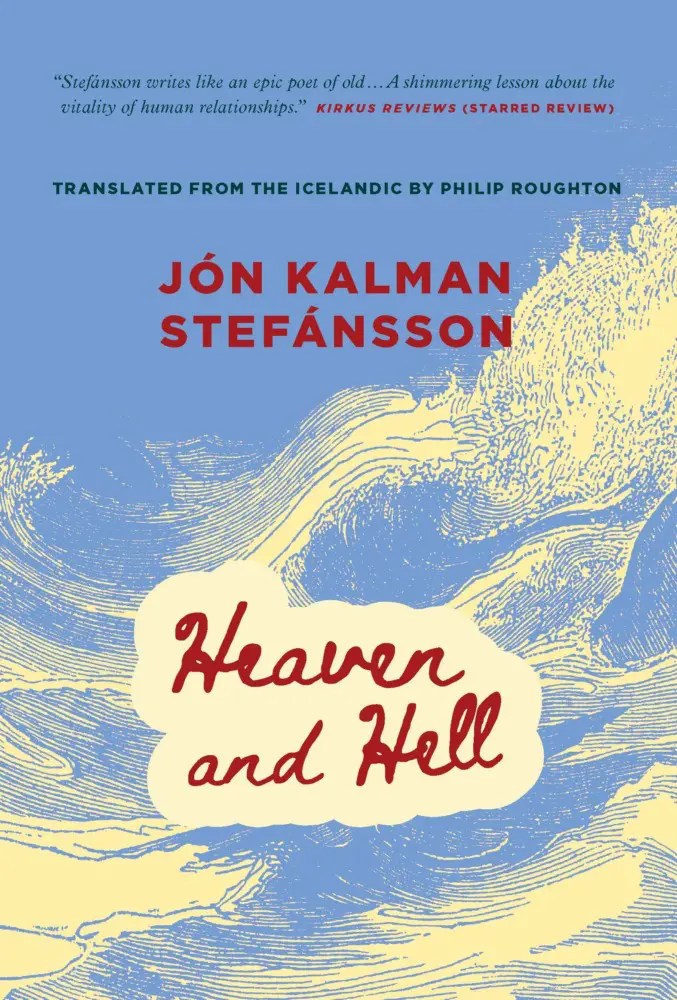
“How many years fit into one day?” Heaven and Hell by Jón Kalman Stefánsson

The sea on one side, steep and lofty mountains on the other; that’s our whole story in fact. The authorities, merchants, might rule our destitute days, but the mountains and the sea rule life, they are our fate, or that’s the way we think sometimes, and that’s the way you certainly would feel if you had awakened and slept for decades beneath the same mountains, if your chest had risen and fallen with the breath of the sea on our cockleshells. There is almost nothing as beautiful as the sea on good days, or clear nights, when it dreams and the gleam of the moon is its dream. But the sea is not a bit beautiful, and we hate it more than anything else when the waves rise dozens of metres above the boat, when the sea breaks over it and drowns us like wretched whelps. Then all are equal. Rotten bastards and good men, giants and laggards, the happy and the sad.

This theatrical landscape, evoked with such poetic intensity, sets the stage for an epic work that combines old-fashioned drama with contemporary literary sensibility, a tale of loss and bravery that makes for a truly glorious read. Somewhat disorienting in the early pages of the first volume of Jón Kalman Stefánsson’s Trilogy About the Boy, it’s not clear when the swirling narrative takes place, and where the protagonist—known simply as “the boy”—and his friend Bárður are in this snow-covered Icelandic terrain. Somewhere between heaven and hell, no doubt.

Heaven and Hell is a tale about the devastating power of the elements and the redeeming power of literature. It has an intentionally timeless, epic quality that is irresistible, thanks in no small part to an overarching narrative voice,  a first person plural chorus of the dead, that relays this story of the past, unfixed in time but set more than a hundred years earlier, “during the years when we were surely still alive.” An epic voice for an epic adventure. But the distinctive lyrical qualities reflect Stefánsson’s natural inclinations as a writer:

Poetry is very important to me; I started my writing career as a poet, published 3 books of poetry before I turned over to prose. In a way, I think that I use, though subconsciously, the technique and the inner thinking of poetry while writing prose; therefore, poetry lies in the veins of my prose. I think as a poet while writing as a novelist. I also see my novels partly as a piece of music, a symphony, a requiem, a rock or hip-hop song. There lies so much music, both in the language and the novel itself: its structure, style, breath. And the structure is for me just as important as the stories; one can sometimes call it one of the characters.

At the centre of this novel is a nineteen year-old orphan, the boy, whose father drowned when he was six, leaving his family separated. He and his brother were sent to board in different communities, while his mother and young sister would die before they could ever see one another again. But although his parents were poor, with limited education, their love of books and his mother’s letters filled with imagery drawn from science, helped foster in her son literary inclinations that would bloom under the right influence. That came through his friendship with Bárður, a young man several years older who introduced him to the beauty of poetry. When Heaven and Hell opens, the two are on their way back from a brief respite in the Village to the fishing hut where they are spending their third winter as part of a fishing crew. In his pack Bárður is carrying a loaned copy of Paradise Lost—a book that will soon cost him his life. As the crew is readying to take to the sea in the early hours of the following morning, Bárður will quickly slip back to commit a few lines of Milton‘s verse to memory, something to share with his young friend during the long hours ahead, but in his haste he will forget his waterproof. When a vicious storm arises, this mistake proves fatal.

When the boat finally returns to shore, the boy is devastated and cannot bear to stay. The captain’s wife helps him prepare for the long walk back to the Village and he slips away intent to return the borrowed book. He intentionally choses the more challenging inland route, haunted by the pain of his loss. He thinks about poetry and he thinks about death:

He trudges into the valley and Bárður is dead.

Read a poem and froze to death because of it.

Some poems take us places where no words reach, no thought, they take you up to the core itself, life stops for one moment and becomes beautiful, it becomes clear with regret and happiness. Some poems change the day, the night, your life. Some poems make you forget, forget the depression, the hopelessness, you forget your waterproof, the frost comes to you, says, got you, and you’re dead. The one who dies is changed immediately into the past. It doesn’t matter how important a person was, how much kindness and strength of will that person had and how life was inconceivable without him or her: death says, got you, life vanishes in a second and the person is changed into the past. Everything connected to that person becomes a memory you struggle to retain, and it is treachery to forget that.

The journey is difficult and dangerous, and the boy does not know what he will do once his mission is complete, but suicide is an option he contemplates. However, once he is back in the Village, he soon finds himself welcomed into what becomes an ad hoc, somewhat eccentric, family of sorts.

What makes this novel succeed so well, and makes it such an entertaining and invigorating experience tp read, lies in the musicality of the language and the strength of the characterization. On one level, there is the fundamental battle between man and nature—the former so small against the enormity and unpredictability of weather, water, and terrain— unfolding in seemingly endless sentences and long breathless paragraphs, followed by short sharp statements that stand alone. The epic sweep of these passages is reinforced by the otherworldy quality of the narrative voice. On the other level, away from immediate environmental threats, individual human interactions have a different tenor. Focus falls on certain striking features—perhaps body size, eyes, or hair—that set one person apart from another, the kind of cues people use to try to assess others. Dialogue is woven into the text without demarcation, much social motivation remains in the shadows, and distrust can be easily kindled. Life is tough in this remote part of Iceland, and so are the people who live here.

This release of Heaven and Hell has been a long time coming. First published in Icelandic in 2007, Philip Roughton’s English translation appeared in the UK in 2010 (MacLehose Press). Now, in 2025, Biblioasis has released the first two parts of The Trilogy of the Boy for North American readers—The Sorrows of Angels just came out—with the final part due next year. And although the books can be read independently, it doesn’t hurt to start right here with part one of this memorable epic tale in which epic poetry is a driving force, leading to death and reaffirming life.

Heaven and Hell by Jón Kalman Stefánsson is translated from the Icelandic by Philip Roughton and published by Biblioasis.