An extraordinary interrogation: Ordinary Notes by Christina Sharpe

I want to tell how sorrow makes a shape that is familiar. And how that familiar thing can be difficult to both name and to narrate. (Note 83)

For the past week or so I have been sitting in the presence of this singular text. I have been ill, so it has had a little extra time to spin through my fevered brain. And yet, it is not easy to articulate my response.

Ordinary Notes is a text one must come to openhearted and openminded. Over the course of 248 numbered “Notes,” writer and professor Christina Sharpe examines, interrogates and honours the reality of ordinary Black existence. This collection of reflections and observations, some as brief as a single sentence, others extending for several pages, supplemented at times with photographs, documents, and artworks, may appear fragmented yet there is form and direction as Sharpe moves through a series of themes or inquiries, with careful focus and lyrical intensity. The result is a dynamic response to the many horrors and losses faced by Black communities, in the face of white supremacy, historically and recently, but, at the same time, it is a deeply personal work—a memoir, an acknowledgement of the writers and artists who have inspired her, and, above all, a love letter to her mother.
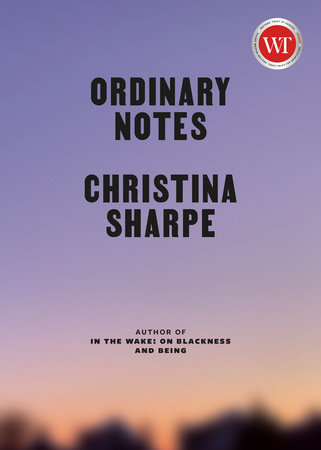
Although a wealth of thinkers, writers and historical figures are referenced in Ordinary Notes, Ida Wright Sharpe is the central inspirational figure in this project. In a number of the earliest notes, Sharpe reflects on the resolve of some of the earliest Black individuals to challenge the colour divide in middle class America: Elizabeth Eckford daring to attend an all-white high school in Little Rock, Arkansas, in 1957, or a Black family moving into an all-white Pennsylvania neighbourhood in the early 1960s. She recognizes an echo of her own experience years later as the only Black student at an all-white Catholic elementary school and then as one of a small number of Black students in a public junior high where it seemed she had made good friends.

Sharpe describes how her mother, recognizing that these friendships her daughter had made were destined to shift with the onset of adolescence, wanted to ensure that she had the necessary knowledge to make her own life choices moving forward—choices she might not have even known she had:

This telling set into motion a series of events that fundamentally changed me.

My mother wanted me to build a life that was nourishing and Black.

My mother wanted me to live in spaces where I would be reflected back to myself without particular distortions.

She spare me tremendous pain.

This Black note changed the course of my life. (from Note 10)

Later Sharpe will explore the lives of her mother and her grandmother, whom she did not know, and the nurturing atmosphere within which she was raised. In a world where Black people are still subjugated in so many areas of ordinary life and society, her mother was determined to ensure that she and her siblings were exposed to literature and arts in which they could see themselves as valued and strong.

As one makes one’s way through this volume, it is perhaps best to take time to stop and process what is being presented, take advantage of the generous footnotes as needed, pay attention to the images. Many of the impressions of anti-Black brutality may be historical, others very recent and widely covered. Slavery, lynching, police violence. Museum visits commemorating historical injustices are described. A multitude of Black voices are welcomed into a conversation with the past and present, the voices of Toni Morrison, Dionne Brand, Audre Lorde, bell hooks and many more. As the Notes accumulate, the observations, reflections, and memories naturally and gradually gather into an examination—a questioning—of the way art, beauty, and literature can form a positive understanding of the meaning of Black experience.

The primary audience Sharpe is addressing and speaking with in Ordinary Notes is a Black one. But a white reader open to listening will find much to both challenge and expand understanding and, as with any intentional engagement with literature, where one comes from and one’s own experiences will inform the reading. Sharpe makes some telling observations about the expectations the often-white reader or reviewer, by virtue of colonialism, brings to a book by a Black writer, fostering a view that “all of that book’s explorations, its meanings, and its ambitions lodge in a place called identity.” They may then praise the writer that “‘bravely’ eschews identity” or does not centre their work strictly in “Black life” as if this is to be commended:

These readers and reviewers are stuck on something they call identity and not something called life or genre or craft or intertextuality or invention or literary tradition.

These readers continually misread the note. They decant all complexity, all invention into that thing they name identity that they imagine is both not complex and not relevant to them.  (from Note 97)

This comment strikes me as applicable to the way much literature is presently reduced to identity, whatever that “identity” is perceived to be, when seen as something distinct from a reader or reviewer’s own experience, disregarding that we are all much more complicated—and ordinary—than any arbitrary designation of identity.

Some things I remember but they no longer live on the surface of my days. (Note 198)

Ordinary Notes has been my companion throughout this Black History Month. It has stimulated much reflection, especially on the legacy of anti-Black racism that is still with us and growing, along with other elements of racism and intolerance, as we don’t have to look too far to see. It challenges me to think more deeply about these issues and explore some of the authors and artists she highlights with whom I should become better acquainted.

Ordinary Notes by Christina Sharpe is published by Knopf Canada, Farrar, Straus & Giroux in the US, and Daunt Books in the UK.

In the footsteps of the man pretending to be me: Under Our Skin – A Journey by Joaquim Arena

The first large group of captured and enslaved Africans arrived in Lagos, a maritime town on the southern coast of Portugal on August 8, 1444. The shipment of 235 men, women, and children marked the establishment of the earliest slave market in Europe, and a segment of that initial African population would end up in Lisbon. A century later, Black Africans would not be an uncommon sight in the city, as colonial Portugal became a major player in the growing trans-Atlantic slave trade. A street scene painted in 1570 depicts a busy plaza in the capital in which half of the people pictured are Black, some socializing, others working, and in the middle of it all, a Black knight passes through on his horse. This image, and the conference where he first sees it, will serve as a catalyst for a journey that will take Cape Verdean-born writer and journalist Joaquim Arena into the Portuguese countryside following the family history of an older woman he befriends who is the descendant of a freed slave. Alongside this narrative, runs the author’s meditation on his own personal history in light of the death of his estranged stepfather.

The hybrid essay is a delicate balance—a common focus must lie at the root of seemingly disparate threads or it feels awkward and forced. With his first nonfiction effort, Under Our Skin: A Journey, originally published in Portuguese in 2017,  Arena manages to weave history, memoir, and travel writing, into an idiosyncratic and entertaining exploration of the early roots of the Black African diaspora in Europe. The thematic mix along with the inclusion of grainy black and white photos will remind some of Sebald (to whom he has been compared), but although both writers blend a personal story with historical and landscape writing, Arena’s story is not fictionalized and his literary style, if at times digressive, is generally more direct.

Under Our Skin opens with Arena’s first encounter with Leopoldina, a retired school teacher, at a conference on Lisbon’s history to which he, much to his surprise, has been invited to represent the ethnic minorities of the city—he, a man of mixed race born in Cape Verde and raised in Lisbon who had until recently been living back in his homeland. While discussing the painting described above, Chafariz d’El Rei, this striking older woman rises to speak,  seemingly with a particular sense of intimacy, of the Blacks, slaves and Moors who would have been living in Portugal in the sixteenth century. Several weeks later, Arena and Leopoldina happen to meet again on a train. They are both returning from an exhibit entitled Blacks at the Heart of the Empire and, as they talk, she confesses that since her retirement, research into the history and social conditions of Africans in Portugal has become a passion of hers. He’s inclined to wonder if this hobby has a personal meaning. Her response: “It’s in the blood.”

Since he is back in Lisbon, at least for the time being, Arena begins to visit Leopoldina on a regular basis, to help her out with occasional tasks and listen to her stories about her family which she can trace back to her great-great-great-grandmother Catarina, a slave in the first Count of Belmonte’s estate. She was apparently treated so badly that she took advantage of an opportunity to escape with a group of slaves who disappeared one morning early in the nineteenth century, making their way south across the Rio Sado valley to settle near the village of São Romão where they found farm work alongside poor white and Black families already in the area. Leopoldina, who would be born there a hundred years later, came to understand her bond to Catarina through the memories and accounts passed down by her female descendants and now she shares this history with her new, younger friend. However, when Leopoldina has a stroke, she asks Arena to go one step further. Unable to speak, she puts her thoughts down on paper, as strength allows, expressing regret that she cannot be buried in her village cemetery because it has been closed for years:

These words make me realize just how much of her life has been spent, that few joys remain for her, and she knows it. I think of her village as a corner of the universe and about time deferred, about permanence and eternity, about all the moments that contribute to a life. I feel an incredible longing for the Sado valley, a nostalgia for heaths, woodland, and rice fields I’ve never seen.

She starts writing again: “Will you go there for me . . .?”

Against Arena’s account of his friendship with Leopoldina, her family’s past and the journey it inspires, is the story of his own family history. Chapters numbered in alphabetical form tell the first story while the latter unfolds in unevenly alternating chapters designated with Roman numerals. Arena’s is a distinctly Cape Verdean story. It is also a search for identity. Born on the island of São Nicolau, to a local woman and a Portuguese temporary worker, Arena grew up with only an imagined picture of his birth father who left when he was two. Four years later he found himself bound for Lisbon, as part of a migration of Cape Verdeans drawn to the city in the early 1970s with the strange man his mother intends to marry. But as a child he initially greeted this new land with a sadness and longing for his island home while his new stepfather, a seaman, essentially remained a stranger who disappeared for months at a time. Now, after years living back in Cape Verde, Arena has returned to Lisbon to help settle his stepfather’s affairs. Can the city’s streets lead the middle-aged man to the boy he once was and, in the process, to himself?

These intertwined journeys, one through the landscapes, villages, and historical sites in an area south of Lisbon reaching, ultimately, all the way to the site of that fateful landing in 1444  and the other exploring the author’s own heritage, as a mixed race Cape Verdean, both include fascinating detours to include eccentric relatives and Black historical figures who started life as slaves, only to find themselves rising to positions of influence in European and Russian society—even if such transformations had their limitations. Arena’s journalistic skills are evident in his ability to transition between historical details and present day encounters. Although they do not explicitly play off one another, the two strands of his journey are necessarily connected, or rather, it seems as if he needs to trace Black African history in Portugal to complete a piece of himself that is missing, a piece that connects him back to a distant African homeland that generations of Cape Verdeans have sought to deny. Cape Verde was discovered and settled by the Portuguese to serve as a base for cross-Atlantic slave trade and, as a result, most of the local population are mixed race and were, historically, afforded a better education than other colonized populations in mainland Africa. This enabled them to play a more active role in the structures designed to exploit African peoples. Such a legacy can foster a complicated relationship—or rejection of a connection—with others of African origin.

Of course, following the stories of others, tracing their lives, and visiting the places they lived is one piece of a much larger puzzle. To understand himself, Arena will also have to come to terms with his own experiences growing up in Portugal and attempt to understand those closest to him, even the one man he feels most estranged from. The journey he will take extends far beyond the Lisbon city limits and reaches far back in time, and it’s conclusion is as rewarding and as nebulous as any historical/existential exploration can be. But it does make for a very rich reading experience.

Under Our Skin: A Journey by Joaquim Arena is translated from the Portuguese by Jethro Soutar, and published by Unnamed Press. It is Arena’s first work to appear in English.