The epigraph at the very beginning of Caroline Clark’s new collection of essays, What Lies Ahead, reads simply:
Can I be with you
while you read this?
Don’t look up or
say anything.
And, as you read the pieces that follow you will be aware of the author’s presence—not as an eerie feeling of someone looking over your shoulder—but in the companionable atmosphere of Clark’s calm and thoughtful engagement with the poetic ideas of others and her own lived experience to make some sense of where she has come from and where she is going. It is not a journey with rigid parameters and a fixed destination. Rather, these essays, she tells us in the introduction to this slender compilation, are “the trail of someone who doesn’t know but wants to know.” She reaches, reconsiders, questions. As such, there is a deep reflective quality that flows through in this short collection of essays written over the past two decades. One that richly rewards the reader fortunate enough to meet it.
In a mix of literary and personal pieces, Clark writes about poetry, language, writing, translation, and memory, drawing on the work of the many and varied writers who have inspired her, and her own experiences living in Russia and Canada, as a parent, and working as an interpreter. Her approach is internally driven, exploratory, and respectful of others in her life. This is not a confessional of the too-much-information variety, it is, rather, an examination of the shifting balance in the relationship between heart and intellect, ideas and creativity, that moves from early academic passions, through to an increasingly mature and individual engagement with literature, tempered by the stuff of life. Her personal journey takes her away from her native England in early adulthood—far away, first to Moscow, then to Montreal—before eventually leading her back to her hometown of Lewes. Along the way: falling in love, marriage, the birth of two daughters, and a diagnosis of cancer mark the passage of time.
Presented more or chronologically (as written) and intended for standalone publication, there is no single theme uniting the essays gathered here, but Clark’s longstanding desire to write (to be a poet), and her open dialogue with the words and ideas of other poets and writers features throughout, whether the piece leans toward the literary or the personal, or somewhere in between. The collection opens with the title essay “What Lies Ahead,” directed to her twenty-five-year-old self from a vantage point some half a dozen years later, looking back at what she learned, and what she wished she had known, when she was writing her MA thesis. Her greatest teachers at the time were her subjects—Osip Mandelstam and Paul Celan—and together they informed much of what she came to understand about reading and writing poetry. In simple terms, she advises: “Mandelstam taught me the importance of drafting and Celan taught me the importance of going deeper, the need to step beyond.” The essay goes on to explore what she took from their work and their approaches to writing, and how it has formed her personal experience of poetry outside the academic framework and how she finds herself, with a little distance, focusing less on the new readerly possibilities that lie ahead, and more on returning to the books of her studies armed with new sources and experiences to deepen her reading and understanding.
This ability to read deeply, to circle back again so as to move forward with a clearer vision, is a quality that shapes her essay writing, whether she is reflecting on her first reading of the work of Russian poet Leonid Aronzon, or encountering Gerald Murnane’s Inland, or starting with a simple memory just to see where it carries her. She begins “What’s Going to Happen?” with a recollection from childhood—watching The Big Breakfast before school with her younger brother—as a prompt to inform an essay without any preconceived direction:
I accept the challenge my mind has dredged up: to see where this banal memory might lead. My tools shall be the things that surround me: the books I’m reading, the words of my two-year-old. Here the essay will be simply a look around: a camera panning, a single shot mapping a field of vision, and with that movement the mind and senses must move too. And just by chance something might jump out from this field. A discovery might be made.
The show she had been watching, with its manufactured sense of “real life,” inspired questions about the nature of reality in her fourteen-year-old imagination. This quickly leads her, the adult essayist, to think about the existential musings of Clarice Lispector’s A Breath of Life and memory, be it neurobiological or digital. Which leads to Cloud storage and the anonymous 14th century text The Cloud of Unknowing, because, well, of course it does. But Clark charts this meandering exercise so beautifully it is difficult not to be charmed. Each of the essays in What Lies Ahead in takes the reader somewhere not entirely expected, as a good essay should. To enter into this selection of attentive, intelligent meditations to be willing to emerge richer for the experience.
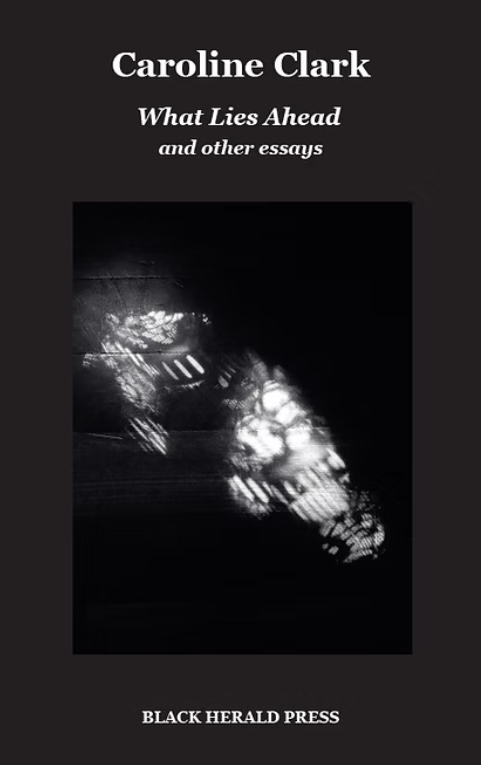
What Lies Ahead and other essays by Caroline Clark is published by Black Herald Press.


