Not that anything / comes to pass
When we give You a name /
For the shape You take
Eludes our grasp.
Far clearer / from something to nothing /
So many things / ever the same /
Poppy blossoms / the falling light /
Sheathes of everything / lost and bright.(“Prayer with poppy”)
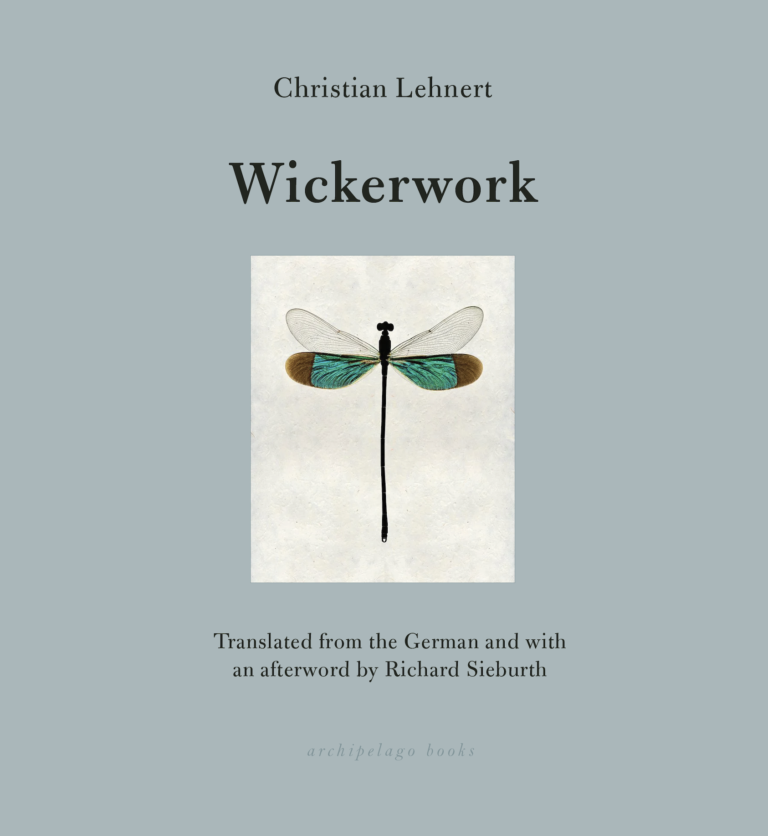
As I am writing this on Remembrance Day, a prayer with (rather than to) poppies somehow seemed like a good place to begin. This book, Wickerwork, a collection of poems by the German poet Christian Lehnert, has been on my shelf since early last year when it was released—his first work to appear in English translation—but as sometimes happens (as it has to me so often of late), it fits seamlessly into some poetic and meditation-themed reading that has captured my attention this year. It met me when I was ready it seems, like another thread waiting to be woven into a larger picture.
Lehnert, born in Dresden in 1969, grew up, as translator Richard Sieburth so aptly puts it, “under the grey godless skies of the German Democratic Republic.” He found his way to the lyric poetry of Rilke, Trakl and other modern German poets and to the mysteries of faith in his youth, but first before he was free to follow these leads, he would be conscripted to serve as a construction soldier. After the Wall came down in 1989, his army obligations ended and he was finally able to pursue advanced studies in theology in Leipzig and Berlin. He also spent a year in Jerusalem, followed by another two studying Spanish baroque painting in Galacia before returning home to take on a position as a Lutheran minister in a small rural community south of Dresden. Today he is the head of the Liturgical Studies department at the University of Leipzig.
The present volume, Wickerwork, gathers a selection of poems from Lehnert’s three most recent collections, presented in receding order. They showcase his fondness for German baroque poetic form, his commitment to the theological tradition of allegory, and his deep attention to the natural world (he once dreamt of becoming a microbiologist). His metaphysical view of nature sets him apart from much of the traditional Naturlyrik, in his particular view of the world as an interdependent, interwoven, non-hierarchical activity within which humans are only one part among countless other souls. There are, in fact, only two mammals that appear among these poems directly, the bat and the whale, but Lehnert otherwise turns his attention, and wit, to a vast range of natural phenomena, from trees to flowers to birds, amphibians, insects, fungi, and even viruses.
Viruses
Leftover lives / it’s only on others they take their chance /
These tiniest of souls / ever restless for foreign lands.
The first and most recent volume featured in this selection is Opus 8, Im Flechtwerk (2022), the Opus 8 signifying Lehnert’s eighth collection, but also reflecting the poet’s deep musical sensibilities. Sieburth describes the overall structure of the work although space naturally limits the number of poems he can include. The balance of Wickerwork is drawn from Cherubinischer Staub (Cherub Dust, 2018) and Windzüge (Windstrokes, 2015). Lehnert’s poetry tends to favour forms with strict meter and rhyme schemes. In his detailed and helpful introduction, Sieburth describes the challenges and rewards of working (and playing) within these constraints to preserve a flexible framework within which the poet’s spirit can be faithfully encountered.
The Wickerwork section includes eighteen paired distiches and octaves, presented with the original German printed in lighter font beneath each poem, “the texts thus facing upwards downwards, the echo of translation rising from the depths of the original.” The balance of Sieburth’s selections from Opus 8 includes twenty-eight rhymed couplets as freestanding poems isolated from their facing octaves. This calls particular attention to one of Lehnert’s distinctive forms, the two-line stanza or distich, in particular, the German alexandrine distich (each six iambic meter line is divided by a strong break after the first six of the twelve syllables). As a further indication of pauses in the poems from this collection, Lehnert employs virgules (forward slashes), another nod, Sieburth claims, to the typographies of German baroque verse. In translation, of course, meter cannot be strictly maintained, but mood and rhyme are re-imagined in a manner that feels respectful. And the keen eye of the naturalist-poet-mystic shines through:
The autumn spider
Knows not / who she is / and has eaten / all she earned.
In her web / she lies in wait / for memories / to return.
Eyed hawk-moth (Smerinthus ocellata)
The sunlight darkens / into the red embers of the trees.
Two eyes open / and the night grows / into what they see.
In the poems of the second section, drawn from Cherub Dust, the poet’s presence is somewhat more immediate. Here we find a series of devotional epigrams authored by an unnamed wanderer, described by Sieburth as “a contemporary backpacker sifting through the intermittent dust of angels.” Again employing his favoured distich, many of these poems are dated and arranged into a sort of calendar, primarily set in the area surrounding Lehnert’s farmhouse in Breitenau, a village located in the Eastern Ore Mountains just north of the Czech/Bohemian border. In the dated poems, the first line paints a condensed yet vivid, active natural image, while the second turns from verbs to nouns beginning “So heißt” (translated “Thus the name” of or “Thus x is called”). These are small metaphysical meditations can catch one off guard with their thoughtful sense of wonder:
End of May 2016, Pfarr Forest in Beitenau
My senses stifled by all the underbrush and bracken.
Thus the name of the spruce seed: amazed, it happens.
November 2016, clear cutting of larches, Breitenau
The forest is surveyed, to check its sprawl from spreading.
Thus the name of lichen grey: the velvet of forgetting.
Moving back in time again, this collection closes with four relatively longer poems and one couplet from Windstrokes. Rich with natural images, familiar subjects of interest, and contemplative reflections, one can see in these pieces the path that Lehnert has followed on his way to his more recent poetic wanderings, leaving this volume hopeful that English language readers will have an opportunity to continue follow his path forward in the future.
Wickerwork by Christian Lehnert is translated from the German by Richard Sieburth and published by Archipelago Books.


