It’s so hard to be a stranger: A Blind Salmon by Julia Wong Kcomt

i looked into his low eyes
black, tired
i looked into his heart
and that splotch of vigor
made me
ephemeral, tardy, rancid, and fleeting

we arrive at the altar
in a state of absorption
i request a living offering
start to cough, phlegmy
till i’ve nearly smashed to pieces
at his feet

– from “opium weddings”

The poetry of Julia Wong Kcomt turns on the unexpected, crosses cultures, languages and borders, reflecting who she is, where she comes from and where she has travelled to and lived. Born into a Chinese-Peruvian (tusán) family in the desert city of Chépen, Peru, in 1965, she was a prolific writer whose work included eighteen books of poetry, along with a number books of fiction and hybrid prose. Questions of identity and belonging are central to her writing, as are themes of migration, motherhood, and the body.
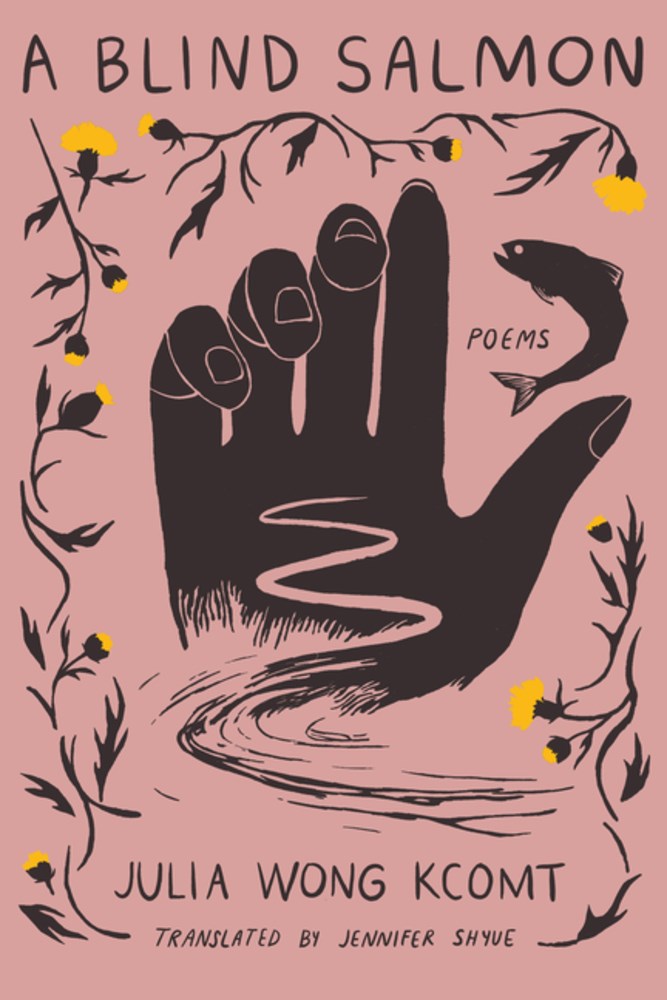
A Blind Salmon, her sixth collection, originally published in 2008, is her first full-length work to be published in English translation. Translator Jennifer Shyue who has a particular interest in Asian-Peruvian writers, has been engaged with her and her poetry for several years making this volume a welcome introduction to an intriguing and important poetic voice. Sadly, however,  Kcomt did not live to see its release; she died in March of this year at the age of 59.

Composed while she was living in Buenos Aries, the poems in this dual-language collection, often involve a shift between languages—Kcomt was multilingual, speaking Spanish, English, German, and Portuguese—creating a challenge of sorts for Shyue, especially when the original contains English. This is handled with the use of an alternate sans serif typeface when appropriate, or by bringing Spanish into her English translation for the words or lines in English in the original, as in the poem “tijuana big margarita.” When German arises, it is left as is. This shifting linguistic terrain, like the sands of the region she comes from, adds texture and variation when they appear.

The poem “on sameness” which is repeated or echoed in the collection, is another wonderful example of the multilingual dynamic at play. The first appearance features Kcomt’s own English version of her poem “sobre la igualdad,” presented in two different typefaces on facing pages (the regular typeface and that which is used to denote English in the original). The wording is, naturally, identical. It opens:

in the circle, sweet circle
of intense immortality

where is my china?
the land with no owners
the face is not repeating itself

Later, when the poem is revisited, Kcomt’s Spanish original faces Shyue’s translation, which she made before reading the poet’s own translation (or at least refreshing her memory of a more distant encounter). The similarities and differences shine a light on the perspective a translator brings to her reading of another’s work—line by line and as a whole:

in the circle, sweet circle
of intense immortality

where my faraway chinese country stayed
the great country of all
where no faces repeat

This collection contains a mix of verse and narrative prose poems, the latter sometimes stretching on for three or more pages and offering a broader canvas for the exploration of identity and belonging, in some instances twice removed when set in Germany where Kcomt studied for a time. They address trying to find a home of some sort, balancing relationships, and finding invisible lines can be crossed in an instant as in “aunt emma doesn’t want to die” where the Asian-Latin American speaker, a foreign student, offends her elderly employer with her attraction to a man in a photo (“no looking, margarita. he’s not for you.”) and is forced to leave her home:

when i was moving out, you wouldn’t look at me. at  the geographic latitudes i’m from, we’re unfamiliar with that feeling, is it called ethnic guilt? perpetuation of folklore.

reiner was the forbidden fruit next to that tiger from kenya and you hated me because I took a bite that full-moon night as the children danced in costumes in the square.

[. . .]

and though i thought reiner would come looking for me or call me, that didn’t happen. not that it would have been necessary. his torso had imprinted on my groin. sometimes skin serves as a sort of reproduction.

in student housing i was once again surrounded by people like me. foreigners. it’s so hard to be stranger, to come from elsewhere, to fight, to steal, to do anything to get inside and the insiders throw you bait only to take it away.

The poems in A Blind Salmon seem to become increasingly charged with life and energy each time they are revisited. Kcomt’s speakers are bold and unapologetic, reaching out with language that is sensual, unexpected, unsettling. Her images are often startlingly corporeal, yet always touching the tender complexities of being in the world, a world that does not always no how to understand you, or you it, but one that is fully alive.

A Blind Salmon by Julia Wong Kcomt is translated from the Spanish by Jennifer Shyue and published by Deep Vellum/Phoneme Media.
Even the birds have gone away: Nostalgia Doesn’t Flow Away Like Riverwater by Irma Pineda

A drop of salt on paper
is silence killing us
Where have your footsteps taken you?
In what corner of the world
.                                  do they hear your laughter?
What shard of earth drinks your tears?

– from “A drop of salt on paper”

****

I traveled the path from the south
my feet blistered with memories
so tired from dragging
all my people’s dreams

– from “I travelled the path from the south”

The migration conversation, in various formulations, is occurring in countries and communities around the globe. Migrant workers are needed to do jobs no one else wants, but the migrants themselves are viewed with suspicion and worse; foreign students and the higher tuitions they can be charged are courted, but when they arrive they are blamed for housing shortages; and refugees fleeing war, famine and persecution—well, nobody really wants them at all it seems. But what about those who see no other option for themselves and their families than to seek opportunities abroad even if it means facing precarious, illegal conditions, torn from the land that they love, fueled by the hope that they will someday be able to go home again? And what about those who stay behind, holding onto tradition, waiting for the absent worker to return?

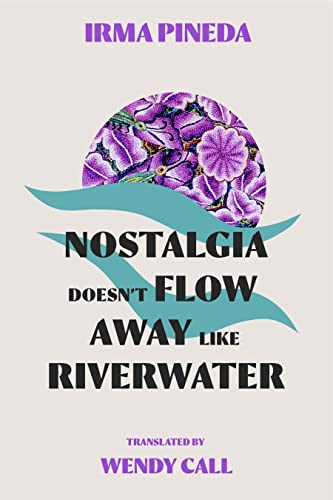
Nostalgia Doesn’t Flow Away Like Riverwater, a three-part sequence of poems by Indigenous Latin American poet Irma Pineda, breathes life into the painful situation in which many people in her own hometown of Juchitán, Oaxaca, have found themselves over the years. Pineda publishes her poems bilingually, in Didxazá, the language of the Binnizá (Isthmus Zapotec) people, and Spanish. She describes these two versions as “mirror poems.” In this collection, translator Wendy Call who has been translating Pineda’s work for many years, draws from both languages, with the close support of the poet herself, to create English translations. As she describes in her introductory essay, there are certain features of English that are closer to Didxazá than Spanish is, allowing her to reflect some qualities that cannot be maintained between the two original versions. The result is a simmering trilingual collection that offers even an unilingual Anglophone reader the opportunity explore and compare the very different appearance and tones of the poems as they appear in the three languages.

The poems in Nostalgia Doesn’t Flow Away Like River Water are divided into three sections of twelve poems each. They are “persona poems,” carrying the voices of two fictional characters from the poet’s hometown of Juchitán—one who has travelled north to the United States looking for work as an undocumented labourer, and their partner who has stayed behind. The poems speak to the impact of ecological pressures, climate change and pollution on the local fishing industry, as a main driver of migrants, men and youth, out of the community, leaving those who stay to try to hold on to their traditions for future generations and for those they hope might return. As Pineda explained to Call, “I create poetry as a way to keep collective memory of my culture alive and to reflect on what is happening to our culture. When I say ‘our culture,’ of course I’m also referring to the earth and the sea.” The river, the sea and the soil all feature in these poems, as do references to Isthmus Zapotec legends and stories.

The first part of this work, MY HEART IN TWO / Chupa ladzidua’ / Dos mi corazon, chronicles the migrating partner’s decision to leave. The reluctance to leave and sadness of those who must let a loved one go is palpable. The inevitability of homesickness is understood from the first poem onward:

Pack your suitcase well
leave the pain here
.                I will take good care of it
leave the nostalgia
.                so it won’t make you sick once you are there

– from “The Suitcase”

At the same time, the uncertainty of the fate that lies ahead of the departing partner weighs heavily:

Doubt wounds me
not knowing which rocks
I must stumble over
not knowing which paths lead
to my destiny
no way to stare
my future in the face

– from “Doubt”

The closing poems of the first section see the migrant departing before daybreak to make it easier on themselves and those who must stay behind. Part II, ON THE PATH / Lu neza / Sobre el camino chronicles the journey north while the character remaining behind speaks of the forces that have led so many to leave and the changed face of the village:

Where did its lifeblood go?
Did its unbearable silence scare away
the dogs?
There are no children in the street,
not even the robbers prowling the roofs
Even the birds have gone away…

– from “The houses of your village have eyes”

In the pieces in this central sequence the sense of absence and distance becomes increasingly evident. Far away from all they have known and loved, the feeling of homelessness and alienation settles on the migrant:

I don’t know which hurts us more
the misfortunes we left behind
or those we find here
becoming invisible
no one looks into my black eyes
no one hears the songs on my tongue
is my brown skin transparent?

– from “Many full moons have passed”

If the second part is transitional in relationship to place and form—somewhat direct and contained—the third, THE DAY WILL COME / Zedandá tí dxi / Un dia llegará, is intense in emotion and energy, similar to the first but more so. The longing is more desperate, tears flow freely, at home and abroad, and the migrant worries that if they are ever able to return will they be forever ruined by their experience in the north. Yet, for the partner waiting back home in southern Mexico, there is no question that welcome awaits no matter the circumstances. Nostalgia is a force pulling on both sides, a desire to be together where they belong is strong:

             You will return to me
lugging your heavy bags
in clothes woven of pain
and words carried from the other side
You will return with strange rhythms
unrecognizable thoughts
I won’t hold fear in my hands
but rather my heart’s song

– from “The days won’t end”

Nostalgia Doesn’t Flow Away Like Riverwater is a very special collection that lays bare the painful decisions that migrants face and the risks they take to provide a better future for their families, while exposing the sacrifices made by those who stay behind. By publishing her poetry in her native tongue, Didxazá, and in Spanish, Pineda is not only writing of and for the Binnizá (Isthmus Zapotec) people, but inviting others to hear their stories. Now with this trilingual edition, English language readers have the ability to appreciate this vital poetic conversation at a time when we need to be listening to the voices of others more than ever.

Nostalgia Doesn’t Flow Away Like Riverwater / Xilase qui rié di’ sicasi rié nisa guiigu’ / La nostalgia no se marcha como el agua de los ríos by Irma Pineda in Didxazá (Isthmus Zapotec) and Spanish with English translations by Wendy Call is published by Deep Vellum & Phoneme Media.