
Only in a poem can you bring back the dead: My Rivers by Faruk Šehić

On a windy August day, a poet walks a stretch of the French Atlantic shore. It’s Liberation Day and his thoughts turn to foreign troops landing on these beaches, in two World Wars, but he thinks especially of the frightened young American marines bound for Normandy:

Such men I would like to lead
into the ultimate battle, into the resurrection
of green grass beneath clear skies
without the salvos of heavy naval guns
without the screech of aeroplanes
or the confusion of anti-aircraft fire
without those shadowy submarines
like long Antarctic whales
seen from high flying planes
Fragile dandelion parachutes
would be all that would fall

This passage, from the long poem “Liberation Day” that opens Faruk Šehić’s four-part poetic cycle My Rivers, is more than one man’s musing on distant wars—Šehić has a much more immediate and lingering association with combat and its aftermath. He was born in Behić in 1970, and when war was declared in the newly independent Bosnia and Herzegovina in 1992, the then twenty-two year-old veterinary medicine student left his studies and volunteered for the army. He would end up leading a 130-man unit, an experience that has informed his novels and short stories, but in this collection of poetry Šehić turns his attention to the post-war condition, to the scars that don’t heal and the remembrances that are always incomplete.

The first two sections, “The Loire” and “The Spree,” find the poet/speaker in France and Germany. He seems to be looking to find—or perhaps lose—himself in the winds and the waves, in mythology and history, on the streets of Paris or Berlin, and in the arms of lovers. In France, Šehić often appeals to nature and to a larger cosmic sense of eternity, while in Berlin the mood is more claustrophobic and ultimately disheartening. He cannot find the escape he seeks, so his wandering takes him back home to Sarajevo, where the bones and ghosts of the dead cannot rest, where the long shadow of war is hard to avoid and must be confronted.

It is in the third part of My Rivers, “The Drina,” that any attempts at distraction or escape fall away. A sharp bitterness can no longer be hidden, as the poet admits that the bloody histories lurking within cannot be washed away by clinging to “literary reminiscences / with which  I stubbornly defend myself / with which we all stubbornly defend ourselves / from a non-metaphorical Bosnia / which gently murders us.” Gently murders us. The poems in this and the final section, “Beyond the Rivers,” are stark and powerful, shot through with flashes of anger and grief as the Šehić tries to find some understanding and relief from the burden he carries as a former soldier and survivor of war and genocide. Speaking for himself and his people, he recognizes the crippling human cost of conflict and dehumanization, but wonders how it can and should be remembered as evidence, even of a relatively recent past, seems to disappear under the façade of a return to “normal.” In several pieces he turns to the example of Buchenwald, questioning if it is even possible to honour the voices of the dead:

But yet again, nothing happens
The grass is worldly indifference
combed over their eyes
like holy green hair
A victim is a victim
with no language, forever
dead, the same body killed several times
with heavy machines, heavy
oblivion in primary, secondary, tertiary
mass graves and a dayless abyss

– from “A Glass Marble from Potočari”

Šehić’s verse is unadorned and direct. His message is not obtuse. In fact, in one piece, he openly questions the value of poetry and metaphor altogether. A weariness and despair is sometimes evident, as is a hope that in nature a certain redemption may be achieved, but the most powerful poems in this collection are fueled by honesty and anger. And, of course, it is impossible to read this work at this moment in time, when we are watching as the value of “Never Again” is once again being eroded, without remembering the many times that promise has been forsaken in the nearly eighty years since it was first proclaimed. 1995, as Šehić well knows, saw one of those incidents of genocide.

When I first went to Srebrenica
piercing  air thick as gelatine
I walked through a town that had moved
underground, with more stray dogs than people
on the streets, everything I saw
transformed into something else
A house here is not like other houses, here
the landlord is Death

This poem, “A Walk through Srebrenica,” chronicles the speaker’s encounters with a place silenced under the burden of history, yet offering some hope that it will not be forgotten:

The weight of my body carried here was a punishment
Yes, guilt is the air we exhale
No poem about Srebrenica will ever end, infinite
sadness is its subterranean hum
The heritage of our souls

First published in 2014 as Moje Rijeke, this is a profoundly moving and, so it would appear, timely collection. My Rivers by Faruk Šehić is translated from the Bosnian by S.D. Curtis and published by Istros Books.

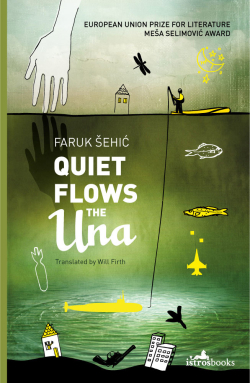
Melancholy is what defines us: Quiet Flows the Una by Faruk Šehić

The Una is a 212 km long river that winds its way across Bosnia and Herzegovina, forming at times, a natural boundary between that country and Croatia. Bosnian writer Faruk Šehić’s EU Prize winning novel, Quiet Flows the Una, allows the passage of this river – gentle and violent as the seasons turn – to carry the narrative of his burdened protagonist as he seeks to heal his troubled past.

1024px-Una(Bih)

“Here at the beginning, it would make sense for me to go back to our origins: to the water we’re made of and the swirling currents of the underwater epic, where I’ll hearken to the anarchist trout and their fulsome chatter. You’ll find out later why the trout are anarchist. ‘Fulsome chatter’ is Rimbaud, I’ll be a hypnotized boat, and the rivers will carry me wherever I wish.”

UnaAlthough the term is frequently evoked, rightly or wrongly, this is a novel that can truly be called hypnotic in the absolute sense of the term. The narrator has surrendered to the direction and influence of a fakir during a sideshow hypnosis session, allowing his thoughts, reflections and memories to be pulled to the surface and recounted under the hypnotist’s guidance. Our Bosnian protagonist, Mustafa Husar, is a haunted man, his wounds run deep – the war and his role in it have sundered the continuity of his existence. To bridge the rift between the leisurely days of his youth and his new life amid the shattered remnants of a world where he is trying to find his adult footing, he knows that he must uncover and bring to light the dark memories that rest uneasily beneath the scars that mark his face and body. By revisiting the bleak, brutal years of the Balkan wars – facing the crimes he witnessed and those he perpetrated – he hopes to find some measure of redemption.

The progress of this novel is not chronological. The narrative, which reads like an extended prose poem, dips in and out of seasons; moves between scenes of idyllic childhood reverie, accounts of wartime brutality, and images of postwar destruction and loss. The river is a persistent presence, it carries the the story. Its relentless flow and the creatures, both natural and supernatural, that inhabit its green waters form the landscape and the mythology by which the young protagonist learns to understand himself. Along the way, his journey is accented with literary and pop culture references – he is a budding poet, he is an earthbound spaceman. And even when the war takes him away from his hometown and the river on which it is anchored, nature is never far from his imagination. Here, for example, his account captures the fragile coexistence of faint beauty and coarse ugliness:

“The sun shone through the leaves covered with transparent-green aphids. It rarely reached the ground, where brown leaves lay rotting in the mud and puddles. Imprints of soldiers’ boots plotted pastel labyrinths, with our lives and deaths in the centre. Our camp lay between wet, forested hills in two valleys connected by gravel paths like spilled intestines. . . . The wind brought whiffs of shit and piss from the latrines on the sides of the hills, where fat white maggots multiplied in the slush. Mosquitoes slept like brooches pinned to the boards of those outhouses, satiated with our blood. A cow with deformed hips hobbled around in the large clearing where we used to line up for the flag salute in the mornings. Its meat ended up in the goulash we had straight before one raid.”

Quiet Flows the Una is an unapologetic indictment against war. The complexities and atrocities that marked the violent dissolution of the former Yugoslavia are woven into the narrative, even if the narrator sometimes affects a stance of emotional remoteness when he recounts his own involvement and ambivalence. His emotions are messy and conflicted. In the end, war reduces action to a matter of survival. He is haunted by a phantom self, an evil force that lurks beneath his wounded skin that, when given voice, spews contempt for the past and a life now lying in ruin, leaving his host with a feeling he vividly describes “as if someone is tattooing you on the inside, on the walls of your internal organs.”

As he grapples with the demons he carries, our protagonist occasionally slips briefly in and out of his hypnotic trance. His persistent efforts to articulate the dark, chaotic details of his experiences during the years of the Balkan War are accompanied by dreamlike, fantastic threads that meander like tributaries off the main narrative flow and by the whimsical illustrations of Aleksandra Nina Knežević that offer a striking visual commentary. The result is an insistent, engaging tale – a celebration of the simple pleasures of childhood, a memorial to the many towns of the region that have been reduced to rubble twice over, and an intimate portrait of a war that pitted neighbour against neighbour, divided along ethnic and religious lines. If there is meaning to be found once the dust of the destroyed buildings has settled, if redemption is to be achieved, Mustafa realizes that it will be found through words:

“I secluded myself among books and other beloved fetishes, and dust collected on them to warn me of the fragility of matter. As soon as you make a world, a house or a hut of sticks, it is doomed to failure; it was already doomed back when it was a black and white sketch in your head. That’s why I began to believe in words. They cannot be destroyed. If you erase them, they come back. Words float in front of your eyes and won’t retreat from the front line. If you set fire to them, they will burn with even greater ardour in your memory, and no memory-wipers like alcohol or narcotics will get rid of them. Words are above destruction. If you erase them, they’re right back on the tip of your tongue again.”

Faruk Šehić was born in Bihac in 1970, and grew up in Bosanska Krupa, a town straddling the Una in what was, at the time, still part of the Socialist Federal Republic of Yugoslavia. He was studying veterinary medicine in Zagreb when war broke out in 1992. He voluntarily joined the army of Bosnia and Herzegovina in which he led a unit of 130 men. After the war, he turned his attention to the study of literature, publishing his first collection of poems in 2000. He has frequently drawn on his wartime experiences to inform his poetry and short fiction. Šehić lives and works in Sarajevo. His debut novel, Quiet Flows the Una (Knjiga o Uni), originally released in 2011, is now available from Istros Books in a crisp, lyrical translation by Will Firth.

An official launch featuring a discussion with the author will be held at the Headquarters of the European Bank for Reconstruction and Development in London, UK on March 31, 2016.