This is the story of a church, one that exists whether it is standing or not. Standing high above the Mosfellsdalur Valley in southwest Iceland, not far from the nation’s capital, Mosfell Church has, at the time of the telling of the story—mid-twentieth century—been recently rebuilt, but it holds a history of rising and falling that reaches back a thousand years. Somewhere along the way it became associated with what parishioners believed were the bones of 10th century poet and national hero, Egill Skallagrímsson. However, the self-named inkman who is committing this account to paper has a more specific focus: he wants to put right a report of the events leading up to the last time the building was destroyed, and resolve the questions that lingered in the wake of that event:
Here, the story will be told of how the church was dismantled and razed to the ground for the third time in the latter part of the 19th century. It will be shown how powerful exponents worked together to destroy this church ever since the Danish king ordered its removal in 1774, although one hundred and twenty years passed before that order was implemented. For almost four generations, consequential parties laid their hands to that plow, such as the government in Denmark, the Icelandic Alþingi time and again, the church authorities one after another, bishops and deans as well as lesser parish authorities; finally, local farmers and honest housewives and robust men belonging to this parish, until no one remained to defend this church but a certain aged farmer at Hrísbrú named Ólafur Magnússon, and an indigent girl, a maid of the priest at Mosfell, named Guðrún Jónsdóttir.
In his introduction to A Parish Chronicle, Salvatore Scibona describes the circumstances surrounding Nobel Prize winning Icelandic writer Halldór Laxness’ decision to begin to work on this novella while vacationing in Rome in 1969. In spite of all the successes and accolades he had received by that time, he still felt like a failure because he felt had not yet gained the international readership he longed for and, at the age of sixty-seven, he may have assumed he was closing in on the end of his productive life. Having already lived two decades longer than his own father, he could not have imagined that he still had twenty-eight years and six more novels ahead of him. But he did, and the first would be this spirited tale, originally drafted six years earlier. First published in Icelandic in 1970, it has finally been made available for English language readers in Philip Roughton’s lively translation.
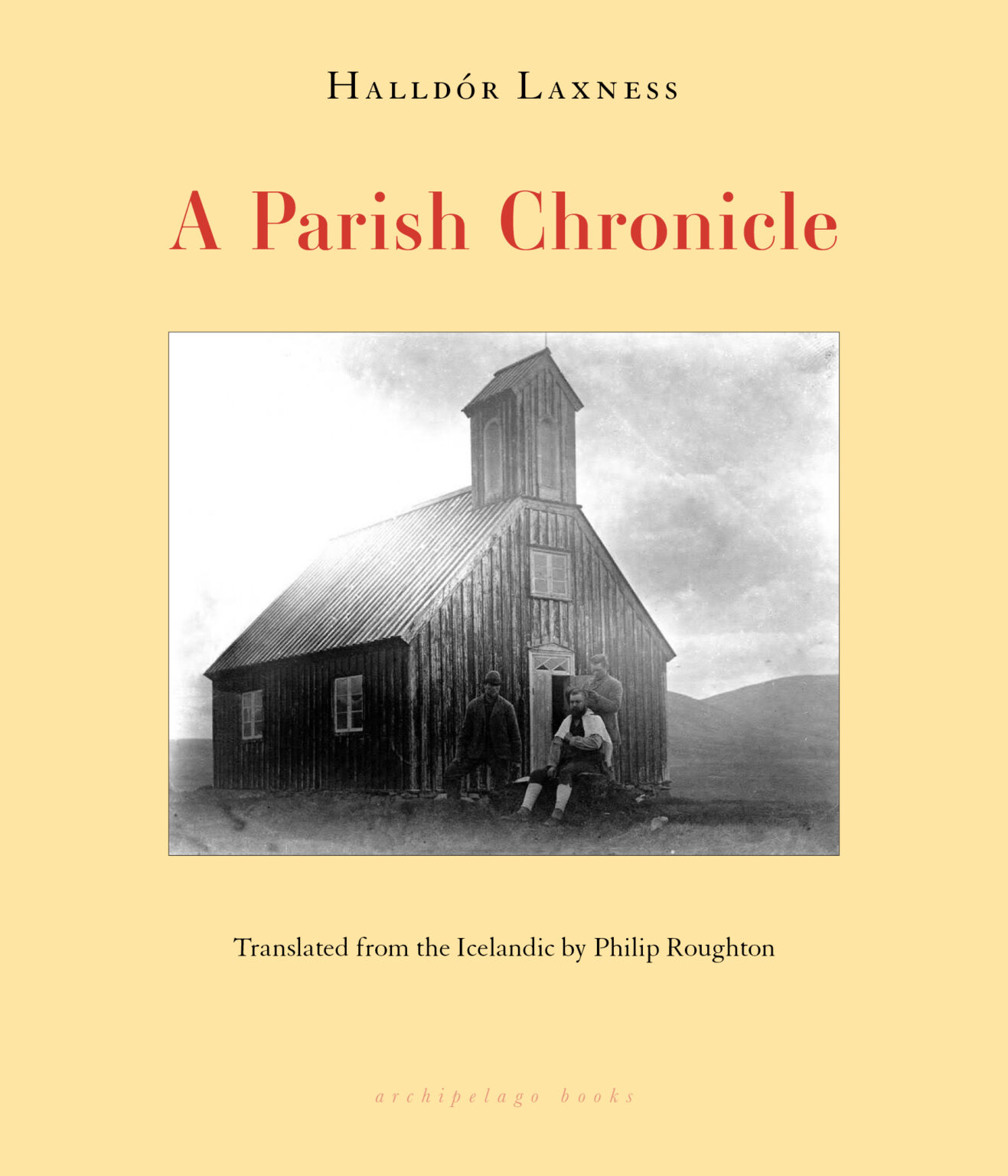 With its folksy tone and wry humour, this tale begins as the story of a parish and the social rather than religious role of the church in the everyday lives and politics of a rural community, but expands to offer a colourful sketch of the impact of increasing modernization on a nation with a long and deeply rooted culture and history. It attempts to adopt a documentary approach, but the events are often exceptional and the characters are eccentric, larger-than-life heroes and heroines of a homespun saga in which Icelandic poets are quoted more than any Bible passage is, even if a church (or its emptied yet still consecrated grounds) stands at its centre. Some of these folk even had real-life counterparts with the same names living in the Mosfellsdalur region. To be on the safe side though, Laxness included a note to the first Icelandic edition that read: “References to named individuals writings documents places times and events do not serve a historical purpose in this text.”
When it appears that the long overdue order to consolidate two parishes into one and construct a new church, was finally going to be implemented, old Ólafur of Hrísbrú, the crusty farmer and sheep herder, sharpens the blade of his scythe and, accompanied by one of his sons, arrives at the church and threatens to lead a revolt. But, in the absence of locals willing to take up the cause with the same steely vigour, a petition is launched instead. In the end, the only other person willing stand by his side, at least in writing, is the maid, Guðrún Jónsdóttir, or, as she is known Big Gunna. Their letter fails to hit its mark and the church is taken down and carted away.
For the inkman who is doing his best to faithfully record the events that occurred before his own birth, Big Gunna becomes an important source of information. His interviews with her when she is an old woman are worked into his narrative. Never inclined to take a husband or to accept money for her labour, she relied on the support of the community to carry her through the long years following the demise of the church and the end of her job there. But she is not a charity case. Delightfully plain-spoken, with her own commendable value system, she describes how she traveled around the region offering her services for almost any work that needed doing—the tougher and dirtier the better.
Then in the latter part of the book, a third key character enters the scene, a young runaway who is, against all odds, taken into the home of old Ólafur and unofficially adopted. This young lad turns out to have an uncanny sense of a good deal, an inexhaustible love of automobiles, and boundless generosity. In his own way, he carries the folks of the Mosfellsdalur Valley into a new era in style.
This book is my first encounter with Halldór Laxness and, I am inclined to think it is as good as any place to start as any. Especially with the excellent introduction (reproduced here at LitHub) to the varied and shifting nature of the Icelandic master’s oeuvre. Known for his ability to be very funny, even in his longer, bleaker novels, the narrative tone of A Parish Chronicle rests on an irresistible sly, understated humour that runs throughout. This passage, for example, describing the typical encounter travellers would have as they passed by Hrísbrú where Ólafur and one or more of his sons invariably could be found standing outside their buildings, captures the centrality of sheep to the rural consciousness:
The folk at Hrísbrú were rather pleasant of manner apart from old Ólafur when he was wrangling with the priest, but showed no particular interest in dragging people out of the mud bordering the walkway and inviting them inside. They asked for news of sheep from all over the country, because life in Iceland was, as it still is today, all about sheep. For example, when talking about the weather, it was only from the perspective of how it suited the sheep. Good weather was the weather that was good for sheep. A good year was one in which enough grass grew for the sheep. A beautiful landscape in Iceland is one in which there’s good pasturage for sheep. People’s livelihoods and outlooks on life were determined by that creature. The Hrísbrú folk were kept informed by travelers of the circumstances of sheep all over the country, and for their part, told stories about the welfare of sheep in the Mosfell district. They remembered exactly what the weather had been like for the sheep year by year for thirty years back. Those people never wore coats, but their woolen cardigans and sweaters stood up to water and wind like the fleece of an Icelandic sheep. All homemade and in the sheeps’ natural colors, mainly russet.
The world Laxness paints is, for all its quirkiness, one shaped by an abiding affection for the land and its people, his land and his people. This is, after all, the area in which he grew up and the inkman dipping his pen into the ink bottle, is a stand-in for himself. There may not be, as he once insisted, a historical purpose to the details of the account he has presented, but it is a thoroughly entertaining story.
A Parish Chronicle by Halldór Laxness is translated from the Icelandic by Philip Roughton with an Introduction by Salvatore Scibona and published by Archipelago Books.


 roughghosts