I am very pleased to have my first review published at The Quarterly Conversation. Dreams and Stones by Polish writer, Magdalena Tulli, is a poetic meditation on the city as an organic entity, essentially an urban cosmology. I read it through twice before writing my review and in my second encounter its nonlinear, cyclical quality was even more apparent. Thinking about it now, two months later, its fantastic, mythic qualities still have a strong hold on my imagination. But there is more that haunts me when I think about this book.
I had been aiming to submit this review in mid-July, my first reading was in late June, but before I could put pen to paper, so to speak, my father had a stroke and car accident and my mother became ill and died. As one might imagine, I struggled to write, let alone read. During times like this words fail us. But, as my father’s death neared I returned to this short book, for distraction, comfort and, above all, to know that I could still write. The ability to sit down and pull together a critical review was an important turning point. In times of immediate crisis and grief when family members find themselves trudging back and forth to the hospital, the advice is to try to return to some measure of routine. The answer, for me, was to write.
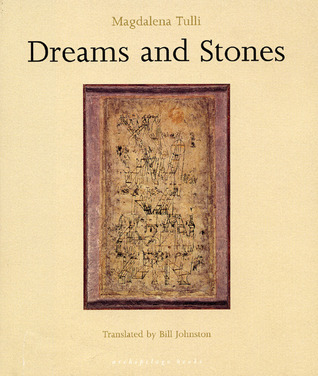
Dreams and Stones is translated by Bill Johnston and published by Archipelago Books. My review, originally published at Quarterly Conversation is reproduced below:
“There are more things in heaven and earth,” Hamlet famously says to Horatio, “than are dreamt of in your philosophy.” So might Polish writer Magdalena Tulli be imagined to warn readers entering her enigmatic first novel, Dreams and Stones: to be prepared to open your minds to an urban cosmology that envisions the city—its evolution, destruction and rebirth—in the light of two seemingly opposite notions of the world. Paragraph by paragraph, Tulli’s images are startling and fresh, and they become the building blocks of a fanciful metropolitan vision that overflows with both magic and sorrow.
Born in 1955, Tulli is one of Poland’s most original contemporary writers. She has received three nominations for the prestigious Nike Prize, and four of her novels translated into English to date, including In Red which was longlisted for the 2012 Best Translated Book Award
Recently re-issued by Archipelago Books in paperback (they published a hardcover edition over a decade ago), Dreams and Stones truly defies simple classification. From the opening passages, the contemplative poetic imagery reads like a re-invented Book of Genesis, sketching out the life cycle of the metaphorical tree upon which a fruit ripens, falls to the ground, and germinates; it holds in its core the seeds of a great city and the parameters of the human system that surrounds it. This archetypal city is fundamental to the vision of the world that Tulli proposes, but herein lies the tension that motivates and propels the narrative: Tulli’s calmly disconnected narrator ponders, never committing to one conception over the other, how the world is to be understood: as a tree or as a machine? Is the city borne of the dreams of its citizens? Or is it grounded in the faith and certainty of its master builders?
Be it natural or mechanical, the city is created by an inextricable combination of thought and the appearance of objects. Necessity and a restless urgency drive this process onward. Tulli’s narrator describes the lines of the city as ordained to appear through the pens of the draftsmen, inspired by the builders’ unshakable belief in one possible truth.
Though it remains a supposition it is not hard to interpret. It proclaims that it is not the power of germinating seeds and not the pressure of juices circulating between the roots and the crown that give the world life, but that it is set in motion by motors, gears, and cogs, devices that keep the sun and stars rotating, pull the clouds across the horizon and drive water along the bed of the river. The clarity and simplicity of this notion may prove salutary. They will make it possible to dismantle, repair and reinstall every broken component—so long as the world is composed only of separate and removable parts . . .
However, as the narrator goes on to speculate, how can one be certain the world is a machine when it resembles a tree in so many respects? This continual pull between the two poles of this dichotomy suggests that the way one chooses to view the world influences, even governs, the way one attempts to exist in it. Both views, it is argued, are true. And both have their limitations.
Tulli spins webs of interconnected realities and counter-realities. As a tree has a network of roots that spread, like the branches of its crown, in the dark depths of the soil, the city and every object in it ideally has its counterpart. But as the inexorable progress of the mechanized world rushes forward, the city is easily separated from the counter-city and, like a tree cut off from its roots, everything begins to spiral out of control, break down, fall apart. The builders that once seemed so assured failed to leave room for fate, chance, and fatigue—not only of materials but of the legions of flesh and blood workers required to build, repair, and maintain the metroplis in its glory.
Eventually time begins to run short and the power required to hold the counter-city at bay outstrips demand. The city, and the framework of the world that surround it, enter a period of cosmic decline. Here the narrative registers a distinct shift in tone:
No one knows where sorrow comes from in a city. It has no foundations; it is not built of bricks or screwed together from threaded pipes; it does not flow through electric cables nor is it brought by cargo trains. Sorrow drifts amongst the apartment buildings like a fine mist that the wind blows unevenly across the streets, squares and courtyards. There are long streets and short ones, there are broad ones and narrow ones. The gray of some bears a trace of ochre while others are bluish from the sidewalks to the roof tiles. Each of them has its own peculiar shade of sorrow.
The city of thoughts is now precariously maintained in the dreams of its inhabitants, their memories. The city of sorrow grows increasingly disordered and fragile. When war threatens to level it forever, the survivors, like their forbearers who constructed the original city, attempt to reconstruct one of memories. For, as the narrator assures us, “nothing in the world—even imaginations—can be destroyed completely and finally.”
Although Tulli never names the city at the heart of her story, recent Polish history, the massive destruction of Warsaw during the Second World War, and the systematic rebuilding and redesign of that place all seem to be woven into Dreams and Stones; but, these threads need not be traced in a linear fashion. This is a fable, one that essentially folds back on itself, a poetic meditation on the soul and heart of a city built, rebuilt and kept alive in the imaginations of its people. A metropolis that is connected to the rest of the outside world, to those shifting, almost fantastic municipalities that exist elsewhere, and yet stands as a self-contained ideal. One has to be aware though, that such an ideal can become distorted over time. Warsaw was reconstructed, with great attention to detail on the one hand, but altered to accommodate the new pressures of a steadily increasing population on the other. Memories and the rebuilt reality do not always align:
It is possible to imagine a city perfect in its entirety, a city that is the sum of all possibilities. In it nothing is missing and nothing can perish, every china teacup comes from somewhere and is destined for somewhere. But precisely this absolute city is eaten away by the sickness of never-ending disasters. Change invariably brings confusion to the lives of the inhabitants. One has to pay attention so as not to drive accidentally onto a bridge that was demolished years ago, so as not to sit on the terraces of torn-down cafés once known for their unparalleled doughnuts.
An obvious counterpart to Dreams and Stones can be found in Italo Calvino’s Invisible Cities. Tulli has translated Calvino and admits to his influence. But in so far as this book can be understood as referencing Warsaw, it retains a sharply central European feel. I was especially reminded of Pavel Brycz’s I, City.[1] Originally published in Czech in 1998, Brycz honors the history and people of the industrial city of Most in northern Bohemia, by giving the narrative voice to that place, setting the stage for a melancholic meditation on an urban center widely understood, at the time, to be in a state of unemployment, decline, and despair. In Tulli’s urban landscape it is the city’s inhabitants who maintain, generation after generation, the idea of their home, even as its proud stone edifices are turned to rubble. In I, City, the concept is reversed. It is the city that retains the memories and affections for its people and its past—it dreams, keeping its spirit alive despite repeated historical destruction, occupations, and finally as its neighborhoods are leveled to mine resources and replaced, not by stones, but by prefabricated concrete slabs.
While Tulli regards Dreams and Stones as a novel, her translator, Bill Johnston, respectfully disagrees. He sees it as prose poem.[2] It is, essentially, a series of images and reflections, and there are no individual characters apart from the measured and detached narrator. Yet either way, novel or poem, the piece is endowed with an overwhelmingly orchestral quality. The dynamic life of the city, builds up speed, slows down, becomes erratic, falls into an abyss, and is reconstructed anew. Tulli is playful with her imagery, intentionally pushing her metaphors to the edge. Even the moods—pride, sorrow, nostalgia—that course through her streets are imbued with a mythic intensity. This motion and fluctuating energy, combined with the fundamental philosophical tension at its core, gives the work its flow, draws the reader in, and, in the end, offers a richly provocative experience that invites and rewards rereading.
[1] Brycz, Pavel. (2006) I, City. (J. Cohen & M. Hofmeisterová, Trans.) Prague: Twisted Spoon Press (Original work published 1998) – Link to publisher page for book: http://www.twistedspoon.com/city.html
[2] Interview with Bill Johnston on Magdalena Tulli. Polish Writing. Retreived from https://web.archive.org/web/20111106183056/http://www.polishwriting.net/index.php?id=125

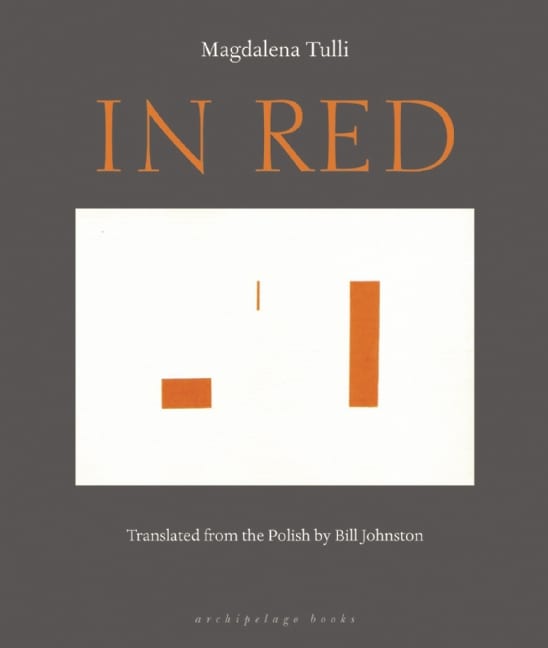 In Red, the 1998 novella by Polish writer Magdalena Tulli is a celebration of the power of stories to create a world that is at once magical and a microcosm of the early decades of the twentieth century in her native country. Echoes of Calvino and Saramago can be heard in her portrait of Stitchings and the many eccentric characters who pass through it and strange circumstances that arise in its streets, structures and public places. Defined by its industry and modes of approach—or exit—the town is, when we first arrive, home to three factories and a salt mine and, should one not approach by sleigh, a railway station to welcome newcomers. The primary businesses, all longstanding family concerns, are Strobbel’s porcelain works, Neumann’s phonograph record factory and Loom & Son who manage the flow of money and goods, and manufacture fine ladies’ corsets for the local and international market. Meanwhile, the salt mine and its miners hold an economic role that is essential to the very lifeblood of the town:
 roughghosts