People can grow old anywhere: Man in the Holocene by Max Frisch

—only human beings can recognize catastrophe, provided they survive them; Nature recognizes no catastrophes.

—man emerged in the Holocene.

It has been raining for days now, no night passes without thunderstorms and cloudbursts. In fact, Geiser can catalogue more types of thunder than the Encyclopedia which, to be fair, is rather mute on the subject, preferring to describe lightening instead. But, when we meet him, the seventy-four year-old widower is passing yet another stormy night trying to build a pagoda out of crispbread. And worrying the possibility of landslides. The highway through the valley is blocked so the mail bus can’t get through. Periodically the power goes out. To get through, he is intent on keeping his mind active, reading, accumulating facts and endeavouring to remember those details—like mathematical formulas—that have slipped into the dust of his aging memory.
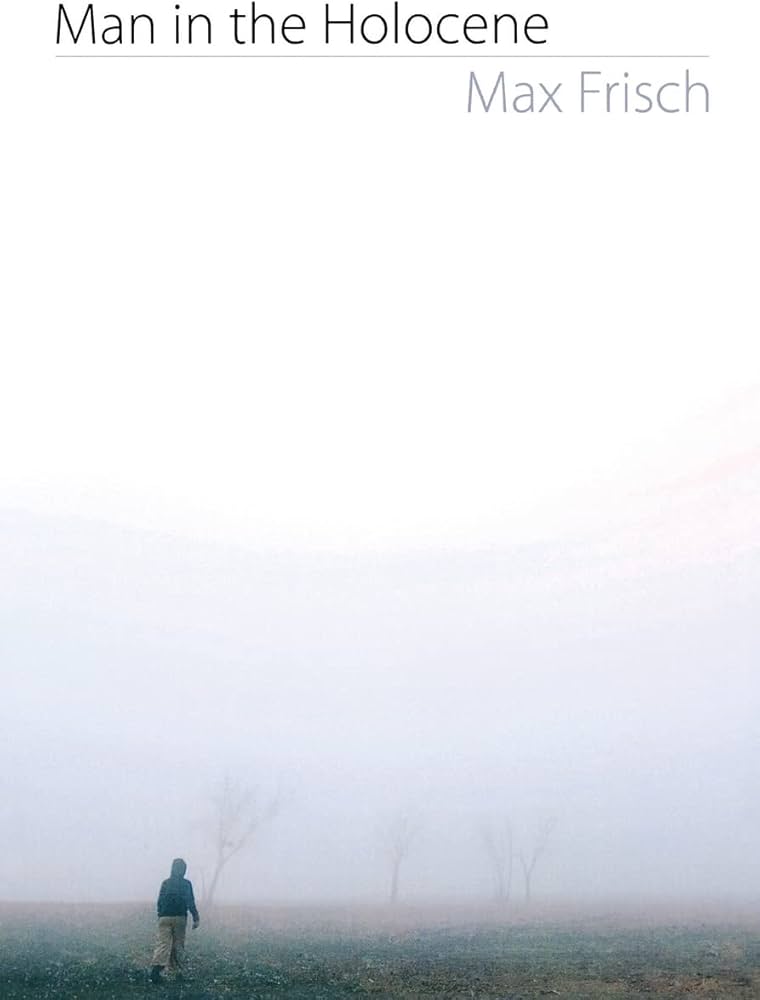
Man in the Holocene by Swiss writer Max Frisch is by turns the funny, unconventional, and bittersweet tale of a man who is waging his own little battle against the dying of the light, and attempting to construct a refuge in a gallery of facts while the storm rages outside his door.

Somewhere a tapping on metal.

He trains his field glasses on the mountainside watching for cracks, and reads up on the meteorological history of the valley he has lived in for the past fourteen years. He  delves into matters of rock formation, studies the measurement of geological time, and records details about dinosaurs. He begins by copying out information, but soon realizes that it is far more efficient to clip out passages of interest from the encyclopedia, the Bible, and other books, and then tape them to the walls of his home. Reproductions of his various cut and paste selections are embedded in the text.

Occasionally Geiser ventures out, umbrella in hand, to examine the state of his garden with its fallen dry stone wall, or once the power goes out for an extended period, to give away all the food in his deepfreeze—“the meat, usually hard as iron, is flabby, and the trout are repulsive to the touch, the sausages soft as slugs.” Only when he returns home, having foisted his thawed goods on his befuddled neighbours, does he remember that he could have at least roasted the meat over the fire in the wood stove.

One is becoming stupid—!

Through a fragmented text, repeated refrains, collected facts, and Geiser’s increasingly muddled meditations, Frisch brings us into the interior world of a truly memorable protagonist. He is a modest, somewhat eccentric figure who, at least since his wife’s death, has tended to keep to himself. Originally from Basel, where his daughter, son-in-law and grandchildren still live, he is an outsider, no matter how long he has lived in the valley. “A valley without through traffic,” as he describes it. A detailed description of the region, its industry, and social history is, if rather nonchalant in tone, not without moments of dry humour:

In the summer there are cranberries, also mushrooms. When it is not raining, the white trails of passenger planes can be seen high in the sky, though one does not hear them. The last murder in the valley—and that only rumored, since it never came to court—happened whole decades ago. Ever since the young men have owned motorcycles, incest has been dying out, and so has sodomy.

Women have had the vote since 1971.

What makes this novella work so well is that it is not simply an assemblage of fragmented passages, repeated refrains, and a collection of assorted facts. It is a well-paced and orchestrated, if crumbling, tragic comedy.  Geiser’s memory may be fading, but the narrative takes us into vivid accounts of the Icelandic landscape he once visited and a youthful attempt to climb the Matterhorn with his brother (a story he’s told so often that even his grandchildren are tired of it). And then there is his possibly ill-advised decision to, due to the blocked highway, head off early one morning with the goal of crossing the mountain pass so he can catch a train to the city. He changes his mind quite late into the adventure and returns home a weakened and diminished soul. A tired, confused man now determined to shut out the world once and for all, but still the reluctant hero of a story that is beautiful, sad, and quite unexpected.

Man in the Holocene by Max Frisch is translated from the German by Geoffrey Skelton and published by Dalkey Archive.
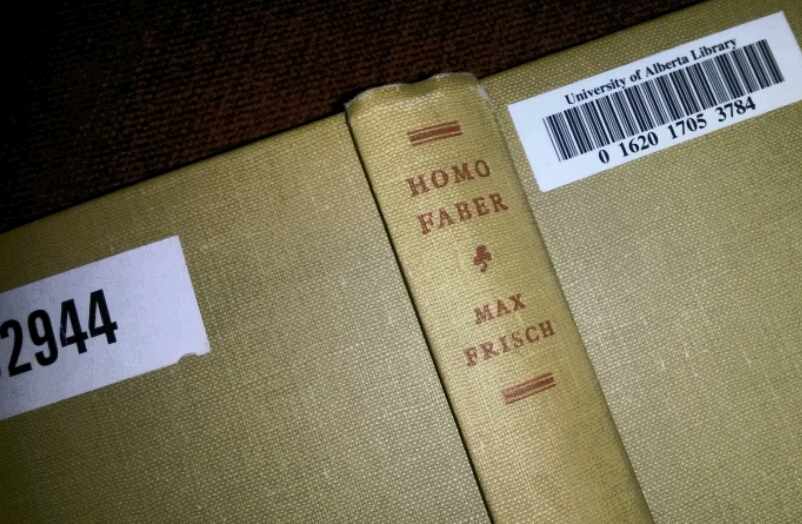
The unmaking of Man, the Maker: Homo Faber by Max Frisch

“We were leaving from La Guardia Airport New York, three hours late because of snow storms.”

Max Frisch’s 1957 novel Homo Faber begins with a matter of fact tone, an air of precision and efficiency. The narrator, Walter Faber, is a Swiss engineer traveling to Venezuela on behalf of UNESCO. Traveling is a way of life for him. But this trip, from the portentous delay on the runway onward, will mark the beginning of a systematic unraveling of a life bound to logic and technological certainty.

Faber’s account of his journey is spare and unromantic; he favours an exactness in his documentation, insisting that he is a practical, pragmatic man. He places, he tells us, no stock in “providence and fate”. Where others see chance, he relies on probability. Yet as a series of incidents appear to conspire against him, the laws and order of his heretofore measure of existence start to blur, to fall away in a stream of seemingly implausible circumstances. Even though he is obliged to admit that he has found himself caught in a flood of coincidences, he seems to hold to this as an excuse to absolve his part in the tragedy that ultimately unfolds. At least until that is no longer possible.

2016-03-09 18.31.00 During a brief stop over in Houston, Faber, feeling overwhelmingly ill and anxious, makes an attempt to miss his connection to Mexico City. He is located at the last moment and ushered aboard. Before long, the plane loses one and then two of its four engines and is forced to make an emergency landing in the desert where the passengers will remain for four days. During this time he will discover that his German seat mate is in fact the brother of his friend Joachim, a man he has not seen in 20 years. Even more surprising, he learns that this friend was, at one time married to Hanna, the woman he once loved.

This unexpected resurrection of ghosts from his past knocks Faber off balance but he still manages to describe the tedious and brutally hot days spent waiting for rescue in a manner so unaffected and matter-of-fact that some scenes take on an element of the absurd:

“Towards evening, just before dusk, the promised aircraft arrived, a sports plane; it circled around for a long time before it finally ventured to drop the parachute – three sacks and two boxes that had to be collected from a radius of three hundred yards – we were saved. CARTA BLANCA, CERVEZA MEXICANA, good beer, even Herbert, the German, had to admit as we stood around with our beer tins in the desert, a social gathering in brassières and underpants with another sunset, which I took on coloured film.”

Once they are finally on their way, Faber will opt to make a detour to seek out his friend and in the process learn of his unfortunate fate. After his intended stop in Venezuela he then returns home to New York where he finds that Ivy, his mistress, has ignored his attempt to break off their relationship. Dismayed at the prospect of a week in her company he makes the impulsive decision to travel to his next business engagement in Paris by ship, rather than plane. As the ship makes its way across the Atlantic he will meet and fall for the dynamic 20 year-old Sabeth, a young woman 30 years his junior. He has, he assures us repeatedly, no idea that she is his daughter.

“What difference does it make if I prove I had no idea, that I couldn’t possibly have known? I have destroyed the life of my child and I cannot make restitution. Why draw up a report? I wasn’t in love with the girl with the reddish ponytail, she attracted my attention, that was all, I couldn’t have suspected she was my own daughter, I didn’t even know I was a father. How does providence come into it? I wasn’t in love, on the contrary, she couldn’t have seemed more of a stranger once we got into conversation, and it was only through unlikely coincidence that we got into conversation at all, my daughter and I. We might just as well have passed one another by. What has providence to do with it? Everything might have turned out quite differently.”

Yet, from this point forward, he is on a collision course with a destiny of Oedipal and tragic dimensions.

With Walter Faber, Frisch has created a character who engenders empathy, in spite of the taboo circumstances in which he ultimately finds himself. He is defensive, he equivocates, and he expresses opinions that, especially to our more socially conscious ears, sound dated, racist, and chauvinistic. They are, of course, in keeping with a man of his times, especially one so inclined to black and white reasoning. However with respect to women, Frisch intentionally places very strong, independent women in his protagonist’s line of sight – and they are the women who hold the deepest attraction for him.

The prose is brilliantly tight and restrained. Repetition and rhythm combined with shifts forward and back in time create a remarkable tension. Faber, as a man making a report on these recent events in his life, a critical accounting as we learn at the end, hides from his narrative only that which is hidden to himself – the depth of his own personal, emotional engagement. The result is a book that resonates with the reader long after the final page is turned. As our hero realizes, far too late perhaps:

“To be eternal means to have existed.”

Originally published in English in 1959, Homo Faber: A Report by Max Frisch is translated by Michael Bullock.

2016-03-09 18.29.26As a postscript, it’s worth noting that this book has no North American rights and, in Canada at least it is as rare as hen’s teeth. I ordered a copy from the UK in early February which has yet to arrive. The ante was upped when I was asked to provide a short “trailer” about this book for the upcoming Spring issue of The Scofield Magazine (Max Frisch & Identity). I ordered a second back up copy for $1, also still missing in action, and placed an inter-library loan request for one of the two copies held in this entire province. Apparently that route has an expected 5-6 week turn around, so getting desperate I finally had to have a librarian from the central branch coax the U of Alberta to find it on their shelves and courier it (at my expense) so I could read it and get my requested piece off by the end of last week.

Ah, but some day I will own two copies of this book! Good thing it’s a keeper.