There be monsters: Dostoyevsky Reads Hegel in Siberia and Bursts into Tears by László Földényi

Humans have become alienated from their own history, as they are from their own cosmic nature.
– “Mass and Spirit”

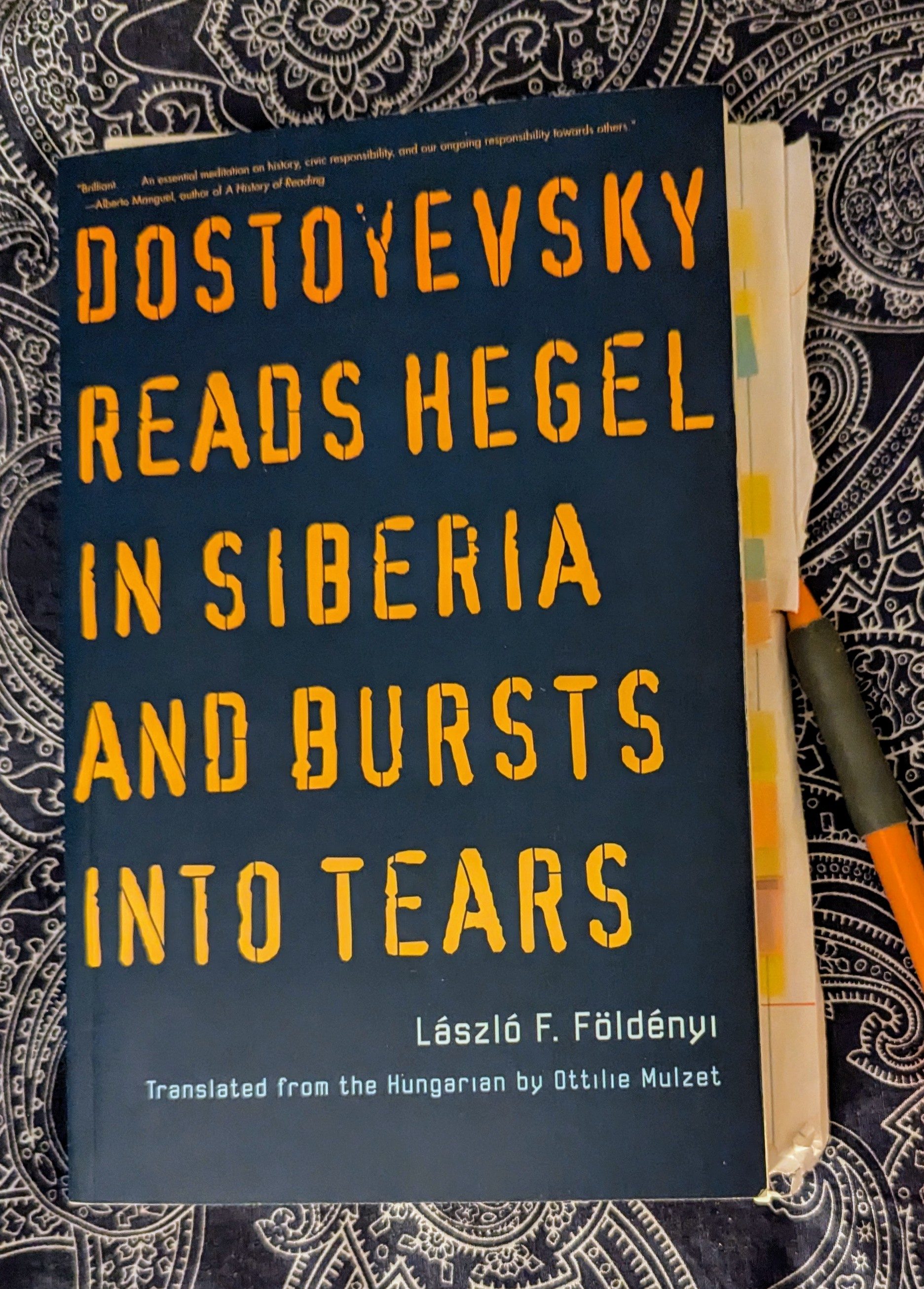
The title is irresistible. It is impossible to read it and not wonder: what is this book about? In truth, it is about many things, or rather, many ideas, but in essence they can all be understood as variations on a dichotomous theme: darkness and light. Pivotal to these inquiries is the lasting impact of post-Enlightenment thinking on a traditional understanding of metaphysics, that is, questions of being and the nature of reality. Where once religion, or belief in God, gods, or some transcendent quality of existence could be turned to in times of darkness, the Enlightenment heralded a belief in “the omnipotence of reason that illuminates all phenomena.” Yet, as László Földenyi posits in this wide-ranging collection of essays, adroitly translated by Ottilie Muzlet, darkness and light (or other similar opposites or variants) are inextricably linked—one cannot be imagined or understood without the other—but in our secularized modern age, we, in our restricted, nondivine omnipotence can find ourselves confronting our own fragility in situations where reason alone may not seem like enough to fall back on. What then?
In his explorations of this conundrum, Földenyi, a Hungarian critic, essayist and professor of art based in Budapest, entertains the ideas, experiences and tribulations of a broad cast of thinkers, writers, poets, artists, and literary figures including Elias Canetti, Heinrich von Kleist, Caspar David Friedrich, Nietzsche, Novalis, Marquis de Sade, Antonin Artaud, and many more. And, of course, the protagonists of the evocatively titled eponymous essay: Dostoyevsky and Hegel. As he examines the manner in which rationalism, and within it a constrained idea of freedom and existence, has been met by those who chafed against its confines to a greater or lesser extent, Hegel is often assigned to the role of advocate for the primacy of logic and reason—not necessarily always fairly—so he makes a regular appearance in a number of pieces. But his main starring role is as philosophical foil to a certain Russian writer exiled to Siberia.

“Dostoyevsky Reads Hegel in Siberia and Bursts in Tears” is a vivid exercise in imagination which takes us to Semipalatinsk in southern Siberia where Dostoyevsky was sent in 1854, to serve a period of military service following four years of forced labour. In this barren, desert environment, he lived in a sparely furnished room and made friends with the young local prosecutor, Aleksander Yegorovich Vrangel, with whom he recited poetry, discussed religion, most critically, studied the books that Vrangel was able to secure for him. There is some reason to believe that one of the authors they read together was Hegel, possibly his lectures on the philosophy of world history, either ordered from Germany or in the form of the book in which they had been gathered and published. Földényi enthusiastically admits that he is taking liberties with his assumptions, but the notion is too tempting to resist.

Dostoyevsky emerged from his years of imprisonment and exile, as a man and writer whose experience with hardship and isolation had ignited a metaphysical drive that he would go on to channel against nineteenth century Europe’s adherence to utilitarianism and rationality through his protagonists. For Hegel, history, despite its messiness and violence,  could only be properly understood as the logical, progressive march of reason. That which fails to conform—at least in terms a European mind might understand, as such Africa and Siberia—is relegated to stand outside of the historical process and to be worth no further consideration.

If the infinite and the transcendent become lost behind the finite things, then it is no longer possible to speak of freedom. God, subjugated to rationality, is not the God of freedom, but of politics, conquest, and colonization. This is the secular religion of the God of the modern age. And history—looking at it from a Hegelian point of view—is the history of secularization. Dostoyevsky might have justifiably felt that Hegel was not just ushering Siberia (and himself with it) out the door; he was trying to convince, in missionary-like fashion, all humanity to accept as historical only that which the censorship of rationality admitted as such.

In envisioning an intellectual clash between the ideals represented by Hegel, and Dostoyevsky’s own experience of life in a place deemed separate from history, under conditions he would never have known had he not been forced to leave Europe, Földényi sees the ground for the openly acknowledged spiritual transformation that the Russian underwent in Siberia, and the writer he would become.

This may be the most passionate essay in the collection, but many of the smaller, quieter pieces turn on equally intriguing ideas in an open, speculative manner. He writes, for example, about happiness and melancholy, fear and freedom, sleep and dreams. Often his intention is to push beyond a simple dichotomy, at other times he wishes to dig down into an idea through the examination of the lives and ideas of one or more individual who found themselves confronting the limitations imposed by a society dedicated to the furthering of rational ideals. Case in point, in the also cleverly titled “Kleist Dies and Dies and Dies,” Földényi unwinds Kleist’s trajectory from an enthusiastic supporter of Enlightenment ideas through an early “Kantian crisis” which shattered his faith that Truth was knowable, to an act—possibly inspired in part by Goethe’s Werther—that eclipsed any of his writing: his carefully orchestrated double suicide with Henriette Vogel on November 21, 1811.

It bears repeating: the death of Kleist is the most thoroughly documented event of his entire life. The French-Romanian philosopher Emil Cioran justifiably states that it is impossible to read even one line of Kleist without thinking of how he put an end to his own life. His suicide preceded, as it were, his life’s work.

It is tempting to consider, and Földényi obliges, how Kleist’s embrace of death, or the act of dying, might be an answer to the loss he felt in an uncertain world.

The pieces in this collection were published in their original form (some have been substantially revised) between 1990 and 2015. They are not presented chronologically, nor can they be read as one cohesive argument, not least due to the fact that times, and presumably their author’s views, change. But it is telling that the volume opens and closes with essays addressed to Elias Canetti: the first, “Mass and Spirit” written in honour of his ninetieth birth anniversary, the latter, “A Capacity for Amazement,” an examination of his seminal Crowds and Power, fifty years after its original publication in 1960. His examination of Canetti’s exploration of the universal crowd and its ambiguous role in human history is measured, at least for Földényi, against Hegel’s understanding of universal freedom as a rational ideal. For Canetti, the crowd is more than a gathering of humans, it transcends that simple notion to incorporate all natural phenomena, it is cosmic and inherently irrational. Although he may or may not be onside with all the implications of Canetti’s singular arguments, Földényi clearly admires his metaphysical energy and, as the title suggests, his capacity for amazement.

The best essays wrestle with ideas, challenge assumptions, and invite the reader to entertain possibilities, debate with them or, even better, be inspired to read further. Dostoyevsky Reads Hegel is filled with references to so many writers and works that it is impossible not to stop to look someone or something up, or pull a volume off one’s shelves. It encourages side trips down rabbit holes. And that is what is so rewarding about spending time with László Földényi and the fascinating company he keeps.

Dostoyevsky Reads Hegel in Siberia and Bursts into Tears by László Földényi is translated from the Hungarian by Ottilie Mulzet and published by Yale University Press.
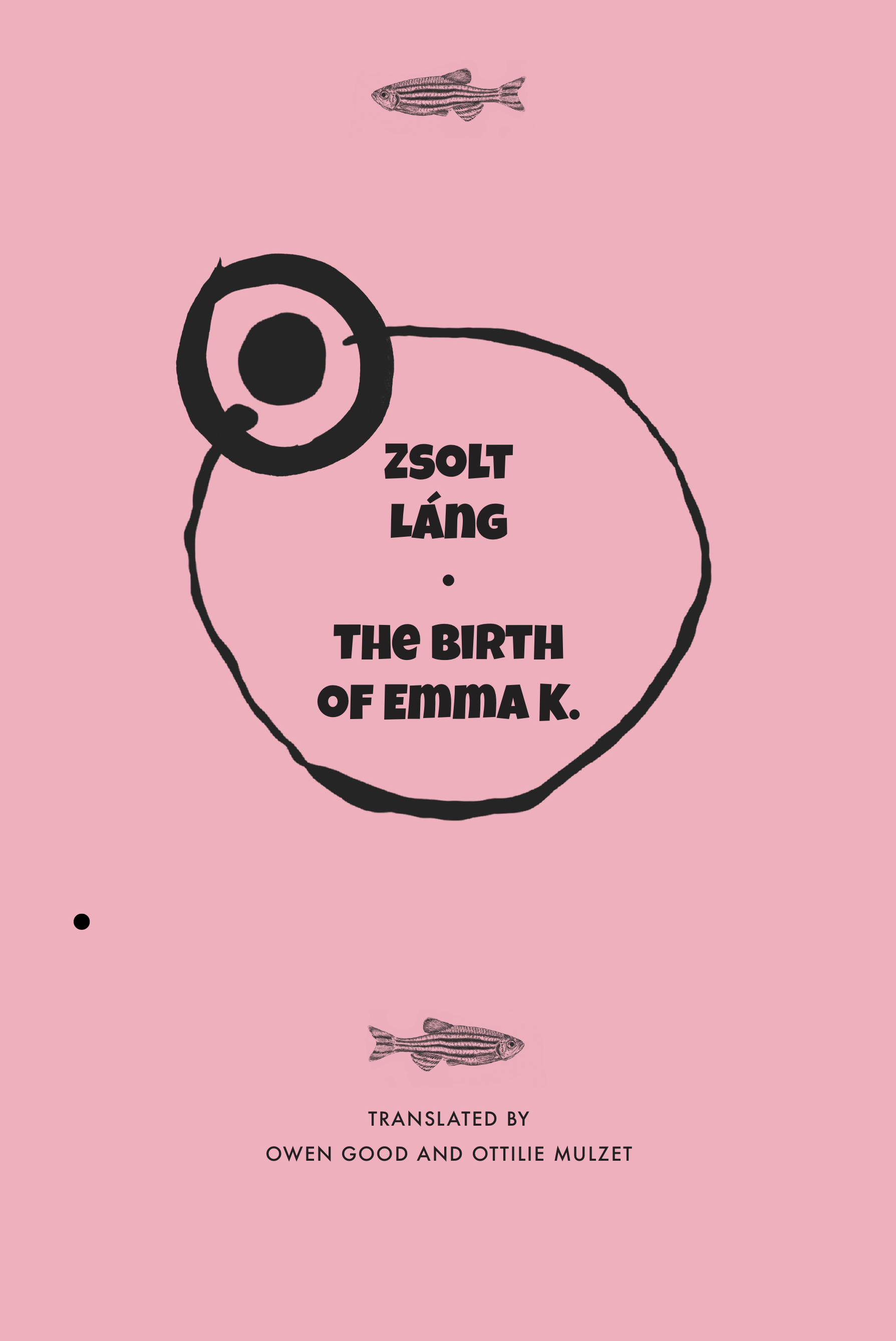
Exploring the uncomfortable corners of human existence: The Birth of Emma K. and Other Stories by Zsolt Láng

The fiction of Zsolt Láng inhabits a slippery space where time, genre, and realities shift and bend, where history shapes and distorts the landscape, and where characters are driven by conflicted passions and paranoias. Think of Flann O’Brien with a side order of Beckett, born and raised in Transylvania, charting his own course to become one of the premier postmodernist Hungarian language writers of our time and you have a hint of what you might find in Láng. And now, for the first time, we can sample that strange brew in English through the stories collected in The Birth of Emma K., translated by Owen Good and Ottilie Mulzet, but, be prepared, it is a delightfully odd journey during which one can lose one’s bearings from time to time.

The collection opens with “God on Gellért Hill,” set in Budapest, which finds “Our Lord” standing or floating above the city, intent on setting right the fragmenting relationship between two rather unattractive lovers. But to His dismay, God—and here the narrator reasons that we are witnessing neither the Father nor the Holy Spirit, but the Son—has been blessed with all kinds of powers, none of which are absolute. And, of course, under the often muddled efforts of their heavenly benefactor, the former lovers, Ida and Tamás, experience intensely swinging emotions that they are each at a loss to understand.

Our Lord followed them, as long as he’s here, he wants to see it through to the end. There’s still no guarantee he’ll intervene. Creation is like throwing a stone: There’s that ballistic arc from taking aim until reaching the target, and then there are the changes caused by gravity and wind; to intervene meant to retroactively meddle with time, at least that’s what a philosopher claimed with whom Our Lord didn’t agree (hence he never read the philosopher’s thoughts, though he could see into them). Our Lord is Our Lord because he sees things differently, his reasoning is different from man’s. But let’s not get mixed up in the difficulties of creation. (Good)

Determined as he is to try grant his subjects a happy ending they may not even want and are bound to undo, the burden of not-quite-absolute power weighs heavily on our heavenly hero, but in this clever opening piece there is a hint of the author’s own inability (or rather, wilful unwillingness) to exercise absolute control over his own characters—he’s happy to let them, and their stories, slip into strange territories, sometimes dark, sometimes light, and, more often than not, somewhere in between.

Láng , born in 1958, studied engineering at university in Cluj. Since 1990 he has lived in Marosvásárhely / Târgu Mureș, Romania, where he is an editor of the literary journal Látó. He has published close twenty volumes including short stories, novels, essays and plays. His work is deeply rooted in his Transylvanian homeland with its complex historical, multicultural, and multilinguistic  dynamics, but also reaches beyond to other European settings. His stories not only exhibit a broad range of characters and conundrums, they have a tendency to transform in style and form as they unfold. As translator Owen Good describes in an informative essay for Hungarian Literature Online:

Zsolt Láng’s is a nonconformist oeuvre. A story turns on a dime from a jovial satire to a poignant coming-of-age tale, from autofiction to metanovel to crime, leaving the reader forever playing catchup. Worlds blur and fantasy simmers to the surface.

If Láng is happy to allow his stories change without warning, he is also content to allow the reader to fumble their way into a tale for a while, or craft anachronistic realities in which, say, a preference for horse and buggy transportation exists alongside an internet café. Likewise, he does not feel inclined to bring all of his stories to a clear and defined conclusion, nor does he need sympathetic characters—some of his most unfortunate protagonists are driven by their own selfish or self-destructive motivations.

Consider “Like a Shaggy Ink-Cap Mushroom,” the tale of a depressed Inspector obsessed with death—his own. He sits at his desk surrounded by, but estranged from, the Beat Cops and the File Desk Girls, and feeling pressure from the powers above. He visits a gravestone with his own name on it, drinking in the sense of relief that comes with the thought of lying beneath it. And, when his former partner reaches out to him for personal assistance, a request that will begin to initiate a change in the Inspector’s sorry trajectory, his initial reaction is rather comically tragic:

He was surprised when his partner called. He didn’t recognize his voice. Hence, maybe, he was filled with the cool, soft promise of the hope for happiness. The tranquility of promise. A deep and hoarse voice. Slowly pronounced sounds. Containing an impossible amount of pain. He shuddered. Furthermore, the ring of the phone had electrified him. He jumped up and almost fell on the handset. The voice’s lumpy sadness. A fine, floury, lumpy sadness. Immediately he thought of Death. Death was calling. Or he was about to hear news of someone else’s death. He wouldn’t be surprised if it was his own. There could be no greater gift. Inspector, sir, I have to relay some really sad news. You’ve passed away, sir . . .  (Good)

In many stories Láng drills directly into his protagonists’ deep (and often dark) desires and fixations—two homeopathic doctors that each share a visceral hatred of the other, a lonely actress past her prime, or an inmate in an asylum conducting his own “research” and engaging the resident intern with his experimental theories. In others, like the longest piece, “The Cloister of Sanctuary” set in a monastery in Moldova, he works across wider canvas to craft an horrific folktale of mystery, manipulation, and cruelty. And then there is the final piece, the title story, which follows the metaphysical musings of an embryo, not exactly desired by her young would-be parents, from conception through a vigorous campaign to dislodge her from her watery accommodation, to her defiant arrival months later. It offers a fresh, insightful embryo-eyed perspective on the world she imagines versus the one she’s potentially heading towards.

With a touch of magic  and a measure of absurdity, the stories collected in The Birth of Emma K. offer an entertaining exploration of the virtues and foibles of human nature and an excellent introduction to another fine Hungarian language writer.

The Birth of Emma K. and Other Stories by Zsolt Láng is translated by Owen Good and Ottilie Mulzet and published by Seagull Books.

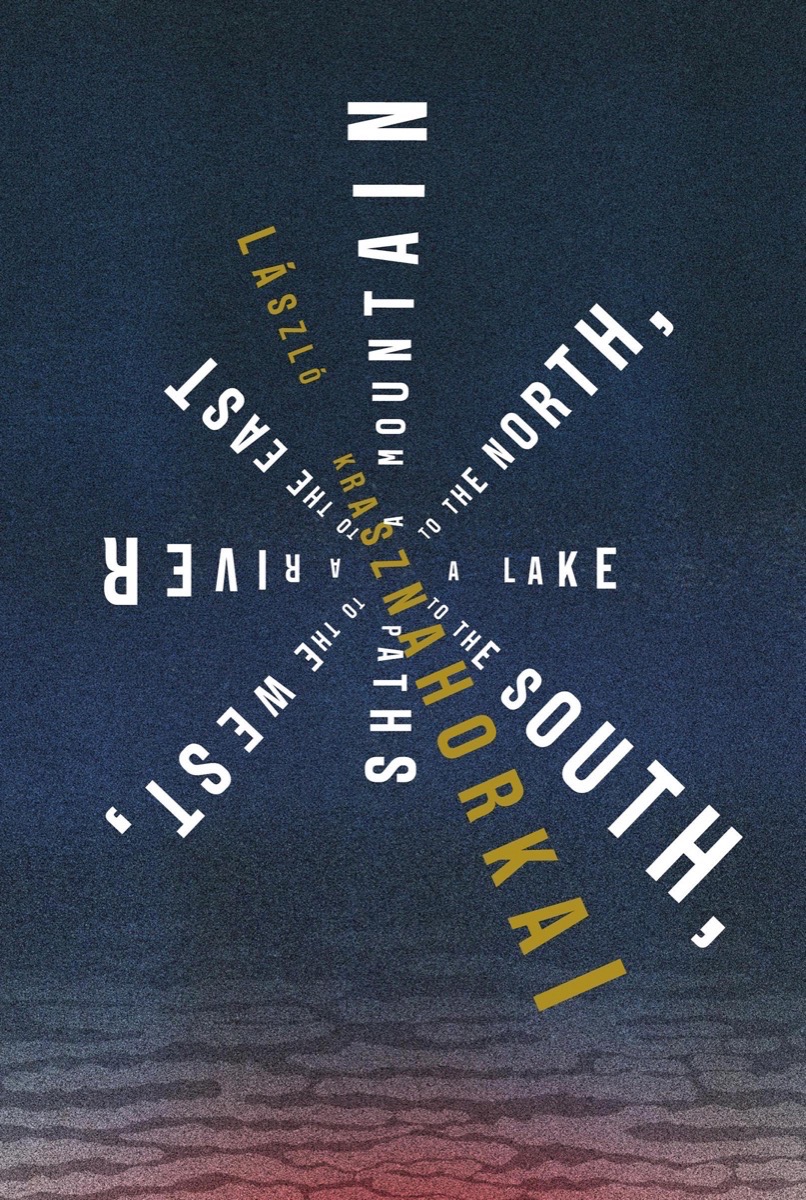
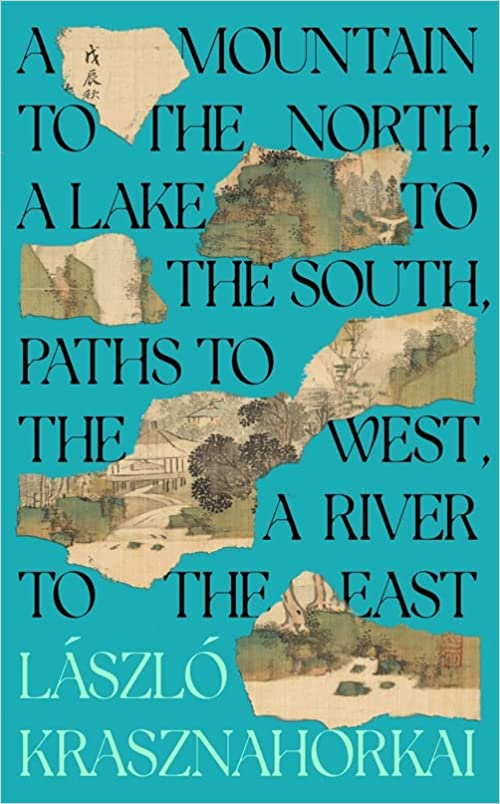
The seeker’s search: A Mountain to the North, A Lake to The South, Paths to the West, A River to the East by László Krasznahorkai

He did not find the gate where he thought he would, by the time he noticed that he was about to step inside he was already inside, he couldn’t perceive how he’d stepped across, suddenly he was just there, and facing him—he was on the other side of the wall—was the enormous gate construction known as Nandaimon: in the middle of the courtyard there suddenly rose four pairs of wide, colossal smooth-burnished hinoki columns upon raised stone plinths, and atop them a gently arching double roof construction; two roofs placed one above the other as if there had been a moment in which, at its beginning and its end, two enormous autumn leaves, slightly singed at the edges, were descending, one after the other, and only one of them had arrived, and now it rested on the timberwork of the columns, while the other was as if still descending through the perfect symmetry of the air…

At first glance, it is the endless title that catches one’s attention. But, by the time you have made your way through this enigmatic volume by Hungarian writer László Krasznahorkai, it is difficult to imagine a more appropriate way of signalling that this is a novel that will gently challenge expectations. Originally published in 2003, now available in a discerning translation by Ottilie Mulzet, A Mountain to the North, A Lake to The South, Paths to the West, A River to the East is a enveloping work that is part existential meditation and mystery, part exposition of the design and construction of Buddhist monasteries, part fantastical geological and botanical visualization and much more. It exists and unfolds in a magical realm of its own, suspended on meticulous details of Japanese Buddhist tradition, practice and design, but raising a much more pragmatic question: what is more important, the quest or its successful completion?

Central to this unusual novel is the grandson of Prince Genji, a character out of time and place, born of and bound to a fictional legacy reaching back a thousand years, who is seeking a garden whose existence has obsessed and eluded him for at least one hundred and fifty years. A suggestion that the hidden garden he seeks may in fact be located in an ancient  monastery above a community outside of Kyoto, he sets off to find it without letting his retinue of attendants know. When he arrives on the train, he is already feeling ill, so his passage through a warren of confusing and seemingly deserted streets is difficult but he perseveres.

However, the monastery, which seems to find him as much as he finds it, appears to be abandoned and, in some places, falling into disrepair. Fatigued and desperate for a drink of water, the grandson of Prince Genji clings to faith that someone will emerge from the silence to attend to him. We learn that his perpetually reinvented existence has left him subject to an “extraordinary sensitivity” manifested in weakness and fainting spells. Now, having escaped his caregivers, he is on his own. His passage through the monastery grounds is accompanied by digressions that describe his surroundings, natural and constructed, and detail the precise and laborious processes of designing the monastery, searching for a location, gathering material and overseeing craftsmen. The layout of walkways, the purpose of structures, the history of paper and book making and the art of gardens are explored in poetic, sometimes mystical terms. Kraznahorkai, at once meditative and restless, paints the confined canvases of his short chapters with uncommon energy. This passage, for example, describes the final effect of the monastery courtyards, where carefully selected stone, transported over long distances, and painstakingly crushed and spread out by select young monks, were finished using the teeth of heavy rakes, drawing:

into the white-gravel surface, those parallel undulations, so that there would come about not merely the idea but the reality of the perfection of paradise which seemed to wish to evoke the ocean’s restless surface, its eddying waves here and there between the wild cliffs, although in reality, it dreamt—into the incomparable simplicity of that beauty—that there was everything, and yet there was nothing, it dreamt that in the things and the processes, existing in their inconceivable, ghastly velocity, enclosed with a seemingly interminable constraint of flashes of light and cessation, there was yet a dazzling constancy as deep as the impotency of words before an unintelligible land of inaccessible beauty, something like the bleak succession of the myriad of waves in the ocean’s gigantic distance, something like a monastery courtyard where, in the peacefulness of a surface evenly covered with white gravel, carefully smoothed over with a rake, a very frightened pair of eyes, a gaze fallen into mania, a shattered brain could rest, could experience the sudden enlivening of an ancient thought of obscure content, and at once begin to see that there was only the whole, and no parts.

Extending over forty-nine brief chapters (numbered to Roman numeral L but commencing with II), most only 2-3 pages long, through flowing, often unbroken sentences that might extend for a page or more, this is a book that is engaging, informative and beautiful. At moments it is even farcical. However, the narrative winds back on itself at points, almost reimagining itself from another angle, blurring an illusion of chronology. Of course, for all the descriptive information woven into it, this is a story that exists outside space and time in a place where ancient and modern collide and fall away again. Thus, the circularity that arises subtly as the story unfolds, doubly rewards a reader on the second passage through this evocative work.

A Mountain to the North, A Lake to The South, Paths to the West, A River to the East by László Krasznahorkai is translated from the Hungarian by Ottilie Mulzet and published Serpent’s Tail imprint Tuskar Rock Press in the UK and New Directions in North America.